
The nude photograph is never only a photograph of a body.
It is a photograph of looking. Of permission. Of distance. Of desire controlled by framing. Of beauty made public and therefore instantly complicated. The nude body may seem like one of art’s oldest subjects, but every generation finds a new way to be embarrassed, seduced, irritated, or intellectually rescued by it.
What we might call soft nude photography exists in a particularly delicate space. It does not rely on shock, theatrical obscenity, or aggressive spectacle. It works through restraint: light instead of noise, form instead of fantasy, atmosphere instead of explicit narrative. The body is visible, but the image asks for something more than consumption. It asks for attention.
That distinction matters. In a digital culture where images are usually scanned, sorted, judged, saved, flagged, desired, and forgotten in seconds, the soft nude photograph performs an almost unfashionable act. It slows the gaze down. It asks the viewer not simply to look, but to look carefully — which is far more dangerous than it sounds.
1. The Nude Was Never Just Naked

Art history has always made a distinction — sometimes useful, sometimes suspicious — between the naked body and the nude. Nakedness is a condition. The nude is an arrangement. Nakedness belongs to ordinary vulnerability; the nude belongs to culture, composition, and the long human habit of turning flesh into meaning.
This distinction is not innocent. It has been used to elevate some bodies and discipline others, to transform desire into prestige, and to make looking feel respectable when placed inside the right institutional frame. A body in a museum may be called classical. A body on a screen may be called problematic. The body itself changes less than the surrounding system of permission.
Soft nude photography inherits all of this. It stands after painting, sculpture, academic studies, studio portraiture, modernist abstraction, fashion imagery, and the endless visual appetite of the internet. Every nude photograph carries the weight of those earlier images, whether it admits it or not.
This is why the genre can never be reduced to exposure. What matters is not only what is shown, but how the image asks to be seen. A soft nude photograph may reveal the body, but its real subject is often distance: how close the viewer is allowed to feel, how much the image gives away, and how much remains withheld inside light, pose, and silence.
2. The Camera Made the Nude More Intimate and More Public

The arrival of photography changed the nude because it changed the authority of the image. A painting could be dismissed as interpretation. A sculpture could be understood as idealization. A photograph, however staged or manipulated, has always carried a dangerous suggestion of evidence. It tells the viewer: this body, this light, this pose, this person existed before the lens.
That claim gives nude photography its particular intensity. The body is not only imagined; it is recorded. Even when the image is controlled, aestheticized, edited, cropped, or theatrical, the photograph preserves a trace of presence. Someone stood there. Someone looked. Someone agreed, performed, directed, trusted, or endured.
This is why nude photography has often felt more intimate than the painted nude. Not necessarily more truthful, but more physically immediate. The camera makes the encounter feel closer. It narrows the space between viewer and subject, sometimes beautifully, sometimes uncomfortably.
The soft nude photograph responds to that discomfort by controlling atmosphere. It avoids the aggressive claim of the purely explicit image. It offers a quieter contract. The viewer is invited into the image, but not allowed to dominate it completely. There is softness, yes, but softness here is not weakness. It is a way of managing power.
3. Modern Photography Learned to Find Abstraction in the Body

One of the great shifts in modern photography was the discovery that the body could be photographed not only as a person, but as form. A shoulder became a landscape. A back became a curve. A hand became architecture. A torso became light moving across surface. The body did not disappear as a human subject, but it also became something else: abstraction with a pulse.
This is the territory where soft nude photography often becomes most interesting. It does not need elaborate narrative because the body already contains visual grammar. Curve, shadow, pressure, balance, extension, stillness — these are enough. The photograph becomes a study of how light persuades flesh to become line.
Modernist photographers understood this well. Edward Weston, for example, is often discussed in relation to the way his photographs found abstract force inside real things. The body, the shell, the vegetable, the landscape — all could be photographed with such precision that they seemed to become both themselves and something larger than themselves.
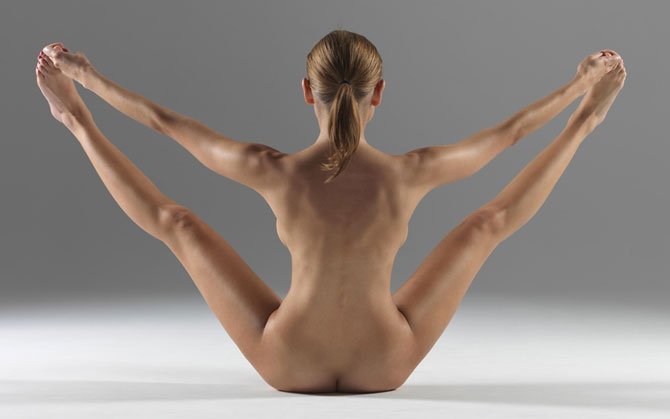
Few contemporary figures illustrate this tension as clearly as Luba Shumeyko. Her image circulates online through the language of soft eroticism, nude yoga, bodily discipline, and minimalist studio photography, yet it resists being reduced to any single category. She is model, collaborator, visual archetype, and co-author of the pose itself — a figure whose presence reveals how the nude body can become both image and structure. We look at her visual legacy more closely in our dedicated Art-Sheep essay, Luba Shumeyko and the Strange Soft Power of Contemporary Nude Photography.
The nude body, under this kind of photographic attention, becomes strangely double. It is intimate because it is human. It is distant because it is formal. It asks for recognition and abstraction at the same time. That doubleness is the quiet engine of many powerful nude photographs.
4. The Soft Erotic Image Refuses to Shout

There is a common mistake in erotic imagery: the belief that intensity requires obviousness. More exposure, more drama, more theatrical invitation, more surface pressure. But many of the most memorable sensual images do the opposite. They refuse to shout. They understand that desire becomes stronger when it is organized rather than spilled everywhere.
The soft erotic image depends on restraint. It uses light, posture, silence, negative space, and the withheld moment. It does not necessarily deny desire; it disciplines it. This is why such images can feel more elegant, and sometimes more troubling, than explicit spectacle. They do not exhaust themselves immediately.
Softness, in this context, is not sentimentality. It is control. The photograph does not collapse into fantasy. It holds the viewer at a measured distance, close enough to feel the intimacy of the body, far enough to notice the structure of the image. The gaze becomes slower, more self-aware, less certain of its own innocence.
That self-awareness is crucial. A photograph of the nude body is always negotiating power. Who looks? Who is looked at? Who frames? Who consents? Who profits? Who remains a person inside the image, and who is reduced to surface? The soft nude photograph does not automatically solve these questions, but at its best, it makes them harder to ignore.
5. The Model Is Not an Object, but a Co-Author of the Image

One of the laziest ways to discuss nude photography is to speak only about the photographer’s eye. The gaze matters, of course. The camera is not neutral. But the model is not an inert object placed beneath it. A successful nude photograph often depends on a collaboration so precise that the final image hides the negotiation behind it.
The model understands posture, tension, expression, balance, exposure, and the emotional temperature of stillness. She knows how the body reads. She knows when vulnerability becomes weakness and when it becomes force. She knows how small adjustments alter the entire atmosphere of the frame. To reduce all of that to “being photographed” is absurdly insufficient.
This is especially true in nude yoga photography, where the body is not merely present but active. A pose must be held. Balance must be maintained. Breath must be controlled. The model produces the image physically, not just visually. The photograph may belong to the photographer’s frame, but it also belongs to the model’s discipline.
That is why the best contemporary readings of nude photography need to move beyond the old model of passive muse and active genius. The image is not born from the camera alone. It is produced between body, lens, trust, direction, and performance. The model does not simply appear in the photograph. She helps build it.
6. When the Internet Turns a Body Into an Icon

The internet has changed nude photography not only by accelerating its circulation, but by changing the way bodies become recognizable. A model can become a name, a tag, a search pattern, a recurring visual presence. The body becomes not only an image, but an index. It is attached to archives, reposts, captions, thumbnails, algorithmic categories, and the strange half-memory of online culture.
This can be flattening. The internet is very good at stripping images of context and leaving behind only appetite. A carefully made photograph can become just another result in a feed. A collaboration can be reduced to a name and a body. A visual language can be swallowed by search behavior.
But the internet can also preserve and intensify certain images. It gives them afterlives. It makes them return. It allows viewers to encounter them years after publication, detached from their original sequence but still carrying visual force. Some photographs survive because they are shocking. Others survive because they are beautiful. A few survive because they are simple enough to be remembered and complex enough to be revisited.

This is where figures like Luba Shumeyko become interesting in visual culture. Her image does not circulate only as glamour or erotic spectacle. It circulates as a recurring form: body, discipline, softness, flexibility, control, intimacy, exposure. Online, that repetition turns the figure into something almost archetypal.
The danger, of course, is that archetypes can erase people. The task of criticism is to restore some of that complexity — to remember that an image may be iconic without becoming empty, and that the body inside the image is not merely material for the gaze.
7. Petter Hegre, Luba Shumeyko, and the Clean Erotic Frame

Petter Hegre’s photographs of Luba Shumeyko sit at the intersection of many of these questions. They are undeniably erotic, but their force depends heavily on restraint, clarity, and form. Hegre’s visual language often favors clean light, minimal distraction, and direct composition. Shumeyko’s body, especially in the nude yoga series, becomes both subject and structure.
That is why the work continues to attract attention beyond the immediate shock value of nudity. The images are not built around narrative excess. They are built around the body’s ability to become line, balance, and controlled stillness. The viewer sees exposure, but also discipline. Sensuality, but also athletic intelligence. Intimacy, but also a highly polished visual surface.
Our Art-Sheep feature Petter Hegre Photographs Luba Shumeyko in Striking Naked Yoga Poses looks more directly at that collaboration, especially the way yoga changes the grammar of the nude image. The photographs work because the body is not simply displayed. It is performing control.
That performance is what separates the series from ordinary erotic imagery. Shumeyko’s presence is not passive. She does not simply occupy the frame; she organizes it physically. Hegre’s camera gives the image its visual discipline, but the body gives it its structural intelligence.
For readers interested in following more of this visual thread through the Art-Sheep archive, the Luba Shumeyko archive offers a useful path into related material.
8. The Ethics of Looking Carefully

To look carefully at a nude photograph is not to pretend desire is absent. That would be dishonest, and usually rather dull. The point is not to erase desire, but to complicate it. To recognize the body as form without forgetting the body as person. To notice beauty without reducing the subject to decoration. To accept that the gaze is powerful, and therefore responsible.
This is the ethical center of serious nude photography criticism. It does not require puritanism. It requires attention. The difference matters. Puritanism wants the image to disappear. Attention asks the image to reveal how it works.
A soft nude photograph can be sensual, formal, intimate, controlled, commercial, artistic, collaborative, objectifying, liberating, and problematic all at once. Images rarely behave as neatly as arguments. They resist our desire to classify them cleanly. That resistance is part of their value.
What we owe such images is not a quick verdict, but a more intelligent gaze. One that understands the long history of the nude, the specific power of the camera, the role of the model, the pressure of the internet, and the difference between looking and merely consuming.
Soft nude photography remains powerful because it inhabits that tension. It shows the body, but also exposes the act of looking. It gives us beauty, but does not allow beauty to remain simple. It reminds us that the human figure is never just an image, even when the image is all we have.
Perhaps that is why the genre endures. Not because bodies are new. They are not. But because every generation must learn again how to look at them without pretending that looking is innocent.