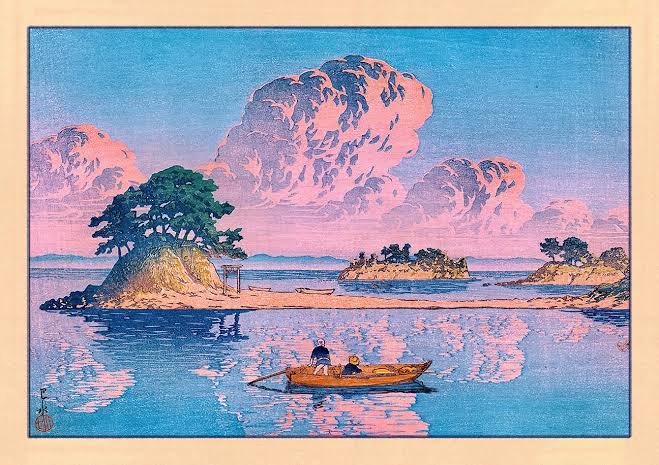
The sea in Kawase Hasui does not arrive as spectacle.
It does not need to roar in order to possess the image. It does not leap like Hokusai’s wave, clawing at boats and turning foam into a kind of divine handwriting. Hasui’s sea is quieter, stranger, more patient. It waits beneath moonlight. It folds against a shore. It holds a boat in the distance, a torii gate in the foreground, a village at the edge of darkness. It is not the sea as drama. It is the sea as atmosphere.
That is why Hasui remains one of the great poets of water in modern Japanese printmaking. He did not simply depict coasts, waves, bays, lakes, boats, and moonlit shores. He understood them as emotional architecture. Water in his work creates distance. It slows the viewer down. It makes the human figure small without making the world cruel. It turns geography into mood.
Born in 1883 and active across the first half of the twentieth century, Kawase Hasui became one of the defining artists of the shin-hanga movement, the “new prints” revival that renewed traditional Japanese woodblock techniques for a modern age. But if Hokusai gave the world the wave as icon, Hasui gave it the coastline as memory.
He mastered the sea not by conquering it, but by letting it remain larger than us.
1. A Modern Printmaker Haunted by Old Weather

Hasui belonged to a modern world, but he kept painting as if weather still had spiritual authority.
This is part of the paradox that makes him so compelling. He was not an Edo-period ukiyo-e master working in the old floating world of actors, courtesans, pleasure districts, and famous views. He was a twentieth-century artist, shaped by photography, tourism, trains, postcards, export markets, and the modernization of Japan. Yet his images often feel as though they are listening to something older than modernity.
Shin-hanga was built on this tension. It revived the collaborative woodblock tradition — artist, carver, printer, publisher — while adapting it to new audiences and new visual desires. The prints were modern objects with nostalgic souls. They preserved the handmade beauty of block, pigment, paper, and pressure, but they also spoke to a world increasingly fascinated by travel, atmosphere, collecting, and the exportable dream of Japan.
Hasui’s gift was not simply technical elegance. It was emotional weather. Rain, snow, dusk, mist, moonlight, river, and sea do not merely decorate his compositions. They decide the mood of the entire world. Human beings appear, but often only as small interruptions inside a larger climate. A traveler on a road, a boatman, a figure under an umbrella, a distant roof, a shrine gate facing the Pacific — these are not protagonists in the ordinary sense. They are measures of scale.
He made landscape feel inhabited, but never possessed. That distinction is essential. In Hasui, the world does not belong to people. People pass through it. The sea remains.
2. After Hokusai, the Wave Learns to Whisper

Any Japanese artist who returns to the sea works, knowingly or not, in the long shadow of Hokusai.
The Great Wave off Kanagawa is not merely a print. It is one of the most famous images ever made. It turned water into an emblem of sublime force, formal elegance, and cultural export. The wave rises like a hand, a claw, a collapsing mountain. Boats tilt beneath it. Mount Fuji shrinks in the distance. The human figure becomes nearly irrelevant before the intelligence of nature.
Hasui’s sea is different.
Where Hokusai gives us catastrophe organized into design, Hasui gives us suspension. His waves rarely seek to dominate the frame through violence. They accumulate quietly. They reflect moonlight. They break against stone. They divide foreground from distance. They hold boats in their smallness. They make silence visible.
This does not make Hasui less powerful. It makes his power less theatrical. He understood that the sea is not always sublime because it destroys. Sometimes it is sublime because it outlasts. A wave may terrify for a second; a coastline can haunt for a lifetime.
That is why Hasui’s relationship to Hokusai feels less like imitation and more like afterimage. Hokusai made the wave iconic. Hasui made water intimate. In our earlier Art-Sheep essay Hokusai: The Man Who Mastered Waves, we explored how Hokusai’s print became a global visual code. Hasui belongs to the next emotional register: not the wave that conquers the world, but the shore one remembers after leaving it.
3. The Pacific as Sacred Distance
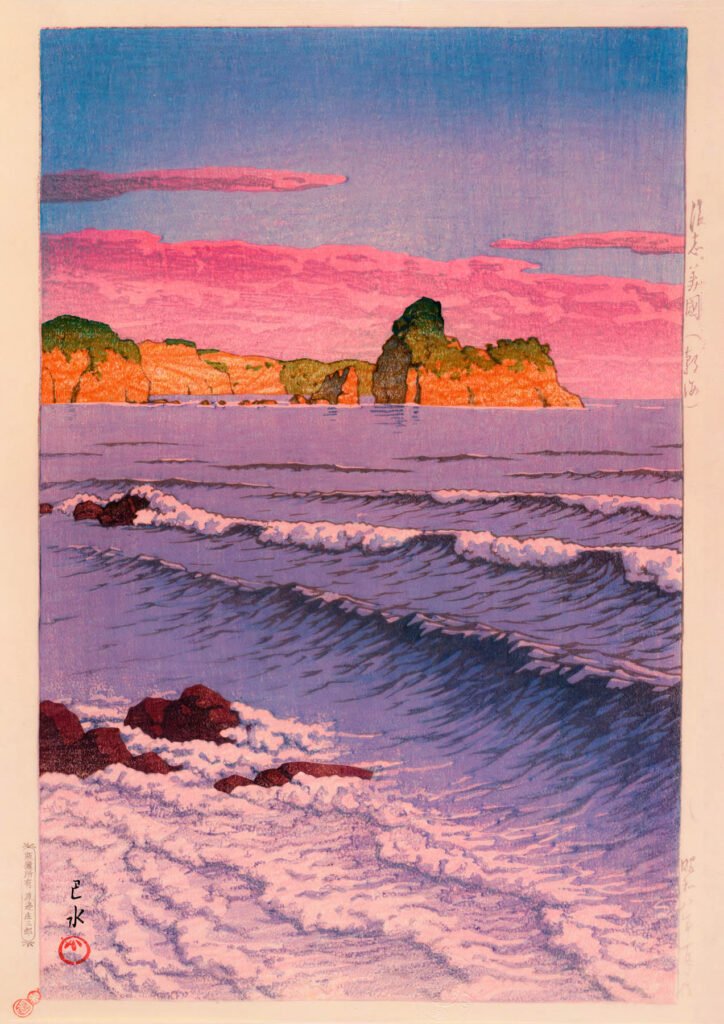
A torii gate stands before the water. Two small figures appear beneath it. The sea extends outward, pale and immense, while waves break in controlled white rhythms below. In the distance, land lies like a thought barely held above the horizon. Nothing dramatic happens. That is the point. The print does not stage an event. It stages a relation.
The torii gate matters because it changes the sea from view into threshold. The ocean is not merely something to look at; it becomes something approached through ritual space. The viewer stands, almost physically, at the edge between human structure and natural expanse. The gate frames the water, but does not master it. It marks a boundary, and then immediately reminds us that boundaries are small things before the Pacific.
Hasui’s great subject here is scale. Not scale as intimidation, but scale as humility. The human figures are present enough to matter, small enough to be corrected by the world around them. The print does not erase human life. It puts it in proportion.
This is where Hasui’s sea becomes philosophical. It does not punish. It does not announce itself as godlike. It simply exceeds us. Its beauty comes from distance, and distance in Hasui is never emptiness. It is reverence.
4. Moonlight, Islands, and the Art of Blue Silence
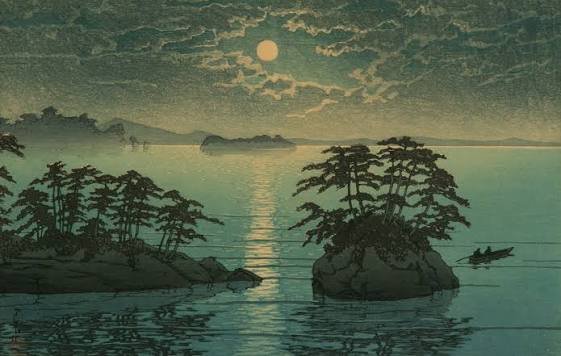
Moonlight in Hasui is never just illumination. It is a form of emotional editing.
Under the moon, the landscape loses its daytime insistence. Details soften. Distance deepens. Color becomes mood rather than description. The world no longer explains itself directly; it glows, withholds, and waits. This is why Hasui’s night scenes feel so modern. They understand atmosphere as narrative.
In his moonlit coastal and island views, the sea often becomes less a surface than a silence. It gathers around the land like memory. The island is not isolated dramatically, but held gently inside darkness. The moon does not reveal everything. It gives just enough light for longing to begin.
Hasui’s blues are central to this effect. He uses blue not simply as color, but as temperature. Blue becomes distance, cold, quiet, depth, and melancholy. It is the color of things that cannot be reached without changing the mood of the entire image.
This is why his seascapes rarely feel like tourist views, even when they are connected to recognizable places. They do not say, “Here is a famous site.” They say, “Here is the hour when the site becomes memory.”
5. Boats, Bays, and the Smallness of Human Intention
,_RP-P-1994-51.jpg)
Hasui often places boats inside his water scenes, but they rarely dominate them.
This is important. In Western marine painting, ships often become symbols of ambition, empire, trade, naval power, exploration, or heroic struggle against nature. Hasui’s boats are usually quieter than that. They are not declarations. They are presences. A boat sits, waits, crosses, drifts, or rests near the shore, its function secondary to its emotional placement inside the landscape.
The result is a very different kind of sea image. The boat does not conquer water. It depends on it. It does not turn the human figure into master of the scene. It reminds us how temporary and delicate human motion is against the larger rhythms of tide, moon, weather, and distance.
This is part of Hasui’s radical modesty. He allows human intention to remain visible, but he refuses to inflate it. Roads, bridges, boats, shrines, houses, and lights appear in his prints as signs of life, yet they never cancel the dominance of atmosphere. The world is lived in, but not controlled.
That restraint makes the prints feel unusually honest. Hasui does not need to dramatize our smallness. He simply draws the world large enough for us to feel it.
6. The Coastline as Emotional Architecture

A coastline is one of the most psychologically useful things an artist can paint.
It is a boundary, but never a simple one. Land does not end cleanly at the sea. It erodes, curves, breaks, reflects, darkens, and returns as mist. The sea does not simply begin. It advances, withdraws, stains, and remembers. The coastline is therefore not a line in Hasui. It is a negotiation.
This is why his coastal compositions feel so delicately structured. Rocks, trees, islands, boats, and shorelines guide the eye with quiet confidence. The viewer moves through the image slowly, almost as if walking along the edge of water. The composition creates pause. It does not push us toward conclusion.
Hasui’s coastlines are architectural because they build emotional space. A dark landmass anchors the scene. A pale strip of water opens it. A moon or light source holds the atmosphere together. A boat or tree gives the eye somewhere to rest. Everything is placed with the discipline of a designer and the melancholy of someone who knows the place will vanish when the light changes.
The sea, in these prints, is not only subject. It is the thing that makes the rest of the subject possible.

7. Printing Weather: How Hasui Made Water Feel Alive

Hasui’s water works because it is never only water.
It is weather printed as surface. It is atmosphere made visible through gradation. It is light absorbed into paper. The woodblock process, with its carved lines, layered colors, and delicate printing effects, allowed Hasui to give water a life that feels both graphic and atmospheric. He could make a wave legible without making it stiff. He could make mist soft without making the image collapse.
This is where shin-hanga’s collaborative discipline matters. The artist’s design was only one part of the final image. Carvers and printers translated that design into material fact, and the publisher helped shape the print’s production and circulation. The beauty of a Hasui seascape is therefore not the result of solitary expression alone. It is a coordinated act of craft.
That coordination suits Hasui’s temperament. His images often look solitary, but they are technically communal. Their silence is constructed by many hands. Every pale sky, every moonlit reflection, every slight shift from blue to green to grey is a decision made through labor disguised as serenity.
This is one reason Hasui’s prints feel so calm without feeling empty. The calm is earned. It is not lack of activity; it is activity brought under control.
For readers who want a broader institutional overview, the Metropolitan Museum of Art describes Kawase Hasui as a leading figure of the early twentieth-century shin-hanga movement, a revival that joined traditional techniques with modern visual sensibility.
8. Why Hasui Still Feels Cinematic
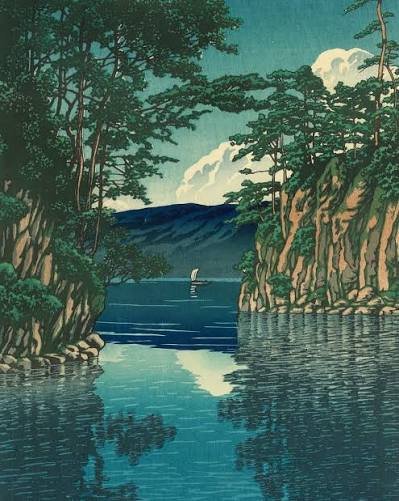
Hasui’s prints often feel cinematic, though not because they imitate cinema directly.
They feel cinematic because they understand the emotional power of framing. A solitary road in snow. A shrine under rain. A bay under moonlight. A boat held between darkness and reflection. These are not merely scenes. They feel like establishing shots from films that never needed to be made.
The frame arrives after the action or before it. Something has just happened, or something may happen, but Hasui usually withholds the event itself. This gives the prints their peculiar suspense. They are not dramatic in the ordinary sense. They are dramatic because they are so quiet. The viewer is left inside the pause.
That quality explains part of Hasui’s contemporary appeal. His landscapes feel close to animation backgrounds, film stills, travel memory, album covers, and the soft melancholy of digital moodboards. They are precise enough to be graphic, atmospheric enough to be emotional, and empty enough for the viewer to enter.
In an age overloaded with images screaming for attention, Hasui still looks modern because he refuses to scream. His sea scenes do not demand the eye. They absorb it.
9. The Sea Remains

Kawase Hasui mastered the sea because he understood that mastery does not always look like domination.
He did not make water submit to drama. He did not force every wave to become a symbol. He allowed the sea to remain atmospheric, distant, repetitive, and greater than the human stories placed beside it. His prints do not insist that nature exists to be conquered or even understood. They suggest something quieter: that nature can be approached, framed, remembered, and still remain beyond us.
This is why his seascapes endure. They are beautiful, but not merely pretty. Nostalgic, but not dead. Modern, but not loud. They carry the old discipline of Japanese woodblock printing into a twentieth-century world of travel, collecting, photography, and changing national identity, yet they retain an almost spiritual modesty before weather and water.
Hasui’s sea is not Hokusai’s wave. It is not the world-famous monster curling above fragile boats. It is the shore after the drama, the moon after the journey, the blue distance one cannot explain to someone who was not there.
Perhaps that is the secret. Hokusai made the wave unforgettable because he turned it into an event. Hasui made the sea unforgettable because he turned it into a mood.
And moods, unlike waves, can last for years.