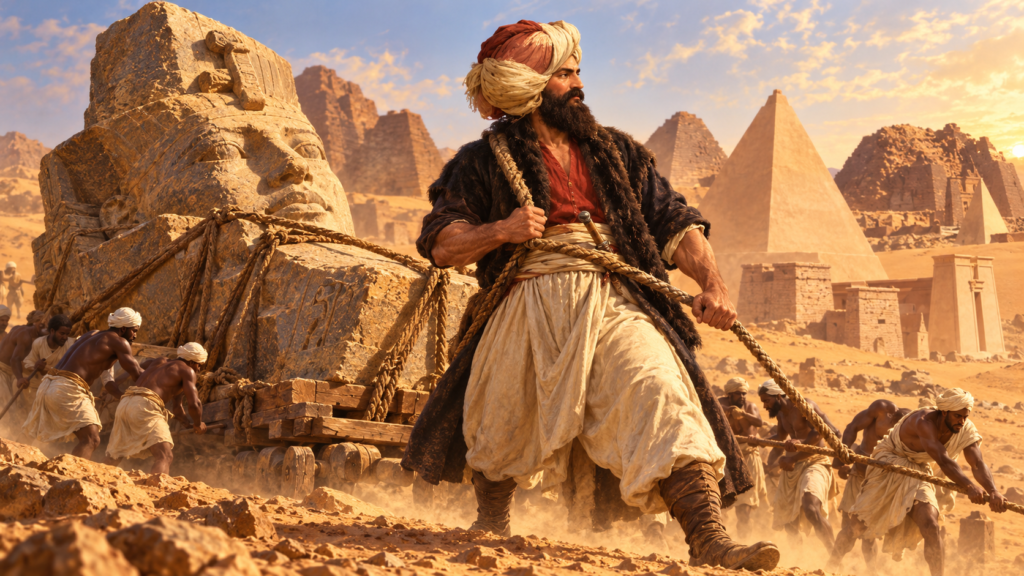
Some men enter history through books. Some through battle. Some through genius, scandal, money, murder, or the inability to leave other people’s monuments exactly where they found them.
Giovanni Battista Belzoni entered history as a very large Italian man dragging ancient Egypt toward London.
He was born in Padua in 1778, the son of a barber, and died in 1823 while attempting to reach the interior of West Africa. In between, he managed to become a circus strongman, hydraulic engineer, traveller, antiquities hunter, amateur archaeologist, showman, author, and one of the most unforgettable characters in the early European encounter with ancient Egypt. He was six feet seven inches tall, known in England as the “Patagonian Samson,” and, in a more symbolic sense, exactly the kind of person the nineteenth century deserved.
Belzoni belongs to that glorious, embarrassing age before archaeology had fully learned manners. It was a time when ancient monuments were not always studied so much as approached, entered, cleared, copied, removed, shipped, exhibited, and occasionally treated like very heavy stage props. Europe called this exploration. Egypt, one suspects, might have chosen a less polite word.
He was not simply a villain. That would be too easy, and history is rarely kind enough to offer us clean monsters. Belzoni recorded monuments, opened sites, published images, and helped bring Egyptian art to a mass European audience. He also removed colossal sculpture, damaged fragile contexts, staged ancient Egypt as entertainment, and helped define a model of archaeological adventure that was equal parts discovery, theatre, muscle and entitlement.
In other words, he is perfect for this series.
A magnificent bastard, if we are being cinematic. A respectable disaster, if we are being accurate.
1. The Strongman Before the Sand
Before Egypt, there was the body.
Belzoni’s first great instrument was not a brush, a trowel, a notebook, or a theory of dynastic chronology. It was himself. After leaving Italy, he wandered through Europe and eventually reached London, where he performed feats of strength at Sadler’s Wells Theatre. The British Museum describes him as a former strongman, a performer whose exceptional height and strength helped him earn a living on stage before Egypt made him famous for other kinds of lifting.
This detail is not decorative. It explains almost everything.
Belzoni approached antiquity with the instincts of a showman and the confidence of a man used to moving things that other people merely stared at. Where a scholar might hesitate, he calculated leverage. Where a poet might sigh, he built a sledge. Where a museum curator might dream, Belzoni recruited labourers and asked which direction the colossal granite head needed to go.
There is something absurdly fitting about the man. Early Egyptology, in its European form, often required a mixture of curiosity, engineering, theatricality, violence and total self-belief. Belzoni had all five, plus the physique of a mythological removal company.
One could say he was born for the age.
Unfortunately, so were many bad ideas.
2. Egypt, But Make It a Career Change

Belzoni arrived in Egypt in 1815, not originally as an antiquarian hero, but as a man trying to sell a hydraulic machine.
This is perhaps the most Belzoni beginning imaginable. He did not float down the Nile accompanied by scholarly destiny. He came with an engineering proposal. His machine did not transform Egyptian irrigation, but Egypt transformed him. Soon he was drawn into the world of consuls, collectors, local officials, rival agents, ancient ruins and the international competition to acquire the most impressive pieces of the pharaonic past.
He met figures like Johann Ludwig Burckhardt, Bernardino Drovetti and Henry Salt. Salt, the British consul in Egypt, would become especially important: he employed Belzoni to collect and remove antiquities destined for the British Museum.
And here the comedy sharpens. The circus strongman became an agent of empire’s museum appetite. The man who had lifted weights for audiences now lifted Egypt for Britain.
It is tempting to mock the arrangement, so let us do exactly that, while admitting it was also historically effective. Belzoni had courage, endurance, practical intelligence and an unusual talent for forcing difficult situations into movement. He was not a delicate scholar, but the early nineteenth century did not always reward delicacy. It rewarded men who could survive heat, negotiate chaos, command labour, improvise equipment and persuade granite that relocation was in its best interest.
Egypt did not need Belzoni. European Egyptology, however, found him extremely useful.
3. The Younger Memnon and the Fine Art of Dragging a Pharaoh

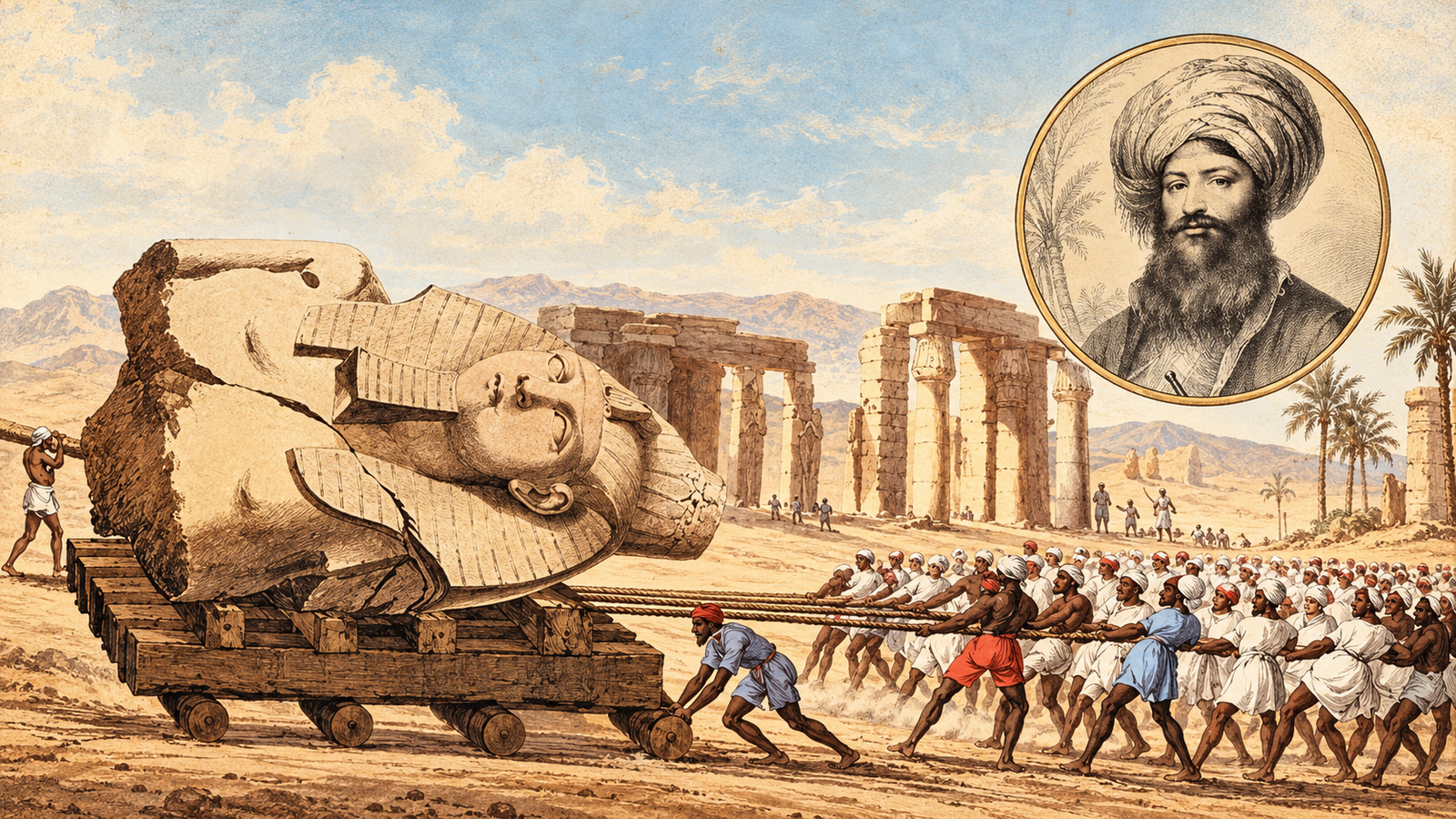
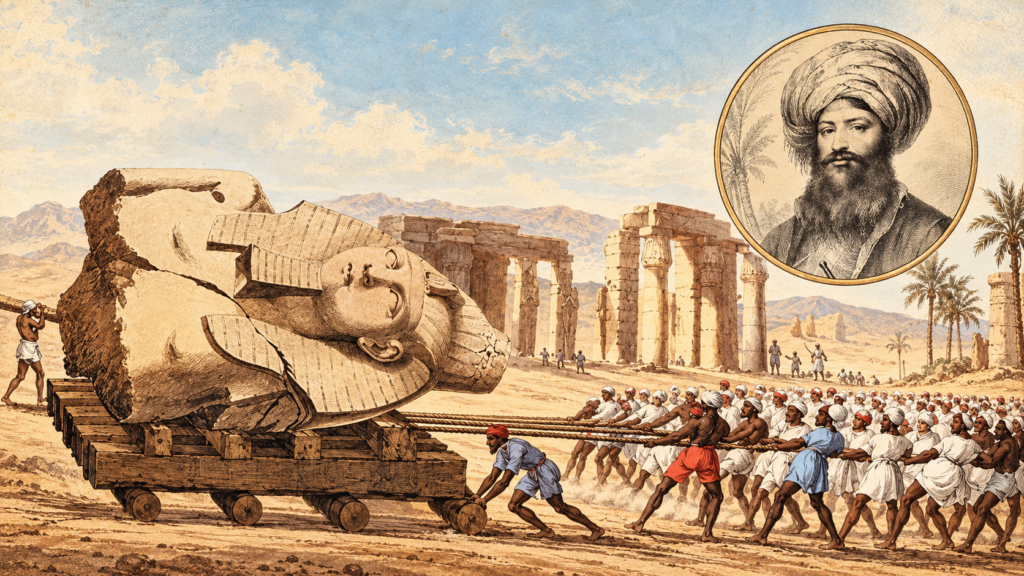
Belzoni’s most famous feat was the removal of the colossal bust known as the Younger Memnon from the Ramesseum at Thebes. Today it sits in the British Museum as a star object, polished by institutional lighting and the slow disinfectant of time.
The British Museum’s own account makes the operation sound like a grand engineering adventure: Henry Salt and Belzoni undertook the removal in 1816; Belzoni recruited local labourers, built wooden sledges, dragged the massive granite sculpture to the Nile, and eventually sent it on its way to London, where it arrived in 1818 and was installed in the museum the following year.
Which is accurate. It is also a sentence wearing a very clean shirt.
Because underneath the achievement sits the more awkward truth: Europe was learning to appreciate Egyptian art at exactly the same moment it was learning how to remove it. Admiration arrived with ropes. Taste came with shipping arrangements. A colossal head of Ramesses II became, through sweat and imperial paperwork, a British museum object.
There is dark poetry in the logistics. The statue had survived millennia in Egypt, only to be dragged across sand by an Italian strongman working for a British consul and then admired in London as proof of ancient genius. The genius was Egyptian. The itinerary was European.
If you ever need a metaphor for the nineteenth century, start with a pharaoh on a sledge.
4. Abu Simbel: Opening the Door to Sublime Trouble
Belzoni also played a central role in reopening Abu Simbel, the great rock-cut temple complex of Ramesses II in Nubia. Earlier travellers had seen parts of the façade, but the entrance was choked with sand. Belzoni worked to clear it and entered the great temple in 1817.
This is where the Belzoni story becomes genuinely difficult to flatten into sarcasm.
Because what he did was not only crude extraction. He also revealed, recorded and publicized monuments that became central to Europe’s understanding of ancient Egypt. His work at Abu Simbel helped bring one of the most extraordinary ancient sites into wider modern attention. His publication later included images and descriptions that circulated through Europe, feeding both scholarship and spectacle.
That is the trouble with these men. They are often useful in precisely the same places where they are unbearable.
Belzoni opened doors. He also opened the age of Egyptian archaeology as public drama. Ancient temples became events. Tombs became exhibitions. Monuments became illustrations, lectures, books, tickets, conversations, and objects of European desire. He did not invent Egyptomania, but he fed it wonderfully.
Art-Sheep has already looked at that fever in Egyptomania: When Europe Became Obsessed with Ancient Egypt. Belzoni belongs to the muscular chapter of that obsession: the point where fantasy put on boots and went looking for entrances.
5. The Tomb of Seti I, or the Discovery That Became a Brand
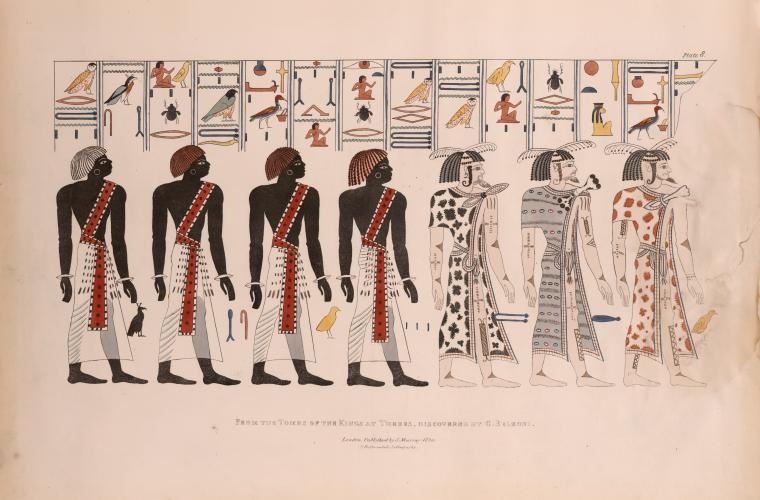
In 1817, Belzoni discovered the tomb of Seti I in the Valley of the Kings, one of the most magnificent royal tombs ever found in Egypt.
For once, even cynicism must pause and behave itself for a moment. The tomb was extraordinary: vast, richly decorated, architecturally complex, covered in painted reliefs, celestial imagery, ritual scenes and underworld texts. It was not simply a burial space. It was a painted cosmos, a theology of death given corridors.
Belzoni understood its visual power immediately. He copied scenes, made casts, and later transformed the discovery into part of his London exhibition. The tomb became not only an archaeological event, but a public spectacle. Ancient Egypt was no longer only in books or diplomatic collections. It could be staged. It could be walked through, imitated, lit, described, sold, and consumed.
Again, the discomfort is the point.
Belzoni did record what he saw. He also took wax impressions from the walls, a practice that later contributed to damage. The Factum Foundation, in its work on the tomb’s preservation and documentation, notes the long history of damage since the tomb’s opening, including the impact of human intervention.
This is Belzoni in miniature: revelation and harm, awe and abrasion, documentation and damage, all wearing the same coat.
He found a masterpiece and immediately helped turn it into a show.
Nineteenth-century archaeology: come for the underworld, stay for the ticket sales.
6. The London Exhibition: Egypt as Entertainment

When Belzoni returned to England in 1819, he did what any subtle archaeologist would do after entering ancient tombs and hauling colossal sculpture across Egypt.
He mounted a show.
His Egyptian exhibition opened at the Egyptian Hall in Piccadilly in 1821, complete with reconstructions, paintings and objects designed to give the public a dramatic experience of ancient Egypt. It was archaeology as spectacle, scholarship as theatre, tomb as attraction. If this sounds vulgar, it was. If it sounds effective, it was also that.
Belzoni understood something that museums, magazines, streaming platforms and cultural institutions still understand perfectly well: knowledge travels faster when dressed as wonder.
The problem is that wonder is rarely innocent. It edits. It dramatizes. It simplifies. It turns the complexity of a civilization into a sequence of astonishments. Belzoni’s exhibition helped make Egypt visible to a wide British audience, but it also made Egypt consumable. The ancient world became an immersive experience before anyone had invented that ghastly phrase.
Still, one cannot deny the theatrical intelligence. Belzoni had spent years performing his own body as spectacle. Now he performed Egypt.
It was a career pivot of almost terrifying consistency.
7. The Narrative: How to Publish Yourself Into Legend

Belzoni did not only move monuments. He moved himself into print.
His Narrative of the Operations and Recent Discoveries Within the Pyramids, Temples, Tombs and Excavations in Egypt and Nubia was published in 1820, followed by illustrated plates. The title alone has the energy of a man unable to enter a room quietly. It promises pyramids, temples, tombs, excavations, the Red Sea, Berenice, the Oasis of Jupiter Ammon, and, implicitly, one very large Italian at the centre of it all.
The Metropolitan Museum of Art notes that Belzoni’s discoveries made him a celebrity in England and that, over time, his interest shifted from recovering individual objects toward excavating and recording monuments. That development is important. He was not frozen in one mode. He learned. He adapted. He became, in some ways, more serious.
But the showman never disappeared.
The Narrative is part travel book, part archaeological report, part personal branding exercise. It helped build Belzoni’s legend as the heroic discoverer of Egypt’s ancient wonders. And like all self-authored legends, it deserves both attention and suspicion. A man may tell the truth and still arrange the lighting in his favour.
Belzoni did not merely discover things. He discovered how to become the person who had discovered them.
8. The Pyramid of Khafre and the Problem With Locked Doors
In 1818, Belzoni opened the pyramid of Khafre at Giza.
This, too, fits the pattern. A closed monument, a famous site, a difficult entrance, a man who did not like being told no by stone. Belzoni had a talent for thresholds. He found them, cleared them, widened them, entered them, described them, and then, whenever possible, made sure everyone knew he had done so.
The modern archaeologist may wince at his methods, and often should. But one must also admit the theatrical structure of his career is almost perfect. He begins as a strongman, enters Egypt as an engineer, becomes a remover of colossal sculpture, opens temples, finds tombs, enters pyramids, publishes a narrative, stages exhibitions, becomes famous, then dies on another ambitious expedition.
It is not a biography. It is a serial adventure with a questionable ethics committee.
The pyramid of Khafre also reminds us that Belzoni belonged to the last great age when entering ancient spaces could still be framed as heroic penetration of mystery. Today, we are more likely to ask about conservation, context, permits, damage, colonial networks, labour, ownership and repatriation. This is progress, although admittedly less good on a poster.
Belzoni lived before the poster learned to apologize.
9. Sarah Belzoni, Because the Story Was Never Only Him
Giovanni Battista Belzoni’s wife, Sarah Belzoni, travelled with him through parts of his Egyptian career and later helped preserve and publish aspects of his legacy.
.jpg)
She is often treated as a supporting figure, because history has long enjoyed handing women the role of “wife of” even when they were crossing deserts, enduring danger, navigating foreign environments, and doing far more than sitting decoratively near luggage. Sarah’s presence complicates the masculine mythology of Belzoni as the solitary giant among ruins.
Adventure stories love the lone man. Reality usually brings assistants, spouses, workers, translators, guides, rivals, patrons, servants, local communities, and people whose names the final narrative forgets to include because they interfered with the silhouette.
Belzoni’s legend is enormous partly because he was enormous. But even giants travel within systems.
That is one of the useful corrections this series can make. The rogue adventurer is never alone. He is merely the one history remembers most loudly.
10. The Man, the Myth, the Museum Problem

Belzoni’s afterlife lives inside a museum problem.
On one hand, he helped preserve, record and publicize Egyptian monuments at a moment when European knowledge of ancient Egypt was rapidly changing. His publications and discoveries mattered. His work at Abu Simbel, the tomb of Seti I, the pyramid of Khafre and the transport of the Younger Memnon shaped the public imagination of Egypt in Britain and beyond.
On the other hand, many of his actions belong to a world in which ancient objects were removed with an ease that now feels obscene. The British Museum itself acknowledges that controversy surrounds nineteenth-century acquisitions like the Younger Memnon, even as it presents the statue as a turning point in Western appreciation of Egyptian art.
That phrase — Western appreciation — is doing a great deal of work.
The uncomfortable truth is that Europe often learned to appreciate ancient civilizations while physically separating objects from the places that gave them meaning. Appreciation and acquisition walked together, arm in arm, pretending not to notice the luggage.
Belzoni was not the whole system. He was one of its most memorable bodies.
11. Why Belzoni Still Works as a Character
Belzoni remains fascinating because he is impossible to reduce.
If we call him only a looter, we miss the courage, endurance and documentation. If we call him only an explorer, we make the old imperial mistake of confusing movement with virtue. If we call him an archaeologist, we must add several footnotes and a glass of something strong. If we call him a showman, we finally begin to get somewhere.
He made Egypt visible to audiences who might never have cared otherwise. He also helped turn Egypt into a consumable spectacle. He opened sites. He damaged contexts. He recorded images. He removed objects. He became famous. He became useful. He became ridiculous. He became history.
That is why he belongs beside Giuseppe Ferlini in this series. Both men were adventurers of the old, dangerous kind: the type who arrived before disciplines had learned enough shame, and before museums had learned to write labels with guilt in the margins.
Ferlini took a pickaxe to eternity. Belzoni brought a strongman’s shoulders to the archive.
Neither story is clean.
Both are excellent.
12. The Moral, If One Must Spoil the Fun
The moral of Belzoni’s life is not simply that early archaeology was bad and modern archaeology is good. That would be too comforting, and comfort is where thought goes to nap.
The better moral is that knowledge often arrives through compromised people.
Belzoni revealed things. He also removed things. He admired Egypt. He also converted Egypt into career, spectacle and shipment. He was brave, energetic, self-promoting, physically astonishing, historically important and ethically exhausting. He helped create the modern European imagination of ancient Egypt, which is another way of saying he helped build a dream with other people’s stones.
Perhaps that is why he still feels so alive. He is not a marble bust of scholarship. He is sweaty, ambitious, theatrical, contradictory, absurd. He does not sit comfortably inside the museum. He drags something across the floor and asks where the applause is.
Giovanni Battista Belzoni was not the man who discovered Egypt.
Egypt was not lost.
He was the man who helped teach Europe how to look at Egypt as spectacle, prize, mystery, museum, commodity and stage.
And, being Belzoni, he did much of it by lifting.