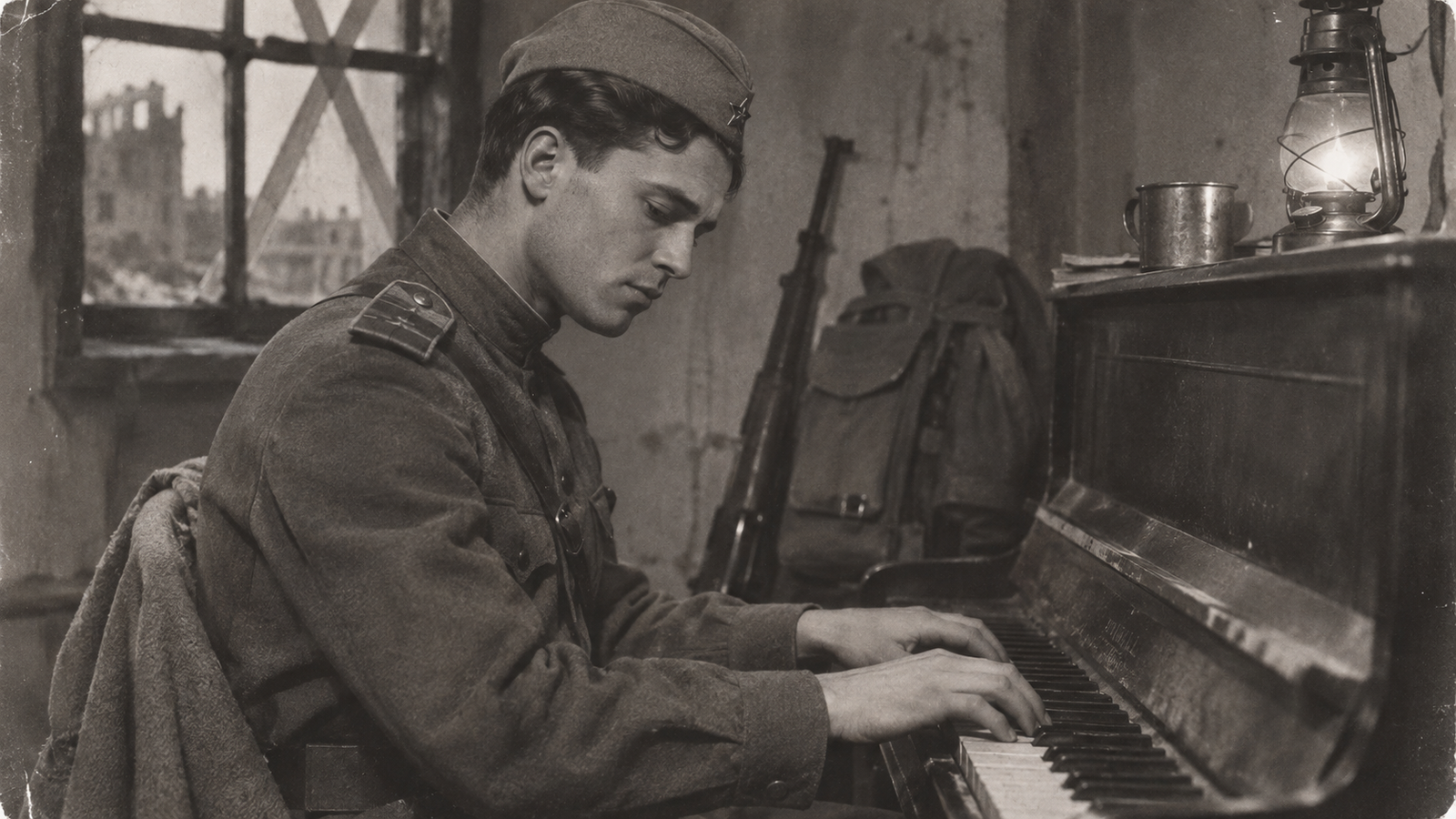
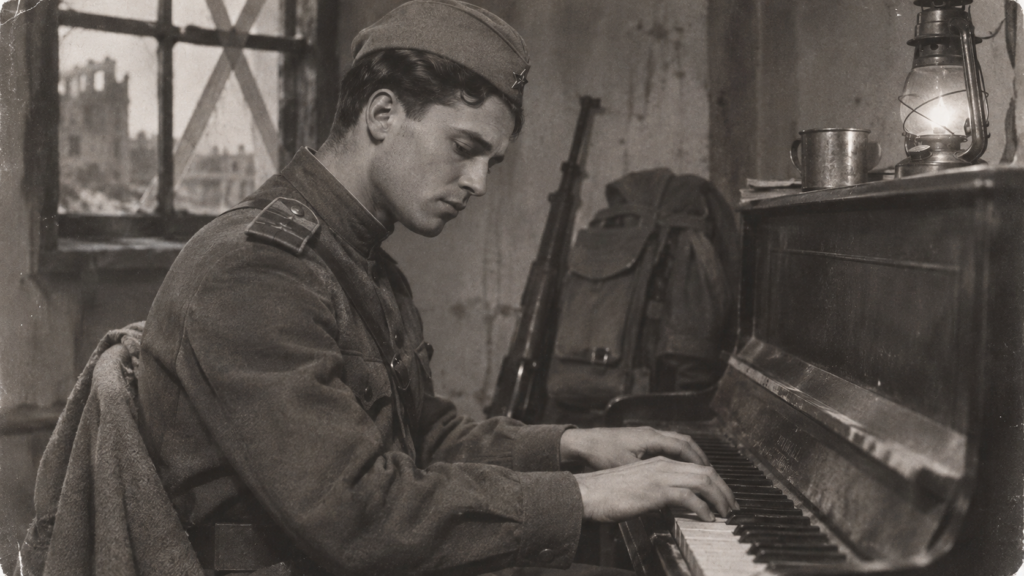
How a quiet melody composed in 1943 became one of the most intimate musical expressions of war, love, fear and the extraordinary human desire to return home.
There are certain pieces of music that seem to have existed long before anyone composed them. They feel less like artistic inventions than discoveries, as though someone had stumbled upon a sound buried somewhere in the collective human consciousness.
Dark Is the Night is one of those pieces.
Perhaps you first encountered it through an old black-and-white recording. Perhaps through a solitary pianist on the internet, playing its haunting melody in a dimly lit room. Perhaps you heard it without knowing its name, its language, or the circumstances under which it was written. And yet, somehow, you understood what it was about.
That is the peculiar power of this Soviet wartime song. It does not require a translation to communicate its emotional architecture. Its sadness is immediately recognizable, even to those who have never heard a word of Russian.
Written in 1943 by composer Nikita Bogoslovsky and lyricist Vladimir Agatov, Dark Is the Night (Russian: Тёмная ночь, transliterated as Tyomnaya Noch) emerged from one of the most destructive periods in human history. It was introduced to cinema audiences through the Soviet film Two Soldiers, in a performance by the actor and singer Mark Bernes.
It was a song born in the middle of a catastrophe. And yet, rather remarkably, it does not sound like a song about winning a war.
It sounds like a man trying to survive the night.

Photograph: P. Bernstein / RIA Novosti archive, image #302.
Wikimedia Commons /
CC BY-SA 3.0.
Unmodified.
A Love Song Written at the End of the World
To understand Dark Is the Night, one must first understand the historical landscape into which it was born.
On June 22, 1941, Nazi Germany launched Operation Barbarossa, invading the Soviet Union and opening a new and devastating chapter of the Second World War. What followed was not simply a confrontation between two enormous military powers. It was a catastrophe that transformed cities into ruins, separated millions of families and subjected entire populations to occupation, starvation, displacement and mass murder.
The Eastern Front of the Second World War became a theatre of destruction on an almost incomprehensible scale. By the time Bogoslovsky composed his melody, the Battle of Stalingrad had demonstrated just how thoroughly modern warfare could dismantle a recognizable human environment.
Streets disappeared. Apartment buildings became defensive positions. Factories became battlefields. The distinction between civilian existence and military necessity was increasingly difficult to maintain.
And somewhere amid all this, people continued to fall in love.
They wrote letters. They looked at photographs. They remembered birthdays. They worried about their children. They imagined what their kitchens might look like when they returned home.
History has a curious habit of presenting war through maps, uniforms, casualty figures and political declarations. These are necessary instruments of understanding, but they are remarkably inadequate at conveying what it means to live through a war.
A map can tell us where an army advanced. It cannot tell us what a soldier thought about immediately before falling asleep.
Dark Is the Night inhabits precisely that neglected territory.
Its central subject is separation. A soldier imagines his beloved awake at home, beside their sleeping child, while he confronts the possibility that he might never see either of them again. The physical landscape of war is present, but its emotional geography is determined by the distance between two people.
It is an astonishingly intimate premise for a song produced within a society whose public culture frequently emphasized the collective over the individual.
There is no enormous orchestral declaration of military superiority. No parade of ideological abstractions. No attempt to make death appear particularly glamorous.
Instead, there is tenderness.
And tenderness, under such circumstances, becomes something considerably more radical than sentimentality.
To remember that one is loved is to remember that one’s existence has meaning beyond the immediate machinery of war. A soldier is not merely a uniform, a weapon, or a statistical unit within a military operation. He is also someone’s son, somebody’s husband, a child’s father, a person with an unfinished private history.
The song preserves that private history. It refuses to allow the entirety of a human life to be absorbed by the battlefield.
It is difficult to imagine a more powerful argument for the importance of art.

Photograph: Zelma / RIA Novosti archive, image #44732.
Wikimedia Commons /
CC BY-SA 3.0.
Unmodified.
The Night a Composer Sat Down at a Piano
The origin of Dark Is the Night is almost suspiciously cinematic, even before one considers that it was composed for a film.
In 1943, Soviet director Leonid Lukov was working on Two Soldiers (Два бойца), a wartime drama starring Mark Bernes and Boris Andreyev. The production took place in Tashkent, in present-day Uzbekistan, where Soviet filmmaking activity had expanded considerably following the evacuation of cultural institutions from territories threatened by the German invasion.
The film followed the friendship of two soldiers, Arkady Dzyubin and Sasha Svintsov, men whose contrasting personalities provided a human framework for the broader experience of war.
One particular scene, however, was causing the director considerable difficulty.
Arkady was supposed to be writing home from a military dugout during the night. Lukov wanted to communicate something emotionally complex: the exhaustion of a soldier, the tenderness of his relationship with those waiting for him and the anxiety of existing in a place where tomorrow was not guaranteed.
The sequence needed something that ordinary dialogue could not quite provide.
It needed music.
According to the account preserved by the Russian National Museum of Music, Lukov described the emotional atmosphere of the scene to composer Nikita Bogoslovsky, who sat at a piano and played the melody that would become Dark Is the Night.
In his own recollection, Bogoslovsky claimed that the melody emerged in a single continuous performance.
Vladimir Agatov was called upon to write the lyrics, and Mark Bernes was brought in to prepare the vocal recording. By the following morning, the production was reportedly ready to film the sequence.
One should, of course, approach such magnificent stories of spontaneous artistic creation with a healthy degree of historical skepticism. Artists have never been entirely immune to the attractive mythology of effortless inspiration. The history of culture is full of masterpieces allegedly conceived over breakfast, during thunderstorms, or in moments of conveniently documented divine intervention.
Nevertheless, the museum preserves a manuscript of the song from Bogoslovsky’s collection, bearing editorial annotations and the stamp of wartime censorship.
That relatively modest piece of paper connects the romantic account of the song’s creation with the considerably less romantic administrative realities of Soviet cultural production.
Here was a melody of remarkable emotional freedom, existing within a system of considerable institutional control.
And here was a composer who had managed to articulate the emotional experience of wartime separation with extraordinary economy.
What makes the melody so effective is not its technical extravagance. Bogoslovsky did not require the colossal orchestral machinery commonly associated with great cinematic expressions of tragedy.
Instead, he created a musical line that could survive almost any degree of reduction.
It could be sung with a guitar. It could be performed by an orchestra. It could be played on an old upright piano. It could exist as a nearly unaccompanied voice.
That adaptability is one of the characteristics of truly exceptional songwriting. The composition remains recognizable even when its original musical clothing has been removed.
There is nothing particularly fashionable about it. It does not depend upon a fashionable instrument, a contemporary production technique, or the peculiar tastes of a particular decade. Its emotional effect is contained within the relationship between melody, harmony and silence.
More than eighty years later, a pianist can sit down in an entirely different country, in an entirely different political world, and reproduce something of the atmosphere that Bogoslovsky created in wartime Tashkent.
Culture possesses few forms of time travel more extraordinary than this.
Mark Bernes and the Extraordinary Art of Understatement
Although another prominent Soviet performer, Leonid Utyosov, recorded the composition before the film reached audiences, it was Mark Bernes whose cinematic interpretation became inseparable from the song’s identity.
Bernes, born in 1911 in Nizhyn, in present-day Ukraine, possessed something more valuable for this particular performance than a conventionally spectacular singing voice.
He understood restraint.
In Two Soldiers, his character sings with a guitar while surrounded by fellow soldiers. There is no grand theatrical transformation. The environment remains humble, the danger remains unresolved, and the performance emerges naturally from the dramatic situation.
He does not appear to be trying to impress anyone.
He appears to be remembering someone.
This distinction is fundamental. Much of modern popular culture has conditioned audiences to associate emotional authenticity with conspicuous displays of feeling. Singers prove their sincerity through vocal acrobatics, carefully calculated crescendos and facial expressions suggesting that they are personally responsible for the invention of heartbreak.
Bernes requires none of this.
His delivery is conversational, almost vulnerable. The emotional intensity derives less from what he demonstrates than from what he appears to be holding back.
There is an extraordinary dignity in this restraint. The soldier is not asking the audience to admire his suffering. He is simply allowing himself, for the duration of a few minutes, to acknowledge it.
Readers can experience the historical performance through the University of Illinois’s Seventeen Moments in Soviet History archive, which places Bernes’s song within the broader context of wartime love and romance.
What is particularly striking about the performance is its relationship with the men surrounding him.
Although the lyrics concern an individual relationship, the situation transforms that personal longing into a collective emotional experience. Each listener might have a different family, a different hometown, a different collection of memories. But the feeling of absence is shared.
This is one of the paradoxes of great art: the more convincingly it articulates a specific, private experience, the more easily it can become universal.
Not by deliberately attempting to speak for everybody, but by speaking truthfully about somebody.
A surviving 1943 recording of Bernes’s performance catalogued by Museum Collection provides a tangible reminder of the song’s existence as a historical object, carried through the twentieth century by recording technology as well as collective memory.
One frequently repeated anecdote concerns a recording session during which a studio worker supposedly became so emotional that her tears affected the recording material. The Russian National Museum of Music recounts a version of this story, although the more dramatic details are best treated as part of the song’s legendary reception rather than independently established fact.
Whether entirely accurate or embellished by decades of retelling, it expresses something about the cultural place the song came to occupy.
It was remembered not simply as a musical success, but as a performance capable of making the practical machinery of recording momentarily secondary to the emotional experience of listening.
Its appeal was not necessarily comfortable for everyone.
As discussed in the academic anthology Mass Culture in Soviet Russia, the song attracted criticism after the war for its melancholy and supposedly escapist qualities.
What some cultural authorities regarded as excessive sentimentality was precisely what made the composition so meaningful to ordinary listeners.
Political institutions generally prefer emotions that can be put to work. Affection should become loyalty; fear should become vigilance; grief should become determination.
But sorrow is not always useful. Sometimes it is simply sorrow.
And music is among the few cultural forms capable of permitting it to remain so.
Why Dark Is the Night Is So Haunting on the Piano
There is something particularly compelling about hearing Dark Is the Night performed as a solo piano composition.
Without Bernes’s voice, without the film’s imagery, without the Russian lyrics, the melody enters a different psychological territory. The historical circumstances remain embedded within its identity, but the listener is no longer explicitly directed towards them by language or narrative.
The song becomes a space into which other memories can enter.
It might remind one listener of a childhood home, another of a person who is no longer alive, another of a relationship that ended years ago, and somebody else of a period of their life that they cannot quite reconstruct without feeling an unexpected sense of loss.
None of these people needs to have experienced the Eastern Front.
They merely need to have experienced absence.
The piano occupies a fascinating position in the history of human emotional expression. It can be monumental, aggressive, ceremonial and theatrical. As we explored in Lisztomania: When the Piano Became a Weapon of Mass Hysteria, the instrument once became the centre of an extraordinary culture of public obsession, artistic celebrity and collective excitement.
Yet it is equally capable of producing the opposite effect.
It can make an enormous room feel like a private conversation.
Unlike instruments whose notes can be sustained indefinitely through continuous bowing or breath, an ordinary acoustic piano produces notes that begin to decay almost immediately after being struck. Even with the sustain pedal engaged, the sound gradually disappears.
Every note contains, in miniature, the process of its own disappearance.
For a composition concerned with separation and the uncertainty of survival, this physical characteristic of the instrument feels particularly appropriate.
In many contemporary piano arrangements of Dark Is the Night, the sombre, minor-key melody is surrounded by gently moving accompaniment. The left hand often creates a sense of repetition and continuity, while the right hand carries a tune that seems suspended between hope and resignation.
The harmonic movement introduces moments of tension and release without transforming the music into a triumphant declaration.
There is room for the melody to hesitate.
There is room for the performer to allow the space between phrases to become emotionally significant.
This is why a sensitive interpretation of the piece often benefits from patience rather than showmanship. Excessive ornamentation can distract from its essential character. The temptation to make the piece sound more spectacular can undermine the intimacy that makes it so affecting.
A contemporary interpretation can be heard in pianist Slava Makovsky’s rendition of Dark Night, which offers an opportunity to encounter Bogoslovsky’s melody independently of its original cinematic setting.
For modern audiences, piano arrangements also offer a kind of linguistic liberation.
The original Russian lyrics are indispensable to understanding the song’s history, but their absence in an instrumental performance allows the composition to travel without requiring the listener to understand their literal meaning.
Music becomes its own translation.
This should not be mistaken for a loss of historical specificity. An instrumental arrangement does not erase the circumstances of the composition’s birth. Rather, it demonstrates how a musical work can retain something essential about its original emotional atmosphere while acquiring entirely new personal associations.
Art, after all, does not merely preserve the emotions of those who created it.
It provides a framework through which subsequent generations can understand their own.
The Distance Between Two Human Beings
The emotional centre of Dark Is the Night is neither the battlefield nor the night itself. It is the imagined connection between two people who cannot be physically together.
The lyrics move between danger at the front and domestic tenderness somewhere far away. The soldier draws emotional strength from imagining his beloved and believing that she is waiting for him.
The juxtaposition is devastating precisely because it is so ordinary.
A child’s bed becomes as important as a military position. A remembered expression becomes more meaningful than a strategic victory. Domestic life, so easily dismissed as unremarkable in times of peace, acquires the significance of an almost sacred destination.
We rarely understand how extraordinary the ordinary is until circumstances threaten to take it away.
During wartime, a letter from home could become one of the most valuable objects in a person’s possession. A folded piece of paper might contain reassurance, fragments of family life, or news that would fundamentally alter the recipient’s understanding of the future.
Its material existence was insignificant. Its psychological importance was immense.

Photograph: Л.П. Джепко (2010).
Wikimedia Commons /
CC BY-SA 3.0.
Unmodified.
These surviving wartime letters possess an extraordinary visual modesty. They are small, fragile objects, somewhat unremarkable when viewed as physical artefacts.
Yet they belong to a world in which receiving a few handwritten sentences could mean the difference between despair and hope.

Dark Is the Night operates as something resembling a musical letter. Its tenderness transforms an imagined conversation into a form of emotional survival.
There is, however, something profoundly troubling beneath its expressions of hope.
The listener knows what the soldier cannot know: that belief, devotion and love offer no guarantee of physical survival.
Millions of people who were loved did not return home. Millions of families waited for individuals who would never arrive. No degree of emotional commitment could alter the material realities of artillery, occupation or disease.
This knowledge transforms the song’s optimism into something almost unbearably fragile.
Its hope is not powerful because it is necessarily justified. It is powerful because it persists in circumstances where justification is impossible.
That distinction gives the composition its philosophical depth.
Hope is often presented as a rational anticipation of favourable circumstances. But here hope functions less as a prediction than as an act of psychological resistance.
The soldier cannot control the course of history. He cannot control the decisions of generals, the development of the battle, or the movements of enemy forces.
What he can control, to some degree, is the world that he continues to inhabit within himself.
By remembering the people he loves, he preserves a part of his identity that war has not yet managed to confiscate.
It is not an argument that love magically conquers death. History offers far too many objections to such an attractive proposition.
It is an acknowledgment that love may make existence meaningful even when death remains a possibility.
And that is a far more substantial claim.
When a Wartime Song Outlives Its Country
The Soviet Union ceased to exist in 1991. Dark Is the Night did not.
The distinction illustrates an important characteristic of cultural history. Political institutions frequently imagine themselves to be permanent, while artistic works are supposedly fragile and dependent upon the circumstances that produced them.
History has repeatedly demonstrated that the relationship can operate in precisely the opposite direction.
Governments disappear. Borders are redrawn. Ideologies collapse. Cultural institutions are dismantled or reorganized. Yet a melody composed in a relatively modest room can continue to travel across continents and generations.
The survival of Dark Is the Night is particularly interesting because its emotional subject is not fundamentally dependent upon Soviet political identity.
Its historical circumstances are unquestionably Soviet. Its language, cinematic origins and cultural reception cannot be separated from the society that produced it.
But its central experience is recognizably human.
Listeners do not need to endorse the political system of the Soviet Union to appreciate the composition, just as one need not approve of the political institutions of Renaissance Italy to appreciate Renaissance painting.
Aesthetic appreciation is not necessarily a declaration of ideological allegiance.
The song has also found a place beyond the conventions of wartime remembrance. The Russian jazz publication Jazz.Ru discusses Dark Is the Night as part of a distinctly Russian repertoire of jazz standards, identifying interpretations by the Oleg Lundstrem Orchestra and later contemporary musicians.
These musical transformations demonstrate that the composition can function not only as a historical memorial but also as living artistic material.
A jazz musician might introduce new harmonic colours, reconsider its rhythmic character or allow improvisation to expand the melody into unexpected territory. A classical pianist might emphasize its lyrical continuity. A singer might approach it as a ballad rather than a historical artefact.
None of these interpretations necessarily diminishes the original.
On the contrary, the possibility of reinterpretation is one of the clearest distinctions between a museum object and a living cultural tradition.
The internet has introduced another chapter into the song’s existence. Historical recordings, modern piano covers and short musical performances now circulate in environments that Bogoslovsky could scarcely have imagined.
There is admittedly something peculiar about encountering a meditation on wartime mortality between an advertisement for expensive headphones and a video of somebody explaining how to become financially independent before the age of twenty-five.
Such is the magnificently absurd architecture of contemporary culture.
Yet the melody continues to find its listeners.
Even when separated from the original film, it seems capable of interrupting the relentless machinery of digital entertainment. It asks for a kind of attention that contemporary media environments are not particularly interested in cultivating: patient, solitary and emotionally reflective.
Of course, modern reinterpretations can also risk romanticizing the visual and musical aesthetics of warfare. Historical suffering is easily transformed into a collection of attractive images, melancholy soundtracks and nostalgic fantasies when viewed from a sufficient geographical or chronological distance.
That is why the history of the composition matters.
Its beauty should not obscure the circumstances that made it necessary.
The song is moving not because war was beautiful, but because someone managed to create something beautiful while living through the consequences of war.
There is an enormous difference.
Perhaps the ultimate achievement of Dark Is the Night is that it offers no grand explanation of the historical catastrophe from which it emerged.
It does not attempt to explain the nature of evil. It does not propose a theory of history. It does not pretend to resolve the relationship between human suffering and political power.
It simply describes the emotional existence of someone who wants to return home.
And perhaps that is enough.
More than eight decades after Nikita Bogoslovsky sat down at a piano, the world remains remarkably proficient at producing new reasons for families to be separated. Humanity has developed more sophisticated technologies, more elaborate political vocabularies and considerably more efficient ways of communicating across enormous distances.
It has not become particularly accomplished at preventing the circumstances that make songs like this necessary.
That is what makes Dark Is the Night feel so unnervingly contemporary.
Not because the world has remained unchanged, but because the most intimate consequences of its violence remain painfully recognizable.
Somewhere, someone is waiting for another person to return.
Somewhere, someone is awake when they should be sleeping.
And somewhere, in a quiet room, somebody sits down at a piano and plays a melody written in 1943.
For a few minutes, history ceases to be an accumulation of dates and becomes something infinitely more personal.
The night is still dark.
But someone is still waiting.