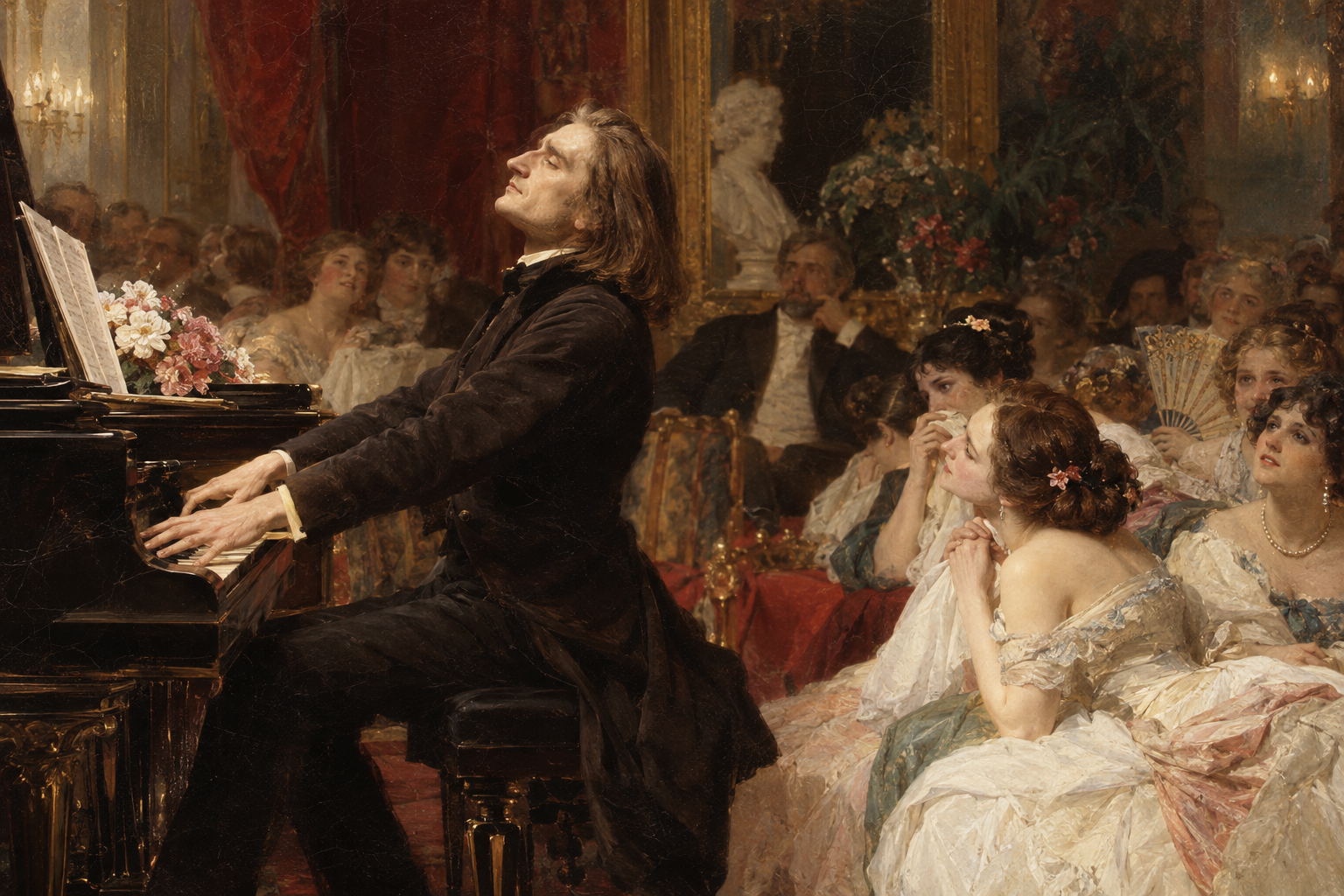
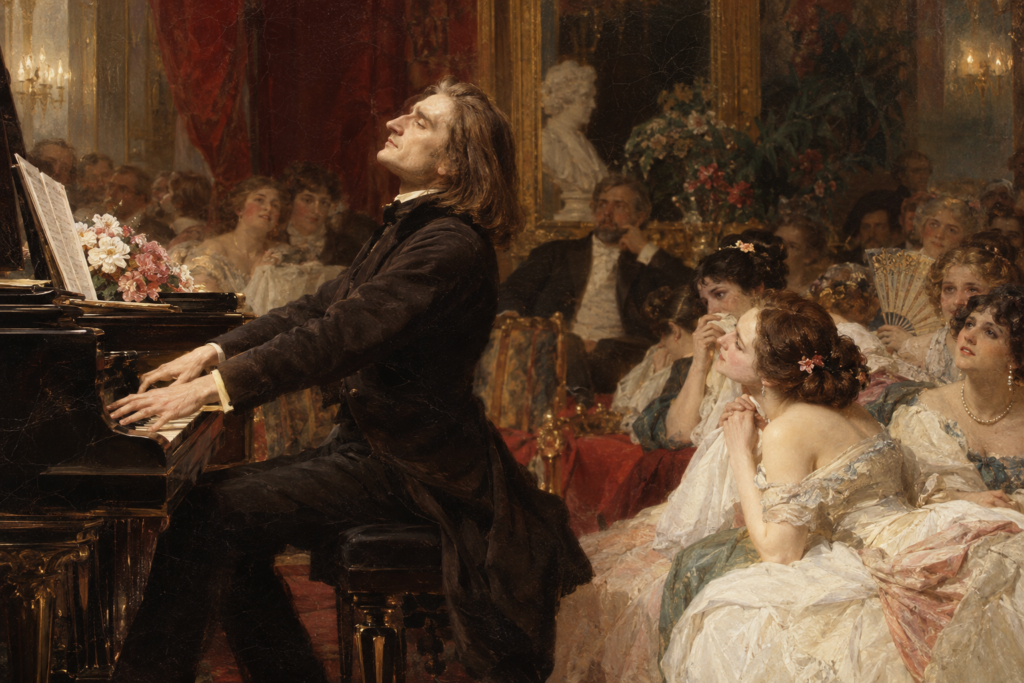
Before the electric guitar learned how to misbehave, before pop stars discovered stadium lighting, before teenage hysteria became a business model and before celebrity culture developed the decency to look embarrassed, there was Franz Liszt at a piano.
This may sound unlikely now, because the piano has spent the last century being trapped between drawing rooms, conservatories, respectable competitions and hotel lobbies trying very hard to sound expensive. But in the 1840s, the piano was not merely furniture with discipline. In Liszt’s hands, it became a public event, a machine of seduction, a vehicle for mass emotion and, depending on whom one asked, a threat to the nervous system of Europe.
The phenomenon had a name: Lisztomania.
The term was coined by Heinrich Heine, who used it in 1844 to describe the strange, almost pathological frenzy that surrounded Liszt’s performances. Heine was not writing like a fan with a wet handkerchief. He was writing like a man watching culture turn into fever. The piano recital had become something more than music. It had become spectacle, personality, erotic projection, social ritual and a very early form of celebrity madness.
Liszt did not simply play the piano.
He weaponized it.
1. The Man Who Made the Piano Look Dangerous

Franz Liszt had the great misfortune of being talented, handsome, theatrical and born early enough that Europe had not yet developed immunity to such a combination.
He was born in 1811 in the Kingdom of Hungary, became a child prodigy, trained in Vienna and Paris, and eventually transformed himself into the most dazzling pianist of the nineteenth century. That sentence is accurate but far too tidy. It makes him sound like a curriculum entry, when in reality he was closer to a weather event with excellent hair.
Liszt arrived at the piano with the whole Romantic century behind him: thunder, spiritual longing, virtuosity, revolution, illness, desire, salons, literature, aristocrats, exile, death, and people fainting in rooms where someone had probably overdone the velvet. The piano was ready for him because the piano itself was changing. It was becoming stronger, louder, more expressive, more public. It could no longer be contained as a polite domestic instrument designed to decorate manners.
Liszt understood this before almost everyone else.
He treated the piano as an orchestra, a confessional, a battlefield, a theatre and a mirror. He did not sit at it like a clerk of sound. He staged himself at it. The angle of the body, the profile, the hair, the hand, the pause, the demonic concentration — all of it mattered.
He was not only heard.
He was watched.
2. Virtuosity Before It Became a Crime
Modern taste sometimes distrusts virtuosity. We hear speed and suspect vanity. We hear brilliance and ask whether the soul has filed an application. This is because modern culture enjoys pretending it is too deep to be impressed by skill, while spending several hours a day applauding people who can arrange brunch attractively.
Liszt came from an age that had no such embarrassment.
Virtuosity was not a decorative excess. It was revelation. Paganini had already shown what could happen when technique became theatre, turning the violin into a demonic instrument and himself into something like a rumor with fingers. Liszt saw Paganini perform in Paris and understood the implication immediately: the instrumental soloist could become a mythological figure.
So he did the obvious thing.
He made the piano theatrical.
This was not only a matter of playing fast. Plenty of people have played fast and left no trace except tired furniture. Liszt’s power was dramatic architecture. He could build tension, suspend time, explode into sound, reduce the room to silence, and then make the audience feel as though something dangerous had passed through the air and charged admission.
The piano became a stage, and Liszt became the one-man opera.
3. The Birth of the Modern Recital, or How One Man Filled the Room Alone

One of Liszt’s most important cultural inventions was not a piece of music, but a format.
In 1840, in London, he gave concerts advertised as “Recitals on the Pianoforte.” The word “recital” had not yet hardened into the respectable thing printed on programs where everyone coughs at the wrong time. It suggested recitation, performance, declamation — music as something spoken through the instrument. Alfred Brendel later pointed out that Liszt’s London announcement used the plural “recitals,” effectively launching a new kind of public concert: the solo piano recital.
This was quietly radical.
Before Liszt, concerts were often mixed affairs: singers, orchestras, chamber music, solo pieces, variety, society, general cultural digestion. Liszt placed himself alone on stage with the piano and expected that to be enough.
It was enough.
More than enough, apparently. He created a model of performance that still dominates classical music: the soloist facing the audience, the piano angled like a polished beast, the program organized as a journey through taste, power, intimacy and endurance. The pianist became not a participant in an evening, but the evening itself.
This is where Liszt’s genius becomes almost annoyingly modern. He understood the recital as a total image: sound, personality, programming, staging, aura. Long before the machinery of modern fame, he grasped that performance was not only what happened between the first and last note. It was the entire social fever around the event.
The man did not merely play concerts.
He produced himself.
4. Lisztomania: Symptoms Include Screaming, Fainting and Poor Object Boundaries
By the early 1840s, Liszt’s fame had become ridiculous in the most useful historical sense of the word.
Audiences chased him. Admirers fought for relics. Women reportedly tried to obtain locks of his hair, broken piano strings, handkerchiefs, gloves, cigar ends and other objects that had entered the sacred orbit of the Liszt body. One hears these stories and realizes that celebrity culture did not decline. It merely gained better lighting and a more expensive legal department.
The frenzy around him was so intense that Heine’s term “Lisztomania” still feels perfect. It is not “Liszt enthusiasm” or “Liszt appreciation” or “Liszt’s impressive reception among European listeners.” It is mania: illness, possession, excess, a crowd transformed into symptom.
And here the piano becomes culturally fascinating.
This was not a singer using words. Not an actor speaking desire into language. Not a military leader promising glory. It was a pianist. A man seated at a machine of wood, wire, felt and hammers, producing abstract sound — and somehow abstract sound was enough to make society briefly lose its posture.
The piano had become a substitute body.
Liszt’s hands were watched as though they contained scandal. The instrument became the place where desire could appear while pretending to be music. A respectable audience could gather in public, witness emotional excess, feel the force of theatrical sensuality, and still call the evening culture.
That is perhaps the true brilliance of classical music.
It gives hysteria a program note.
5. The Salon Becomes a Battlefield

Josef Danhauser’s famous 1840 painting of Liszt at the piano is one of the great documents of Romantic self-mythology.
It shows Liszt performing in a salon before an impossible gathering of cultural greatness: Alexandre Dumas, George Sand, Marie d’Agoult, Paganini, Rossini, perhaps Berlioz or Victor Hugo, with Beethoven literally present as a bust on the piano and Byron watching from the wall like a dead poet supervising the emotional temperature.
No one should mistake the painting for documentary realism. It is better than realism. It is propaganda with taste.
The image tells us exactly how Liszt wanted to be imagined: not merely as a pianist, but as the magnetic center of European Romantic culture. Literature, music, theatre, aristocracy, rebellion, genius and death all gather around him. He sits at the piano like a priest of intensity, while the great names of the century arrange themselves into a fan club with better jackets.
This is celebrity before photography fully industrialized the face.
It is the salon as myth machine.
6. The Piano Learns to Perform Masculinity
Liszt did something unusual to the image of the pianist.
The keyboard had long been associated with domestic accomplishment, social grace, aristocratic refinement and polite education. It was an instrument of drawing rooms and daughters, of cultivation and manners. Liszt turned it into something theatrical, public, athletic and aggressively charismatic.
He made the pianist physically dramatic.
This matters because the piano is a strange instrument. Unlike the violin, it does not require an embrace. Unlike the voice, it does not emerge from the body. Unlike the flute, it does not visibly involve breath. It is a piece of furniture containing a storm. The performer must convince the audience that the storm is personal.
Liszt did that.
He made the act of piano playing look like conquest, confession and possession. His virtuosity suggested not merely refinement, but force. Suddenly the pianist was not a polite mediator between composer and audience. He was the event’s dangerous center.
The piano became masculine theatre with pedals.
One can dislike this. One can also admit it worked.
7. Celebrity, But With Sheet Music
Lisztomania did not exist only in the concert hall. It moved through print, gossip, portraits, reviews, rumors, published music and social mythology.
Liszt understood the media ecology of his time with almost indecent clarity. He toured, published, appeared, disappeared, cultivated aristocratic circles, attracted literary attention and allowed the public to imagine him as more than a musician. He became a type: the Romantic virtuoso, the inspired wanderer, the beautiful sufferer, the man whose talent seemed both spiritual and slightly improper.
Today we would call it branding, because modern language has the spiritual depth of a conference room.
But branding is not entirely wrong. Liszt created a public image that converted musicianship into aura. He gave audiences something to hear, something to see and something to talk about afterward. The concert became the beginning of the experience, not the end.
The Library of Congress Franz Liszt collection preserves part of that enormous afterlife: manuscripts, letters, printed music and materials that show how Liszt moved through nineteenth-century musical culture not only as a performer, but as a phenomenon of documentation.
This is how fame works. First the body appears. Then the paper follows.
8. The Audience Becomes Part of the Instrument
Liszt’s audiences were not passive listeners. They were part of the performance.
Their reactions completed the spectacle. The screams, swoons, applause, crowding, relic-hunting and emotional excess turned each concert into a social drama. This is something modern concert culture often tries to suppress. We have trained audiences into silence, as though music were best honored by everyone pretending not to have nervous systems.
Liszt’s world had fewer such inhibitions.

That does not mean his audiences were more honest, exactly. They were also performing themselves: their taste, passion, class, sensitivity, erotic imagination and proximity to genius. To go mad for Liszt was to participate in a fashionable form of emotional collapse.
In that sense, Lisztomania was not only about Liszt. It was about the audience discovering the pleasure of being an audience.
Fans always think they are worshipping the star. Often, they are also worshipping the feeling of worship.
9. Was It Really About the Music?

The sensible answer is yes, of course it was about the music.
The more interesting answer is: not only.
Liszt was an extraordinary musician. To reduce him to hair and hysteria would be lazy, though admittedly tempting on certain afternoons. His technique was revolutionary, his transcriptions expanded what the piano could contain, his later compositions pushed harmonic language into strange and prophetic places, and his influence on performance culture is immense.
But Lisztomania was not caused by music alone. It was caused by music plus image, scarcity, virtuosity, sexuality, theatricality, media, social pressure, Romantic ideology and the desire of audiences to witness genius in a form they could take personally.
That combination is what makes the story modern.
We still do this. We still confuse art with access, talent with intimacy, performance with revelation. We still treat the famous body as though proximity to it might change our own temperature. We still collect objects, signatures, photos, fragments, records, tickets and digital proof that we were near the aura when it passed.
Lisztomania did not disappear.
It learned to livestream.
10. The Piano After Liszt
After Liszt, the piano could no longer be only polite.
He helped expand the idea of what a piano performance could be: not background accomplishment, not salon decoration, not merely domestic refinement, but public drama. The instrument became capable of carrying symphonies, storms, confessions, fantasies, operatic paraphrases and acts of almost athletic display.
That shift still shapes how we imagine pianists.
The grand piano on stage remains a descendant of Liszt’s theatre. Every solo recital carries a little of his madness, even when the pianist is wearing a sensible black suit and pretending not to be part of a nineteenth-century ritual. The audience sits quietly now, mostly. Nobody is supposed to faint. Nobody is supposed to fight over broken strings. Nobody is supposed to turn musical experience into public erotic weather.
But the structure remains.
One person. One instrument. A room waiting to be conquered.
Liszt proved that this was enough.
11. The Rock Star Before Rock Had the Courtesy to Exist
Calling Liszt the first rock star is a cliché, but clichés become clichés by being annoyingly useful.
He had the touring schedule, the charisma, the mythology, the devoted fans, the critical backlash, the erotic charge, the public image, the technical excess and the ability to make serious people complain about society. He also had something modern rock stars would recognize immediately: the knowledge that performance is not only sound. It is presence under pressure.
The difference is that Liszt did it with a piano.
No amplification. No smoke machine. No electric feedback. No video screen. No social media team writing captions about gratitude and growth. Just a man, an instrument and a Europe apparently prepared to lose its mind because someone played octaves with unacceptable conviction.
There is something magnificent about that.
There is also something deeply ridiculous.
That is usually where culture becomes interesting.
12. Why Lisztomania Still Matters
Lisztomania matters because it shows that the modern cult of celebrity did not begin with cinema, radio, television or pop music.
It was already there in the concert hall, waiting for the right body, the right instrument and the right century. It shows that classical music was never as bloodless as its later etiquette suggests. It could be vulgar, erotic, hysterical, commercial, theatrical and socially contagious. The piano was not always a symbol of discipline. It was once a dangerous piece of furniture with very good public relations.
It also reminds us that music history is not only a sequence of works and composers. It is also a history of bodies, rooms, audiences, machines, rumours and desire. The piano changed not only because composers wrote differently for it, but because performers like Liszt taught society to look at it differently.
Art-Sheep has explored the sacred burden of the piano in another key through Nina Simone and the gospel of artistic fury. Liszt belongs to an earlier, silk-lined version of that same truth: the piano is never just an instrument. It is a stage on which personality becomes audible.
Franz Liszt did not invent celebrity.
But he gave it a keyboard.
And for a while, Europe behaved accordingly.