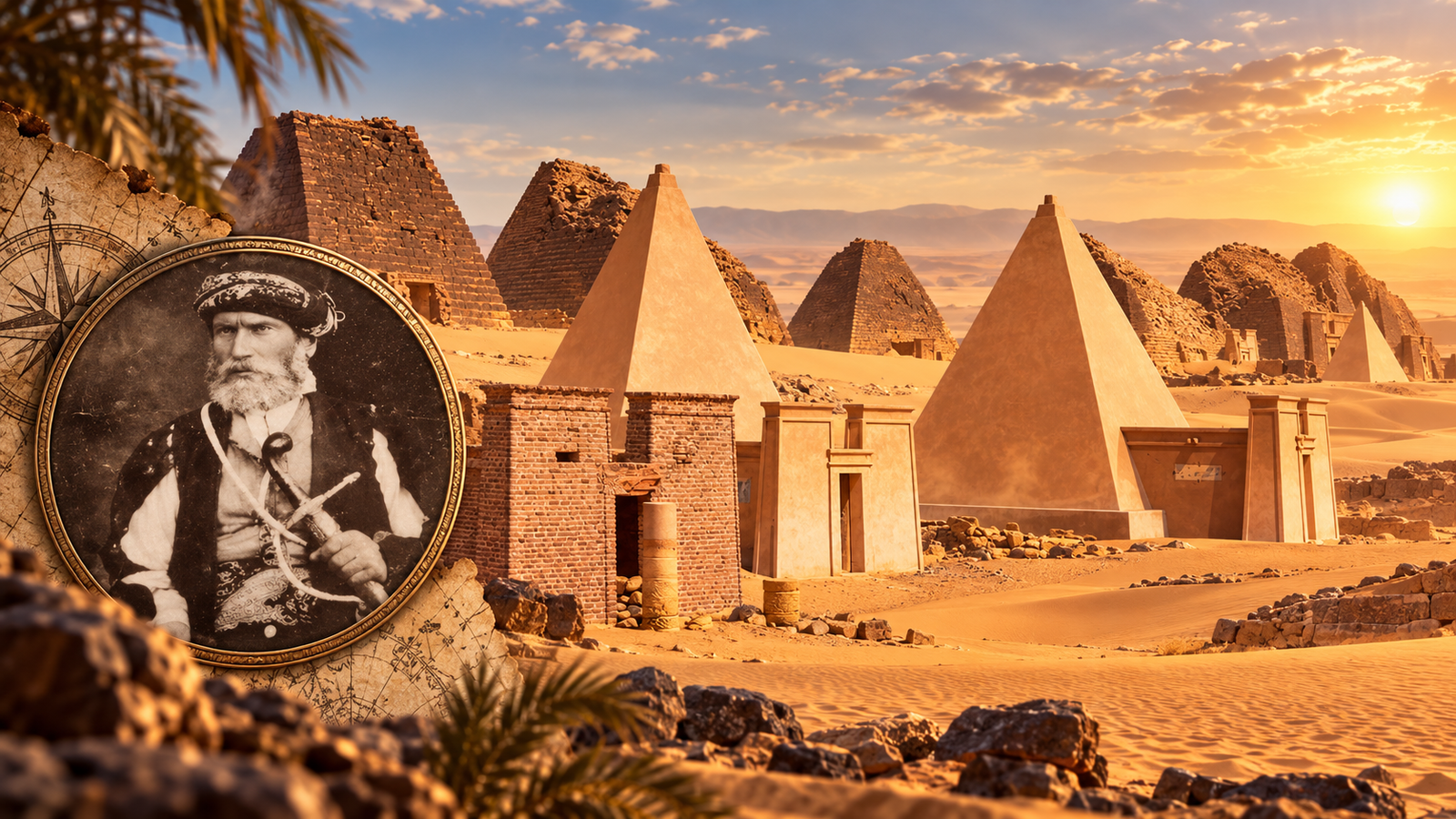
Every age gets the adventurers it deserves.
The nineteenth century, being a period of opera hats, imperial confidence, terrible facial hair and extremely flexible definitions of “research,” produced Giuseppe Ferlini: an Italian doctor, soldier, traveller, treasure hunter and enthusiastic reminder that archaeology did not always arrive with a notebook and a brush. Sometimes it arrived with workers, tools, permission of a kind, commercial optimism, and the emotional restraint of a burglar who had read Herodotus once.
Ferlini is best remembered for one episode: his 1834 treasure hunt at Meroë, in present-day Sudan, where he dismantled the pyramid of the Kandake Amanishakheto and found a spectacular cache of gold and silver jewellery. The treasure eventually reached Europe and entered museum collections. The pyramid, less fortunate, did not enjoy the same career development.
He is therefore perfect for our series on adventurers, rogues and other respectable disasters: people who stepped into history wearing the clothes of curiosity and left behind a crime scene with better lighting.
To call Ferlini an archaeologist is technically possible in the same way that calling a shark a marine dining enthusiast is technically possible. It depends on how generous one wishes to be, and whether one has already had lunch.
1. A Doctor, Because Apparently That Was Enough Qualification

Giuseppe Ferlini was born in Bologna in 1797 and died there in 1870. His early life followed the kind of restless, useful, unstable path that nineteenth-century adventure biographies absolutely adore: medicine, travel, military service, movement across the eastern Mediterranean and Egypt, and eventually the discovery that ancient tombs might contain the one thing more persuasive than history: gold.
He worked as a doctor and served in military contexts before turning his attention toward Nubia. This matters because Ferlini was not a trained archaeologist in any modern sense. He was a man with enough medical training to sound respectable, enough experience abroad to sound worldly, and enough appetite for buried wealth to become a danger to architecture.
That combination was hardly unusual. The nineteenth century was full of men who looked at distant ruins and saw knowledge, glory, profit, and occasionally a convenient wall that could be removed. The period had not yet fully separated scholarship from collecting, collecting from looting, looting from patriotism, or patriotism from shopping.
Ferlini belonged to that grey zone perfectly. He was not the first to search for treasure under the respectable umbrella of exploration, and he would not be the last. He was, however, impressively direct about the whole thing. Whatever else one says about him, the man did not hide his interest in treasure behind too many adjectives.
Some people go into the past looking for meaning. Ferlini went in looking for valuables. History, inconveniently, gave him both.
2. Meroë Before the Incident

The pyramids of Meroë, Sudan. Image via Wikimedia Commons.
Meroë was not a convenient pile of picturesque rubble waiting for European self-improvement.
It was one of the great centres of the Kingdom of Kush, a civilization whose power, architecture, religion, language and artistic traditions connected northeastern Africa with the Mediterranean and Middle Eastern worlds over many centuries. The UNESCO World Heritage Centre describes the Archaeological Sites of the Island of Meroe as the heartland of Kush, a major power from the 8th century BCE to the 4th century CE, with pyramids, temples, domestic buildings and water-management installations.
This is worth saying clearly because the language of “discovery” often performs a small act of theft before anyone even touches a monument. Meroë was not discovered by the nineteenth century. It was re-entered by foreign travellers, documented, misread, desired, damaged, collected from, and eventually historicized through European systems of knowledge.
Before Ferlini arrived, Meroë already had its own long afterlife. Its pyramids stood as funerary monuments of Kushite rulers. Its landscape carried traces of political power, ritual authority and artistic exchange. It was not an empty stage. It was a place with memory.
Unfortunately, memory is not always a sufficient defence against a determined man with tools.
3. The Nineteenth Century: When “Exploration” Often Meant “Bring Tools”

To understand Ferlini, one must understand the magnificent moral convenience of the nineteenth century.
Europe had fallen in love with antiquity, which is a polite way of saying it wanted to name, sketch, classify, remove and occasionally purchase it under doubtful circumstances. Egypt and Nubia became fields of desire: biblical, imperial, scholarly, decorative, touristic, occult, archaeological and commercial all at once.
Art-Sheep has already explored this appetite in Egyptomania: When Europe Became Obsessed with Ancient Egypt. Ferlini belongs to the rougher side of that story. Not the drawing-room fantasy of obelisks and sphinx-shaped furniture, but the field version: heat, labour, speculation, permissions, rumours, and the practical belief that ancient stones were probably hiding something negotiable.
In this world, the line between adventurer and scholar could be thin, smudged, or removed entirely for ease of transport. A man could destroy part of a monument, publish an account, display the objects, seek buyers and still move within circles that considered themselves intellectually serious.
It was a beautiful system, assuming you were not the monument.
4. Amanishakheto’s Pyramid and the Treasure Problem

The key object in the Ferlini story is the pyramid of Amanishakheto, a ruling queen of Kush, often described with the title Kandake.
Ferlini and his associate Antonio Stefani searched among the pyramids of Meroë looking for treasure. The early attempts were not especially successful, which must have been disappointing for men who had travelled a long way in the hope that ancient royalty had been thoughtful enough to leave cash-equivalent objects near the surface.
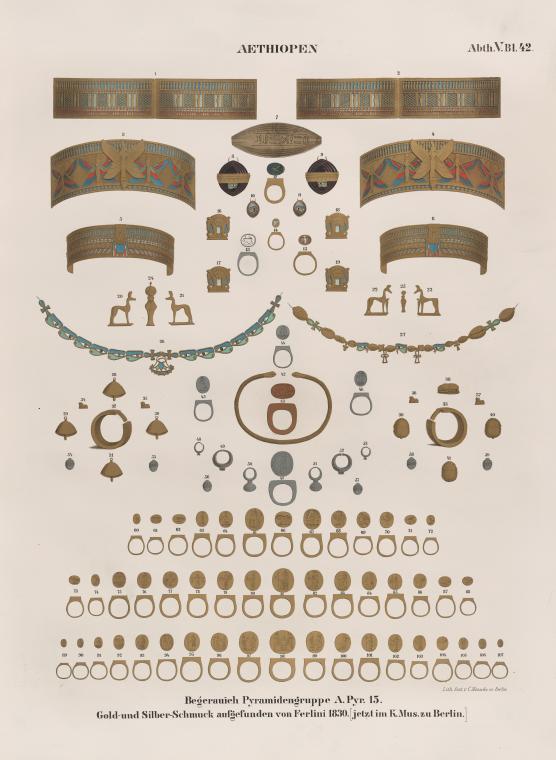
Then came the pyramid associated with Amanishakheto. Ferlini dismantled it from the top downward and eventually found a cache of jewellery. Modern museum descriptions connect this treasure with Amanishakheto’s burial and identify it as one of the great surviving groups of Meroitic goldwork.
The treasure included bracelets, rings, amulets and necklace elements — the kind of objects that suddenly make an expedition look like genius instead of vandalism, at least to the sort of person who believes success is a moral argument.
The pyramid itself was nearly destroyed. But Europe would soon have a collection to admire, and collections have always been very good at distracting from the noise made when they were born.
5. Archaeology, But Make It Looting

There is a particular kind of nineteenth-century sentence that deserves to be handled with gloves: “He excavated.”
In Ferlini’s case, one may prefer “he dismantled,” “he demolished,” “he looted,” or, if the coffee is strong enough, “he performed an aggressive architectural edit.” The word “excavation” carries too much dignity for what happened at Meroë. It suggests a discipline. Ferlini had an objective. The objective was treasure.
This distinction matters. Archaeology, at least in its better modern form, is interested in context. Where an object was found, how it was placed, what surrounded it, what layers enclosed it, what the site reveals as a whole — these are not boring details. They are the meaning. Looting, by contrast, is interested in the shiny noun and deeply impatient with the surrounding grammar.
Ferlini found astonishing objects. He also destroyed information that can never be reconstructed. That is the exchange: gold for silence. The jewellery survived. The full context did not.
This is why the story is funny only until one remembers it is also irreversible. The comedy lies in the absurdity of the adventurer’s confidence. The tragedy lies in the missing evidence.
History, as usual, has terrible comic timing.
6. The Moment the Treasure Became Suspiciously Real
When Ferlini returned to Europe with the treasure, he encountered one of history’s most elegant insults: people doubted the objects were authentic.
The jewellery was too sophisticated, too finely made, too splendid for many European expectations of ancient Nubia. This disbelief is almost more revealing than the looting itself. Ferlini had damaged the pyramid and carried away the treasure, only to discover that Europe’s imagination was not ready for the quality of what he had taken.
This is where the story becomes blackly perfect. The thief arrives with proof of a civilization’s brilliance, and the market hesitates because the civilization has been underestimated. It is a museum-world farce staged over a grave.
Only later, after scholarly attention — including the role of Karl Richard Lepsius — did the treasure’s authenticity gain wider acceptance. A portion had already been acquired by King Ludwig I of Bavaria; the majority would eventually be purchased for Berlin. The objects began their second life: no longer grave goods, but museum treasures.
The pyramid was gone. The jewellery was suspicious. The buyer was cautious. The scholar intervened. The collection was born.
If one wanted to compress the nineteenth century into five acts, there are worse scripts.
7. Europe Meets the Gold and Pretends to Be Surprised

The treasure of Amanishakheto is beautiful in exactly the way that makes morality inconvenient.
Gold, colour, fine workmanship, amuletic forms, royal ornament, hybrid visual traditions — the pieces are astonishing. They testify to Meroitic craftsmanship, wealth, cultural exchange and courtly sophistication. They also testify to a pyramid being treated like a locked cabinet with inconvenient masonry.
This is the problem with looted beauty. It keeps being beautiful. It refuses to become ugly just because the story around it is ugly. In fact, the ugliness of the story can make the beauty sharper, because the viewer feels the distance between the object and the violence that displaced it.
Museum displays often struggle with this tension. A jewel wants light. A provenance wants accountability. A label wants to be concise. History, inconsiderately, wants several paragraphs and an unpaid committee.
Ferlini’s treasure therefore does not allow a clean reaction. To admire it without thinking about its removal is vulgar. To think only about the removal and not admire the skill of its makers is another kind of failure. The objects deserve more than moral shorthand. They deserve the full discomfort.
Which is unfortunate, because discomfort looks terrible on a museum postcard.
8. Berlin, Munich, and the Polite Display of Bad Behaviour
.jpg)
Today, the treasure’s afterlife is divided mainly between Berlin and Munich.
The Staatliche Museen zu Berlin notes that the hoard, dated to the end of the first century BCE, was recovered by Ferlini in 1834 from the tomb of Amanishakheto and eventually reached Germany through purchases. It describes roughly 240 metal jewellery objects, with about one third in Munich and the remaining two thirds in the Egyptian Museum and Papyrus Collection in Berlin.
There is something almost too neat about that distribution: the violence of extraction softened into institutional geography. One-third here, two-thirds there. The museum world does love a fraction. It gives catastrophe the air of inventory.
This is not to say that the objects should not be studied, preserved or displayed. They absolutely should. But the display should not be allowed to clean the story until it shines too politely. The treasure did not float into Europe on a cloud of neutral scholarship. It came through damage, commerce, doubt, authentication and acquisition.
Museums are not only places where objects are kept. They are places where difficult histories learn to speak in captions. Sometimes they whisper. Sometimes they cough. Sometimes they say “acquired” and hope no one asks follow-up questions.
9. Ferlini as a Type: The Adventurer Who Arrives Before the Discipline

Ferlini is interesting because he is not merely an individual villain. Individual villains are convenient; systems are more embarrassing.
He belongs to a type: the adventurer who arrives before the discipline has fully learned to be ashamed of itself. The man who calls damage discovery. The man who turns rumour into itinerary. The man who enters a site with the confidence that whatever is old, distant and insufficiently guarded must surely be waiting for him.
There is a long, cheerful, catastrophic tradition of such men. Some were brave. Some were skilled. Some were observant. Some preserved information that might otherwise have disappeared. Some also removed, sold, smashed, mislabelled and misunderstood things with the confidence of people who expected posterity to thank them for the inconvenience.
Ferlini’s importance lies in that contradiction. He did reveal the existence of an extraordinary treasure. He also damaged one of the monuments connected to it. He helped bring attention to Meroitic goldwork. He also helped produce the loss of archaeological context. He is, in short, a useful disaster.
History contains many such men. They are not comfortable ancestors, but they are very good material.
10. The Comedy of Respectability

The funniest thing about the nineteenth century is how often bad behaviour dressed well.
Ferlini was not a pirate in a children’s illustration. He was not a bandit leaping from behind a dune with a theatrical laugh. He was a doctor, a traveller, a man who published reports, sought buyers, dealt with experts, corresponded, negotiated and moved within respectable circuits. This is precisely what makes him more interesting than a cartoon villain.
Respectability has always been one of history’s best disguises. It allows violence to enter the room through the front door, wipe its feet, and ask whether the paperwork is in order. Looting becomes collecting. Destruction becomes exploration. Profit becomes scholarship. An object removed from a tomb becomes “provenance.”
Ferlini’s later life adds a strangely comic coda. Treccani describes him aging into a somewhat pathetic figure, photographed in Turkish costume, moving through Bologna with medals and memories, even patenting a method for preserving meat. There is no novelist alive who could improve that detail without being accused of symbolism.
The man who broke into antiquity ends up as a local character with a preservation scheme. History has a cruel sense of narrative balance.
11. What He Destroyed vs. What He Revealed

It would be easy to end by saying Ferlini destroyed more than he discovered.
It would also be too simple. The problem is that he did reveal something: an extraordinary body of Meroitic jewellery that forced European scholars and collectors to confront the sophistication of Kushite craftsmanship. The treasure mattered, and still matters. Its existence is not reduced by the ugly circumstances of its recovery.
But the context matters too. What was lost when the pyramid was dismantled cannot be put back into the ground. Archaeology is not only about objects. It is about relationships: object to body, body to tomb, tomb to architecture, architecture to landscape, landscape to culture. Ferlini gave the world dazzling pieces and took away part of the grammar that made them speak fully.
This is the central bargain of treasure hunting, and it is always a bad bargain. It turns sentences into nouns. It keeps the jewel and burns the paragraph.
The treasure survives. The missing context survives too, but only as absence. That is harder to display under glass.
12. Why Ferlini Is Perfect for This Series
Ferlini is perfect for a series on adventurers because he exposes the genre’s dirty little engine.
Adventure stories love courage, distance, danger, improvisation and the intoxicating idea that one determined person can bend the world into a plot. They are less enthusiastic about the invoice: damaged sites, extracted objects, distorted histories, unpaid labour, colonial permission structures and the charming habit of calling theft “enterprise” when the thief has European handwriting.
Ferlini gives us both halves. He is absurd, destructive, fascinating, energetic, historically useful and morally unpleasant. He belongs to the family of men who make excellent stories and terrible precedents.
That is exactly why he works for Art-Sheep. Not as a moral lesson wrapped in disinfectant. Not as a simple villain to be hissed at from the safety of modern superiority. But as a character through whom a whole era becomes visible: its hunger, ignorance, courage, racism, greed, curiosity, vanity and talent for turning other people’s past into its own furniture.
Ferlini did not invent that world. He simply arrived with tools and made the metaphor embarrassingly literal.
13. History’s Worst Guests Often Leave the Best Footnotes
The story of Giuseppe Ferlini is the story of a man who entered the ancient world like a guest who suspects the host has hidden silverware.
He came to Meroë chasing treasure and found it. He damaged a pyramid and produced a museum legacy. He revealed the splendour of Amanishakheto’s jewellery and helped destroy the context that held it. He was laughed at, doubted, partly vindicated, partly disgraced, and eventually absorbed into the long comic-horrific parade of European adventurers who made history worse in ways that later became historically important.
There is no clean ending here, which is probably why the story is worth telling. The treasure is real. The damage is real. The beauty is real. The absurdity is real. The museums are real. The missing stones are real too.
Ferlini wanted gold.
He got it.
Unfortunately for him, history kept the receipt.