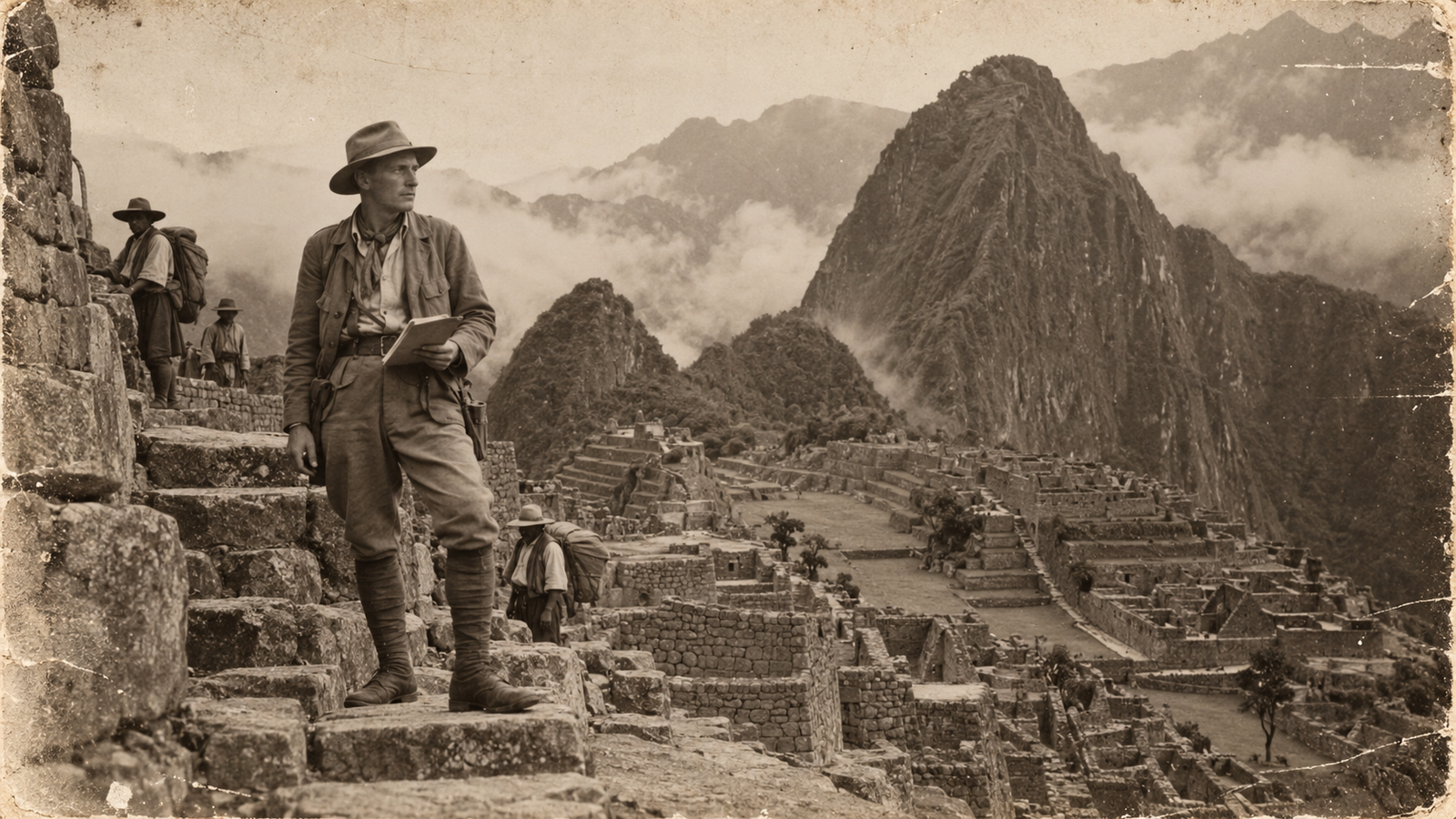
There are very few careers in which a man can arrive somewhere, find people already living there, ask them to show him the interesting buildings, and subsequently become famous for discovering the place.
Archaeology, fortunately for Hiram Bingham, was once one of them.
On 24 July 1911, the American historian and explorer climbed through the mountains above Peru’s Urubamba Valley and came face to face with one of the most extraordinary surviving architectural landscapes of the Inca world: Machu Picchu. It was a magnificent moment. Stone terraces stepped across a narrow ridge. Carefully fitted walls emerged from the vegetation. The great peaks of the Andes rose behind a city that seemed almost designed to embarrass every postcard ever printed.
Bingham was stunned. The rest of the world would soon be stunned too.
There was just one minor complication.
The place was not exactly lost.
Local people knew about the ruins. Families farmed terraces in their vicinity. A guide led Bingham up the mountain. A child helped show him around. Other visitors had been there before him.
None of this prevented Bingham from becoming the most famous name attached to the site’s modern history. He had something more powerful than being first: he had a camera, an American university, the support of the National Geographic Society, and an exceptional instinct for presenting an expedition as an event of global consequence.
He did serious work. He helped make Machu Picchu internationally known. And he became the central character in a discovery story whose supporting cast had the unfortunate habit of already knowing the location.
For the final episode of Adventurers, Rogues and Other Respectable Disasters, we meet the man who made an ancient Inca city into the world’s most successful archaeological publicity campaign.
1. A Yale Man Goes Looking for the Lost City

Hiram Bingham III was born in Honolulu in 1875. He studied at Yale, continued his education at Berkeley and Harvard, and developed an academic career devoted to Latin American history. He would later enter American politics, serve as governor of Connecticut, and become a United States senator.
Before that, however, he wanted adventure.
Not the untidy kind where a gentleman wanders off and returns with a peculiar souvenir. Bingham preferred an expedition with purpose, backing and the possibility of a very good book.
He was interested in the final chapter of the Inca Empire: the decades after the Spanish conquest, when Inca rulers and their followers maintained a state of resistance in the forests and mountains of Peru. The elusive city of Vilcabamba, the last Inca stronghold, occupied a particularly large space in his imagination.
Finding Vilcabamba would be a scholarly coup. It would also make a spectacular story.
So Bingham went to Peru to look for the refuge of the last Incas.
In the process he encountered something else, and eventually persuaded a remarkable portion of the English-speaking world that what he had encountered was the discovery of a lost civilization.
He was not the first explorer to be wrong about his destination.
He was simply among the best at turning the detour into a career.
2. The City Was Lost. The Directions Were Surprisingly Good.
Our story begins with the small but rather important distinction between a place being unknown to international scholars and a place being unknown to the people who live near it.
For visitors from Europe or the United States, Machu Picchu might have seemed remote, mysterious and practically inaccessible. For people in the Urubamba Valley, the mountains and their ruins formed part of a landscape of paths, farms, work and local knowledge.
This does not mean everyone in Peru knew the detailed history of Machu Picchu. Its original Inca name and exact function remain subjects of scholarly debate. Nor does local familiarity mean the ruins had already received the kind of systematic archaeological documentation that Bingham’s expeditions would later provide.
But the location was known.
That fact is not a minor correction to the heroic story. It changes its main verb.
Bingham did not arrive at an uninhabited blank spot on the map and single-handedly pull a vanished metropolis out of the clouds. He followed information supplied by people who lived in the region.
 Machu Picchu in 1912, after major clearing work. Photograph by Hiram Bingham III, published in the April 1913 National Geographic. Public domain / Wikimedia Commons.
In archaeology, there is a world of difference between finding something, studying something, and becoming the person whose name appears most often in stories about something.
Bingham would prove remarkably good at the third activity.
3. Melchor Arteaga: The Man Who Already Knew the Way
At Mandor Pampa, near the Urubamba River, Bingham learned about substantial ruins higher up the mountain from Melchor Arteaga, a local farmer and tenant of the area. Arteaga knew the route. Bingham wanted to see the buildings. An agreement was reached, with a small payment promised for guidance.
It is a modest exchange with extraordinary consequences.
A man describes nearby ruins. Another man asks to be taken there. The second man later receives an enormous amount of credit for the discovery.
If this were a restaurant, Arteaga would have been the local who recommended the place, while Bingham became the internationally celebrated critic who claimed to have discovered dinner.
Accompanied by a Peruvian civil-guard sergeant named Carrasco, Bingham undertook the difficult ascent on 24 July 1911. It was wet, steep and exhausting. Dense vegetation hid the architecture. The terrain was not designed for a comfortable morning stroll by an American academic.
Yet none of the difficulties erased the crucial point: the path was known, and the expedition relied on local knowledge.
Without Arteaga, the day’s itinerary would have looked considerably less impressive.
Without the photographs and publications that followed, however, Arteaga’s directions might never have become part of a worldwide historical narrative.
This is the beginning of the Bingham paradox: the local guide had the directions, but the visiting scholar had the distribution network.
4. July 24, 1911: The Great Discovery Meets Its Residents

When Bingham reached the ridge, he encountered more than ancient masonry.
Families were living and farming in the vicinity. Accounts identify the Richarte (also spelled Recharte) and Álvarez households, whose members cultivated terraces and used water from an old Inca channel.
Imagine announcing that you have found a lost city and then discovering that someone has been growing crops next door.
It does take something away from the isolation.
The ruins themselves were remarkable. Vegetation covered much of the settlement, but beautifully worked stone emerged in places: walls, terraces, stairways and temples, their surfaces demonstrating an extraordinary refinement of Inca craftsmanship.
Bingham photographed what he saw, including the Temple of the Three Windows. He understood immediately that the place was important, even if he did not yet understand precisely what role it had played in Inca history.
Crucially, the local residents did not need him to tell them there were ruins on the mountain.
He needed them to show him.
The difference would become increasingly hard to detect beneath the headlines.
5. The Boy Who Guided the Great Explorer
One of the most revealing details of the entire episode concerns the child who guided Bingham through the ruins after the ascent.
Accounts agree that a young boy from one of the resident families helped the visitor navigate the site. His name is less securely established. Peruvian retellings commonly identify him as Pablo Richarte, sometimes called Pablito, while other scholarly accounts discuss an identification with Melquiades Álvarez. The details deserve caution rather than another perfectly polished legend.
The important part is not the uncertainty of a name.
It is the certainty of a role.
A child knew how to move through the place. The adult foreign explorer, whose name would become almost inseparable from Machu Picchu, needed the child to show him.
This is the sort of scene that historical publicity usually edits out for dramatic reasons.
The explorer is meant to be a solitary figure standing before the unknown. The unknown is not supposed to have someone available to show him around.
And yet that scene is infinitely more interesting than the polished myth. It reveals two forms of knowledge meeting: intimate familiarity with a lived landscape and an outsider’s capacity to translate what he saw into photographs, lectures, books and international interest.
Bingham possessed one kind of power.
The local guides possessed another.
History was much better at remembering the first.
6. The Extremely Inconvenient Signature From 1902

And now for the sort of evidence that publicists prefer to discover after the publicity campaign.
Inside the Temple of the Three Windows, early photographs recorded an inscription associated with a Peruvian visitor named Agustín Lizárraga, dated 1902.
Lizárraga, a farmer and explorer from the Cusco region, had reportedly visited the ruins years before Bingham. Accounts of earlier visits and maps also circulated, though the quality of the evidence varies and should not be flattened into a new heroic discovery story.
Still, a recorded visit in 1902 is enough to create difficulties for any literal claim that no one had reached the site before 1911.
It is almost comically precise.
Not a vague legend about someone passing through the valley. Not merely an oral tradition whispered by an unreliable narrator. A name and a date associated with the ruins themselves.
The building effectively came with a prior visitor’s guestbook entry.
That does not make Lizárraga the sole discoverer, either. The local communities’ relationship with the landscape long predated both men. Replacing Bingham with one earlier individual would preserve the same flawed idea of discovery, merely with a different face on the commemorative plaque.
The point is more useful than that.
By 1911, Machu Picchu was not waiting for the first human being to notice it.
It was waiting for an international audience.
7. An Inca City With a Most Uncooperative Amount of Vegetation

What Bingham saw in 1911 was not the immaculately arranged collection of stone buildings known to millions of visitors today.
Much of the archaeological site was concealed beneath vegetation. Walls and terraces emerged in fragments. Trees and vines occupied rooms designed by the Incas. Agricultural activity and the natural growth of the surrounding mountain had altered the visual experience of the settlement.
For an illustrator of adventure stories, this was excellent news.
A few spectacular stone walls glimpsed through dense foliage can do more for an explorer’s reputation than an entirely visible city with a ticket office and a gift shop.
For archaeologists, however, the vegetation posed practical problems. Mapping, surveying, recording and excavating the structures required sustained work. That work would take place during return expeditions involving scholars, technicians and a large number of Peruvian labourers.
The magnificent images of Machu Picchu that eventually circulated around the world therefore reflected not only an ancient architectural achievement, but also modern clearing and photographic choices.
The city’s famous silhouette was partly the result of making the ruins visible to an audience that had not been there.
Bingham understood this.
Few things help a place become a legend quite like a good photograph of its best side.
8. The Lost City He Was Looking For Was Somewhere Else
Bingham’s interest in Machu Picchu was inseparable from his search for Vilcabamba, the last Inca stronghold after the Spanish conquest.
He came to think that the mountain site might be the legendary refuge he had been trying to locate. That interpretation was dramatic, persuasive to many readers, and mistaken.
Subsequent research identified the historical Vilcabamba at Espíritu Pampa, a different site in the region. Machu Picchu is generally understood today as a fifteenth-century Inca complex with royal, ceremonial, agricultural and other functions, although its precise purpose continues to be debated.
This is an important part of the story because it separates the significance of the discovery from the accuracy of the discoverer’s theory.
Bingham brought Machu Picchu to a vast international audience without correctly identifying exactly what he had found.
That is not unusual in archaeology. Discoveries often precede their proper interpretations. Scholars change their minds, evidence accumulates, and a more accurate history eventually emerges.
It is somewhat more unusual for the initial misunderstanding to become the premise of a global adventure brand.
Bingham searched for one lost city.
He made another city famous.
And the public, being fond of a good story, was not particularly anxious about the distinction.
9. Yale, National Geographic, and the Art of Making a Wonder Famous

Bingham’s great achievement was not simply arriving at Machu Picchu. It was understanding how to make the event impossible to ignore.
He returned to Peru in 1912 with support from Yale University and the National Geographic Society. The expedition investigated, cleared, surveyed and photographed the site and other places in the region.
The National Geographic Society contributed $10,000 toward the 1912 expedition, an amount matched by Yale, according to the introduction to Bingham’s own 1913 account.
This is where the modern architecture of an adventure story appears in almost complete form.
A recognizable protagonist.
An extraordinary landscape.
Institutional credibility.
Photographs.
Money.
And a publication large enough to place the story before an international audience.
The April 1913 issue of National Geographic was devoted to the work of the Peruvian expedition, with Bingham’s extensive article In the Wonderland of Peru and a lavish array of photographs.
The result was transformative.
Scholars had new material to examine. Readers had images of a spectacular place few had imagined. Bingham had something that every modern communications professional would recognize: an almost perfect launch campaign.
Ancient masonry had acquired a media strategy.
And it worked.
10. The Photographs Did Not Just Record the Story. They Created It.

Bingham’s photographs are important historical documents. They preserve views of the buildings and landscape during an early phase of archaeological investigation, before decades of conservation, tourism and further research transformed the site.
But photographs also make choices.
They frame. They exclude. They emphasize. They turn one corner into the image by which an entire place is remembered.
At Machu Picchu, the contrast between dark mountains, carefully cut masonry and terraces descending into cloud-filled valleys was almost absurdly photogenic.
The modern viewer scarcely needs to read the caption.
The site looks like a revelation.
This visual power helped Bingham establish the idea of a lost city emerging from centuries of obscurity. The images were authentic, but the interpretation surrounding them was selective.
They could show the magnificent architecture.
They could not, by themselves, explain the knowledge of local communities or the lives of the people who had guided the expedition there.
A photograph of an empty stone terrace is a powerful image of a forgotten world.
A photograph of the family farming near that terrace tells a different, equally important story.
Both might be true.
Only one was guaranteed a place in the international adventure narrative.
11. The Archaeology Was Real. So Were the People Doing It.

It would be unfair to reduce Bingham to a publicity expert wearing expedition clothes.
The investigations he directed contributed substantially to the documentation of Machu Picchu. Teams cleared vegetation, mapped buildings, examined burials, studied architecture and assembled collections of archaeological material.
The work involved scientific specialists and local labourers, whose practical contributions were essential. Like earlier expeditions in Egypt and elsewhere, it depended on people who rarely received the same share of international recognition as the director whose name appeared on the book.
Look closely at photographs from 1912 and you can sometimes see the imbalance in miniature. The ruins occupy the centre of the image. The American expedition gives them a published meaning. A local assistant carries equipment, tools or maps.
The picture tells us an immense amount about archaeology, even when the caption is mostly interested in the architecture.
There is real intellectual achievement here: survey, excavation, photographic evidence and the creation of records that later scholars would use and question.
And there is a persistent issue of credit.
History likes leaders.
It is less efficient at remembering the men who carried the tripods.
12. The Yale Collection: A Century-Long Argument About Where History Belongs
As the expeditions continued, archaeological objects and materials recovered at Machu Picchu were transported to Yale for study.
They included pottery fragments, stone objects, metal artifacts and human remains, among other materials. Many were fragmentary and of primary scientific rather than decorative interest.
The movement occurred within the legal and political arrangements of the early twentieth century, including permissions that subsequently became the subject of serious disagreement. Peru argued that the objects had been allowed to leave for study and should be returned. Yale disputed aspects of the competing claims for many years.
Calling the entire episode a simple suitcase theft would make for a more dramatic sentence, but not a more accurate history.
The real dispute was complicated, lengthy and important.
Who had the right to keep archaeological objects removed from a Peruvian site? Did permission to study them abroad amount to ownership? What obligations accompanied the ability to conduct scientific research in another country?
These were not merely administrative questions.
They went to the heart of how archaeological institutions, powerful universities and the countries from which collections originated understood cultural heritage.
In other words, one of the world’s most famous archaeological publicity successes was followed by a very long conversation about the shipping arrangements.
History may be magnificent.
Provenance is considerably less photogenic.
13. Peru Would Like Its Artifacts Back, Please

By the twenty-first century, the dispute between Peru and Yale had become a significant international cultural-property controversy.
The Peruvian government sought the return of materials collected during Bingham’s expeditions. The disagreement involved legal arguments, public campaigns, scholarly relationships and competing narratives about the original terms under which the artifacts had left the country.
In November 2010, Yale announced an agreement with the government of Peru to return the archaeological materials. A partnership with the Universidad Nacional de San Antonio Abad del Cusco followed in 2011.
The return was carried out in stages: shipments took place in March and December 2011 and in November 2012.
The collections became part of the Museo Machu Picchu at Casa Concha in Cusco, where conservation, research and display could continue in Peru.
This was a more fitting conclusion than the endless argument that preceded it.
Research did not have to end because objects returned home. Institutional cooperation could continue. The materials could be studied in a country with an obvious historical and cultural interest in their future.
And Bingham’s legacy acquired yet another chapter.
The famous discoverer’s excavations had yielded objects whose journey home took approximately a century.
One hopes the paperwork was more carefully filed this time.
14. Indiana Jones Before the Hat Became a Franchise
There is an obvious temptation to describe Bingham as a real-life Indiana Jones.
He travelled through dramatic landscapes, searched for ancient cities, appeared in photographs wearing expedition clothes and became associated with an adventure narrative in which academic curiosity and physical danger shared the same pages.
The resemblance is useful as a metaphor, but it should not be mistaken for a proven direct line of inspiration from Bingham to the fictional character.
The broader cultural connection is more interesting.
Bingham helped popularize a particular image of the archaeologist: the energetic Western man moving through remote terrain, solving historical mysteries and returning with stories and images for a public hungry for discovery.
That image shaped popular expectations of exploration long before Hollywood turned it into a franchise.
It also brought the familiar problem.
The heroic explorer often appears alone, even when his achievements depend on guides, collaborators, workers, local historians, institutional sponsors and people whose everyday knowledge predates his arrival.
What makes a good adventure poster is not always what makes a good history.
Bingham was a compelling protagonist.
He was not the entire cast.
15. Was Machu Picchu Ever Really Lost?
This is the question that the story keeps trying to escape.
Was Machu Picchu lost?
To whom?
It had ceased to function as the Inca settlement it once was. Its precise history was obscure to scholars, and much of the architecture was covered by vegetation. But the mountain was not a featureless mystery to nearby communities, and the ruins had not disappeared from all human knowledge.
So there are several different kinds of discovery here.
The encounter with a place previously unknown to an individual.
The scientific investigation and documentation of a site.
The publication of evidence before a global audience.
And the construction of a personal legend around all three.
Bingham unquestionably contributed to the second and third. His role in making Machu Picchu internationally famous is not in serious doubt.
What requires correction is the notion that an American scholar was the first person to know the place existed.
It is an appealing myth because it makes history easy to narrate.
One hero. One mountain. One moment of revelation.
Unfortunately, reality was populated by rather more people.
And some of them had been farming the terraces.
16. How to Become the Face of a Civilization You Did Not Build
The central achievement of Machu Picchu belongs, of course, to the Inca builders who designed and constructed it in the fifteenth century.
They created an extraordinary relationship between architecture and landscape: terraces that stabilize steep slopes, walls of carefully fitted stone, spaces associated with ceremonial practices, and infrastructure suited to a difficult mountain environment.
The site became a UNESCO World Heritage property in 1983, recognized for both its cultural and natural significance.
Bingham’s role was much later and very different. He helped record, investigate and publicize a place produced by people whose names, for the most part, do not survive in the documentary record.
The distinction should be obvious.
Yet cultural fame often has a strange way of attaching itself to the person who brings an achievement before a new audience rather than the people who made it possible.
The Inca engineers built the city.
Local residents retained knowledge of the landscape.
Peruvian guides brought Bingham to the ruins.
Expedition teams studied and photographed them.
National Geographic delivered the pictures.
And Bingham became the name most easily remembered.
That is not an argument for erasing him from the story.
It is an argument for making the story large enough to include everyone else.
17. Machu Picchu Wasn’t Lost. The Credit Was.
Hiram Bingham died in 1956. By then, Machu Picchu had become one of the defining images of South American archaeology, and his name was firmly attached to its introduction to the wider world.
His expeditions produced valuable documentation. His images helped generate international interest in the Inca past. The publicity brought scholarly attention and, eventually, tourists in numbers that no one on that rainy July morning in 1911 could have imagined.
Those achievements were substantial.
So were the contributions of the people whose knowledge, labour and guidance made them possible.
That is what makes Bingham such a fitting finale to our series.
We have met men who opened ancient monuments with explosives, pursued royal treasure through layers of history, collected antiquities on an industrial scale, and turned excavations into personal theatre.
Bingham’s distinctive talent was different.
He understood the machinery of attention.
He knew that a discovery becomes far more powerful when it can be photographed, financed, published and retold.
He did not need to invent Machu Picchu. The Incas had already done the difficult part.
He did not need to be the first person to see it. Others had already been there.
He needed to make the world look.
And there, undeniably, he succeeded.
The lost city turned out not to be quite as lost as advertised.
But the publicity was magnificent.
Research and image sources
- National Geographic — Then + Now: Machu Picchu
- National Geographic — In the Wonderland of Peru (1913 article)
- Peru official newspaper — 24 July 1911
- Peruvian National Library — Study of Bingham and the local guides
- Yale News — 2010 return agreement
- Yale News — Artifact returns completed through 2012
- UNESCO — Historic Sanctuary of Machu Picchu