The first is as one of humanity’s greatest works of literature: an epic of rage, honour, mortality, war and the deeply unfortunate consequences of allowing aristocratic men to make decisions near sharp objects.
The second is as a set of excavation instructions.
Heinrich Schliemann preferred the second.
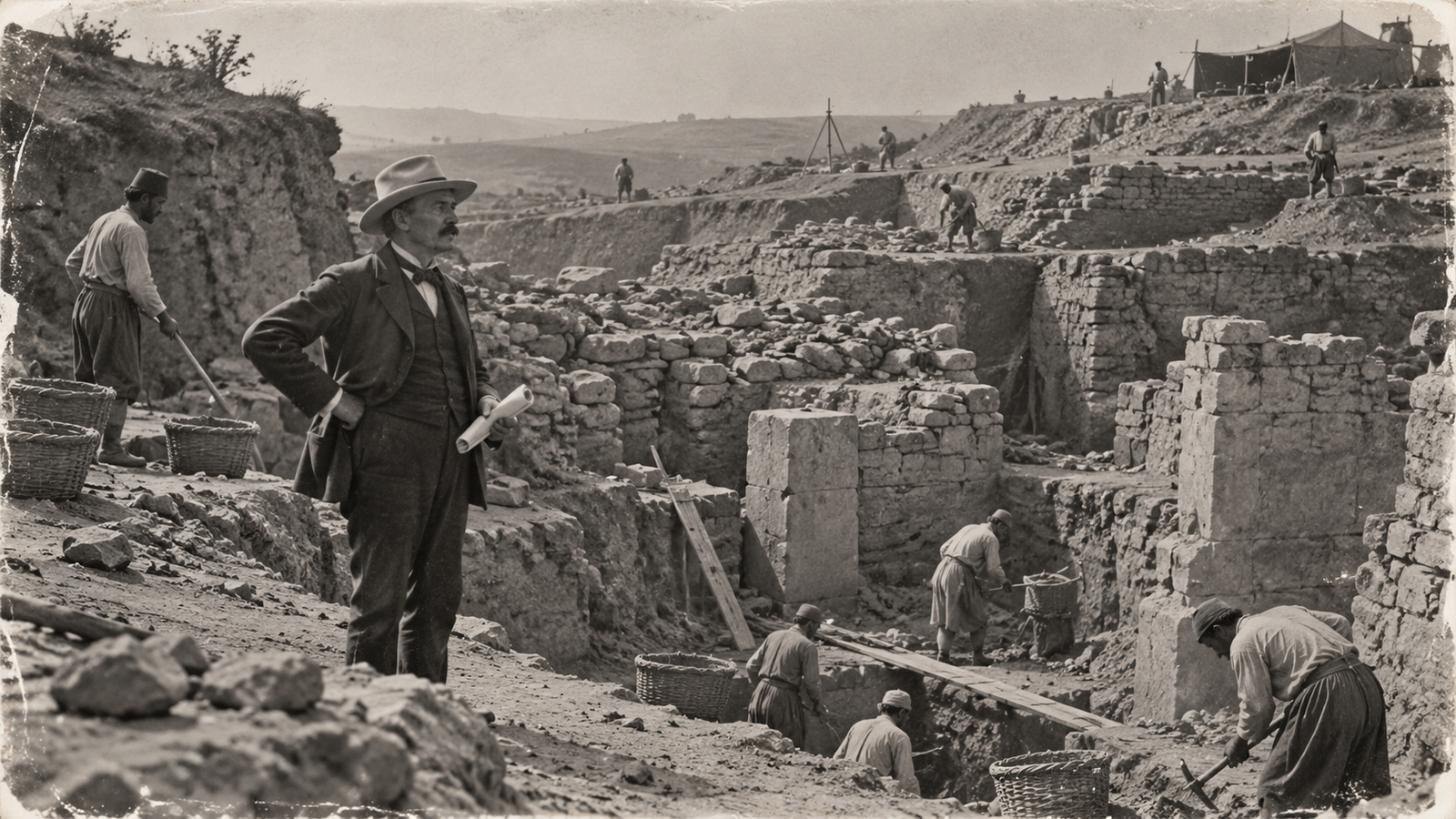
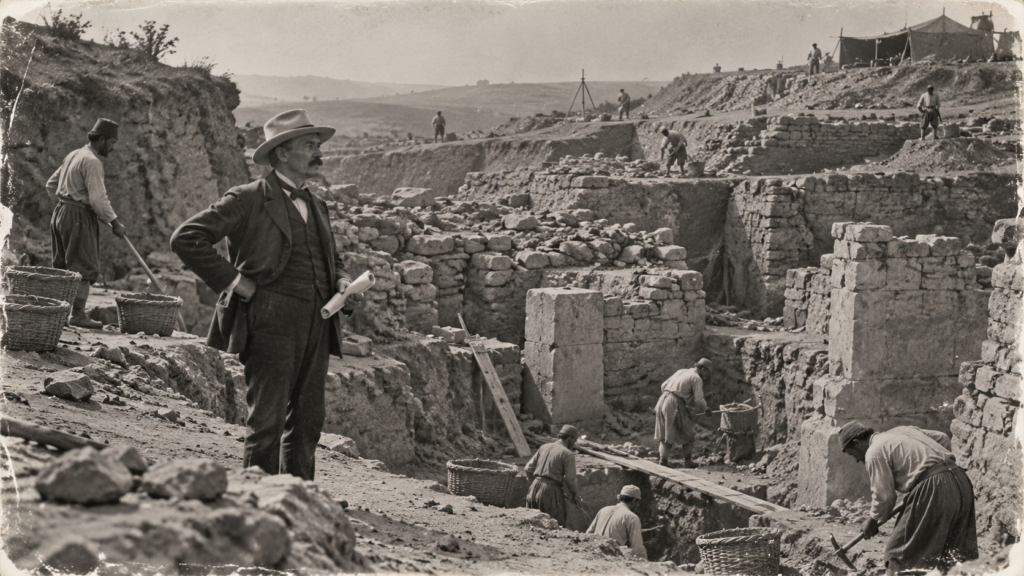
Born in 1822, Schliemann made a fortune in international business, taught himself languages with ferocious enthusiasm and eventually decided that his real calling was not commerce but ancient Troy. He travelled to northwestern Anatolia, helped bring the ruins at Hisarlik to international attention, excavated with an energy that alarmed even some of his contemporaries and announced that he had found the treasure of King Priam.
There was one problem.
The treasure was real. The king was probably not involved. And the city layer from which it came was roughly a thousand years too early for the Trojan War as traditionally situated.
A lesser publicist might have found this embarrassing. Schliemann had already arranged the story, the photographs and the headlines.
He was a pioneering excavator, a ruthless self-promoter, a gifted linguist, an unreliable storyteller and a man who could turn an archaeological discovery into an international event before anyone had finished checking the date.
Archaeology, but make it branding.
1. A German Businessman With a Very Expensive Childhood Dream
Schliemann was born in Mecklenburg, in northern Germany, and grew up in circumstances very different from those of the grand aristocratic collectors who had spent the early nineteenth century shopping for the ancient world.
He later told a charming story about becoming fascinated with Troy as a child after seeing an illustration of the city’s destruction. It is the sort of origin story biographers adore: one small boy, one legendary city, one destiny waiting patiently to unfold.
Unfortunately, Schliemann’s autobiographical accounts are not always reliable. He had a habit of revising the story of his own life until it resembled the sort of narrative he wanted the public to believe. The childhood obsession may contain truth; the neatness with which it explains everything should make any historian a little nervous.
His commercial achievements, however, were beyond dispute. He worked in Amsterdam and Russia, developed remarkable linguistic skills and accumulated serious wealth through trade and finance. By the time he turned decisively toward archaeology, he could afford something most dreamers cannot: an excavating workforce.
This was important. Reading Homer with enthusiasm was free. Removing thousands of cubic metres of earth in the Ottoman Empire was not.
Schliemann had spent years mastering markets, prices, logistics and publicity. When he moved from commodities to antiquity, he did not abandon those skills.
He simply found himself a more photogenic product.
2. Homer Was a Poet. Schliemann Preferred Him as a Surveyor.
By the nineteenth century, the historical status of the Trojan War was hotly debated. Few serious scholars believed that every detail of the Iliad could be read as a literal account of a Bronze Age conflict. But the possibility of a real settlement behind the legend was not absurd, and the landscape of the Troad had attracted antiquarian attention long before Schliemann appeared.
Schliemann was uninterested in being merely cautious.

He believed that Homer could direct him toward the actual places of the epic. The geography mattered. The distances mattered. The hills, plains and ancient remains mattered. If Achilles had chased Hector around Troy, surely the landscape might still have something to say about it.
That was an inspiring premise, even when Schliemann’s reasoning ran faster than his evidence.
His genius was partly his willingness to ask whether great literature preserved memories of genuine places and events. His weakness was his tendency to treat a plausible interpretation as though it came with a signed statement from the Bronze Age.
For him, an archaeological find did not merely suggest a connection to Homer. It frequently arrived already wearing a Homeric name tag.
And yet his conviction drew public attention to a question that would prove historically fruitful: what, exactly, lay under the mound of Hisarlik?
3. Meet Frank Calvert: The Man Who Found the Right Hill Before the Famous Man Arrived
The standard legend introduces Schliemann as the discoverer of Troy. It often forgets to introduce Frank Calvert.
Calvert, a British expatriate who lived in the Troad and knew its landscape intimately, had already identified Hisarlik as a promising location for ancient Troy and carried out limited excavations there in the 1860s. He lacked the enormous private funds necessary to investigate the mound on a dramatic scale.
Schliemann possessed precisely those funds.
The two met in 1868, and Calvert helped direct the wealthy newcomer toward the site. Without that groundwork, Schliemann’s famous project would have had a rather more difficult opening act.
It is therefore more accurate to say that Schliemann transformed the investigation of Hisarlik into a major, internationally famous enterprise than to say he alone located a completely forgotten Troy.
Unfortunately for Calvert, identifying an important archaeological site and financing a spectacular excavation are not equally useful skills when history begins assigning celebrity status.
Calvert knew the hill. Schliemann knew the audience.
Guess whose name ended up on the poster.
4. Hisarlik: Nine Cities, One Hill, and Absolutely No Patience
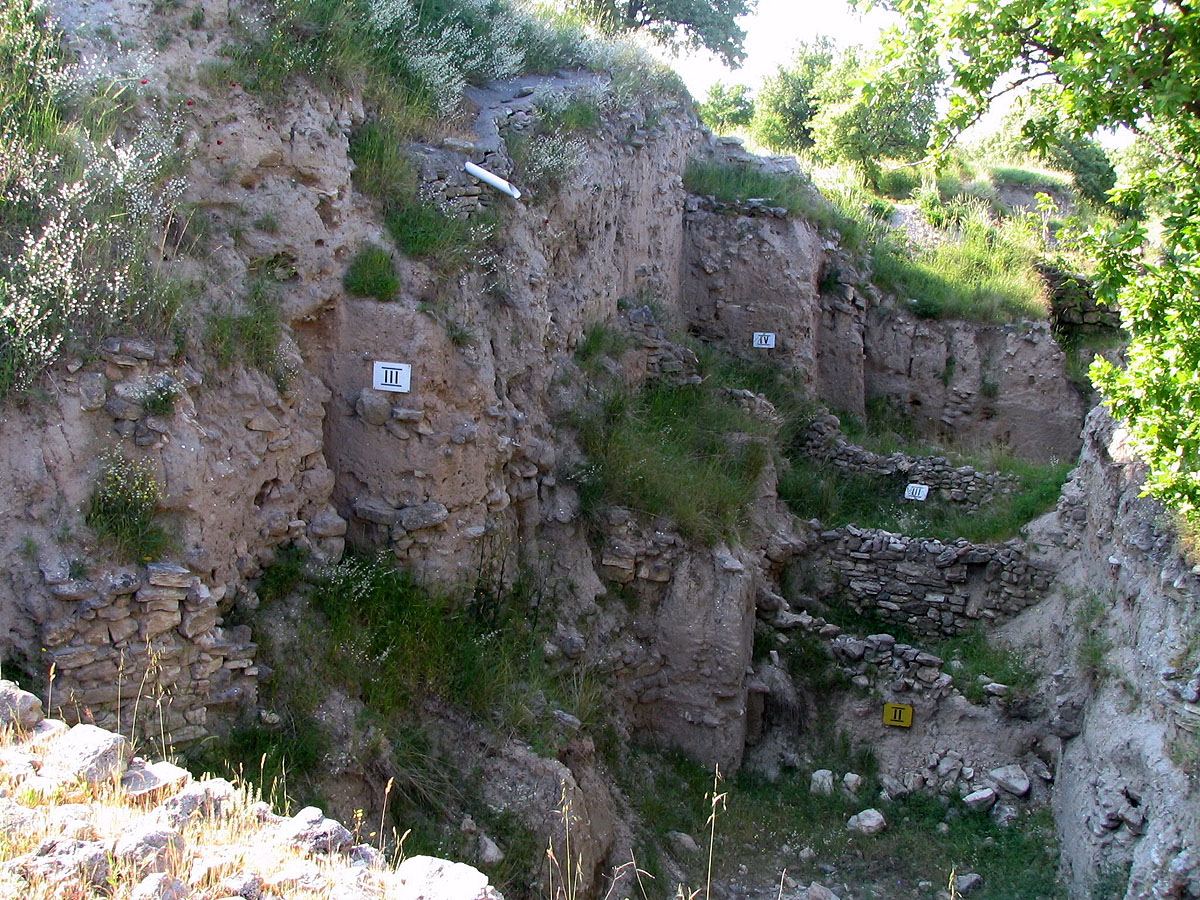
The real difficulty at Hisarlik was that Troy was not simply one city.
It was a succession of settlements built, destroyed, rebuilt, expanded and transformed over many centuries. The archaeological sequence includes multiple major occupation phases, conventionally labelled Troy I through Troy IX, with subdivisions and later occupation complicating the picture still further.
Schliemann wanted the Troy of Priam.
The hill offered a thousand years of other people’s building projects on the way down.
The stratigraphic problem was fundamental. A ruined wall near the top might be centuries younger than a buried wall below it. A pot beside one structure could belong to an entirely different period from a pot several metres deeper. Context mattered as much as the object itself.
Schliemann understood enough to know that the site was complicated, but his early approach was driven by a disastrous assumption: the oldest, deepest city must be the Homeric one.
He dug downward with extraordinary determination.
Unfortunately, the Bronze Age city most often discussed in relation to a possible historical background for the Trojan War belongs to the much later Troy VI–VII horizon, not the early settlement he celebrated as Priam’s.
In archaeology, being a thousand years early is not a rounding error.
It is an entirely different civilization waiting to be introduced.
5. The Great Trench: When Your Excavation Method Is Essentially a Giant Scar

Schliemann’s most visible contribution to the landscape remains an enormous trench cut through the mound.
It was not a delicate intervention.
The cutting, at points roughly forty metres wide and extending deeply toward bedrock, removed large quantities of material in his drive to reach what he believed was the earliest and therefore most important city. Later levels, including remains now considered crucial to understanding Bronze Age Troy, suffered serious damage.
To a modern archaeologist, this is a nightmare dressed as an excavation strategy.
The tragedy is that archaeological layers are not obstacles concealing the real story. They are the story. Removing them without adequate recording can erase relationships that cannot be reconstructed afterward.
Schliemann was not working in the complete absence of archaeological knowledge, and later in his career he became more attentive to specialist advice. But his early excavation methods were often brutally intrusive, even when judged against the standards of an emerging discipline.
He was searching for a city in a poem.
The trench destroyed parts of several real cities along the way.
It is a remarkable professional achievement to find the place you were looking for while damaging the evidence that would have helped explain it.
6. May 31, 1873: Ladies and Gentlemen, Priam’s Treasure
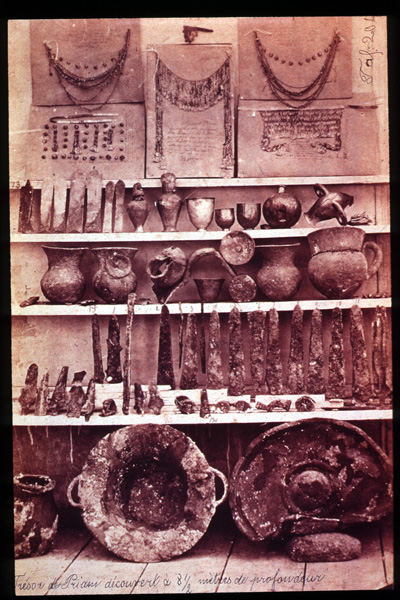
Then came the gold.
On 31 May 1873, Schliemann recorded the discovery of a remarkable deposit of metalwork at Troy: gold ornaments, precious objects, vessels and other items that would become internationally famous under the name Priam’s Treasure.
The collection was spectacular. Gold diadems with delicate pendants, jewellery of extraordinary craftsmanship and objects that offered a glimpse into the wealth and technical abilities of early Bronze Age communities.
Schliemann’s response was entirely predictable.
He assigned the treasure to one of literature’s most famous royal families.
The name was irresistible. Priam, the aged king of Troy, belonged to a story everyone educated in the classics already knew. To announce the discovery of an early Bronze Age hoard would have excited specialists. To announce the treasure of Priam was to make the entire Western literary imagination sit up and listen.
Here was the cleverness of the branding.
Schliemann did not simply say that he had found gold.
He gave the gold a protagonist.
Suddenly, the discovery belonged to the Iliad: the destruction of Troy, the doomed royal house, the fall of a legendary city. Archaeological objects acquired a ready-made emotional plot.
The trouble was that the plot had not survived contact with the chronology.
7. A Minor Chronological Problem: Priam Hadn’t Been Born Yet
The objects associated with Priam’s Treasure came from Troy II, an early Bronze Age settlement dating broadly to the third millennium BCE.
The later Bronze Age city that might preserve the historical setting behind stories of the Trojan War belongs many centuries afterward, commonly discussed in connection with Troy VI and Troy VII.
In round numbers, Schliemann’s magnificent treasure was roughly a thousand years too old to have belonged to Homer’s Priam.
This does not make the artefacts any less extraordinary. Quite the opposite. The craftsmanship is impressive precisely because it belongs to a much earlier phase of Anatolian history.
But it does make the label exceptionally optimistic.
Schliemann had found a treasure at Troy. That is already a tremendous discovery. He did not need to prove that Hector had once watched his father inventory the contents.
Yet a treasure without Priam was an archaeological assemblage.
A treasure with Priam was a worldwide sensation.
The former required patient study. The latter practically wrote its own publicity material.
And Schliemann, who had made a fortune understanding what people wanted, knew the difference.
8. The Wife Who Helped Discover the Treasure Without Actually Being There
There was another delightful complication in Schliemann’s account.
He initially described his wife, Sophia, as helping him remove the treasure from the ground. It was a wonderfully cinematic scene: the devoted couple together, rescuing golden antiquities as though participating in the final chapter of a romantic adventure.
The problem was that Sophia was in Athens when the treasure was discovered.
This is not merely a hostile allegation from a later critic. Schliemann himself acknowledged in private correspondence that he had written Sophia into the discovery story to encourage her interest in archaeology. The American School of Classical Studies at Athens preserves the documentation behind this episode.
What should we call this?
An affectionate exaggeration? A promotional embellishment? A rather inventive approach to field attendance?
Whatever the preferred terminology, Sophia’s absence exposes a pattern in her husband’s storytelling.
He did not necessarily need to fabricate an archaeological discovery to create a misleading account of it. Sometimes he only needed to improve the cast.
History had happened.
Schliemann thought it might look better with a supporting actress.
9. Sophia Schliemann, Helen of Troy, and the Greatest Archaeological Fashion Photograph

Whatever her absence from the moment of discovery, Sophia became indispensable to its public image.
In the famous nineteenth-century photograph, she wears the elaborate golden diadem and necklaces from the Trojan collection. The image is one of archaeology’s most striking early publicity moments: an ancient treasure placed on a living woman and transformed into a bridge between Homeric fantasy and contemporary European society.
Schliemann had not discovered Helen of Troy.
He did, however, arrange a photograph that made people think of her.
The effect was brilliant. Most viewers had no particular desire to examine stratigraphic sequences or compare ceramic typologies. They could recognize a glamorous woman wearing spectacular ancient gold.
In a single photograph, complex archaeological evidence became a human story.
The picture’s visual power is difficult to overstate. It survives not simply because the objects are beautiful, but because it packages the entire Schliemann enterprise in one unforgettable image.
Troy had become personal.
The treasures had become wearable.
The archaeological campaign had acquired a leading lady.
If there had been a nineteenth-century department devoted to international cultural branding, Schliemann could reasonably have applied for the position of director.
With Sophia as the campaign photograph, naturally.
10. Smuggling the Treasure: Because the Ottoman Authorities Were Being Inconvenient
Hisarlik was in the Ottoman Empire. Schliemann was excavating under an Ottoman permit, and that permit imposed obligations concerning the division of finds.
Schliemann did not particularly enjoy those obligations.
Instead of reporting and dividing the treasure as required, he secretly moved it to Greece. When Ottoman officials discovered what had happened, they brought legal proceedings against him in Athens.
The case ended in a financial settlement, although the documentary record distinguishes the initial court-ordered amount from the larger sum Schliemann ultimately paid as part of his efforts to repair relations and resume work. The State Museums of Berlin record the court settlement at 10,000 gold francs, alongside further payments connected with excavation rights.
This is an especially revealing part of the story because Schliemann was not an ignorant tourist who accidentally packed a priceless ancient diadem into the wrong suitcase.
He was an experienced businessman operating under known conditions.
He understood contracts rather well when they protected his own interests.
Here, they had become inconvenient.
The treasure had supposedly belonged to King Priam, was found in Ottoman territory, was spirited to Athens and would eventually be presented to museums in Germany.
Several countries acquired an interest.
The Trojans, regrettably, had no legal department available.
11. From Troy to Berlin: A Very Patriotic Change of Ownership
Schliemann eventually donated his Trojan collection to the Royal Museums in Berlin in 1881.
The objects had completed an extraordinary transformation. They were once possessions of Bronze Age inhabitants of Anatolia. After excavation, removal and a diplomatic dispute, they became the property of a major European museum.
The collection brought cultural prestige, scholarly interest and public fascination. Schliemann gained a more permanent place in the history of archaeology, now reinforced by an institutional home for the objects associated with his discoveries.
This was an age in which museums were not only places of scholarship. They were also expressions of national pride.
The British acquired antiquities. The French acquired antiquities. The Germans were certainly not going to sit quietly at home while everyone else collected civilizations.
Troy’s treasures had become part of a European competition over who could own, display and interpret the ancient world.
Schliemann had succeeded at something larger than excavating a site.
He had given a nation a cultural trophy and given himself a very durable monument to personal achievement.
It was excellent public relations, although the archaeological provenance story was becoming unusually well travelled.
12. From Troy to Mycenae: The Mask of a King Who Wasn’t Agamemnon
Schliemann was not finished with Homer.
In 1876, he excavated at Mycenae in Greece, working under the supervision of the Greek archaeological authorities, including the ephor Panagiotis Stamatakis. In the shaft graves of Grave Circle A, the excavations uncovered magnificent gold funerary objects, weapons and masks.

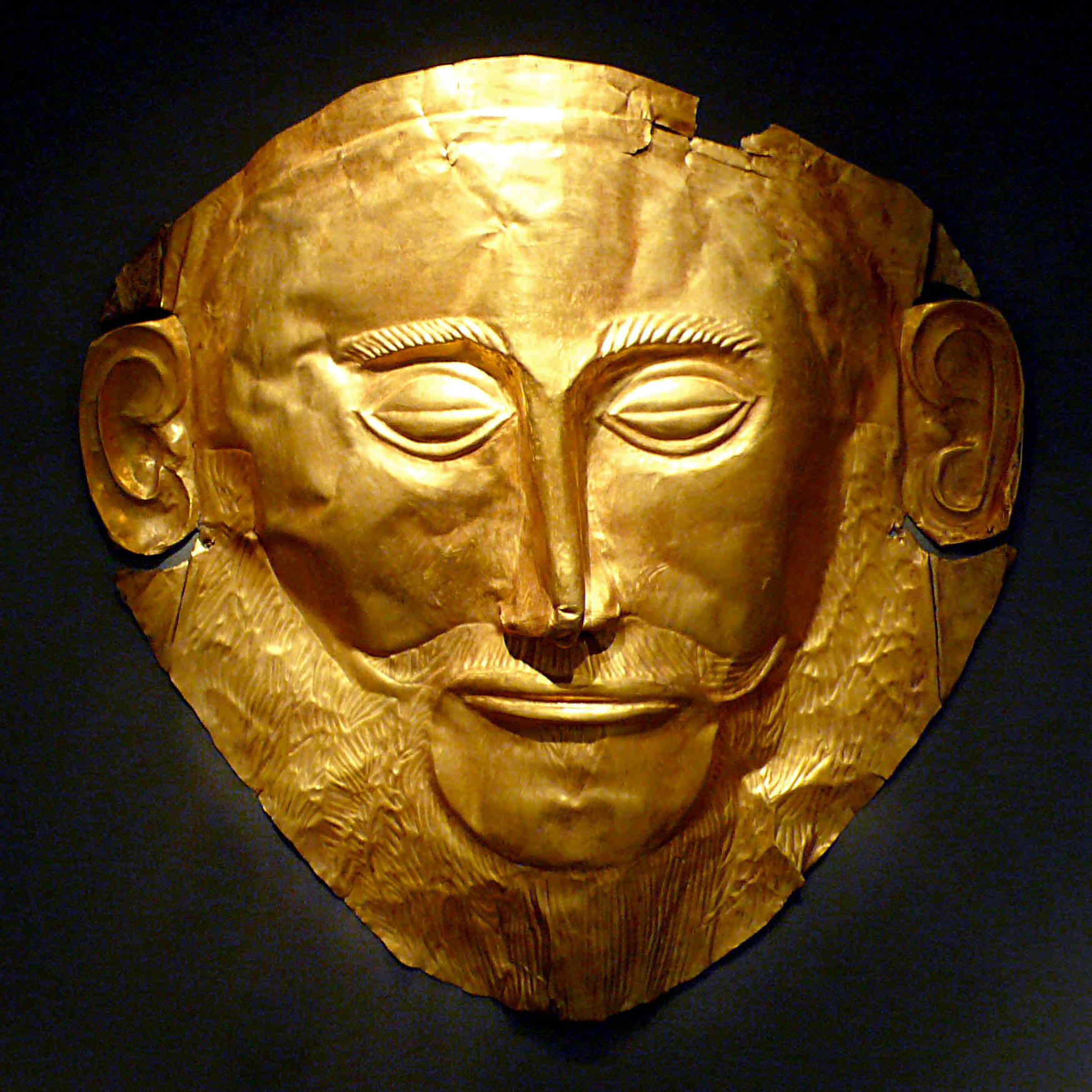
Among them was the celebrated gold face now called the Mask of Agamemnon.
Once again, Schliemann had made an extraordinary discovery.
Once again, the name attached to it was more confident than the evidence allowed.
The mask is usually dated to the sixteenth century BCE, centuries before the conventional period associated with a possible historical Trojan War. There is no secure basis for identifying its owner as Homer’s Agamemnon.
The famous story that Schliemann declared he had gazed upon Agamemnon’s face is itself disputed; it should not be quoted as a verified utterance.
No matter. The name stuck.
There is something magnificent about finding an ancient gold mask and immediately assigning it to one of the most famous kings in Greek literature.
Schliemann had repeated his signature achievement: a genuine archaeological discovery delivered with an imaginative identity attached.
The man was not always wrong about where to dig.
He was rather less dependable about whom he expected to meet there.
13. Was Schliemann a Liar, a Genius, or Just His Own Publicist?
The answer cannot be reduced to one adjective.
Schliemann undoubtedly exaggerated parts of his life and discoveries. His account of Sophia’s participation in the treasure’s discovery is a documented example. His tendency to fit objects into Homeric narratives repeatedly outran what archaeology could establish.
But not every allegation made against him is equally secure.
For decades, some researchers argued that the celebrated hoard was not a single discovery but an artificial assemblage gathered from earlier finds and presented as one dramatic moment. This theory became influential in reassessments of his honesty.
A detailed 2024 study by archaeologist Donald F. Easton, published in Hesperia, revisited the Schliemann papers and concluded that the claim of a subsequently fabricated core hoard lacked concrete evidence. The study distinguished the specific Treasure A1 find from Schliemann’s broader use of the phrase Priam’s Treasure for a larger collection.
That does not resolve every historical debate. It does mean that the old accusation cannot responsibly be repeated as though the matter were closed.
And frankly, the man requires no invented scandal.
His actual record provides enough material for several seasons of a television drama: aggressive digging, dubious attributions, misleading personal stories, secret movement of antiquities and some of the most important discoveries of nineteenth-century archaeology.
He was neither a wholly fraudulent showman nor a flawless founder of scientific excavation.
He was a person whose enormous ability and enormous ego were frequently employed on the same project.
The result was spectacular, productive, destructive and often very well publicized.
14. The Treasure Disappears Again: Berlin, World War II, and Moscow
Schliemann died in 1890, but the objects he had made famous were not finished travelling.
The Trojan collection remained in Berlin for decades. During the Second World War, valuable holdings were moved to protective storage. In 1945, after the defeat of Nazi Germany, Soviet forces transported much of the treasure to the Soviet Union as war booty.
Its exact whereabouts remained unknown to the wider public for many years. In the 1990s, the golden objects were acknowledged to be in Moscow, where they became associated with the Pushkin State Museum of Fine Arts.
Germany has sought their return. Russia has maintained its own position concerning wartime removals. The wider arguments over cultural ownership are historically and legally complex, particularly because the objects had already been removed from Ottoman territory under contested circumstances in the nineteenth century.
Consider the itinerary.
Ancient Anatolia. Ottoman territory. Athens. Berlin. Wartime storage. Moscow.
The so-called treasure of Priam has spent an extraordinary amount of its modern existence demonstrating how determined later civilizations are to claim the possessions of earlier ones.
The old king might have found the whole affair exhausting.
Assuming, of course, that the treasure had belonged to him.
Which it had not.
15. The Man Who Damaged Troy and Made the World Believe in It

Schliemann’s legacy is genuinely difficult to balance.
His destructive trench eliminated evidence that later archaeologists would dearly love to possess. His early recording methods were inadequate. His identifications often confused archaeological chronology with the dramatis personae of Homer.
And yet he helped demonstrate that the legendary geography of the Iliad deserved serious archaeological investigation. He brought attention and resources to a remarkable site, transformed public interest in the Bronze Age and encouraged further inquiry into the civilizations of the Aegean.
Later investigators, particularly Wilhelm Dörpfeld and the archaeologists who followed him, made the stratigraphy of Troy far more understandable. Their work corrected Schliemann’s errors while building on the investigations he had set in motion.
This is the inconvenient lesson of the story.
A person can make an important discovery and explain it badly.
A person can contribute to the development of archaeology while damaging an archaeological site.
A person can sincerely believe in a historical question and then become so attached to a particular answer that contrary evidence feels like a personal insult.
Schliemann was all three.
He helped give Troy a place in modern archaeological scholarship, even as his methods removed portions of the very past he wanted to illuminate.
One could hardly invent a more appropriate hero for a series about respectable disasters.
16. Heinrich Schliemann Didn’t Just Discover Troy. He Invented Heinrich Schliemann.
Perhaps the greatest archaeological object Schliemann ever constructed was not a gold mask, a treasure inventory or a trench through Hisarlik.
It was the figure of Heinrich Schliemann himself.
He built that figure from childhood destiny, self-made wealth, exotic travel, linguistic brilliance, marriage, Homeric obsession, spectacular finds and carefully arranged images.
The resulting character was almost impossible to resist: the businessman who believed in an epic poem, followed it to the earth and brought the lost world of Troy back into public consciousness.
Much of the story was true.
Some of it was misleading.
And almost all of it was excellent publicity.
Frank Calvert had helped identify the site. Local workers had done the physical excavation. Greek and Ottoman authorities had their own roles, objections and interests. Later archaeologists corrected the dates, reconsidered the monuments and clarified what Schliemann’s discoveries actually meant.
But the name on the great public story remained Schliemann.
In the end, he really did find extraordinary things. He found ancient settlements, remarkable treasures and evidence of a world far older and more complex than the familiar Homeric narrative.
He simply preferred to introduce every discovery as though Achilles might be arriving for dinner.
The treasure was real. The archaeology mattered. The destruction was real too.
And the branding was magnificent.
Heinrich Schliemann didn’t just make Troy famous. He made sure Troy made Heinrich Schliemann famous.
Selected sources and further reading
- Staatliche Museen zu Berlin — 150 years since the discovery of Priam’s Treasure
- American School of Classical Studies at Athens — Sophia and Heinrich Schliemann
- Donald F. Easton, “New Light on ‘Priam’s Treasure,’” Hesperia (2024)
- Smithsonian Magazine — The Many Myths of the Man Who Discovered and Nearly Destroyed Troy
- National Geographic — How Heinrich Schliemann Rediscovered Troy—and Then Destroyed It