There are many ways to approach a 4,500-year-old architectural masterpiece.
One might study its proportions, examine its construction, admire the remarkable precision of its masonry, contemplate the civilization responsible for its creation, or simply stand before it in the Egyptian sunlight and experience the increasingly unfashionable emotion known as humility.
Colonel Howard Vyse had another idea.
Gunpowder.
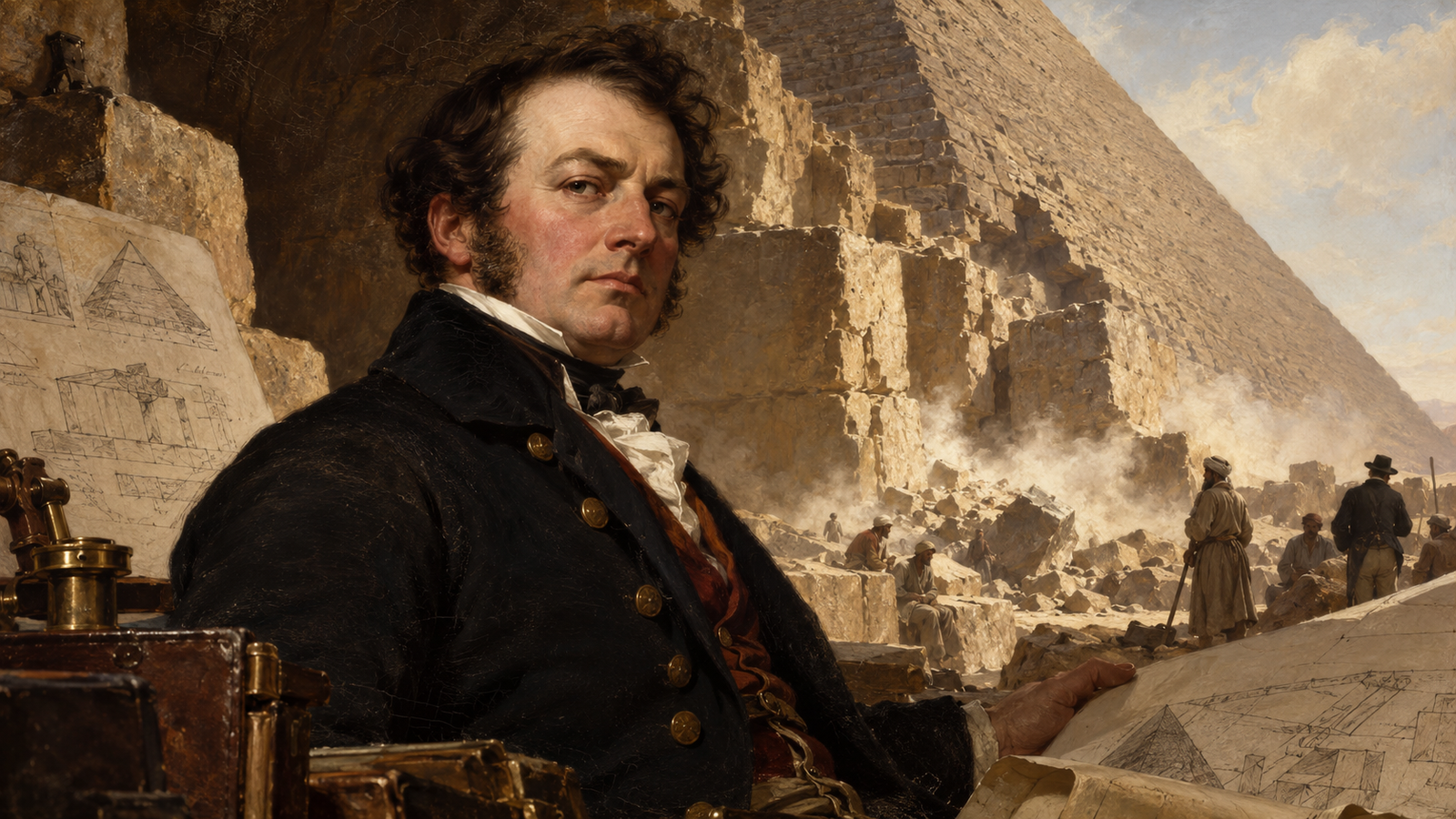
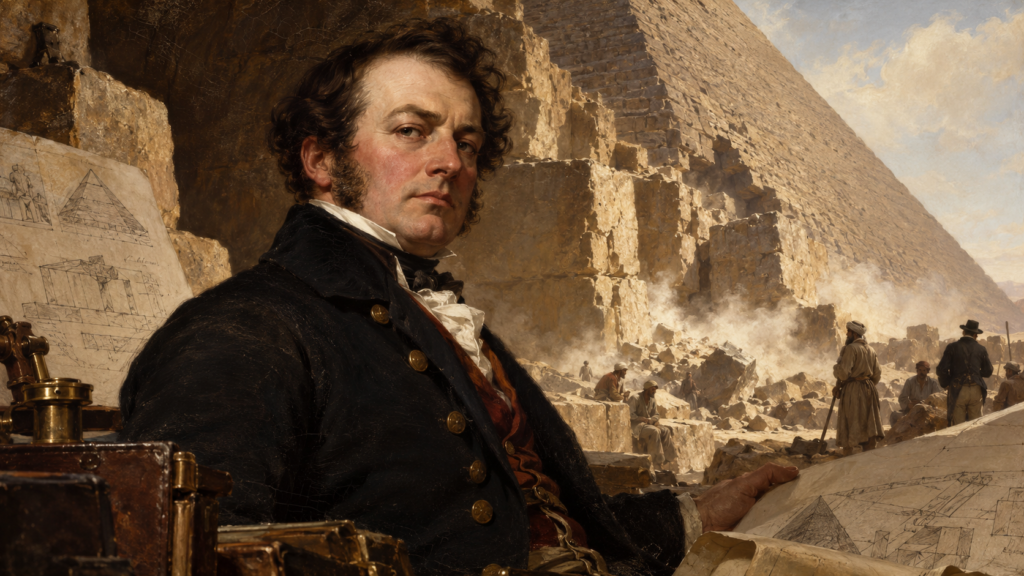
In 1837, the British military officer and antiquarian Richard William Howard Vyse conducted a series of excavations at the pyramids of Giza. His operations involved surveying, tunnelling, drilling, removing masonry and using explosives to penetrate sections of the ancient structures. His most famous achievement was the opening of four previously inaccessible chambers above the King’s Chamber inside the Great Pyramid.
These were not particularly comfortable chambers. They were low, cramped spaces built into the enormous mass of masonry above the royal burial chamber. They contained no glittering treasure, no golden furniture and no convenient collection of objects ready for shipment to London.
They contained something considerably more important.
Ancient marks left by the builders, including inscriptions associated with the name of the pharaoh Khufu.
And so we arrive at one of archaeology’s most irritating historical paradoxes: a man using methods that would be considered destructive by modern conservation standards helped uncover evidence of extraordinary importance for the study of ancient Egypt.
Vyse is therefore a natural addition to our series on adventurers, rogues and other respectable disasters. He was not quite the tomb-smashing entrepreneur Giuseppe Ferlini, nor the colossal strongman Giovanni Battista Belzoni, nor the diplomatic antiquities businessman Bernardino Drovetti.
Vyse represented another species of nineteenth-century trouble.
The determined British officer who encountered a mystery, considered the available options, and apparently concluded that history would benefit from a small explosion.
1. A British Colonel With a Rather Aggressive Sense of Curiosity
Richard William Howard Vyse was born in England in 1784. He came from a military and socially established family, pursued a career in the army and served as a Member of Parliament before developing the interest in Egyptian antiquities that would eventually secure his place in archaeological history.
He was not a penniless wanderer searching for adventure. Nor was he a theatrical performer who had stumbled into antiquities collecting through the unpredictable demands of employment. Vyse possessed rank, resources, connections and that peculiarly nineteenth-century confidence produced when military authority encounters an ancient civilization.
He belonged to a Britain that was expanding its political influence, commercial networks and cultural reach across the world. Egypt, with its monumental remains and the growing prestige of Egyptology, offered a particularly attractive destination for men interested in combining exploration with personal distinction.
By the 1830s, European travellers had been entering Egyptian monuments for generations. Napoleon’s expedition had helped turn Egypt into an intellectual obsession. Scholars were deciphering inscriptions. Artists were publishing lavish books. Collectors were filling museums. And every successful explorer seemed to have another extraordinary discovery to announce.
Vyse entered this world with the habits of a soldier rather than those of a patient antiquarian.
He wanted results.
He wanted them documented.
And, judging from what followed, he was not excessively sentimental about the masonry standing between him and the results.
2. The Great Pyramid Had Survived Four Millennia. Then Came Howard Vyse.

There is something wonderfully disproportionate about the encounter between Vyse and the Great Pyramid.
On one side stood one of the largest and most ambitious stone monuments ever constructed, built for Khufu during Egypt’s Fourth Dynasty. Its massive limestone structure, internal passages and carefully arranged chambers represented the accumulated skill of thousands of ancient workers operating within an extraordinary administrative and engineering system.
On the other side stood a British officer in his early fifties who had developed an increasingly urgent interest in getting inside its unexplored spaces.
It was not exactly a contest of equals.
Yet the pyramid had one considerable disadvantage.
It could not object.
By Vyse’s time, the Great Pyramid had already endured centuries of intrusion, quarrying, exploration, speculation and occasional destructive intervention. The outer casing had largely disappeared. Its passages had been opened, blocked, explored and reopened. Travellers had written about its interior, measured its rooms and offered competing explanations for almost everything.
The structure had become one of humanity’s most famous architectural puzzles.
For Vyse, this was less a reason for caution than an invitation to proceed.
The nineteenth century had developed a remarkable relationship with ancient monuments. The older something was, the more urgently Europeans felt compelled to interfere with it in the name of understanding.
Egypt had been standing perfectly well without them.
But Europe had questions.
And Europe was not famous for taking silence as an answer.
3. Meet Giovanni Caviglia: A Rival, Not a Conservation Officer
Before Vyse began his famous operations, another Italian investigator had been working among the pyramids: Giovanni Battista Caviglia.
Caviglia had considerable experience at Giza. He had cleared passages within the Great Pyramid and conducted excavations around the Sphinx. He knew the monuments, understood the difficulties of working inside them and had developed his own ideas about where further investigations should take place.
When Vyse arrived, Caviglia initially became involved in the operations. But the relationship deteriorated, largely over differences in priorities, methods, authority and the allocation of workers.
It would be pleasant to imagine Caviglia as a sensitive guardian of ancient architecture, standing nobly against a reckless British colonel.
Unfortunately, that would make the story rather too convenient.
Caviglia was himself an early nineteenth-century excavator, a profession that did not yet possess the conservation standards or archaeological methods expected today. The dispute was not a straightforward battle between modern science and barbarism.
It was also a quarrel between ambitious men working within a competitive and imperfectly regulated field.
Vyse became dissatisfied with the pace and direction of Caviglia’s work. Caviglia resisted changes to the operation, while Vyse was determined to redirect labour toward investigations that interested him more directly.
Eventually, Caviglia was removed from the enterprise.
His departure would later become entangled in disagreements over credit, particularly concerning the possibility of hidden spaces above the King’s Chamber.
Nothing reveals the maturity of an emerging discipline quite like two men arguing over who deserved recognition for a room neither of them had built.
4. Enter John Shae Perring: Every Mad Idea Needs an Engineer

Every historical disaster becomes considerably more interesting when someone involved knows what he is doing.
For Vyse, that person was John Shae Perring.
Perring was a civil engineer and surveyor whose technical abilities proved essential to the operations at Giza. He helped examine the structures, prepare measurements and create drawings that remain valuable historical records.
This partnership deserves attention because it complicates the easy caricature of Vyse as a man running around the Great Pyramid with a barrel of gunpowder and a particularly unhealthy smile.
There was real technical work involved.
Surveying the pyramid required precision, persistence and an understanding of complex architecture. Mapping passages and internal spaces was difficult. Identifying the position of cavities within enormous masses of stone demanded observation and reasoning.
The problem was not that Vyse and his associates lacked intelligence.
The problem was that their intelligence operated within an age whose tolerance for invasive methods was considerably greater than ours.
Perring’s drawings transformed the results of these investigations into a visual record that scholars could consult. His publications, including The Pyramids of Gizeh: From Actual Survey and Admeasurement, belong to the foundations of modern pyramid documentation.
So the expedition combined two rather different kinds of confidence.
Vyse supplied the determination to get inside.
Perring helped determine what the inside actually looked like.
It was a productive partnership.
For scholarship, certainly.
For the uninterrupted dignity of ancient masonry, considerably less so.
5. Archaeology, But Make It Explosive
The most notorious feature of Vyse’s work was his use of gunpowder.
Not dynamite, which had not yet been invented, but gunpowder employed in blasting operations to force passages through resistant stone and clear obstructions.
This distinction matters, not because it makes the intervention seem especially delicate, but because history deserves accuracy even when the accurate version is ridiculous enough.
Vyse’s operations involved considerable manual labour, excavation, drilling and the use of explosive charges. The technique was not exclusive to his expedition; blasting had wider applications in engineering, mining and the more forceful approaches to nineteenth-century exploration.
Yet applying it to the Great Pyramid remains an astonishing image.
There is a peculiar logic to it.
If the objective is to penetrate solid masonry, gunpowder is undeniably persuasive. Unfortunately, so is a demolition crew, and neither automatically qualifies as archaeological methodology.
To modern eyes, the method represents an unacceptable risk to a monument of incalculable historical value. Blasting can damage stone, destroy context and permanently alter the very structures being investigated.
For Vyse, however, the immediate objective was clear.
There were spaces to investigate.
There were obstacles.
The obstacles were made of stone.
Something, apparently, had to give.
It would be unfair to claim that Vyse simply tried to blow up the entire Great Pyramid. He did not. His use of explosives was directed toward opening passages and penetrating specific sections of the structure.
But the broader absurdity remains intact.
One of the wonders of the ancient world had become a nineteenth-century engineering problem, and the selected solution included detonations.
Somewhere between archaeology and quarrying, the distinction was having a difficult afternoon.
6. The King’s Chamber Had a Ceiling. Vyse Took That Personally.
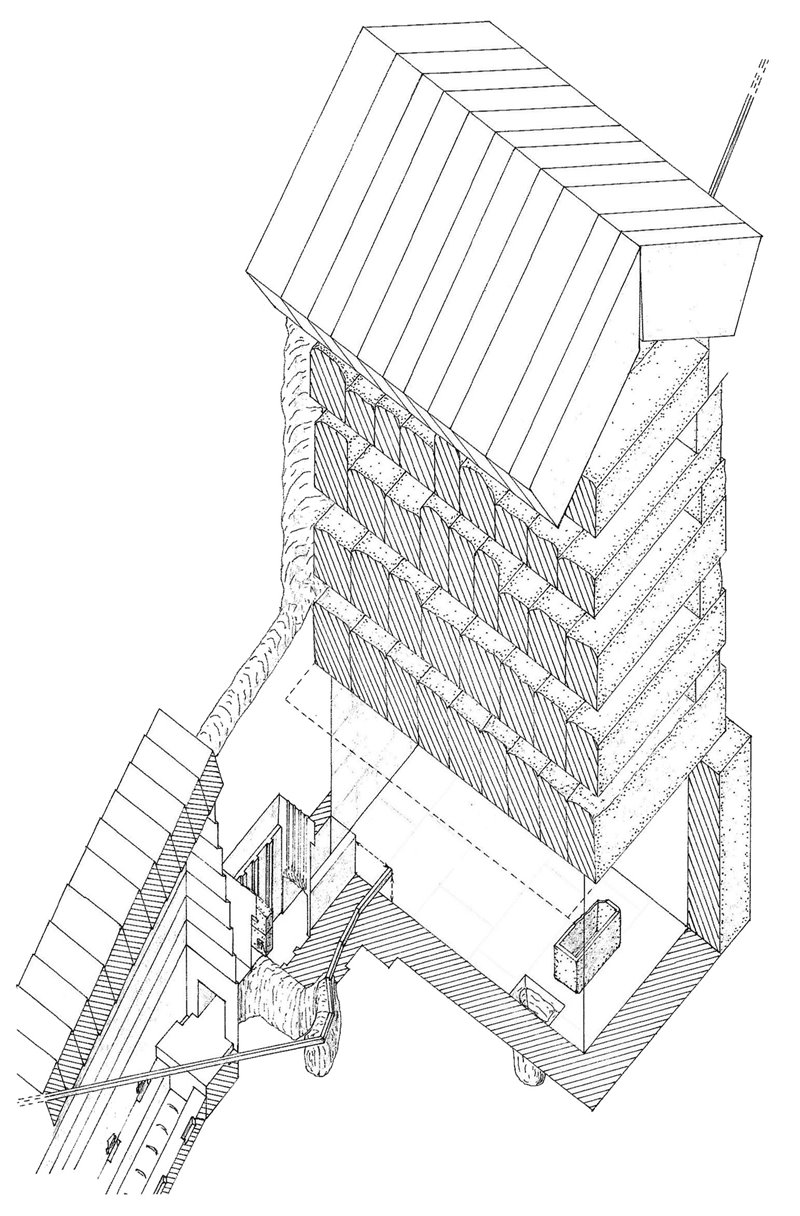
The King’s Chamber lies deep within the Great Pyramid, surrounded by enormous masses of masonry.
Above it is a series of relatively low spaces, separated by immense granite beams and topped by a gabled arrangement of massive stone blocks.
These spaces are generally called the relieving chambers, reflecting their architectural role in managing the loads above the King’s Chamber.
The lowest had been entered long before Vyse arrived.
In the eighteenth century, Nathaniel Davison investigated a cavity above the King’s Chamber that became known as Davison’s Chamber.
The existence of this space raised an obvious question.
Was there anything higher?
Vyse became increasingly interested in the possibility.
Rather than accepting the visible chamber as the final answer, he pursued the spaces above it. Using excavation techniques and blasting, his team opened a route upward through the surrounding masonry.
What followed was a series of discoveries.
On 30 March 1837, the expedition entered the chamber that would be named Wellington’s.
On 25 April, it reached Nelson’s Chamber.
Lady Arbuthnot’s Chamber followed on 6 May.
Finally, on 27 May, the team reached the highest space, Campbell’s Chamber.
Four previously inaccessible chambers had entered the modern archaeological record in less than two months.
They were narrow, awkward and empty of anything resembling a royal treasure.
From a treasure hunter’s perspective, this would have been profoundly disappointing.
From an architectural perspective, it was extraordinary.
The internal structure of the Great Pyramid had become more understandable. The arrangement of granite beams, walls and the upper gabled roof provided important evidence about the design and construction of the King’s Chamber.
For all the absurdity of the method, the discoveries were real.
The Great Pyramid had been made to reveal another part of its anatomy.
It had not volunteered the information.
7. Wellington, Nelson, Lady Arbuthnot and Campbell: Naming Ancient Egypt After Britain
The names of the four chambers deserve a moment of appreciation.
Wellington.
Nelson.
Lady Arbuthnot.
Campbell.
These are not ancient Egyptian names.
They are the names attached to spaces inside a pyramid constructed for Khufu thousands of years before the British Empire existed.
The first two honoured celebrated British military figures: the Duke of Wellington and Admiral Horatio Nelson. Lady Arbuthnot was connected to Vyse’s contemporary social world, while Campbell referred to Colonel Patrick Campbell, a British diplomatic figure in Egypt.
The naming scheme reveals something wonderfully characteristic about nineteenth-century European exploration.
A British expedition enters a previously inaccessible space inside an Egyptian monument and promptly gives it a British name.
There is no particular need for malice here. The convention was familiar in the age of exploration, when newly recorded features were often named after patrons, colleagues, rulers, relatives and prominent national figures.
Yet the absurdity is exquisite.
Imagine spending thousands of years buried within the greatest pyramid on Earth, only to be introduced to the modern world as Nelson’s Chamber.
It is a peculiarly elegant form of historical gatecrashing.
The British did not build the rooms.
They did not design the granite beams.
They had not invented the engineering principles that made the structure possible.
But they had found the entrance.
And apparently that was sufficient to invite Wellington.
8. The Red Marks on the Walls: When Ancient Workers Left Their Signatures

The most historically significant discoveries were not the chambers themselves.
They were the marks on the stones.
Inside the newly opened spaces, the expedition encountered red-painted signs and inscriptions left by the ancient builders.
These were not polished royal declarations meant to impress posterity. They belonged to the practical world of construction: quarry marks, work-gang names and other marks associated with the organization and movement of stone blocks.
This is what makes them so fascinating.
The Great Pyramid is usually encountered as an abstraction of royal power. Its enormous scale, geometrical form and association with a pharaoh encourage us to imagine one monumental act of authority.
But a pyramid is also a construction site that happened to survive for four and a half millennia.
It required workers, supervisors, materials, transport, planning, food, accommodation, administration, communication and an almost unimaginable amount of coordination.
The red marks brought part of that human machinery back into view.
They suggested not the ceremonial world of the finished monument, but the working environment of its creation.
Ordinary markings, placed on blocks during construction, had survived inside spaces that were never intended to become galleries or tourist attractions.
There is something deeply moving about that.
The pharaoh received the pyramid.
His workers left the handwriting.
And, several thousand years later, a British colonel with gunpowder encountered both.
9. Khufu’s Name and the Discovery That Actually Mattered

Among the inscriptions recorded in the newly entered chambers were royal names associated with Khufu, the Egyptian king known to Greek writers as Cheops.
For Egyptology, this was a major development.
The association between the Great Pyramid and Khufu was already known from classical sources, particularly Herodotus. But the discovery of construction-period marks inside the monument provided a different category of evidence.
This was not a Greek historian describing a structure centuries after its creation.
These were ancient marks preserved within the masonry itself.
The presence of the names Khufu and Khnum-Khufu, incorporated into work-gang inscriptions, reinforced the connection between the monument and the Fourth Dynasty ruler.
The discovery also demonstrated the importance of something archaeological treasure hunters rarely appreciated adequately: context.
A royal name painted on a portable fragment is interesting.
A royal name painted on blocks enclosed within the construction spaces of the Great Pyramid is something else entirely.
It belongs to the story of how the building was made.
Which is why the discovery cannot be dismissed merely because its modern discoverer had treated the surrounding masonry with less than ideal tenderness.
The evidence and the method must be evaluated separately.
And that leaves us with a rather uncomfortable conclusion.
Vyse’s work was destructive by modern standards.
Vyse’s work was also historically important.
History, inconsiderately, refuses to make the two statements cancel each other out.
10. The Forgery Conspiracy: Because Apparently Gunpowder Wasn’t Controversial Enough
One might imagine that blasting one’s way into hidden chambers inside the Great Pyramid would be sufficient controversy for a single career.
Apparently not.
Long after Vyse’s death, theories emerged claiming that the inscriptions associated with Khufu had been forged by members of his expedition. These allegations became especially prominent in alternative histories of ancient Egypt, where the Great Pyramid is regularly recruited into arguments involving lost civilizations, mysterious technologies and timelines that disagree rather strongly with conventional Egyptology.
The basic accusation is that Vyse, or someone acting for him, painted the royal names in order to manufacture evidence of a discovery and secure the credit.
It is certainly a dramatic allegation.
It also lacks convincing evidence.
Egyptological scholarship accepts the inscriptions as ancient construction marks. Their forms, locations and relationship to the original masonry are consistent with what is known about Egyptian work crews and building practices.
And the evidence connecting the Great Pyramid with Khufu does not depend solely on these marks.
The discovery of the Wadi al-Jarf papyri, including the famous logbook associated with an official named Merer, provided independent evidence concerning transport operations during Khufu’s reign and work connected with his pyramid complex.
These ancient administrative documents were discovered in the twenty-first century, long after Vyse and his workers had departed the stage.
Unless the colonel had also developed a method of planting evidence across nearly two centuries, the broader historical picture is rather inconvenient for the conspiracy.
The appeal of the forgery story is understandable. Vyse was ambitious, sometimes heavy-handed and operating within a period whose archaeological standards leave much to be desired.
Such a character makes an excellent suspect.
But a good suspect is not the same thing as proof.
One of the more depressing habits of modern culture is its preference for an exciting accusation over a boring body of evidence.
Vyse gave future generations plenty of legitimate reasons to criticize him.
There is no need to invent new ones.
11. The Men Doing the Actual Blasting
Adventure stories have a long and deeply irritating habit of turning collective labour into one man’s achievement.
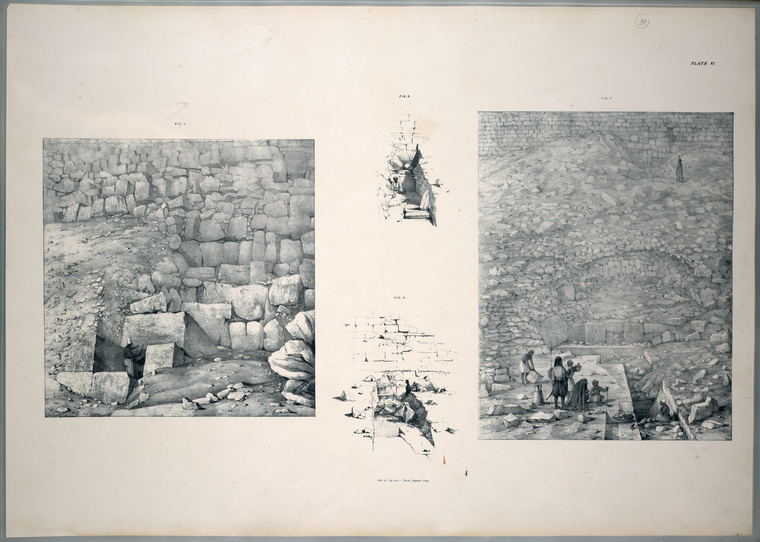
Vyse’s published journal provides an unusually clear reminder that the operations at Giza were performed by many people.
Daily entries recorded the numbers of workers assigned to different parts of the excavation. They documented quarrymen, supervisors, men and children, along with the progress of various investigations.
The work was not simply a colonel issuing orders while a pyramid politely opened itself.
People cleared rubble, transported equipment, prepared access routes, handled stone, worked in confined spaces and faced genuine danger.

Vyse’s journal even records a worker named Daoud, whom he praised for his strength and dedication. During blasting operations at the Second Pyramid, Daoud narrowly escaped serious injury after returning to an explosive charge that had failed to detonate when expected.
It subsequently exploded.
He survived with comparatively minor injuries.
There is an entire history hidden inside that incident.
We remember the name of the colonel.
We remember the chambers he named.
We remember the publication bearing his name.
But the danger was often closest to the men handling the tools.
This does not eliminate Vyse’s role in directing the expedition. Nor does it make his technical and organizational achievements imaginary.
It simply reminds us that archaeological history is full of people whose work became someone else’s biography.
The pyramid was built by collective labour.
Its nineteenth-century investigation was also collective labour.
In both cases, the person receiving the largest share of recognition was unlikely to be the one carrying the heaviest stones.
12. The Archaeological Crime Scene That Became a Reference Book
Vyse’s most lasting achievement was not simply entering the newly opened chambers.
It was recording what he and his team had done.
His multi-volume Operations Carried on at the Pyramids of Gizeh in 1837, published between 1840 and 1842, gathered journals, measurements, observations, plans and descriptions of the investigations.
The work remains a valuable historical source, not because every interpretation in it was correct, but because it preserves information about the state of the monuments and the methods used to explore them.
There is a familiar irony here.
A destructive intervention can produce valuable documentation.
The fact that a method is unacceptable today does not mean the observations made through it are worthless. Equally, the scientific importance of a discovery does not retroactively justify every action used to obtain it.
Both truths must be allowed to exist.
The resulting publication was also a formidable instrument of self-presentation.
Victorian scholarly publishing had an extraordinary talent for taking the messy reality of adventure and transforming it into dignified volumes with elegant typography.
Once printed, the explosions became operations.
The holes became passages.
The discoveries became plates.
The entire affair acquired the sober authority of a book that looked exceptionally respectable on a library shelf.
One can almost hear the gunpowder being converted into footnotes.
13. What He Destroyed, What He Discovered, and the Uncomfortable Balance Sheet
How should we remember Howard Vyse?
It would be easy to present him as a monster with explosives, a man who approached one of humanity’s greatest monuments and behaved with spectacular indifference to its preservation.
It would also be incomplete.
Vyse conducted surveys, documented architectural features, explored multiple monuments and revealed previously inaccessible spaces inside the Great Pyramid. His work, alongside Perring’s, became part of the historical foundation on which later Egyptologists built more precise investigations.
These achievements are real.
So is the damage associated with the methods of the period.
The difficult question is not whether the discoveries were important. They were.
The difficult question is whether their importance can be separated from the risks taken to obtain them.
Modern archaeology generally works from the principle that excavation is an irreversible intervention. Once a layer is removed, once an object is displaced, once a structure is cut open, part of its original context may be lost permanently.
That is why documentation, conservation and the least destructive appropriate methods matter so much.
Vyse worked before many of those principles became standard expectations.
He belongs to an earlier world in which ambition, engineering, curiosity and physical intervention could be almost indistinguishable.
There is no need to pretend we would be better scholars by repeating his methods today.
Nor is there any intellectual advantage in pretending his discoveries never happened.
The useful lesson is more complicated and considerably less comfortable.
Historical knowledge can emerge from actions we would not choose to repeat.
It is a very annoying truth.
And history is full of them.
14. The Great Pyramid Survived. Archaeological Ethics Took a Little Longer.
There is one more reason why Vyse deserves his place among our adventurers and respectable disasters.
He exposes the enormous difference between a civilization’s achievement and the methods later generations used to understand it.
The ancient Egyptians built the Great Pyramid through extraordinary planning, organization, engineering and labour. Their work created a monument that continued to command attention long after the political world that produced it had disappeared.
Vyse arrived thousands of years later with a completely different understanding of what such a monument might offer.
For the builders, it was a royal funerary project constructed within a sophisticated religious and political world.
For Vyse, it was also a challenge to be penetrated, measured and explained.
For nineteenth-century Europe, it was a symbol of antiquity, a source of prestige and an inexhaustible machine for producing speculation.
For modern Egyptology, it remains an archaeological structure whose preservation matters as much as the information it contains.
These interpretations are not identical.
And they do not always coexist comfortably.
Our series has already encountered adventurers who approached the ancient world with equally memorable ideas. Giuseppe Ferlini searched Nubian pyramids for treasure with catastrophic results. Giovanni Battista Belzoni used his remarkable physical abilities to help move colossal Egyptian sculpture and transform antiquities into popular spectacle.
Vyse brought something different.
A soldier’s impatience with obstacles.
An engineer’s confidence in mechanical solutions.
An antiquarian’s desire for discovery.
And a remarkable willingness to employ gunpowder near a monument that had already demonstrated an admirable ability to survive without his assistance.
What makes the story worth telling is that this combination produced both destruction and knowledge.
Not every bad method produces a worthless result.
Not every important discovery makes its discoverer a hero.
And not every man who contributes to history deserves to be trusted with a chisel.
15. Some Men Leave Their Mark on History. Howard Vyse Used Explosives.
Howard Vyse died in 1853, long after his Egyptian adventures had entered the literature of early Egyptology.
The Great Pyramid remained.
The chambers remained.
The red inscriptions remained.
And the nineteenth-century names assigned to those ancient spaces remained, an oddly permanent reminder of the men who had entered them.
Today, the story feels almost impossible to invent.
A British officer enters one of the world’s oldest and most impressive structures, removes masonry, employs explosives, discovers four hidden chambers, records ancient builders’ marks and helps strengthen the historical association between the Great Pyramid and Khufu.
He then publishes the enterprise in respectable scholarly volumes.
Future generations criticize his methods while continuing to study the evidence he uncovered.
And the pyramid, which endured all of this without issuing a single public statement, remains among the most recognizable monuments on Earth.
Perhaps this is the final joke.
Vyse wanted to understand the Great Pyramid.
He did learn something important about it.
But the monument also revealed something about him, his age and the strange European habit of confusing determination with entitlement.
Some men approach eternity with reverence.
Some approach it with questions.
Howard Vyse approached it with questions, workers, engineering equipment and a supply of gunpowder.
To his credit, he found answers.
To the pyramid’s credit, it survived the interview.