Every great civilization eventually attracts a man who believes it would look better in his living room.
Ancient Egypt attracted thousands of them. Soldiers, scholars, artists, consuls, aristocrats, excavators, adventurers, tourists and gentlemen whose professional qualifications consisted largely of possessing a passport, a letter of introduction and a highly developed interest in other people’s property.
Bernardino Drovetti was different.
He did not simply want a souvenir from Egypt. He wanted the collection. Preferably an enormous one. Preferably with statues, mummies, papyri, funerary objects, inscriptions and enough ancient material to make a European monarch consider purchasing the entire enterprise.
And, astonishingly, he succeeded.
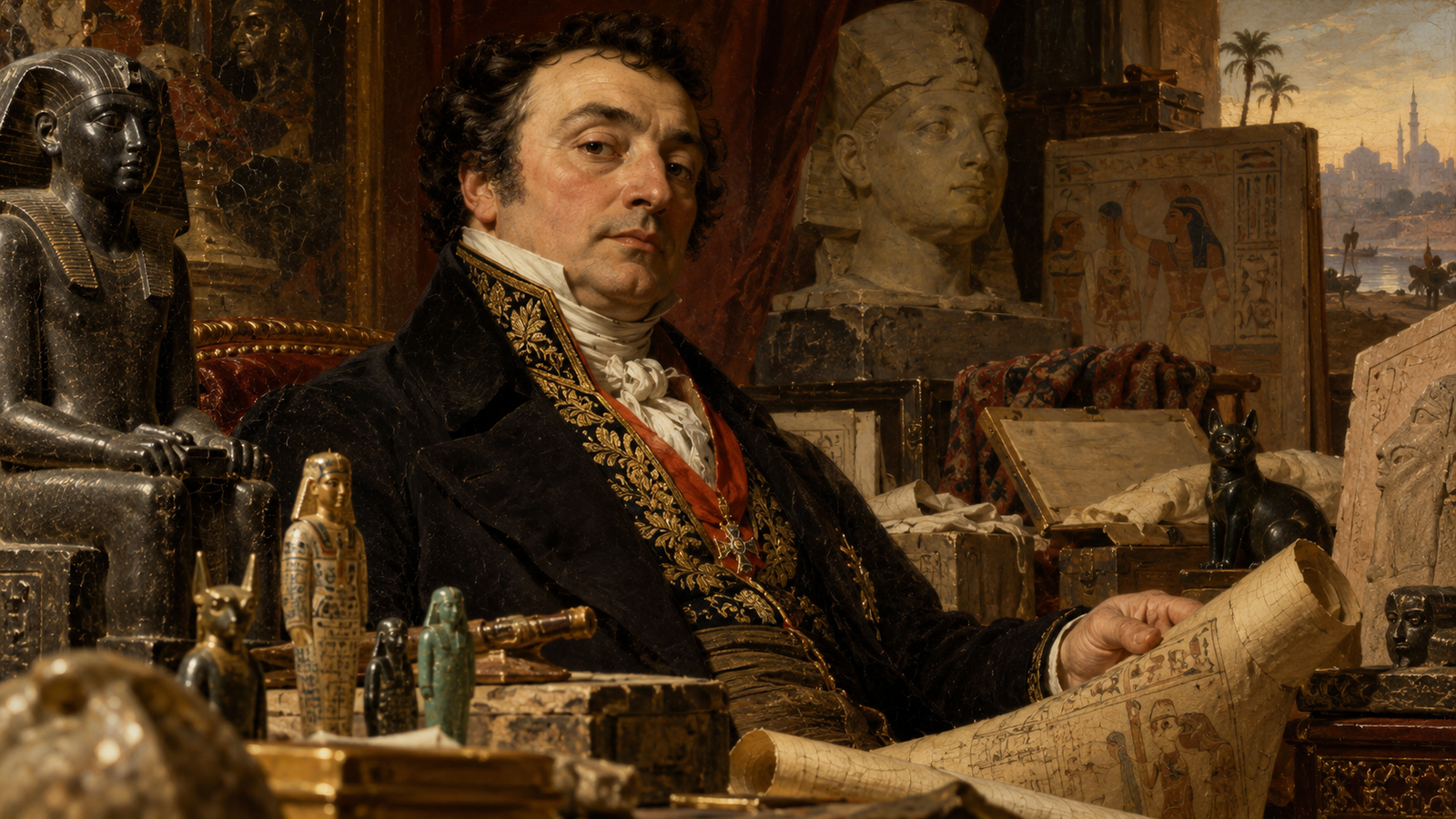
Born in Piedmont in 1776, Drovetti became a soldier in Napoleon’s service, a French diplomatic official in Egypt, an influential political operator and one of the most successful antiquities collectors of the nineteenth century. His activities eventually produced a collection of approximately 8,000 Egyptian objects, purchased by King Carlo Felice of Sardinia for 400,000 lire. In 1824, that acquisition formed the foundation of Turin’s Museo Egizio.
This was a considerable achievement, especially for a man who did not have the inconvenience of being an ancient Egyptian.
Unlike Giuseppe Ferlini, who became notorious for tearing into a Nubian pyramid in search of gold, or Giovanni Battista Belzoni, the former circus strongman who treated monumental archaeology as a particularly demanding weightlifting competition, Drovetti understood that the real money was not necessarily in breaking into the tomb yourself.
The real money was in organizing the business.
He was the administrator of the archaeological appetite, the entrepreneur of ancient death, the respectable gentleman who discovered that diplomatic connections and Egyptian antiquities could make an extraordinarily productive combination.
History remembers him as one of the founders of European Egyptology.
It might also remember him as the man who looked at Egypt and thought: excellent inventory.
## 1. An Italian, a French Consul, and a Very Flexible Sense of Ownership

Bernardino Michele Maria Drovetti was born on 4 January 1776 in Barbania, near Turin. His father was a notary, which is a rather suitable detail for someone whose later career would involve so much paperwork surrounding the movement of ancient property.
He studied law at the University of Turin before joining the French army in 1796. He served during Napoleon’s Italian campaigns, participated in the military world surrounding the rise of Bonaparte, and eventually abandoned the battlefield for a different arena of European ambition.
Diplomacy.
In 1802, Napoleon appointed him to a commercial diplomatic position in Alexandria. Drovetti reached Egypt in 1803, at a moment when the country was emerging from the turmoil of Napoleon’s invasion and entering a new period of political struggle.
He was young, ambitious, multilingual, politically adaptable and very good at understanding where authority was moving.
These were excellent qualifications for a consul.
They were even better qualifications for a man hoping to build an antiquities collection.
Drovetti’s Italian origin and French position made him an interesting hybrid: a Piedmontese serving French interests in an Egyptian political environment shaped by Ottoman authority, British influence and the ambitions of Muhammad Ali.
To outsiders, the arrangement might have looked confusing.
To Drovetti, it looked like opportunity.
He would spend much of the next three decades in Egypt, moving between diplomacy, political influence, exploration and collecting. His career illustrates one of the nineteenth century’s most useful tricks: if you could maintain the appearance of official legitimacy while pursuing private ambition, the two activities might eventually become indistinguishable.
A government appointment was not a treasure map.
But it certainly helped with access.
## 2. Napoleon Leaves Egypt. Drovetti Sees an Opportunity.
When Napoleon invaded Egypt in 1798, he brought soldiers, engineers, scholars, artists and the kind of intellectual ambition that tends to accompany an empire when it wants to describe itself as enlightened.
The invasion failed as a lasting military occupation, but the cultural consequences were enormous.
European fascination with ancient Egypt expanded dramatically. Monuments were recorded, inscriptions copied, objects collected and images circulated. The great publication *Description de l’Égypte* helped transform ancient Egypt into an immense European intellectual and visual obsession.
Art-Sheep has explored this cultural fever in [Egyptomania: When Europe Became Obsessed with Ancient Egypt].
Drovetti entered the scene just as the military adventure was becoming a commercial and scholarly industry.

Bernardino Drovetti and his entourage measuring a colossal Egyptian head. Lithograph after Jean-Pierre Granger, printed by Godefroy Engelmann, 1819. British Museum / Wikimedia Commons.
He understood that Napoleon’s departure did not mean the end of French influence. Nor did it mean that Egypt’s ancient monuments would cease to interest European governments.
Quite the opposite.
Egypt was becoming a competition.
The British wanted antiquities. The French wanted antiquities. Italian collectors and scholars wanted antiquities. Museums wanted antiquities. Kings wanted antiquities. Wealthy private individuals wanted anything sufficiently ancient and sufficiently impressive to make their drawing rooms look historically important.
Drovetti saw a market in which the demand was enormous, the rules were inconsistent and the merchandise had already been manufactured several thousand years earlier.
From a purely entrepreneurial standpoint, it was almost offensively convenient.
The pharaohs had done the hard work.
Europe merely needed to arrange delivery.
## 3. Diplomacy by Day, Treasure Hunting by Appointment

Drovetti was not merely a man who happened to collect antiquities while employed as a consul.
His diplomatic and collecting careers developed alongside one another.
He cultivated relationships with Egyptian authorities, including Muhammad Ali, whose rise to power transformed the political landscape. Drovetti became a significant figure in diplomatic circles, using connections that helped him navigate a country where political influence could determine access, protection and commercial advantage.
This makes him more complicated than the usual image of the reckless treasure hunter.
Ferlini had his tools. Belzoni had his muscles. Drovetti had access to the rooms where decisions were made.
There is a reason organized collecting often proved more successful than isolated adventuring. A single explorer might find a remarkable statue, but a well-connected collector could arrange expeditions, commission excavations, employ agents, store discoveries, negotiate transport and eventually approach a royal buyer.
It was not simply exploration.
It was infrastructure.
We should resist the temptation to imagine Drovetti personally digging through every tomb attached to his name. Much of his collection was acquired through teams and intermediaries. The achievement was collective, although the ownership and eventual glory were considerably more selective.
This is another charming nineteenth-century convention.
One man receives the collection.
Several dozen other men receive the labour.
## 4. The Men Behind the Collection
The romantic image of the European explorer usually includes a solitary figure standing before an enormous ruin, dramatically considering history.
The actual operation involved many more people.
Guides, excavators, local workers, guards, translators, merchants, boatmen and intermediaries performed the practical labour necessary to locate, recover and transport ancient material. Drovetti employed agents who worked particularly in western Thebes, where tombs and ancient settlements offered an extraordinary supply of objects.
Among the figures associated with his collecting network was Antonio Lebolo, an Italian who worked as an excavator in Egypt. Lebolo’s own activities would acquire a curious historical afterlife, particularly through the dispersal of mummies and antiquities into other collections.
Drovetti, meanwhile, operated at a level above the individual excavation.
He organized, commissioned, acquired and accumulated.
His enterprise reminds us that archaeology did not suddenly become industrial when modern institutions appeared. Its early commercial forms already possessed many of the characteristics of an industry: specialization, logistical networks, agents, storage, buyers and international competition.
The difference is that the industry was selling objects that had once belonged to living cultures and funerary worlds.
Ancient Egypt had not created its tombs with nineteenth-century European distribution in mind.
But nobody seems to have asked the procurement department.
## 5. Bernardino Drovetti vs. Henry Salt: The Great European Shopping War
No great commercial enterprise is complete without a rival who believes he has an equal right to the merchandise.
For Drovetti, that rival was the British collecting network associated with Henry Salt, the British consul in Egypt.
Salt employed Giovanni Battista Belzoni, whose extraordinary physical strength, mechanical ingenuity and talent for difficult excavation made him a valuable agent in the competition for antiquities.
Drovetti had influence and a collecting organization.
Salt had diplomatic power and Belzoni.
Egypt, unfortunately, had the objects.
The rivalry became fierce. Europeans competed over access to excavation sites, permission to remove antiquities and the acquisition of particular objects. What later generations might describe in scholarly language as the formation of collections was, on the ground, frequently a contest involving personalities, money, status and personal resentment.
The competition was especially absurd because all parties claimed to be acting in the interest of knowledge.
That may have been partly true.
But knowledge was behaving suspiciously like a competitive export business.
The great museums of Europe were emerging as symbols of national prestige. An Egyptian statue was not only an ancient work of art. It was a trophy, a demonstration of diplomatic influence and a valuable addition to the cultural arsenal of a state.
The British wanted to possess Egypt in London.
The French preferred Paris.
Drovetti eventually helped Turin join the argument.
It was an international dispute conducted through monuments, correspondence and shipping arrangements.
Very civilized.
## 6. Enter Giovanni Belzoni: When Archaeological Rivalry Required Pistols
Here the story becomes considerably more entertaining.
According to the Fitzwilliam Museum, the rivalry between Drovetti and Belzoni became so heated that, on one occasion, men working for Drovetti threatened Belzoni and his party with firearms.
Let us appreciate the situation.
Two European collecting operations in Egypt, each ostensibly devoted to recovering the magnificence of an ancient civilization, had reached the point at which someone considered introducing pistols into the scholarly conversation.
This is a wonderful scene, provided one was not standing in the direction of the barrels.
And the relationship had not always been hostile.
Drovetti had previously drawn Belzoni’s attention to the enormous granite coffin lid of Ramesses III. Belzoni subsequently succeeded in moving it, later claiming the lid for himself. It would eventually enter the collection of the Fitzwilliam Museum in Cambridge.
There was no shortage of personal ambition.
Belzoni was physically dramatic, notoriously self-promoting and deeply conscious of his achievements. Drovetti was influential, experienced and capable of operating within a formidable diplomatic network.
These were not men ideally suited to sharing.
The conflict exposes the uncomfortable reality beneath the heroic stories of early Egyptology. The men who described themselves as explorers were also competitors in a market. Their rivalries concerned not merely interpretation but possession.
Who had permission?
Who reached the site first?
Who employed the workers?
Who could remove the object?
Who would receive credit?
And, eventually, whose museum would get the statue?
The ancient Egyptians, having been dead for some considerable time, were regrettably unavailable to adjudicate.
Belzoni’s own adventures belong to another chapter of this wonderfully disreputable age, explored in Art-Sheep’s [Giovanni Battista Belzoni: The Circus Strongman Who Dragged Egypt Into Europe](https://art-sheep.com/giovanni-battista-belzoni-the-circus-strongman-who-dragged-egypt-into-europe/).
Drovetti’s advantage was that he did not need to win every individual confrontation.
He was building something larger than a single spectacular discovery.
He was building inventory.
## 7. Eight Thousand Antiquities and the Remarkable Absence of Restraint

By the early 1820s, Drovetti had assembled a collection estimated at approximately 8,000 Egyptian antiquities.
Eight thousand.
There is collecting, and then there is developing what appears to be a private distribution centre for the ancient world.
The collection contained major statues, smaller sculptures, mummies, papyri, funerary objects and everyday material. Its importance was not simply a matter of quantity. Some of the objects were exceptional works of Egyptian art and invaluable historical documents.
The collection included royal sculpture from the New Kingdom, material from Thebes, funerary manuscripts and records that would later contribute to the developing science of Egyptology.
And this is where Drovetti becomes unexpectedly interesting.
He did not collect only the largest or most obviously lucrative objects. His holdings also contained material associated with ordinary life, administration, writing and the practical operation of Egyptian society.
This wider interest distinguished the collection from a simple warehouse of decorative masterpieces.
It suggested at least an emerging awareness that ancient Egypt was a civilization to be studied, not merely a supply of impressive stone faces.
Of course, it also meant that the warehouse contained even more objects.
One need not choose between intellectual curiosity and commercial ambition when one has sufficient storage capacity.
Drovetti was apparently quite comfortable with both.
## 8. The Papyrus Problem: Ancient Egypt Came With Paperwork

Among the extraordinary documents associated with the Drovetti collection was the Turin King List, also known as the Royal Canon of Turin.
This damaged papyrus contains a list of ancient Egyptian rulers and became a document of considerable importance for reconstructing Egyptian chronology.
The irony is almost too refined.
A collector operating within the chaotic antiquities market helped preserve a document through which scholars would attempt to impose order on thousands of years of royal succession.
One man accumulated objects.
Another generation tried to make sense of them.
The papyrus survived in fragments, and its reconstruction became a long scholarly undertaking. It remains a reminder that the most valuable object in a collection is not always the one that requires the strongest men to lift it.
Sometimes the real treasure is a ruined piece of paper.
This is perhaps the moment at which Drovetti’s activities become more intellectually significant than their commercial origins might suggest.
His collection did not merely furnish a museum. It supplied material with which scholars could investigate language, chronology, religion and administration.
Not every acquisition was a colossal statue waiting to impress a king.
Some were documents waiting to embarrass historians.
And a few were both beautiful and almost unbearably informative.
## 9. The Ancient Gold Map That Took a Very Modern Journey

Another remarkable acquisition was the Turin Goldmine Papyrus, an ancient Egyptian map showing the Wadi Hammamat region and its mineral resources.
Created during the Ramesside period, the document depicts mountains, routes, settlements and areas associated with quarrying and gold extraction. It is among the earliest known maps to represent geological distinctions.
Drovetti acquired it in Egypt sometime between approximately 1814 and 1821. It subsequently passed into the royal collection purchased for Turin.
There is an irony here that deserves its own small monument.
The man who spent years accumulating the riches of ancient Egypt also acquired an ancient Egyptian map indicating where gold could be found.
One imagines him appreciating the professional relevance.
Yet the papyrus is much more than a curiosity. It reveals the sophistication of Egyptian geographical and practical knowledge. Its annotations distinguish mineral areas, routes and structures, demonstrating a degree of observational precision rarely acknowledged in popular fantasies about ancient civilization.
It is a document produced not for modern admiration, but for practical use.
The ancient Egyptians were not drawing maps to entertain European collectors.
They were organizing work.
Drovetti, in his own strange way, was doing much the same thing.
The difference was the ownership of the results.
## 10. The Most Expensive Garage Sale in Egyptian History
Eventually, the collecting enterprise required a buyer.
Accumulating thousands of antiquities was one thing. Storing, transporting and monetizing them was quite another.
Drovetti began negotiating the sale of his collection to European buyers. France was interested. Britain represented another possible market. But negotiations with the Kingdom of Sardinia ultimately proved decisive.
The price was extraordinary: **400,000 lire**.
King Carlo Felice agreed to the proposed sum in 1820, although the transaction itself involved further negotiations and documentation before its completion in January 1824.
The State Archives of Turin preserve the paperwork surrounding the agreement, including a document by which Drovetti authorized Domenico Pedemonte to negotiate the sale on his behalf.
This is the point where adventure becomes administration.
After years of excavations, collecting, diplomatic maneuvering and international competition, the great enterprise concluded not with a dramatic chase through a temple but with contracts, signatures, payments and transportation arrangements.
One suspects Drovetti found this entirely satisfactory.
Carlo Felice, meanwhile, understood the cultural and political value of the acquisition. The collection promised to enrich Turin, attract scholars and visitors, and secure for the Savoy monarchy a prominent position within Europe’s developing fascination with Egypt.
There was a patriotic dimension to the sale as well. Drovetti was Piedmontese, and some of those advocating the purchase believed it appropriate that his extraordinary collection should remain connected to his homeland.
It was a beautiful piece of national reasoning.
Egyptian antiquities would become Italian cultural prestige because the collector happened to be from Piedmont.
Geography can be wonderfully accommodating when royalty is involved.
## 11. Getting the Pharaohs to Turin Was Not Particularly Easy
The acquisition of a civilization is generally presented as an intellectual achievement.
Transporting several tons of ancient sculpture across Europe is a different problem.
After years of storage and negotiations, the Drovetti collection began moving toward Turin in shipments that passed through Italian ports and overland routes.
The logistical difficulties were considerable.
The State Archives of Turin record military wagons, delays, shortages of horses, disputes over equipment and roads that were not particularly enthusiastic about accommodating colossal Egyptian statues.
In October 1824, the collapse of a bridge over the Bormida forced those responsible for transporting one Egyptian colossus to arrange passage over a specially constructed bridge of boats.
Consider the scene.
An ancient Egyptian monument, created for an entirely different world, was being transported through nineteenth-century Piedmont while local officials tried to work out how to get it across a river.
Somewhere, a man was worried about horses.
Another was worried about loading equipment.
A third was probably worried about the bill.
The pharaoh, being made of stone, maintained an admirable silence.
This is the detail that makes the entire story feel almost cinematic. European museums are often described as temples of knowledge, but their origins sometimes resemble the administrative nightmare of moving an exceptionally heavy house.
And the paperwork survives.
Which is fortunate, because the paperwork is sometimes funnier than the adventure.

## 12. Four Hundred Thousand Lire Later, a Museum Is Born
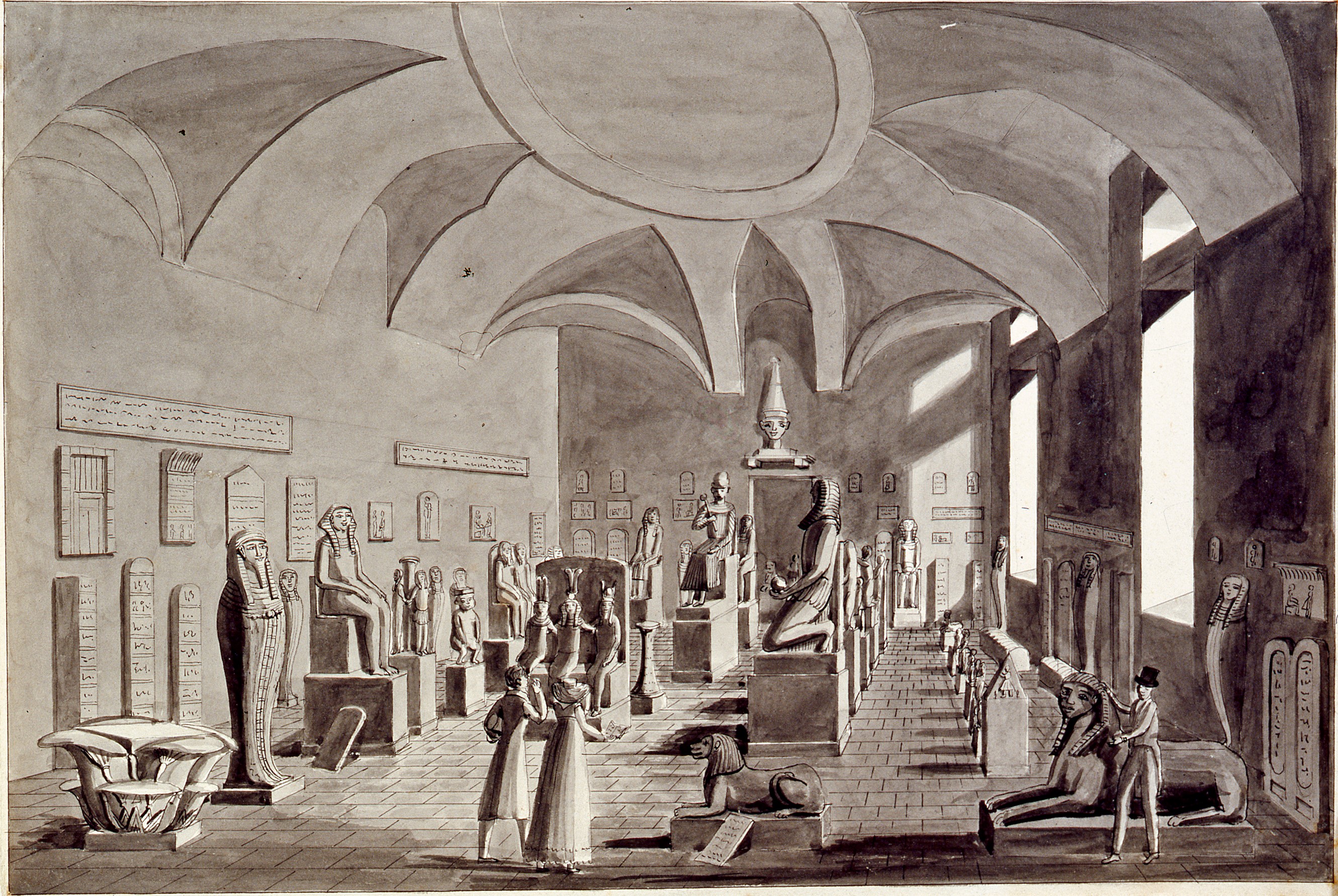
In 1824, Turin’s Museo Egizio was founded around the acquisition of Drovetti’s collection, becoming the first museum devoted entirely to ancient Egyptian civilization.
It would open to the public in 1832, following the enormous task of organizing the objects and adapting the building in which they were displayed.
The transformation was extraordinary.
What had been a private collecting operation, assembled in Egypt through a complicated network of agents, excavations and acquisitions, became the foundation of a European institution.
Stone moved from ancient landscapes into display rooms.
Papyri entered catalogues.
Funerary objects became scholarly materials.
Mummies, once participants in religious practices centered on the afterlife, became subjects of modern classification.
Everything received a new institutional identity.
The process was not without intellectual value. The objects could now be conserved, studied and compared within a growing scholarly community. Their presence would help establish Turin as one of the most important centres of Egyptology.
But the transformation also required an extraordinary change in perspective.
The collection had originated in Egypt.
Its prestige now belonged to Turin.
This was a familiar nineteenth-century arrangement, and one that European institutions became extremely skilled at explaining in dignified language.
The museum was magnificent.
Its origin story was rather less tidy.
## 13. Champollion Arrives, and the Warehouse Becomes Scholarship
The arrival of Jean-François Champollion in Turin in June 1824 added another remarkable character to the story.
Champollion had announced his breakthrough in deciphering Egyptian hieroglyphs in 1822. His ability to read the ancient language was helping transform Egyptian antiquities from mysterious objects into historical evidence.
The Drovetti collection offered him an extraordinary scholarly opportunity.
But the museum was still in the process of becoming a museum.
According to correspondence preserved by the State Archives of Turin, Champollion offered advice on the conservation and organization of the material. He was dissatisfied with aspects of the arrangement and clashed with Giulio Cordero di San Quintino, who was responsible for overseeing the new collection.
The scholar wanted access.
The custodian wanted control.
The antiquities, as usual, were caught between two men who believed they knew what was best for them.
At one point, Champollion even requested permission to take objects home for study if necessary. The suggestion was not welcomed.
This is an almost perfect illustration of the awkward birth of modern scholarship.
A collection assembled through competitive nineteenth-century antiquities acquisition had become a museum, and the first great scholars to examine it were already arguing about access.
The looting age had begun to give way to the cataloguing age.
There would be fewer pistols, perhaps.
But certainly no shortage of egos.
## 14. The Museum Afterlife: Egypt, Perfectly Arranged

The Museo Egizio eventually became one of the world’s most distinguished institutions dedicated to ancient Egyptian civilization.
Its collections expanded far beyond Drovetti’s original acquisition. Excavations, purchases, research and conservation projects transformed it into a major international centre of scholarship.
Today, its galleries offer a carefully designed encounter with Egyptian art, architecture, religion and everyday life.
The statues are arranged beautifully.
The lighting is sophisticated.
The objects are studied by specialists.
The museum is serious, respected and deservedly celebrated.
It is also the descendant of a deeply strange moment in European history, when private ambition, royal prestige, diplomatic influence and the desire to possess the ancient world converged in a single collection.
To acknowledge this is not to diminish the museum.
It is to make the museum more interesting.
The history of collecting is part of the history of the collected objects, whether institutions are comfortable with it or not.
And the Drovetti story is unusually revealing because the private collector stands so clearly at the center of the transition.
The man acquired.
The monarch purchased.
The scholars interpreted.
The museum preserved.
Each participant helped produce the institution, but each operated according to a different understanding of what ancient Egypt was for.
For Drovetti, it was also an opportunity.
A rather successful one.
## 15. The Gentleman’s Guide to Turning Other People’s History Into National Prestige
There is a temptation to make Drovetti into a simple villain.
It would be convenient, and it would fit the tone of the story rather nicely. A French consul assembling thousands of Egyptian antiquities and selling them to a European king is hardly a scenario that requires much help from a satirist.
But he was more than a caricature.
Drovetti was a capable diplomat, an influential political figure, an organizer, a collector with a genuine interest in Egyptian civilization and a man whose activities helped preserve objects that became fundamental to scholarship.
He was also deeply involved in an antiquities market whose methods raise serious questions about ownership, excavation practices, removal and the treatment of archaeological contexts.
These realities existed together.
That is what makes him worth writing about.
He belonged to an age when the boundaries between collector, scholar, merchant, explorer and opportunist were often almost invisible. Objects passed through networks of excavation, sale, diplomacy and patronage. The result could be a magnificent museum, even when the process was considerably less magnificent.
And there is another final complication.
Drovetti did not retire after selling his great collection to Turin. He assembled further antiquities and sold another collection to the Louvre in 1827.
One might describe this as admirable professional consistency.
The first museum had barely begun organizing its holdings, and Drovetti was already doing further business.
Some men have a passion for history.
Others discover a recurring revenue model.
## 16. Drovetti Didn’t Need to Rob a Tomb. He Had a Business Model.
Bernardino Drovetti died in Turin in 1852, having lived long enough to see the collection that made his name become an institution of international significance.
He had served Napoleon and later the restored French monarchy. He had participated in the politics of Egypt, competed in the antiquities market, built connections, organized collecting operations and sold a remarkable collection to a European king.
There was nothing particularly modest about his career.
And yet, compared with some of his contemporaries, Drovetti can seem almost disappointingly civilized.
Ferlini smashed his way into the archaeological record.
Belzoni hauled colossal stone across the desert and performed ancient Egypt for London audiences.
Drovetti negotiated.
He made collecting systematic. He made antiquities available in quantities that required warehouses, inventories and military wagons. He understood that the growing European fascination with Egypt was not merely an intellectual phenomenon.
It was also a market.
The objects he collected became the foundation of one of the world’s most important Egyptian museums. Their scholarly value is immense. Their history of acquisition remains inseparable from the political and commercial structures of the early nineteenth century.
This is precisely why he belongs in *Adventurers, Rogues and Other Respectable Disasters*.
Not because he was the loudest, the strongest or the most theatrically destructive character in the story.
But because he understood something that many adventurers never quite grasped.
Why risk everything searching for one treasure when you could organize an entire supply chain?
Why fight over a single statue when you could accumulate thousands of objects?
Why become famous for one dramatic discovery when you could persuade a king to buy the collection?
Drovetti did not simply collect Egypt like furniture.
He managed to convince Europe that it urgently needed a much larger house.
And, somewhere in Turin, eight thousand ancient objects began their second lives.
The invoice, naturally, was very respectable.