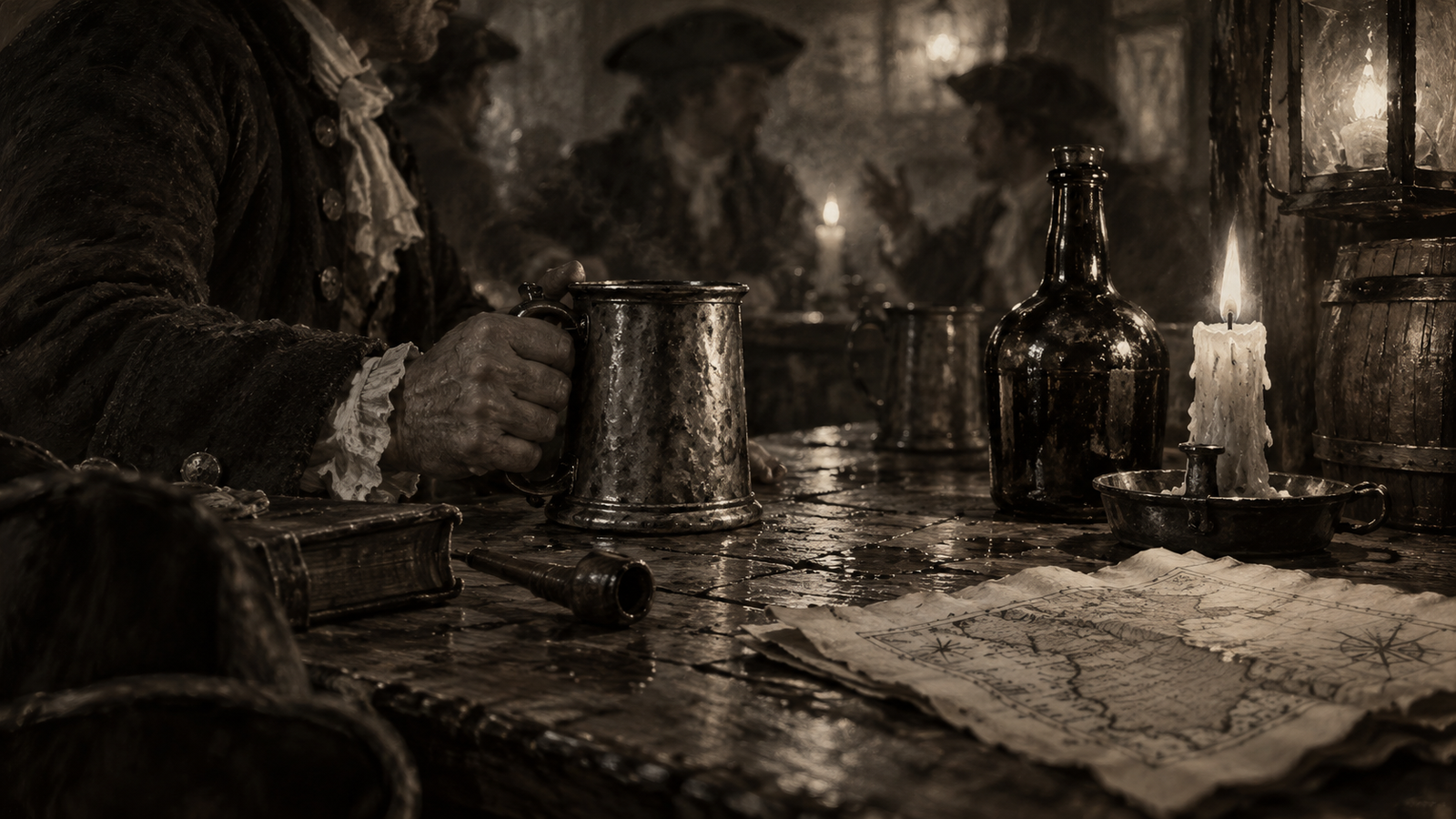
Imagery of a colonial tavern scene.
Long before coffee shops and neighborhood pubs became everyday gathering places, colonial taverns served as the heart of American public life. From the bustling port of Annapolis to the revolutionary streets of Williamsburg, taverns offered more than food and lodging. They became meeting places where news traveled quickly, business deals took shape, and revolutionary ideas gained momentum.
But taverns also had a more unsettling side. Late-night revelry, dangerous journeys, and centuries of human drama left behind stories that continue to intrigue visitors. According to local legends, some historic gathering places may still have a few lingering guests who never quite checked out.
Today, these historic taverns offer a fascinating glimpse into America’s early years. Their stories reveal how ordinary social spaces helped shape an extraordinary nation, while their darker legends add another layer of intrigue. The best way to learn about these taverns is to go on a guided ghost tour throughout colonial cities. US Ghost Adventures dives into the associated history and local legends of notorious taverns.
WHAT ARE SOME HISTORIC TAVERNS THROUGHOUT AMERICA?
From revolutionary meeting places to lively colonial inns, historic taverns played a remarkable role in shaping America’s identity. Many welcomed influential visitors and witnessed major political developments. Some still stand today, while others survive through reconstructed buildings and museum exhibits.
Here are three fascinating places to start exploring:
- City Tavern in Philadelphia, where political leaders gathered during the nation’s founding.
- Gadsby’s Tavern in Alexandria, where the young nation’s political and social elite came together.
- King’s Arms Tavern in Williamsburg, where revolutionary tensions simmered alongside everyday colonial life.
City Tavern: Where America’s Founders Broke Bread
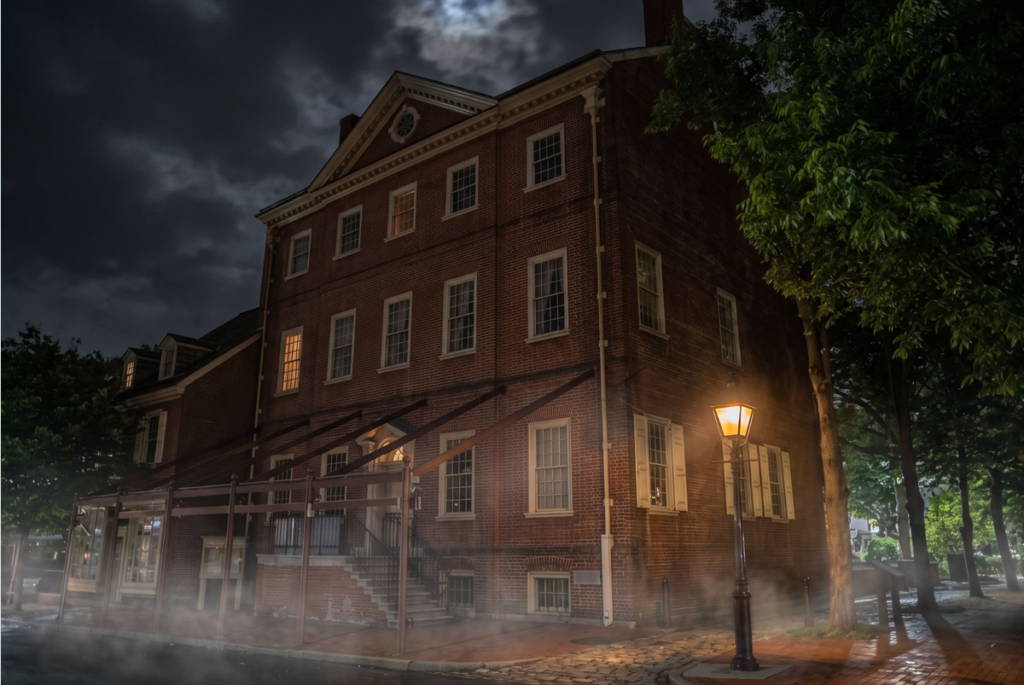
City Tavern at night.
Few taverns can claim a place in America’s founding story quite like Philadelphia’s City Tavern.
Opened in 1773, this impressive gathering place welcomed merchants, politicians, and visitors to the city at a time when tensions between Britain and its American colonies were reaching a boiling point.
City Tavern became a favorite meeting place for members of the Second Continental Congress, who gathered in Philadelphia to debate the colonies’ future.
In 1787, delegates to the Constitutional Convention visited after working on the new framework of government, making the tavern part of the social world surrounding the nation’s founding.
The original building was demolished in 1854, and the reconstructed structure dates to 1975. Although City Tavern is no longer an operating restaurant, its historic site remains part of Independence National Historical Park.
But some prior patrons may still remain. Local legends tell of a bride whose wedding dress caught fire during a celebration and whose spirit reportedly remains in the building. Other stories describe a former waiter who died in a duel and is said to reenact his final moments.
For those exploring Philadelphia’s colonial past, City Tavern illustrates how a place to eat and drink could become an important backdrop to political change.
The Horse You Came In On Saloon: Baltimore’s Legendary Last Call
In Baltimore’s historic Fell’s Point neighborhood, The Horse You Came In On Saloon has welcomed patrons for generations.
The establishment traces its roots to 1775, when taverns served the sailors, shipbuilders, merchants, and travelers of Baltimore’s busy waterfront. With its location near the harbor, the saloon became part of a neighborhood where news traveled over drinks and strangers from distant ports crossed paths.
Today, it’s widely known as one of America’s oldest continuously operating saloons. But the saloon’s most famous story involves a literary legend.
According to local lore, Edgar Allan Poe stopped here for his last drink before his mysterious death in October 1849. Poe was found gravely ill in Baltimore and died four days later.
There is no conclusive evidence that this particular saloon was his final stop. Even so, the tale has become part of the establishment’s identity, and a seat marked “Poe’s Last Stop” invites curious visitors to imagine the troubled writer sitting down for one final drink.
The Poe legend doesn’t end with his supposed final visit. Staff and visitors have reportedly witnessed strange activity inside the saloon, including cash registers opening on their own and chandeliers swinging without an obvious cause.
Some believe Poe’s ghost still returns to his supposed favorite watering hole, and staff have reportedly left a glass of whiskey out for him after closing time.
Whether these stories reflect a lingering presence or the power of a good local legend, The Horse You Came In On offers a memorable blend of Baltimore history and eerie intrigue.
Gadsby’s Tavern: A Gathering Place for a Young Nation
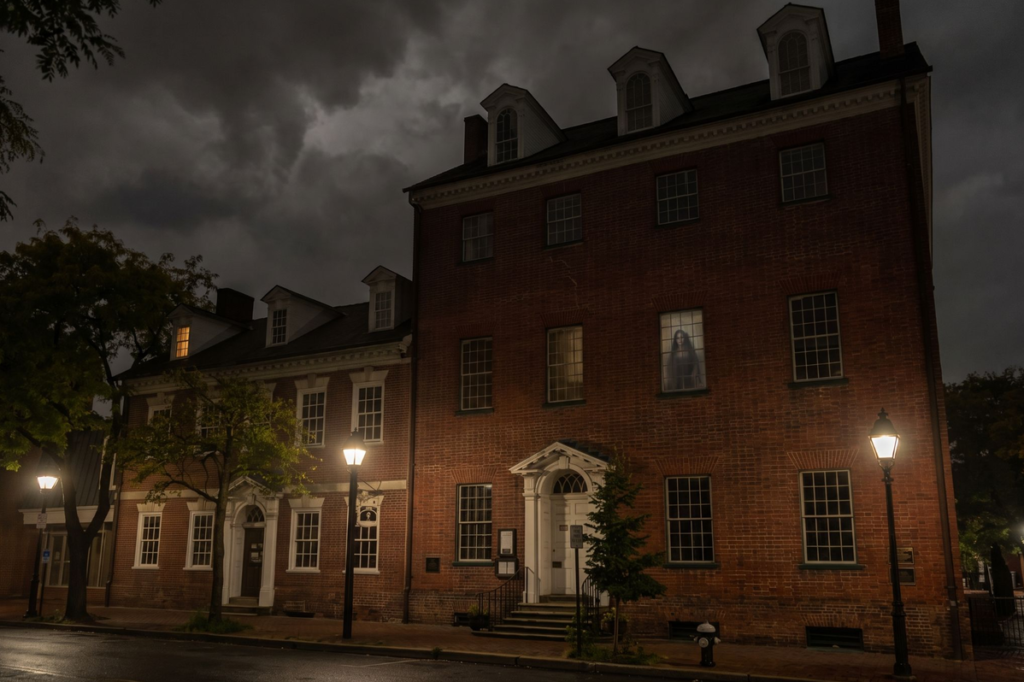
Veiled figure peering out from a window at Gadsby’s Tavern.
Just outside the nation’s capital, Gadsby’s Tavern in Alexandria preserves a remarkable chapter of early American life. The museum includes two historic buildings: a tavern dating to around 1785 and the City Tavern and Hotel, built in 1792.
Englishman John Gadsby operated the businesses from 1796 to 1808, when Alexandria’s waterfront trade made the city an important commercial center. The tavern offered meals, lodging, and entertainment to travelers and prominent guests, including George and Martha Washington, Thomas Jefferson, and the Marquis de Lafayette.
One of its most memorable traditions was the Birthnight Ball. Washington celebrated his birthday at the tavern in 1798 and 1799, bringing a touch of national prestige to the lively social scene.
These historic legacies are not the only thing Gadsby’s Tavern is known for. The tavern is associated with the legend of the Female Stranger, a mysterious woman who died at the property in 1816 without her identity being publicly established.
Buried beneath a tombstone identifying her only as a stranger, she became the subject of stories about a veiled figure appearing near the windows and unexplained crying. Since her true identity remains a mystery, she is one of Alexandria’s most enduring ghostly legends.
For visitors exploring the DC area, Gadsby’s Tavern Museum is a reminder that America’s story was shaped not just in government buildings, but also in the social spaces where people gathered to eat, celebrate, conduct business, and debate the future.
Middleton’s Tavern: Annapolis’s Gateway for Seafarers
With its waterfront setting and busy colonial harbor, Annapolis depended on taverns to welcome sailors, merchants, and travelers arriving by land and sea. Middleton’s Tavern became one of the city’s enduring landmarks and offers a window into the commercial life that helped Annapolis flourish.

The property’s history stretches back to the first half of the eighteenth century.
In 1743, Horatio Middleton rented the property, and in 1750, he purchased it and called the establishment an “Inn for Seafaring Men.” The name captured its practical purpose: providing a place for people connected to maritime trade to eat, rest, exchange news, and find lodging.
Its location also placed it close to the civic life of Annapolis, a city that became Maryland’s capital in the seventeenth century and later played a role in the nation’s founding era. The tavern’s story helps explain how local businesses supported a growing colonial city by serving the people whose work kept its economy moving.
Middleton’s Tavern remains an important part of Annapolis’s historic landscape, but it’s also part of the city’s spectral side. Local stories describe a ghostly figure named Roland. Workers and visitors have reportedly seen a man dressed in Revolutionary-era clothing and noticed cigar smoke near the upper balcony without an obvious source.
King’s Arms Tavern: The Social Heart of Williamsburg
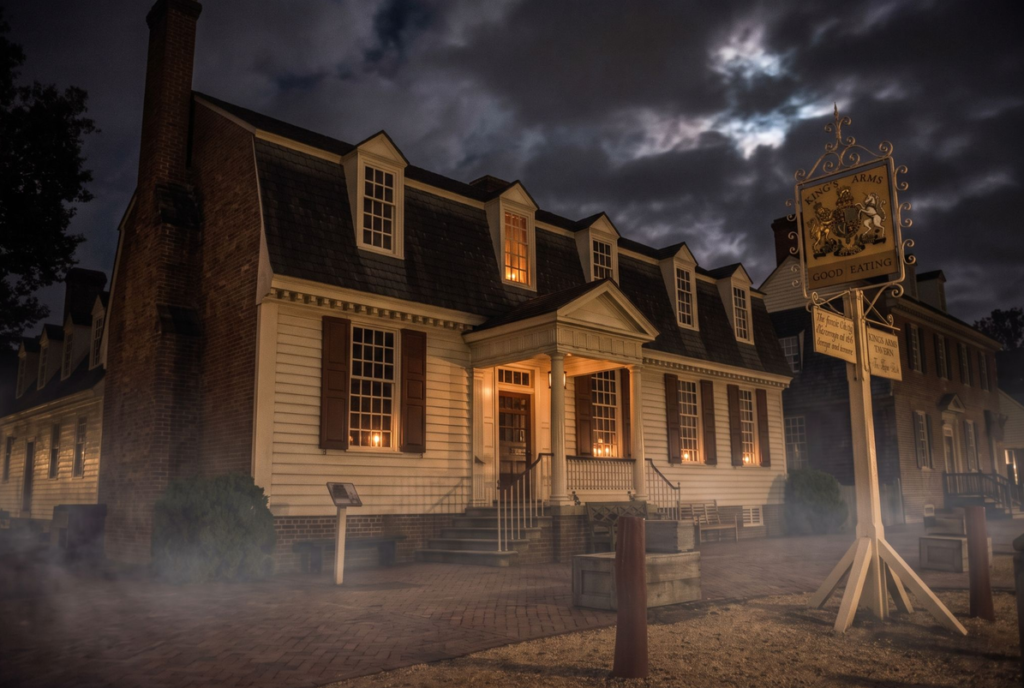
King’s Arms Tavern on a foggy night.
In colonial Williamsburg, taverns served as places to dine, find lodging, conduct business, and exchange news from across the colonies. King’s Arms Tavern became one of the town’s notable establishments under Jane Vobe, who opened the tavern at its Duke of Gloucester Street location in 1772.
Vobe had built a reputation as a successful tavernkeeper, attracting well-connected patrons. George Washington and Thomas Jefferson were among those who frequented her establishments, while other guests included students, travelers, and prominent Virginians visiting the colonial capital.
The original building was lost, but Colonial Williamsburg reconstructed the tavern using historical records, archaeological evidence, and architectural research. The site offers visitors an opportunity to explore colonial dining traditions while learning about the people whose work sustained them.
But there’s another unsettling side to King’s Arms.
King’s Arms is associated with a ghostly woman sometimes called Irma. According to local legends, unexplained cold spots, extinguished candles, and strange activity around doors and windows have been reported at the tavern.
For travelers interested in Williamsburg’s colonial past, King’s Arms reveals how taverns were woven into everyday life and the growing struggle for independence.
Conclusion
Historic taverns were much more than places to eat and drink. They connected communities, hosted political debates, and welcomed travelers during the formative years of the United States. From Philadelphia’s revolutionary gathering places to Annapolis’s busy waterfront, each location reveals another side of early American life.
Their ghost stories add another layer of intrigue, keeping local legends alive alongside documented history. Whether you want to explore America’s founding or hear tales of mysterious figures after dark, these historic destinations offer plenty to discover.
US Ghost Adventures offers guided ghost tours in destinations across the country, bringing local history and reported hauntings to life. Explore historic streets, hear the stories behind famous landmarks, and discover the legends that may linger long after the crowds have gone home.