
In the nineteenth century, Europe did not simply travel to Egypt. It measured it, copied it, packed parts of it, published it, argued over it, and then placed it inside museums with the calm confidence of a continent that mistook access for understanding.
Karl Richard Lepsius belongs exactly to that moment.
He was not an artist in the romantic sense of David Roberts, arranging temples under theatrical skies for collectors who wanted the East to arrive politely in folio form. Lepsius was something colder, and in many ways more consequential: a philologist, Egyptologist, organiser, expedition leader, museum-builder, and one of the figures who helped turn Egyptology into a modern scholarly discipline. If Roberts made ruins glow, Lepsius made them answer questions.
That does not make his work innocent. No European expedition into Egypt in the age of empire is innocent, and any article pretending otherwise should be wrapped in linen and buried somewhere dry. But Lepsius matters because his mission was not merely picturesque. It was systematic. His expedition wanted to document, classify, copy, compare, and build an archive large enough to make ancient Egypt newly legible to European scholarship.
In 1842, under the patronage of King Frederick William IV of Prussia, Lepsius led a scientific expedition to Egypt and Nubia. The results would become Denkmäler aus Aegypten und Aethiopien, one of the monumental publications of nineteenth-century Egyptology: a vast attempt to turn temples, tombs, inscriptions, pyramids, reliefs, plans, colours, names and ruins into a reproducible scholarly world.
Europe had already been obsessed with Egypt, as Art-Sheep explored in Egyptomania: When Europe Became Obsessed with Ancient Egypt. Lepsius represents the next stage of that obsession: not simply desire, but method. Not just fantasy, but paperwork. The usual romance, but wearing better boots and carrying measuring instruments.
He did not discover Egypt. Egypt was not missing.
He helped invent the modern European archive of Egypt.
1. The Scholar Before the Expedition
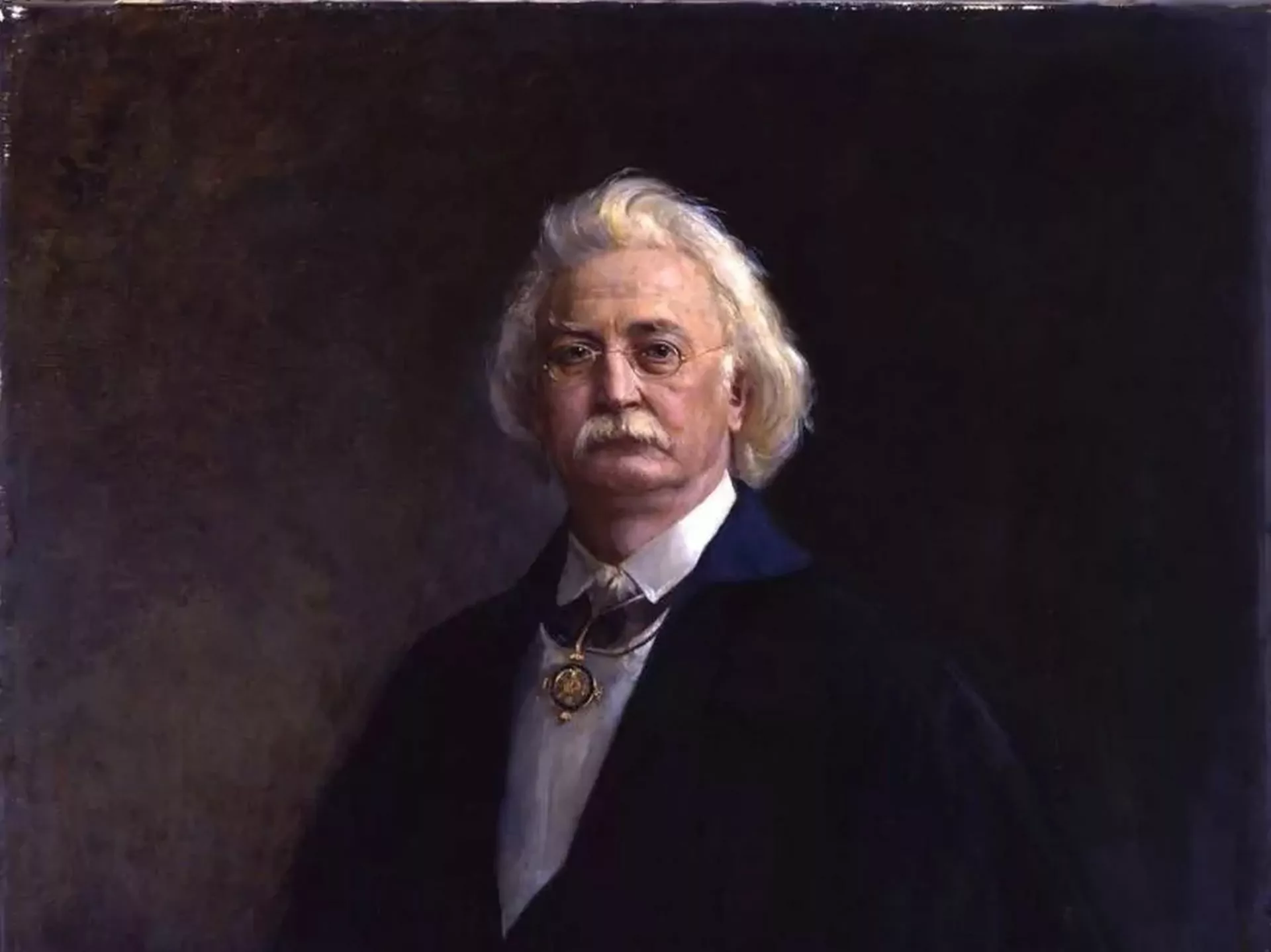
Karl Richard Lepsius, one of the foundational figures of German Egyptology.
Karl Richard Lepsius was born in Naumburg in 1810 and died in Berlin in 1884. Before he became the man of the Nile expedition, he was trained in philology, archaeology, ancient languages and the severe European art of believing that enough grammar might eventually discipline the past.
His intellectual timing was almost perfect. In 1822, Jean-François Champollion had deciphered Egyptian hieroglyphs, reopening ancient Egyptian writing to modern scholarship. Lepsius entered the field in the generation that followed, when the old mystery of hieroglyphs was becoming a technical problem, and technical problems are exactly where disciplined minds become dangerous.
He was not simply fascinated by Egypt as spectacle. He wanted systems. Chronology, language, monuments, inscriptions, dynasties, scripts, sequences, architectural plans — all the things that turn admiration into a discipline. The Berlin-Brandenburg Academy’s biographical account notes his study of Champollion’s decipherment and the support he received from figures including Humboldt and Bunsen before his royal commission to lead the expedition.
That background matters because Lepsius did not go to Egypt as a wandering aesthete. He went as a scholar backed by a state. His gaze was not casual. It had funding.
And funded gazes tend to leave large shadows.
2. Prussia Arrives at the Nile
.jpg)
The Royal Prussian Expedition gathered in Alexandria in September 1842. From there, it moved into a country that had already become a European theatre of scholarship, military memory, biblical imagination and imperial appetite.
Napoleon’s Egyptian campaign had turned documentation into power. Champollion had made hieroglyphs speak again. Museums in Europe were hungry. Scholars wanted chronology. Kings wanted prestige. Publishers wanted images. The Egyptian past had become a place where nations could perform seriousness.
Lepsius’s expedition was designed accordingly. It included architects, artists, draughtsmen and specialists who could record monuments with a level of precision that earlier travellers had rarely achieved. This was not the old Grand Tour fantasy of ruins seen from a distance. This was archaeology beginning to behave like bureaucracy: structured, comparative, ambitious, and magnificently convinced of its own usefulness.
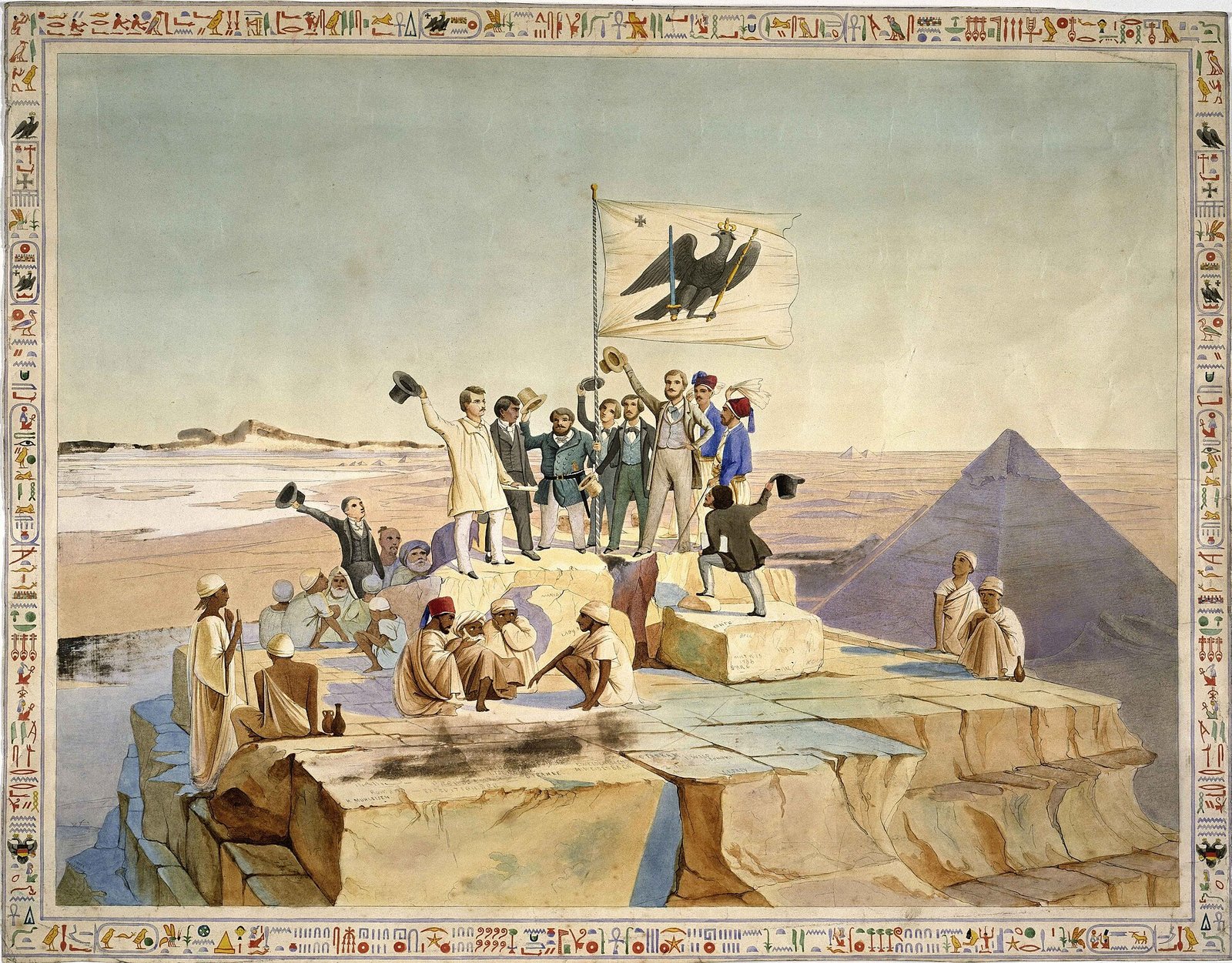
The famous image of the Prussian flag being raised on the Great Pyramid captures both the grandeur and the comedy of the enterprise. There is something almost operatic about it: scholars and artists standing on ancient stone, celebrating a European king above a monument that had outlived every government that ever tried to claim it symbolically.
History is often at its funniest when everyone involved is being very serious.
3. Giza, Pyramids, and the Need to Number the Eternal
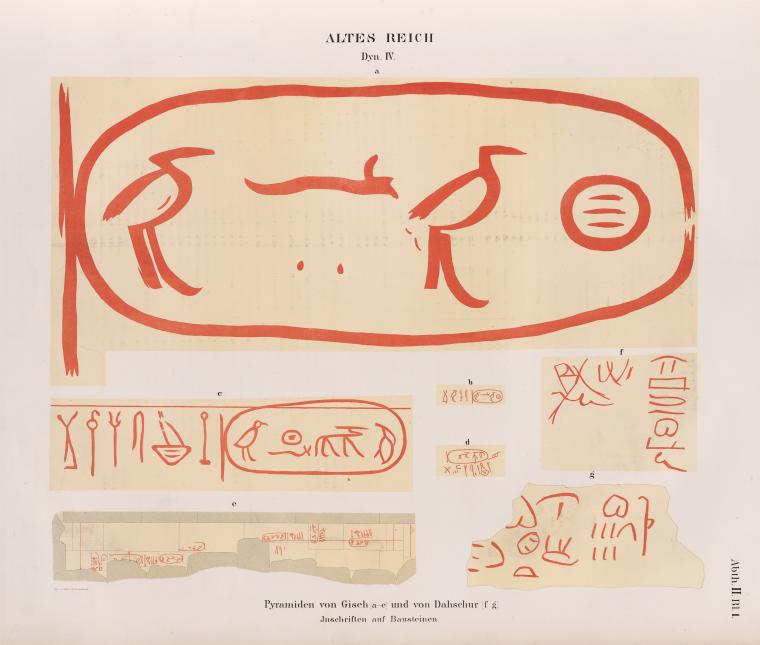
The expedition’s work at Giza and the pyramid fields shows Lepsius at his most characteristic.
Where a romantic traveller might stand before the pyramids and produce awe, Lepsius produced structure. He studied, recorded, classified, numbered and compared. The pyramid was not only a sublime object; it was evidence. It belonged to a system of monuments, dynasties, construction histories and inscriptions.
This is why Lepsius’s relationship to the pyramids feels both heroic and faintly absurd. There is something magnificently human about wanting to number the eternal. The pyramids had already survived pharaohs, Persians, Greeks, Romans, Arabs, Europeans, tourists, soldiers, looters, scholars and the weather. Then came Lepsius with order.
But the urge to order was not trivial. It helped create the foundations for later Egyptological study. Documentation allowed comparison. Comparison allowed chronology. Chronology allowed history to become less mythic and more difficult, which is usually an improvement.
The pyramids did not need Lepsius in order to exist. Egyptology, however, needed people like Lepsius in order to become more than admiration with footnotes.
4. Thebes, Tombs, and the Discipline of Looking Carefully
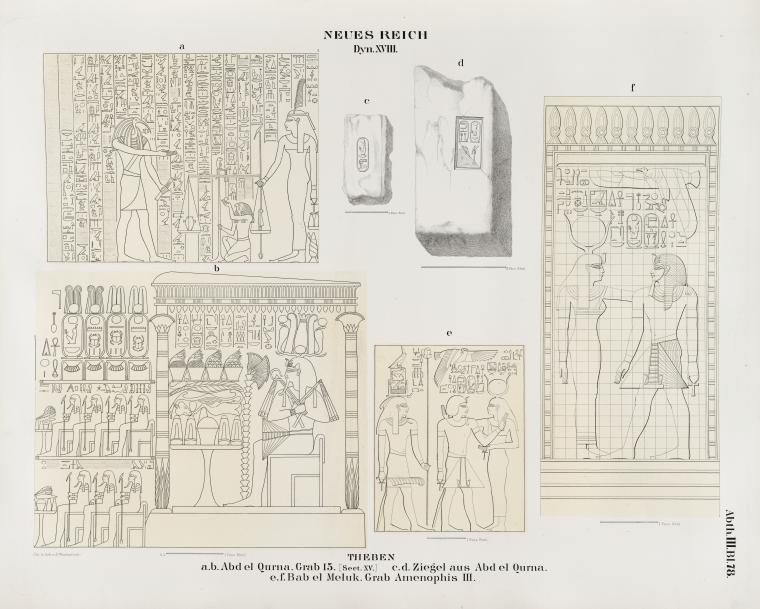
In Thebes, the expedition encountered not only monumentality, but density.
Temples, tombs, inscriptions, reliefs, painted scenes, royal names, ritual spaces, architectural fragments and the enormous archive of the dead all demanded attention. The task was no longer simply to admire ruin. It was to copy it before it changed, broke, disappeared, or was helpfully improved by someone with a chisel and a market.
This is one of the reasons Lepsius’s project still matters. Archaeological documentation is often least glamorous when it is most useful. Plans, copies, inscriptions, colour notes, measurements and drawings may not have the immediate drama of a discovered golden mask, but they become vital when the original monument is damaged, relocated, destroyed or altered.
The Met describes the artists working with Lepsius in Egypt and Nubia between 1842 and 1845 as producing some of the first truly scientific recordings of Egyptian monuments. That phrase is important. It marks the shift from image as souvenir to image as research tool.
Of course, even scientific images are not neutral. Every drawing selects. Every copy translates. Every monument becomes slightly different when carried onto paper. But the discipline of looking carefully remains a serious achievement. Lepsius made looking behave as though the future might need receipts.
5. Nubia and the Southward Expansion of the Archive

The expedition did not stop at the familiar monuments of Lower and Upper Egypt. It pushed south into Nubia, extending the Prussian archive along the Nile and into regions that European scholarship had documented far less systematically.
This southern movement matters because Nubia was not simply an appendix to Egypt. It had its own histories, kingdoms, languages, visual traditions, political powers and relationships with Egypt across centuries. Yet nineteenth-century European scholarship often treated Nubia through the gravitational field of Egypt, as though it existed primarily to explain, extend or ornament the Egyptian story.
Lepsius’s expedition helped record Nubian monuments in remarkable detail, but it also participated in that larger European habit of turning whole regions into departments within someone else’s archive. The work preserved. It also organised. And organisation is never innocent when the organiser arrives with a royal commission and leaves with objects, drawings and prestige.
The best way to read this material is therefore with two eyes open. One eye sees the immense scholarly value of recording monuments that were vulnerable to time, water, removal and neglect. The other sees the machinery of nineteenth-century knowledge gathering: Europe travelling outward, copying inward, and then calling the result civilization.
As usual, the archive is both treasure and crime scene. It just has very good captions.
6. The Team Behind the Monument

Lepsius’s name stands above the expedition, but the work was never his alone.
The Prussian mission depended on draughtsmen, artists, architects, surveyors, assistants, local labour, guides, officials, permissions, transport, supplies and the quiet violence of logistics. Archaeology likes great names, because great names are tidy. Expeditions, unfortunately for tidy history, are messy collective organisms.
The names attached to the visual record — Ernst and Max Weidenbach, Georg Erbkam, Johann Jakob Frey and others — remind us that the archive was made by hands as much as by intellect. Someone had to stand before walls and copy inscriptions. Someone had to measure. Someone had to draw. Someone had to decide where a line ended, how colour should be translated, and how a damaged surface could be made legible without inventing too much.
This is where the expedition becomes almost theatrical in another sense. It was a travelling production. Lepsius directed, but the image-world of the expedition was produced by a cast. Ancient monuments became scenes, the draughtsmen became interpreters, and the later publication became the printed performance.
It is useful to remember this because “Lepsius” can become shorthand too easily. Behind the monumental scholar stood a machine of people, paper, stone, sweat and imperial admin. Very romantic, if your idea of romance includes inventories.
7. Denkmäler: Turning Egypt Into a Printed Monument
The expedition’s great afterlife was printed.
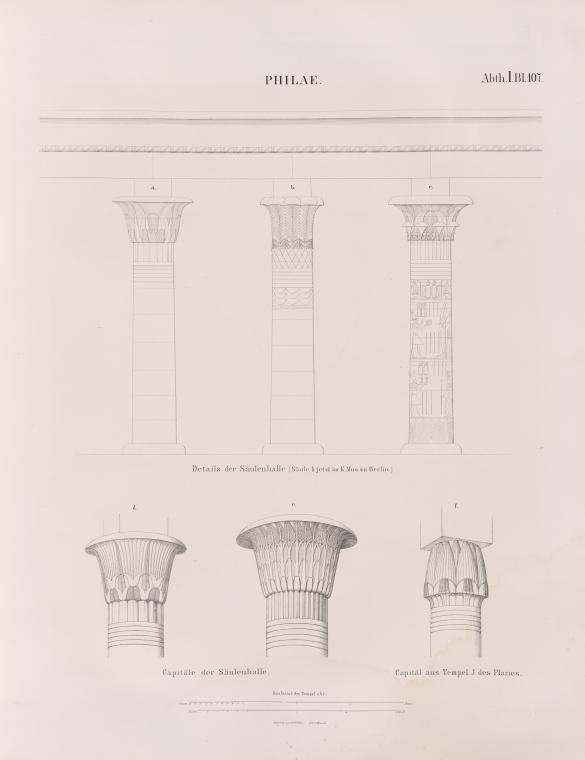
Denkmäler aus Aegypten und Aethiopien was not simply a book. It was a monument made of paper. Published in the middle of the nineteenth century, the vast work gathered plans, inscriptions, reliefs, architecture, objects and copies from the expedition into a system that scholars could consult without standing in the desert themselves.
This was the great magic of nineteenth-century scholarly publishing: the world became portable, provided one had the money, shelves and social confidence to own enormous volumes of dead civilizations. The publication transformed Egyptian and Nubian monuments into a European research environment. Stone became plate. Tomb became folio. Temple became reference.
The Staatliche Museen zu Berlin notes that the expedition’s documentation was published from 1849 to 1859 in twelve enormous volumes with 894 illustrated plates. Numbers like that matter because they show the scale of ambition. Lepsius was not producing a charming travel album. He was building an apparatus.
And apparatuses change disciplines. They give scholars a shared visual field. They allow errors to be repeated, corrected, challenged and refined. They make future scholarship possible, while also reminding us that knowledge often arrives dressed as possession.
Denkmäler turned ancient Egypt into something Europe could study at a distance. That distance was useful. It was also the point.
8. The Neues Museum and the Colour of Ancient Knowledge

The expedition did not end when the ships returned. It continued in Berlin.
Objects, casts, drawings and records flowed into the Prussian museum world, helping shape the Egyptian collections and their public display. From 1850 onward, objects brought back by the expedition were shown to the Berlin public at the Neues Museum. Egypt was no longer only on the Nile. It was now also on Museum Island, arranged through European categories, lighting, architecture and institutional pride.

This is perhaps Lepsius’s most lasting cultural role. He was not merely documenting Egypt; he was helping build the museum conditions through which Egypt would be seen in Europe. The museum did not just preserve objects. It staged knowledge. It created routes, hierarchies, rooms, labels, atmospheres and educational authority.
The nineteenth-century museum loved to pretend it was simply showing the world. In reality, it was editing the world with walls.
That does not make museums useless. It makes them powerful. Lepsius understood that power. His influence on Berlin’s Egyptian collections helped transform the expedition from a journey into an institution. The Nile became archive. The archive became exhibition. The exhibition became public imagination.
And public imagination, once trained, is very difficult to untrain.
9. The Second Return: Tanis and the Decree of Canopus

Lepsius’s relationship with Egypt did not end with the great Prussian expedition of 1842–1845.
In 1866, he returned to Egypt and became associated with one of the major textual finds of the century: the Decree of Canopus, discovered at Tanis. The inscription was significant because, like the Rosetta Stone, it belonged to the world of multilingual Egyptian decrees, where hieroglyphic, Demotic and Greek texts could be compared against each other.
For a field still consolidating the results of decipherment, this mattered enormously. The Egyptian Museum in Cairo describes the Canopus Decree as a trilingual inscription in Egyptian hieroglyphs, Demotic and Greek, commemorating an assembly of priests held at Canopus to honour Ptolemy III Euergetes, Queen Berenice and Princess Berenice.
In other words, Lepsius’s career returned again and again to the same central drama: making ancient writing speak in modern scholarly terms. The expedition had copied monuments. The museum had displayed objects. The publication had multiplied evidence. The Canopus Decree reinforced the linguistic architecture on which Egyptology depended.
There is an elegant irony here. The monuments made Lepsius famous, but the scripts made the monuments usable. Without language, Egypt becomes spectacle. With language, it becomes argument.
10. The Beauty and Trouble of the Scientific Eye

Lepsius forces us to think about the beauty and trouble of the scientific eye.
Compared with many travellers of the period, his expedition was rigorous, methodical and genuinely important. It documented monuments with a seriousness that helped preserve information future scholars would need. It moved Egyptology away from fantasy and toward disciplined record. That is no small achievement.
But the scientific eye is still an eye. It still looks from somewhere. In Lepsius’s case, it looked from Prussia, through royal patronage, through European museums, through the ambitions of a discipline that was being built at the same time as the empires and institutions surrounding it.
That does not mean we dismiss him. It means we read him properly. The lazy version of history wants heroes and villains because they are easy to arrange on a shelf. Lepsius is more interesting than that. He is a scholar of immense importance, a system-builder, a documenter of endangered evidence, and also part of the nineteenth-century European machinery that turned other civilizations into collections.
His work preserved. His work possessed. The trick is not to choose one sentence and pretend the other disappears.
That is the mature pleasure of looking at Lepsius now. The archive is brilliant. The archive is compromised. The archive remains useful. Welcome to history; please wipe your feet before entering.
11. Why Lepsius Still Matters
Karl Richard Lepsius still matters because he belongs to the moment when Egypt became a modern archive.
Not Egypt as fantasy. Not Egypt as pure museum spectacle. Not Egypt as a decorative fever of obelisks, sphinxes and tasteful European hallucination. But Egypt as a field of inscriptions, plans, dynasties, monuments, languages, copies, arguments and scholarly method.
He did not do this alone, and he did not do it innocently. But he did it with a scale and discipline that changed the field. His expedition’s recordings remained useful because they were made with a seriousness that outlasted the political vanity around them. That is one of history’s more annoying habits: compromised things can still be valuable.
This is why Lepsius belongs beside figures like David Roberts, but also apart from him. Roberts turned the East into a lithographic dream, as Art-Sheep explored in The Legendary David Roberts and the Lithographic Dream of the East. Lepsius turned Egypt into a scholarly machine. Both men shaped European vision. One seduced the drawing room. The other disciplined the archive.
The monuments, of course, remain older than all of them. Older than Prussia. Older than photography. Older than the museums that claimed to explain them. Older than the books that reproduced them. Older than the scholars who numbered, copied and named them.
Lepsius did not catalogue eternity. No one does.
But for a while, with astonishing ambition and very Prussian confidence, he tried.