Before the camera made the world look available, David Roberts made it look biblical.
He travelled with sketchbooks, but his real luggage was heavier: the theatre, the Bible, empire, archaeology, Romanticism, commerce, and the Victorian appetite for distant places arranged under excellent light. His images of Egypt, Nubia, Syria, Petra, Jerusalem, and the Holy Land did not merely show audiences what foreign landscapes looked like. They taught them how distance should feel: ancient, monumental, theatrical, half-sacred and very conveniently collectible.
Roberts was not simply a lithographer, though the word follows him everywhere because of the prints that made him famous. He was a Scottish painter and traveller whose drawings were transformed into some of the most celebrated tinted lithographs of the nineteenth century, largely through the extraordinary work of Louis Haghe. Roberts supplied the vision. Haghe gave it the polished, reproducible glow of luxury print culture.
The result was one of the great visual publishing projects of the age: The Holy Land, Syria, Idumea, Arabia, Egypt & Nubia, issued in London by F. G. Moon between 1842 and 1849. In those volumes, ruins became theatre, temples became revelation, and the so-called East became a stage on which Europe could admire its own hunger for the ancient, the sacred, and the exotic.
Roberts did not invent the Western fantasy of the East. He gave it excellent lighting.
1. From Edinburgh Walls to Sacred Ruins

David Roberts was born in Stockbridge, Edinburgh, in 1796, the son of a shoemaker. His beginnings were not grand. At a young age, he was apprenticed to a house painter, learning the practical craft of surfaces, interiors, illusion, and decoration before he had any claim to the higher altitudes of art.
That detail matters more than it first appears. Before Roberts painted temples, he had learned how to paint walls. Before he made Egypt and the Holy Land look like colossal theatres of history, he had worked in the world of applied illusion. He later became involved in theatre scenery, and that experience never really left him. It is visible everywhere in his mature work: in the way architecture frames space, in the way light enters like a cue, in the way small figures appear almost as actors placed before a gigantic painted set.
This does not make the images false in any simple sense. It makes them theatrical. Roberts had an instinct for staging grandeur. He understood that ruins needed scale, depth, shadow, and human smallness in order to become emotionally persuasive. A temple was not enough. It needed to be entered by light, crossed by figures, softened by dust, and arranged as if history had been waiting centuries for the curtain to rise.
His career therefore begins with a useful irony. One of the men who would teach Victorian Britain how to imagine the Holy Land and ancient Egypt began as someone trained to make ordinary surfaces look like something else.
Before Roberts became the painter of sacred distance, he was already a technician of illusion.
2. The Journey East: Sketchbooks, Dust, and Expectation

Roberts travelled to Egypt and the Near East in the late 1830s, moving through Alexandria, Cairo, the Nile, Nubia, Sinai, Petra, Jerusalem, and other sites that European imagination had already loaded with religious, historical, and imperial significance.
He was not travelling as a neutral eye. No artist does, but Roberts especially did not. He came with training, ambition, patrons, expectations, and an audience waiting back home. He came after centuries of biblical imagination and during a century increasingly obsessed with archaeology, travel, empire, ancient ruins, and the profitable romance of distance.
Still, the journey mattered because Roberts drew on the spot. His sketches gave his later work the authority of encounter. They allowed the finished lithographs to claim a special kind of truth: not photography, not pure fantasy, but something in between. A witnessed dream. A real place filtered through a powerful visual appetite.
This is why the Roberts project became so convincing. It promised viewers both evidence and drama. It said: this is what the artist saw. But it also said: this is how such places ought to be seen. Tall, silent, ancient, dignified, ruined, sun-struck, inhabited by small figures and enormous histories.
The sketchbook was the seed. The lithograph was the empire of the image built from it.
3. Louis Haghe and the Miracle of the Tinted Lithograph
The phrase “David Roberts lithographs” is useful, but slightly misleading if taken too literally.
Roberts made the drawings and watercolours that formed the basis of the famous prints. The lithographic transformation was carried out by others, most importantly Louis Haghe, a Belgian-born artist and specialist in hand-tinted lithography. The final plates belong to a collaboration between travel, drawing, translation, printing, publishing, and colour.
That collaboration is part of their magic. The Roberts-Haghe images sit between categories. They are not paintings, though they glow with painterly atmosphere. They are not simple reproductions, though they were made to circulate. They are not documentary records, though they lean heavily on the authority of on-site drawing. They are luxury images: reproducible, collectible, theatrical, and designed to bring the world into the library without bringing the dust with it.
This was nineteenth-century image culture before Instagram, before travel blogs, before glossy tourism campaigns, before the airport bookshop made global wonder cheap and laminated. A Roberts volume was an object of prestige. To own it was to own a version of distance, tastefully bound and hand-tinted for the educated imagination.
Roberts supplied the vision. Haghe turned it into a dream that could be bought, shelved, admired, and inherited.
4. The Holy Land as Theatre

In Roberts, the Holy Land is never merely seen. It is performed.
Jerusalem, Bethlehem, Petra, the Church of the Holy Sepulchre, the road to Bethany — these locations appear not simply as sites, but as stages already filled with memory. The compositions often open with a commanding view, a line of architecture, a procession of figures, a dramatic fall of light, or a carefully placed foreground that invites the viewer to enter the scene as if entering sacred theatre.
The effect is powerful because it satisfies several hungers at once. It gives the religious viewer a place that appears spiritually legible. It gives the traveller a place that appears distant and authentic. It gives the collector a place that appears tasteful. It gives the empire a place that appears available to be catalogued, framed, and understood.
This is the seductive danger of Roberts. His Holy Land feels too beautifully arranged to be innocent. It offers reverence, but also possession. It makes sacred geography available as a view, and views are never harmless. To view something from a distance is already to place oneself in relation to it — often above it, outside it, safe from it.
And yet the images still work. They work because Roberts understood that sacred architecture is not only made of stone. It is made of expectation. The viewer arrives at Jerusalem already carrying an idea of Jerusalem, and Roberts gives that idea a horizon, a shadow, and a very handsome foreground.
5. Egypt and the Architecture of Awe

If the Holy Land allowed Roberts to stage sacred memory, Egypt allowed him to stage awe.
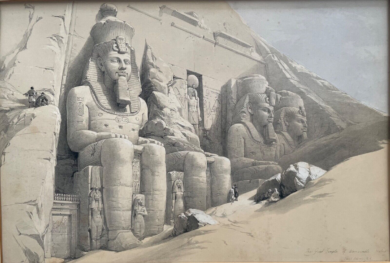
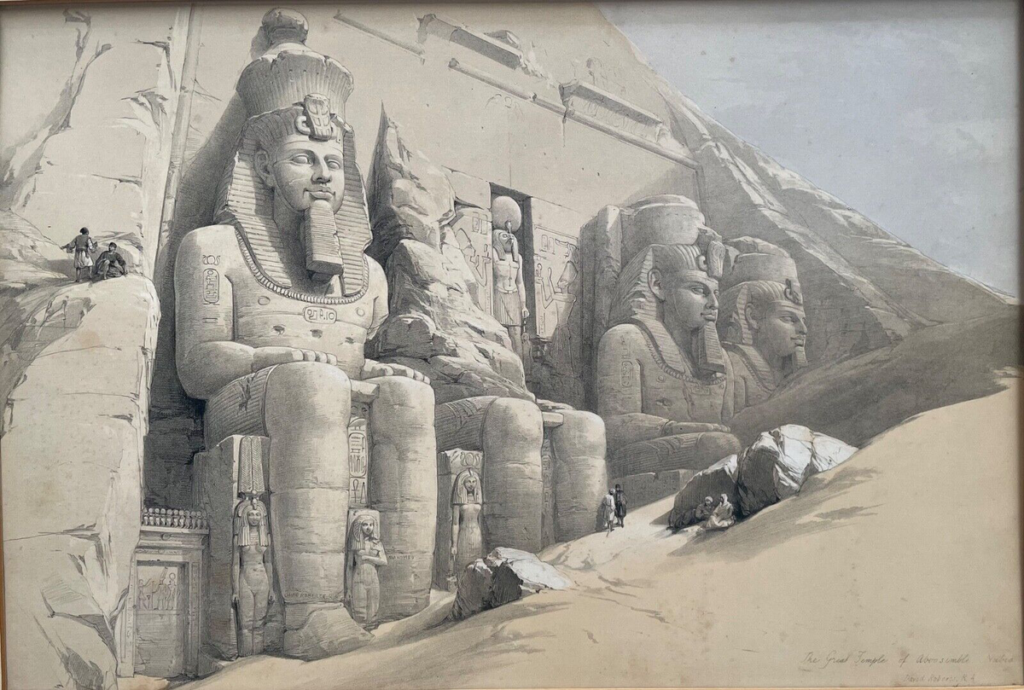
His Egyptian and Nubian images are built around the shock of scale. Abu Simbel, Karnak, Luxor, Philae, Thebes, colossal statues, temple interiors, pylons, columns, fragments, and monumental facades become theatres of human smallness. Roberts repeatedly places figures, animals, tents, local inhabitants, guards, travellers, and bits of ordinary life before vast architectural remains. The effect is immediate: the monument becomes older because the body looks temporary.
This is one of Roberts’s great visual tricks. He does not simply draw a large thing. He creates a world in which largeness becomes emotional. The viewer feels the weight of stone, the age of ruin, the heat of light, and the absurd brevity of human motion before it all.
It is also where Roberts connects naturally to the wider story of European Egyptomania. Nineteenth-century Europe did not merely admire Egypt. It consumed Egypt as symbol, décor, archaeology, fantasy, power, and proof of antiquity. As we explored in Art-Sheep’s essay on Egyptomania and Europe’s obsession with ancient Egypt, Egypt became a mirror in which Europe could see its own desire for permanence.
Roberts gave that desire some of its most persuasive images.
6. Petra and the Romance of Arrival

Few subjects suited Roberts better than Petra.
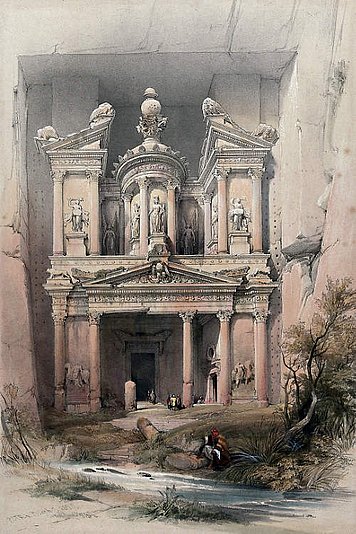
Petra already has the advantage of looking invented. Rock, façade, gorge, shadow, desert, architectural carving, and theatrical approach are built into the place itself. Roberts did not need to force drama upon it. He only needed to understand how to delay revelation.
His Petra images are obsessed with arrival. The viewer approaches, peers through ravines, encounters structures as if they have just emerged from stone. The famous façade of El Khasneh becomes not merely an archaeological subject, but an apparition. It seems less built than disclosed.
This is where Roberts’s background in theatre becomes almost embarrassingly useful. Petra is a stage entrance created by geology and empire long before Victorian print culture arrived to applaud it. Roberts composes it as spectacle, yes, but spectacle with genuine force. The architecture appears to step forward from the rock, while small figures below remind us that human beings mostly arrive too late to the worlds they claim to discover.
Discovery, in Roberts, is often just a more elegant word for being impressed by something that was never waiting for you.
7. The Beauty and the Problem of the Orientalist Eye

The images are beautiful. That is exactly why they need to be handled carefully.
Roberts’s work belongs to the broad nineteenth-century European Orientalist imagination, a visual culture that often turned the East into mystery, ruin, spectacle, sensuality, timelessness, and theatrical difference. The problem is not that Roberts looked. Artists look. The problem is that looking is never innocent when backed by empire, religion, commerce, and an audience eager to have other people’s worlds arranged for its pleasure.
His prints often present the East as ancient, picturesque, dramatic, and available. Local figures populate the images, but rarely control them. They provide scale, atmosphere, movement, costume, and proof of life. The real authority belongs to the composition, and behind the composition stands the European viewer.
That does not make the work artistically worthless. It makes it historically alive in uncomfortable ways. Roberts is interesting because he gives us both visual brilliance and ideological construction. He shows us beautiful places, and also how nineteenth-century Europe wanted beautiful places to behave: still enough to be studied, exotic enough to be desired, ancient enough to be admired, and distant enough not to interrupt the fantasy too rudely.
The right response is neither lazy cancellation nor decorative worship. Roberts deserves better than both. His images are most powerful when we admit that their beauty is part of their danger.
8. Ruins, Scale, and the Tiny Human Figure

Roberts was a master of making people look temporary.

Again and again, his compositions depend on the same devastating contrast: immense architecture and small human figures. The figures matter, but not because they are protagonists. They are measures. They calibrate awe. Without them, the monuments would still be large; with them, they become historical.
This is a subtle but powerful distinction. Scale in Roberts is not purely mathematical. It is emotional. A column becomes more ancient when someone walks beneath it. A temple becomes more overwhelming when a group gathers at its base. A fallen fragment becomes more tragic when a figure sits nearby as if history were ordinary furniture.
In Roberts, people do not inhabit history. They pass briefly in front of it.
This gives the ruins a strange authority. They appear to outlast not only individuals, but the cultures currently moving around them. Human life is presented as movement; architecture as duration. A camel crosses, a guard stands, a traveller gestures, a group rests in shadow. The stone remains.
That is why the prints still have such interior-design power today. They make a room feel older by association. They import the glamour of endurance. Hang a Roberts lithograph, and suddenly the wall pretends it has read Gibbon by candlelight.
9. Publishing the World as a Luxury Object

The Holy Land, Syria, Idumea, Arabia, Egypt & Nubia was not only an artistic achievement. It was a publishing event.
The volumes were issued for a nineteenth-century audience that understood travel imagery as culture, status, education, and possession. These were not casual illustrations glanced at between errands. They were luxury objects for libraries, collectors, subscribers, scholars, clergy, aristocrats, and anyone who wanted distant landscapes arranged with enough dignity to justify the expense.
The title-page language matters. The project advertised itself as being made “from drawings made on the spot,” a phrase that gave the images documentary prestige. But the finished product was anything but raw fieldwork. It was edited, translated, lithographed, tinted, printed, described, bound, sold, and absorbed into the domestic spaces of people who could travel imaginatively without having to endure sand in their shoes.
The New York Public Library catalogue records the project as The Holy Land, Syria, Idumea, Arabia, Egypt and Nubia, lithographed by Louis Haghe after drawings made on the spot by David Roberts. That phrase contains the entire nineteenth-century bargain: travel, authority, translation, luxury, and distance made safe enough for the drawing room.
Roberts turned travel into furniture for the educated imagination.
10. Why His Lithographs Still Seduce Collectors

Roberts lithographs still seduce collectors because they offer several pleasures at once.
They are art objects, travel documents, antique prints, religious images, architectural fantasies, Orientalist artifacts, and status symbols. They look serious without being cold. They look decorative without being empty. They carry enough history to flatter a library and enough visual drama to rescue a wall from looking like it was decorated by someone whose soul died in a catalogue.
There is also the aura of process. These images feel handmade even when they are reproducible. The tinting, the paper, the softness of colour, the architectural line, the delicate theatricality of the scenes — all of it gives them a presence that digital images can imitate but not quite possess. They belong to a moment when reproduction still carried craft visibly inside it.
To hang a Roberts lithograph is not simply to hang a place. It is to hang a nineteenth-century desire for that place. A desire for antiquity, distance, authority, sacred atmosphere, imperial confidence, and the pleasure of owning the view without being troubled too much by the life around it.
That is why the best Roberts prints remain compelling. They are not just pretty old images. They are beautiful evidence of how a century taught itself to dream in ruins.
11. Before Photography, After Fantasy

Roberts belongs to a fascinating historical moment: after Romanticism had taught Europe how to desire ruins, before photography fully took possession of travel, and during the rise of archaeology, empire, and luxury publishing.
This is why his work feels both documentary and unreal. He stands close enough to the modern image-world to seem familiar, but far enough from photography to preserve the authority of artifice. His lithographs do not ask us to believe they are neutral documents. They ask us to surrender to their arrangement of light, history, architecture, and distance.
That surrender remains tempting. The scenes are gorgeous. The temples loom. The skies open. The figures pass beneath stone like temporary thoughts. The Holy Land glows with the pressure of belief. Egypt becomes an architecture of awe. Petra waits like a secret designed by geology and rediscovered by theatre.
But the distance is never innocent. Roberts does not show us the East “as it was.” He shows us how nineteenth-century Europe wanted to see it: ancient, sacred, ruined, picturesque, legible, theatrical, and available to the eye.
That is not a reason to stop looking. It is a reason to look better.
David Roberts did not merely illustrate distant places.
He helped manufacture the way distance itself was meant to look.