The Discovery That Wasn’t a Discovery
There is something quietly ironic about Egyptomania. Europe did not discover Egypt. Egypt had been there, uninterrupted, monumental, and largely indifferent to European curiosity for millennia.
What Europe discovered instead was its own desire for Egypt.
From the late 18th century onward, particularly after Napoleon Bonaparte’s campaign in Egypt, a cultural obsession began to take shape. Scholars, artists, architects, designers — all turned toward the ancient world not as historians, but as interpreters. Or perhaps more accurately, as stylists.
Egypt became less a place than a visual vocabulary.
Empire, Knowledge, and Aesthetic Control
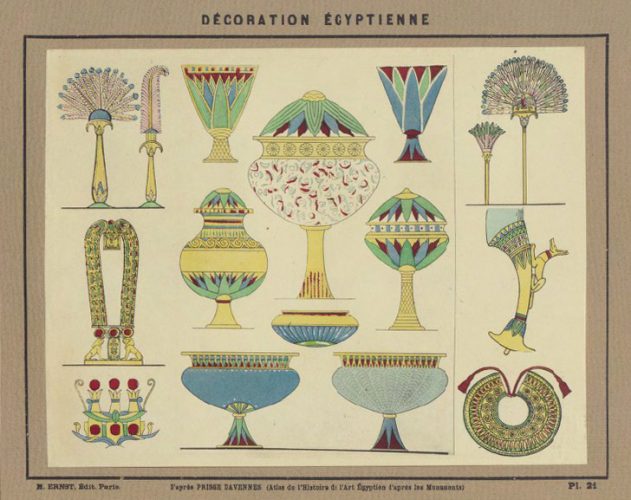 “Vases of different materials,” an illustrated plate from Décoration égyptienne. Via the State Library of Ohio Rare Books Collection on Ohio Memory.
Napoleon’s expedition to Egypt in 1798 is often framed as a military endeavor. It was also, crucially, an intellectual one. Scientists, artists, and scholars accompanied the army, documenting monuments, inscriptions, and landscapes with an intensity that bordered on obsession.
The resulting publication, Description de l’Égypte, did not simply record Egypt — it reorganized it. It translated ancient architecture into engravings, hieroglyphs into symbols, landscapes into compositions.
For Europe, this was not just knowledge. It was access.
For a broader understanding of how ancient Egyptian culture has been interpreted and reinterpreted over time, see this overview of Ancient Egypt.
Egypt as Image System
 A publicity still with Claudette Colbert in the 1934 film “Cleopatra.”
What followed was not scholarship alone, but diffusion.
Egyptian motifs began to appear everywhere:
- architecture
- furniture
- textiles
- decorative arts
Columns resembled papyrus stalks. Sphinxes guarded doorways. Obelisks were relocated, replicated, aestheticized.
Egypt was no longer distant. It was integrated.
But this integration was selective.
What was adopted was not Egypt as a living culture, but Egypt as an image — a curated set of forms detached from their original context.
The Decorative Absorption of the Exotic
Egyptomania reveals something fundamental about European decorative culture: its ability to absorb the foreign and render it familiar.
The unfamiliar is not rejected. It is stylized.
Hieroglyphs become pattern. Monuments become motifs. The symbolic becomes ornamental.
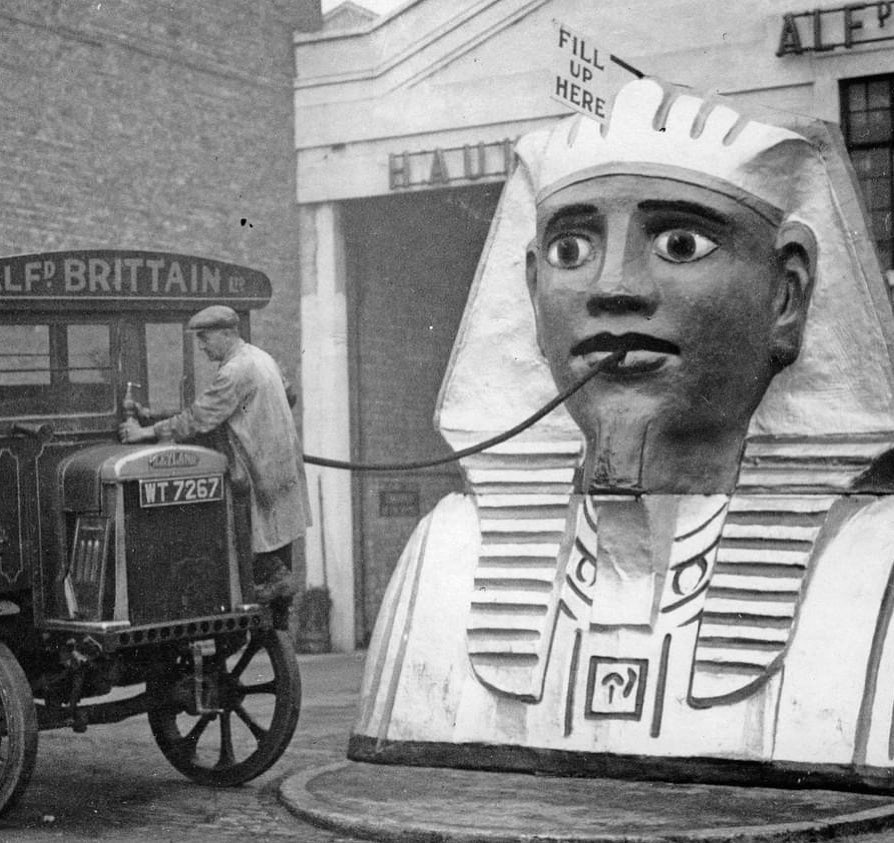 Petrol Pump in London, England, circa 1930
This process is not neutral. It transforms meaning.
Egyptian imagery, once embedded in religious, political, and cultural systems, becomes surface. It decorates without demanding interpretation.
And in doing so, it becomes safe.
Textile Egypt: When Empires Became Pattern
One of the most revealing expressions of Egyptomania appears not in architecture or painting, but in textiles.
Here, the translation is complete.
Ancient monuments — temples, obelisks, figures — are reduced to repeatable scenes, printed across fabric. Scaled, arranged, simplified. Integrated into domestic interiors.
It is difficult not to see the parallel with artists like Jean-Baptiste Huet, whose work for the Oberkampf manufactory transformed visual culture into a system of repeatable imagery.
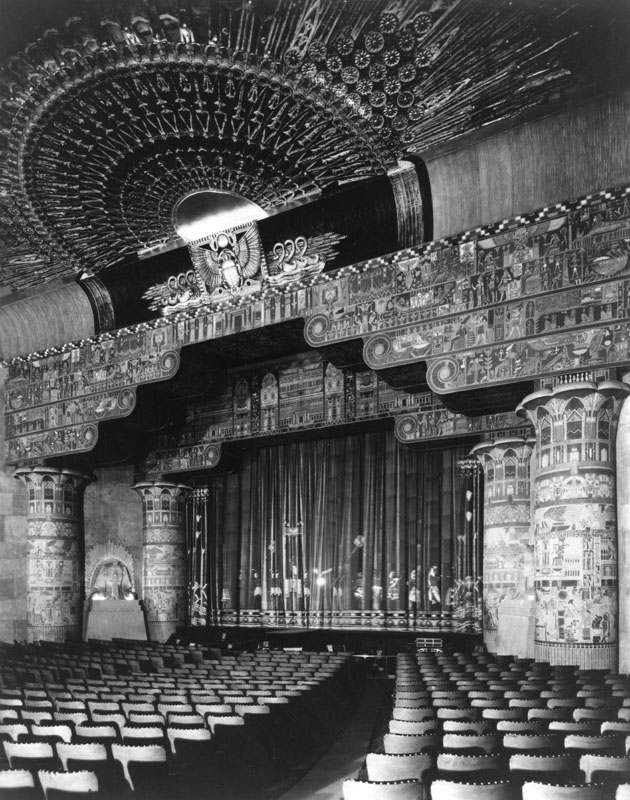 The Egyptian Theatre, Los Angeles
Egyptian-themed toile designs follow the same logic:
- narrative compressed
- symbolism flattened
- history aestheticized
The result is not representation, but simulation.
A similar transformation of imagery into controlled visual systems can be observed in pieces like Hilarious Parodies of Popular Household Brands by Art Spiegelman, where familiar forms are recontextualized into new visual languages — though in this case, the tone is less ironic and more decorative.
Architecture of Fascination
Egyptomania also left a lasting mark on architecture.
Buildings began to incorporate Egyptian elements not as structural necessities, but as stylistic choices:
- pylons framing entrances
- columns echoing temple forms
- decorative reliefs referencing hieroglyphic systems
These elements did not recreate Egyptian architecture. They referenced it.
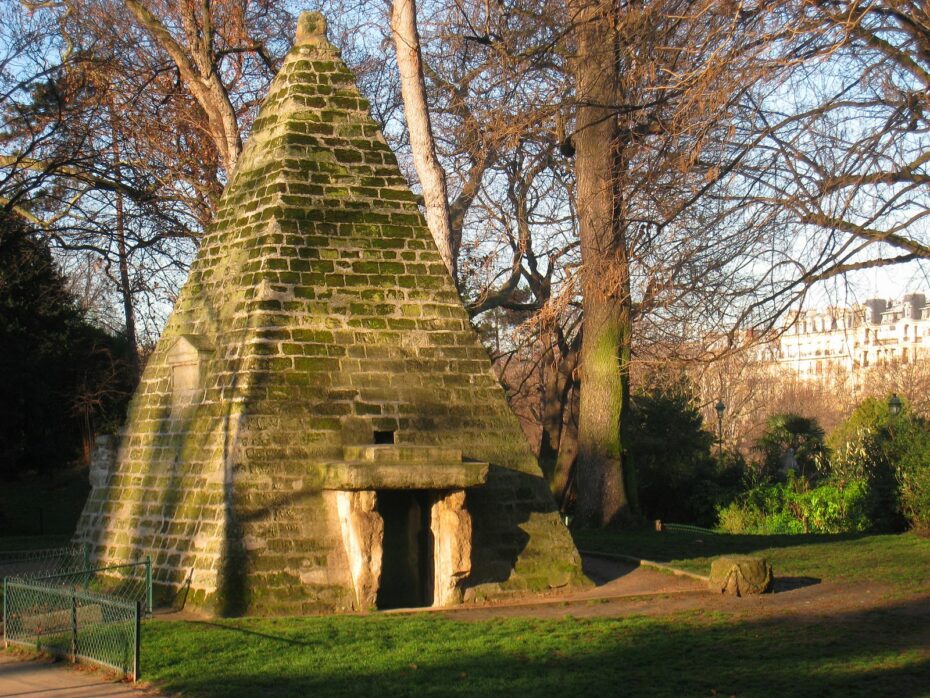 Parc Monceau’s pyramid, Paris
And reference, in this context, is a form of control. It allows for engagement without commitment, for admiration without understanding.
The Allure of Permanence
Why Egypt?
Why not Greece, or Rome, or any number of other ancient civilizations?
The answer lies, at least in part, in perception.
Egypt represented permanence.
Its monuments were not ruins in the same way as classical architecture. They felt older, more distant, less accessible. They suggested continuity beyond the scale of European history.
For a continent undergoing rapid change — industrialization, political upheaval, social transformation — Egypt offered something reassuring: the illusion of timelessness.
And like all effective illusions, it was carefully constructed.
Exoticism Without Encounter
Egyptomania allowed Europe to engage with the “exotic” without leaving home.
This is perhaps its most defining characteristic.
The foreign is brought closer, but not too close. It is filtered, adapted, aestheticized. Stripped of complexity, rendered legible.
The result is a form of distance disguised as proximity.
One could decorate a room with Egyptian motifs, wear Egyptian-inspired garments, surround oneself with references to a culture that remained fundamentally external.
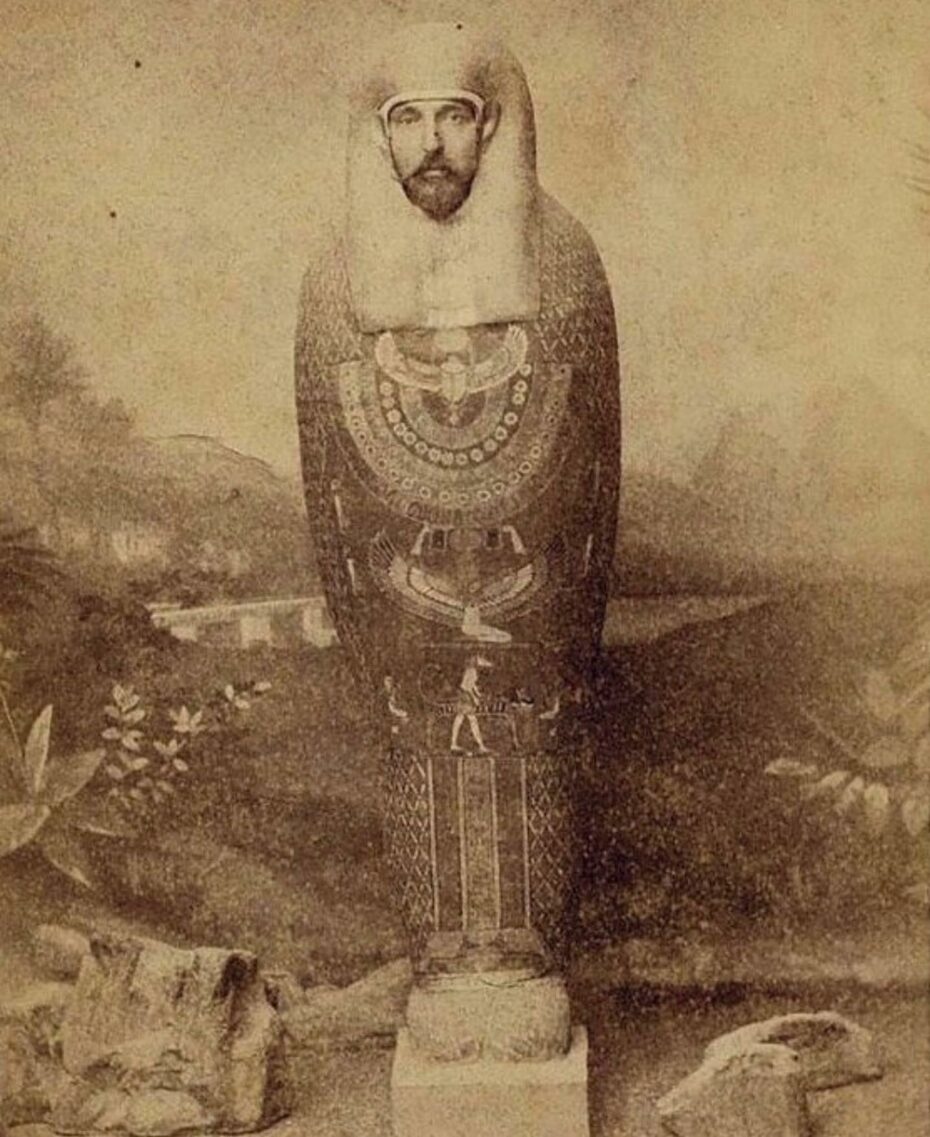 Unknown tourist poses in the Strommeyer and Heymann photographic studio in Cairo (c. 1885)
It is not exchange. It is consumption.
The Quiet Violence of Aesthetic Translation
It would be easy to describe Egyptomania as admiration. And in many ways, it was.

But admiration, when filtered through power, becomes something else.
The translation of Egyptian culture into European decorative systems involved a series of reductions:
- religious symbols become decorative motifs
- architectural forms become stylistic references
- historical complexity becomes visual simplicity
This is not destruction. It is transformation.
And transformation, in this context, is a form of control.
After Egypt
Egyptomania did not disappear. It evolved.
It resurfaced in the 19th century, again in the 1920s after the discovery of Tutankhamun’s tomb, and continues to appear in contemporary design, fashion, and visual culture.
Each iteration reinterprets Egypt through the lens of its own time.
But the underlying logic remains consistent.
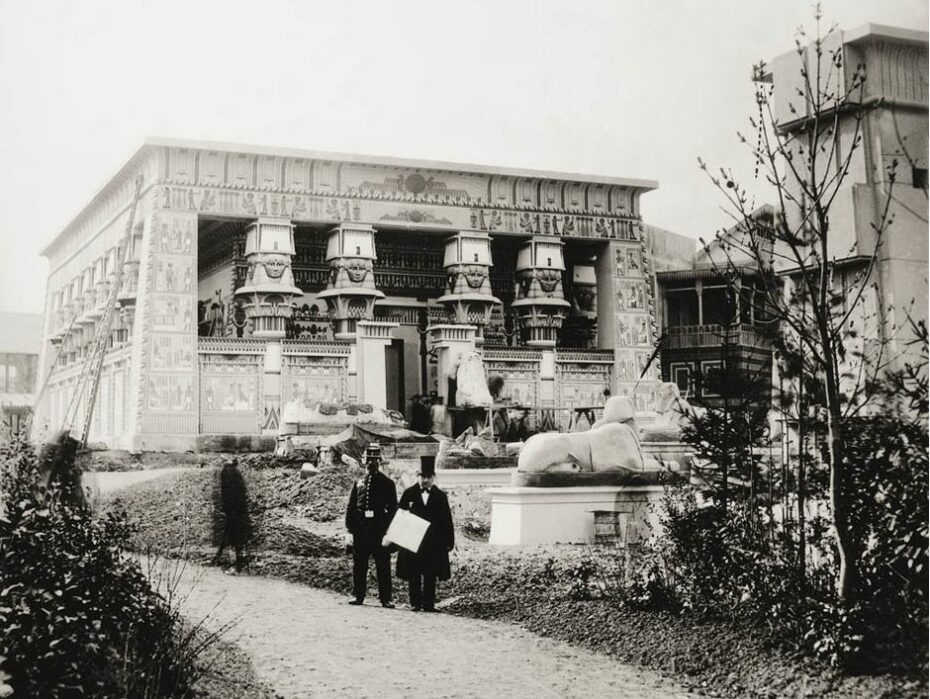 Egyptian Pavillion, Paris World Fair 1867
Egypt is not engaged with directly. It is mediated.
The Persistence of the Image
What remains today is not Egypt itself, but its image.
A collection of forms, symbols, references — circulating across cultures, detached from origin, continuously reinterpreted.
In this sense, Egyptomania is not a historical phenomenon. It is an ongoing condition.
A way of seeing that prioritizes surface over structure, familiarity over complexity.
Final Reflection: The Desire to Possess the Past
Egyptomania reveals less about Egypt than about Europe.
It exposes a desire not simply to understand the past, but to possess it. To integrate it into contemporary systems of meaning, to make it available, usable, decorative.
And perhaps this is the most enduring aspect of the phenomenon.
Not the monuments themselves, but the impulse behind them.
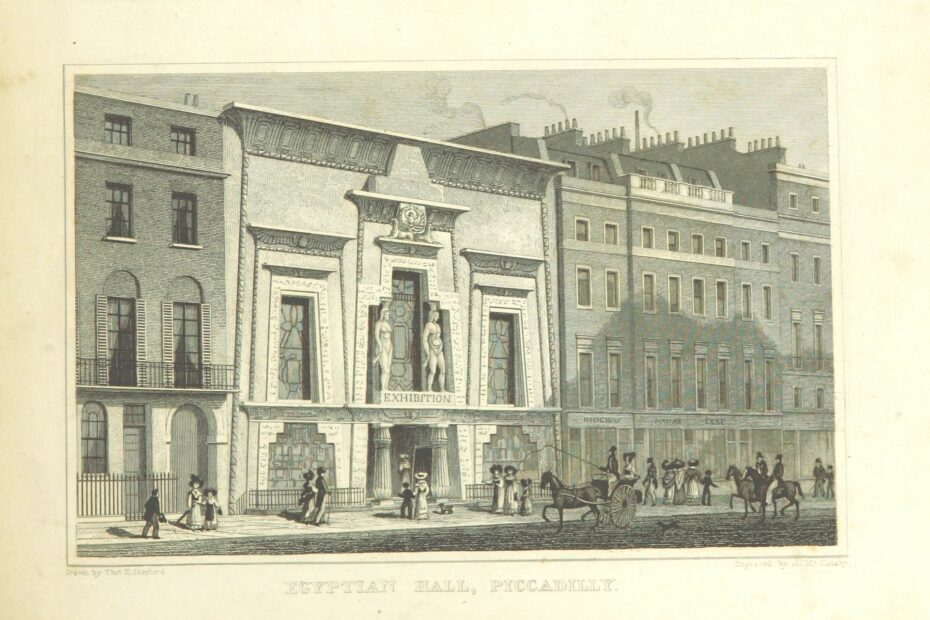 Egyptian Hall, Picadilly
The need to transform what is distant into something that can be repeated, displayed, and ultimately, controlled.
A Quiet Warning
There is something seductive about ancient cultures. Their distance allows for projection. Their complexity invites simplification.
But every act of translation carries risk.
The more we simplify, the more we lose.
And yet, we continue — repeating, adapting, aestheticizing — until the image becomes more familiar than the reality it once represented.
And at that point, the transformation is complete.