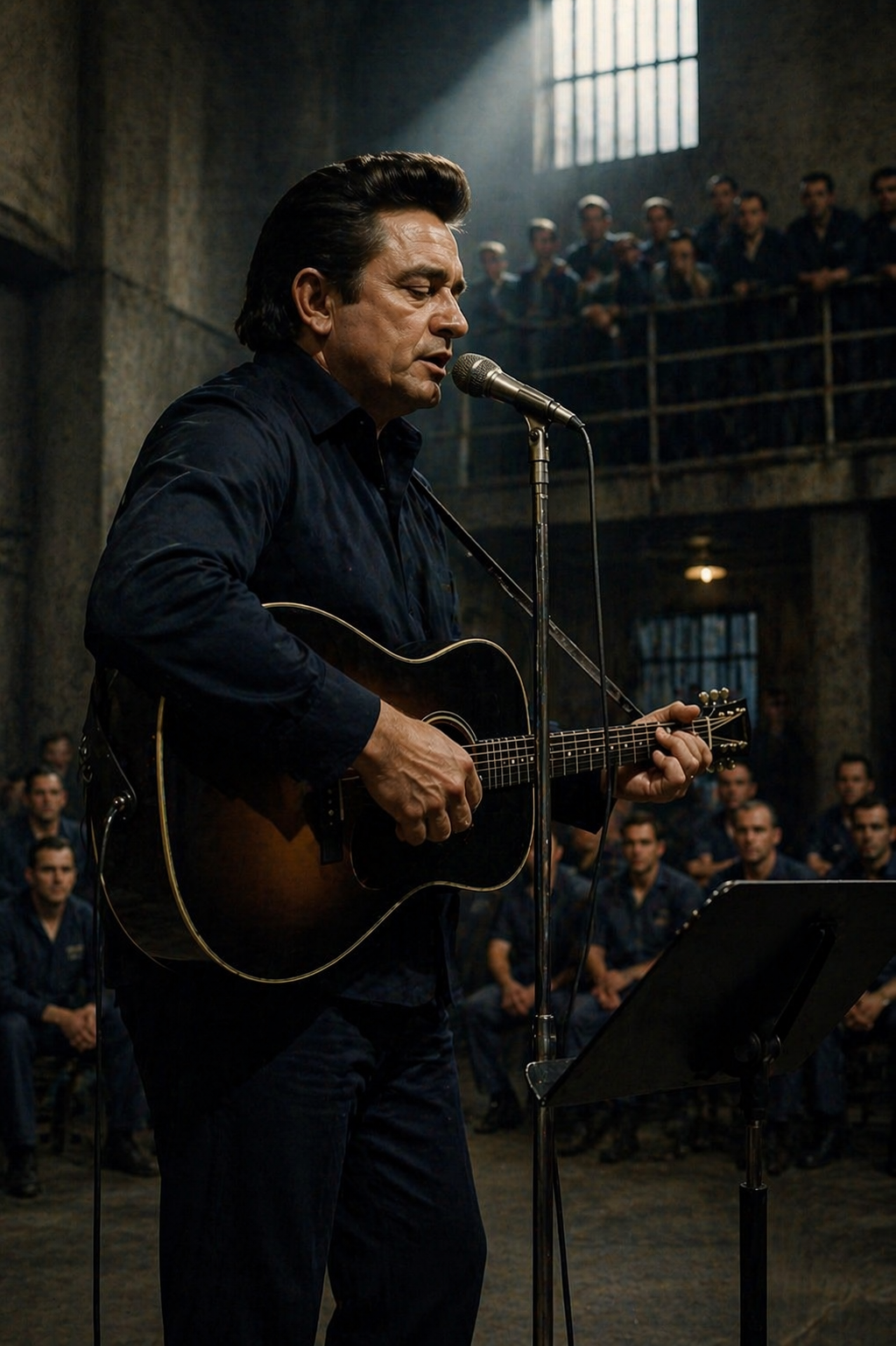
“I was thinking about you guys yesterday. Now, I’ve been here three times before, and I think I understand a little bit of how you feel about some things. It’s none of my business how you feel about some other things, and I don’t give a damn about how you feel about some other things. But anyway, I tried to put myself in your place, and I believe this is how I would feel about San Quentin…”
A Man Who Sounded Like Justice
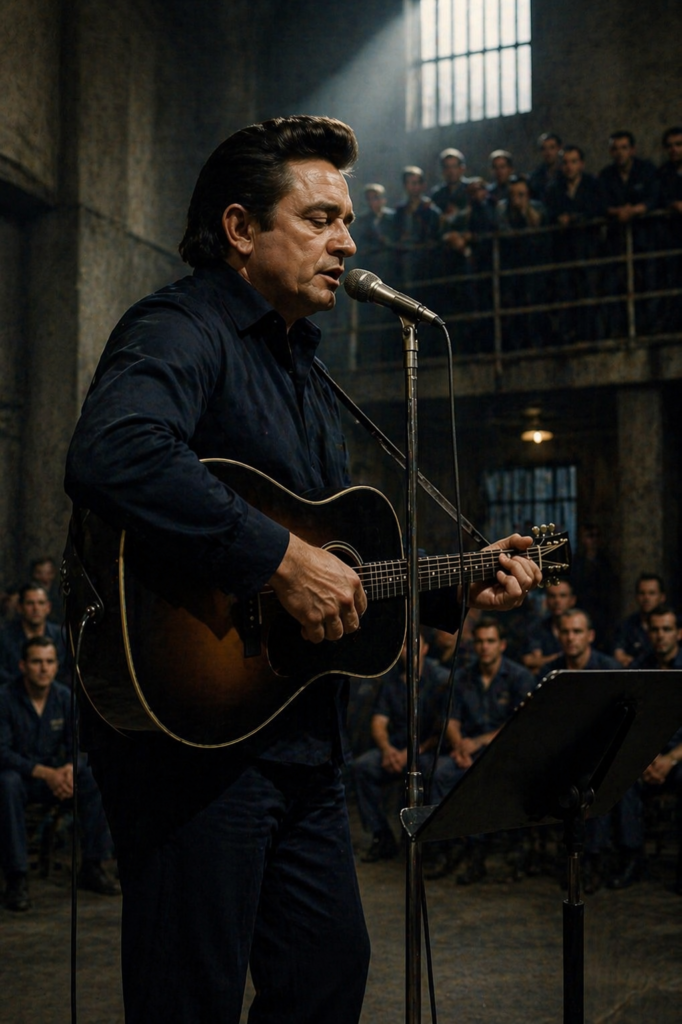
There are performances that entertain, and then there are performances that feel like they are passing judgment on the world itself. When Johnny Cash walked into San Quentin State Prison in 1969, he did not arrive as a celebrity visiting inmates for spectacle. He arrived as something far more ambiguous — part witness, part advocate, part provocateur.
And when he sang San Quentin, he did not perform the song. He delivered it.
What is striking, even now, is not simply the energy of the crowd — though that alone is electric — but the way Cash appears almost unnervingly composed. Not calm, exactly. Something sharper. Something closer to moral clarity.
The inmates roar. He barely moves.
The Prison as Audience
Cash’s relationship with prisons was not incidental. It was, in many ways, central to his artistic identity.
Long before San Quentin, he had already performed at Folsom State Prison in 1968 — a concert that would become one of the most iconic live recordings in American music history. But even that performance did not come out of nowhere.
Cash had been writing about prisons since the 1950s. Songs like Folsom Prison Blues were not based on lived experience of incarceration, but on something perhaps more revealing: identification. He saw, in the figure of the prisoner, a distilled version of constraint, regret, and consequence.
But he also saw something else — a system.
His prison performances were not charity. They were statements.
Why San Quentin
San Quentin State Prison was, at the time, one of the most notorious prisons in the United States. Known for its harsh conditions, strict discipline, and symbolic weight within the American penal system, it represented something larger than itself.
To perform there was not neutral.
It was a confrontation.
Cash had already established credibility with inmates through Folsom, but San Quentin was different. More volatile. More charged. More aware of itself.
And then there was the song.
The Song That Wasn’t Supposed to Be Comfortable
San Quentin was not a love song. It was not even a traditional protest song. It was something more direct — almost confrontational.
“I hate every inch of you.”
There is no metaphor here. No poetic distance. Just declaration.
The song was written specifically for the prison, and more importantly, for that audience. It was not meant to be universal. It was meant to be heard in that room, by those people, at that moment.
And they understood it immediately.
The Performance
Before he begins, Cash speaks.
There is something disarmingly casual about it. He jokes. He interacts. He lowers the distance between himself and the inmates, not through grand gestures, but through tone. Through presence.
It sounds small. It isn’t.
It reveals the dynamic of the space. The invisible structure of authority. The fact that even he, Johnny Cash, must still navigate the rules of the institution.
And then he begins.
“Thank you very much. One more time? Maybe before we do it, though, if any of the guards are still speaking to me, can I have a glass of water?”
When the Room Changes
The first thing you notice is the reaction.
The inmates do not applaud politely. They erupt. There is recognition, almost immediate, almost visceral. They are not hearing a song about prison. They are hearing a song from inside it.
Cash stands there, steady, almost still. There is no theatrical anger. No exaggerated performance. His voice carries the weight.
This is where the performance becomes something else.
He does not shout. He does not need to.
The power lies in the contrast:
- the controlled delivery
- the uncontrolled response
The inmates cheer at lines that openly reject the institution around them. The tension is not hidden. It is amplified.
And yet, Cash never loses composure.
He is not swept up by the crowd. He remains slightly apart from it.
Which is precisely what gives him authority.
The Strange Authority of Restraint
What makes this performance so compelling is not just its defiance, but its restraint.
Cash does not behave like a rebel. He behaves like someone who understands the system well enough to criticize it without losing control.
This is where that sense of “δικαιοσύνη” — of justice — comes in.
He does not plead for the inmates. He does not romanticize them. He does not perform outrage.
He simply states.
And in doing so, he allows the audience to respond freely.
The result is something rare: a performance that feels both aligned with the crowd and independent from it.
The Inmates
The reaction of the inmates is not incidental. It is central.
They laugh. They shout. They respond line by line. There is a sense of recognition that goes beyond entertainment. This is not escapism. It is participation.
For a moment, the hierarchy of the prison shifts.
Not disappears — that would be too much to claim — but shifts.
The inmates are not being addressed as subjects of control. They are being addressed as an audience. As individuals capable of response, interpretation, reaction.
It is a small shift. But within that space, it is significant.
After the Song
When the performance ends, the tension does not disappear. It lingers.
Cash does not deliver a speech. He does not attempt to resolve what has just happened.
Instead, he returns to the structure of the concert.

Which, in itself, is revealing.
The moment is not framed as exceptional. It is allowed to exist within the flow of the performance, as if to suggest that such moments should not be rare.
Consequences
The San Quentin concert was not without risk.
Performing a song that openly criticizes the prison system, inside the prison itself, in front of inmates, is not a neutral act. It carries implications.
And yet, the performance was recorded, released, and became widely known.
Rather than damaging Cash’s career, it reinforced his image — not just as a musician, but as a figure willing to occupy uncomfortable spaces.
There were, of course, critics. Concerns about glorifying inmates. Questions about the appropriateness of such performances.
But those concerns were overshadowed by something else: impact.
What Remains
Today, the performance of San Quentin is often remembered as a moment of authenticity.
But authenticity is an overused word. What makes the performance enduring is not that it is “real,” but that it is precise.
Every element is in place:
- the location
- the audience
- the song
- the tone
Nothing feels accidental.
And yet, nothing feels forced.
A Quiet Legacy
Johnny Cash did not change the prison system.
He did not dismantle structures of authority.
What he did was smaller — and perhaps more lasting.
He created a moment in which those structures were visible.
In which the relationship between performer and audience, authority and resistance, control and expression, was briefly exposed.
And in that moment, something shifted.
Not permanently. Not dramatically.
But enough to be remembered.
Final Note
There is a tendency to look back at performances like this and frame them as heroic. As acts of rebellion. As singular events.
But perhaps what makes this performance so compelling is its lack of spectacle.
Cash does not try to be larger than the moment.
He simply occupies it — fully, precisely, without hesitation.
And sometimes, that is enough.