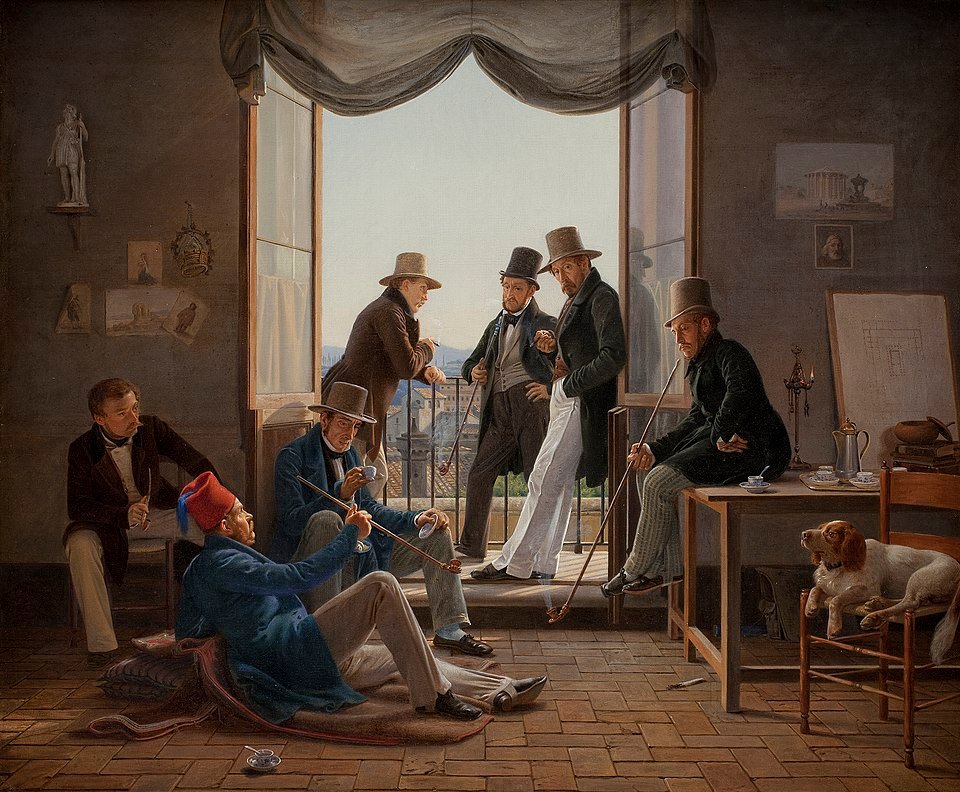
 A company of Danish artists in Rome, painted by Constantin Hansen, 1837. Lying on the floor is architect Bindesbøll. From left to right: Constantin Hansen, Martinus Rørbye, Wilhelm Marstrand, Albert Küchler, Ditlev Blunck and Jørgen Sonne.
A Different Kind of Brilliance
There is something almost suspicious about the Danish Golden Age. Not because it lacks importance, but because it refuses to announce it.
While much of Europe in the early 19th century was busy constructing grand narratives — revolutions, empires, romantic storms, historical drama — Denmark did something quieter. It turned inward. It looked at light. At rooms. At streets that did not aspire to become symbols.
And somehow, in that restraint, it produced one of the most precise visual languages in European art.
After Collapse, A Turn Inward
The Danish Golden Age did not emerge from triumph. It emerged from loss.
In the early 1800s, Denmark faced a series of national setbacks: economic decline, military defeat, the loss of Norway. The country, once regionally influential, found itself reduced — politically, economically, psychologically.
This matters.
Because instead of responding with grandeur, Danish artists responded with concentration. They did not attempt to compete with larger European powers. They refined their own perspective.
The result was not expansion, but clarity.
The Academy and the Discipline of Seeing
At the center of this movement was Christoffer Wilhelm Eckersberg, often referred to as the “father” of the Danish Golden Age.
Eckersberg was not revolutionary in the dramatic sense. He did not reject tradition. He systematized it.
His approach emphasized:
- precise observation
- controlled composition
- clarity of form
Students were encouraged not to invent, but to look. To study light, structure, proportion. To understand that realism was not about copying reality, but about constructing it carefully.
 View north towards Kronborg Castle, Denmark
This pedagogical discipline shaped an entire generation.
The City as Subject
One of the most striking aspects of Danish Golden Age painting is its attention to the everyday.
Copenhagen appears not as a capital, but as a place. Streets are empty or nearly so. Buildings stand without drama. Light moves across surfaces with quiet intention.
Artists like Christen Købke captured urban scenes that feel almost suspended in time. Nothing happens. And yet, everything is present.
This absence of event is not emptiness. It is focus.
Where other traditions seek narrative, Danish painting offers duration.
The Precision of Light
Light, in Danish Golden Age painting, is not atmospheric in the romantic sense. It is not dramatic. It does not overwhelm.
It is measured.
Surfaces are illuminated with a clarity that borders on mathematical. Shadows are controlled. Reflections are subtle. The effect is not spectacle, but stability.
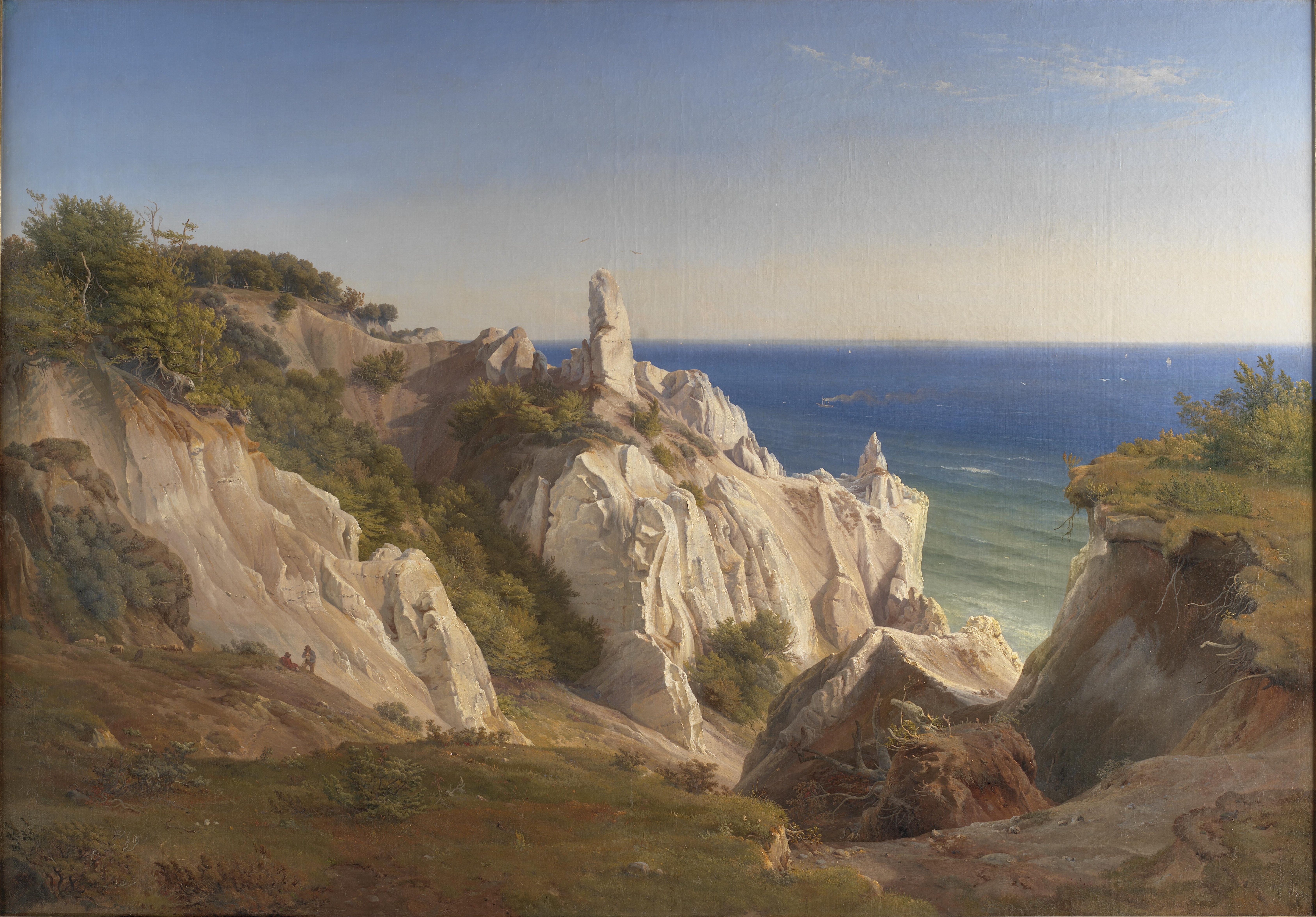 Møns Klint by Louis Gurlitt (1842)
For a broader understanding of how light has been treated across different artistic traditions, see this overview of realism in art.
But Danish realism is not quite the same as French or later photographic realism. It is less concerned with social commentary, less interested in exposing conditions.
It is, instead, concerned with accuracy without intrusion.
Interiors and the Architecture of Stillness
Perhaps the most recognizable contribution of the Danish Golden Age lies in its interiors.
Rooms appear empty or sparsely occupied. Furniture is arranged without excess. Windows admit light that seems to settle rather than enter.
There is a sense of containment.
This tradition would later find a quiet continuation in the work of Vilhelm Hammershøi, whose late 19th-century interiors extend the logic of stillness into something almost metaphysical.
 Vilhelm Hammershøi “Interior from Strandgade with Sunlight on the Floor”
But even in earlier works, the structure is present.
The interior is not just a space. It is a condition.
Silence as Method
It is tempting to describe Danish Golden Age painting as calm. But calm suggests passivity. What is happening here is more deliberate.
Silence is constructed.
Nothing distracts. Nothing interrupts. The viewer is not guided toward a narrative or emotional climax. Instead, they are asked to remain.
This creates a different kind of engagement.
One does not “read” these paintings. One inhabits them.
Against the European Current
To understand the uniqueness of the Danish Golden Age, it is useful to consider what it is not.
It is not:
- Romanticism (with its emphasis on emotion and nature’s force)
- Academic history painting (with its grand narratives)
- Later realism (with its social critique)
It exists alongside these movements, but does not fully align with any of them.
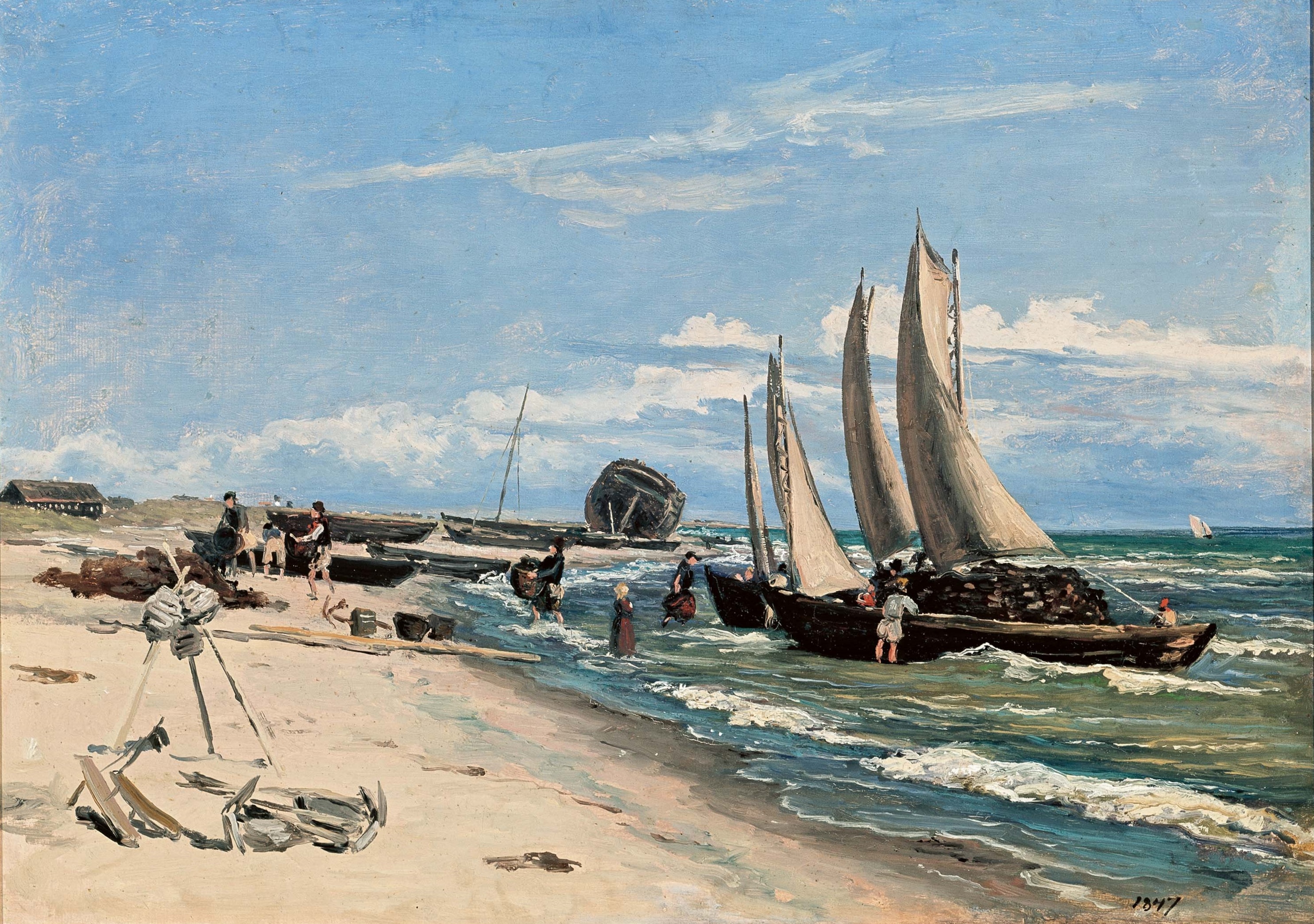 The beach at Skagen Vesterby by Martinus Rørbye (1847)
This independence is part of its strength — and part of the reason it is often overlooked.
It does not fit easily into established categories.
The Discipline of Limitation
There is a paradox at the heart of the Danish Golden Age: its limitation is its strength.
By focusing on:
- local environments
- controlled compositions
- restrained palettes
artists were able to develop a level of precision that broader ambitions might have diluted.
This is not minimalism in the modern sense. It is concentration.
 Summer afternoon by a lake, 1859
A refusal to expand beyond what can be fully understood.
The Persistence of Influence
The Danish Golden Age does not dominate art historical narratives in the way that larger movements do. It does not claim centrality.
And yet, its influence persists.
One can trace its logic in:
- contemporary interior photography
- minimalist design
- the aesthetic of “quiet luxury”
The emphasis on light, space, restraint — these are not relics. They are recurring preferences.
A similar attention to atmosphere and controlled visual language can be seen in pieces like I See Neon Lights Whenever You Walk By — The Prophecy, where environment becomes the primary subject, and narrative recedes.
A Culture of Looking
What the Danish Golden Age ultimately offers is not a style, but a way of seeing.
It suggests that attention, when applied carefully, is sufficient.
That not every image needs to declare itself. That not every composition requires complexity.
This is, in its own way, a radical proposition.
Final Reflection: The Weight of Quiet
In a visual culture increasingly defined by excess — color, speed, information — the Danish Golden Age feels almost resistant.
It does not compete. It withdraws.
And in that withdrawal, it creates space.
Space for observation. For duration. For a form of engagement that does not rely on intensity.
It reminds us that clarity can be as powerful as spectacle.
And that sometimes, the most enduring images are the ones that do not insist on being seen — but remain, quietly, until they are noticed.