
John William Waterhouse did not paint myth as an escape from reality. He painted myth as a trap.
His women do not simply appear inside stories. They seem to know that stories are closing around them. They stand by water, lean over mirrors, hold cups, cast spells, sit in boats, wait beside flowers, turn away from judgment, or look back at the viewer with the unnerving calm of someone who understands more than she intends to say. In Waterhouse, beauty is rarely innocent. It waits. It listens. It looks. Sometimes it destroys.
This is why his paintings continue to exert such a strange power. They are immediately seductive, full of hair, fabric, flowers, water, marble, myth, and skin. But underneath that beauty sits something darker: desire as danger, femininity as ritual, the gaze as curse, and the body as the place where myth becomes irreversible.
Waterhouse is often grouped with the Pre-Raphaelites, and rightly so in terms of subject matter, literary atmosphere, jewel-like color, and obsession with women drawn from poetry, mythology, and legend. But he arrived later than the original Brotherhood. He was not one of the youthful rebels of 1848. He was their afterlife: more theatrical, more fluid, more cinematic, and often more psychologically dangerous.
His best paintings do not merely illustrate old stories. They stage the precise second when beauty becomes fatal.
1. A Late Pre-Raphaelite, But Not Quite

Waterhouse was born in Rome in 1849 to English parents who were both painters, and later moved to London, where he trained at the Royal Academy Schools. That biographical outline already places him in an interesting position: English by artistic identity, Roman by birthplace, academic by training, Pre-Raphaelite by sympathy, and theatrical by instinct.
He did not belong to the original Pre-Raphaelite Brotherhood of Dante Gabriel Rossetti, John Everett Millais, and William Holman Hunt. By the time Waterhouse matured as an artist, the Brotherhood’s founding moment had already passed into influence, myth, and market. But that distance gave him freedom. He could inherit the Pre-Raphaelite love of medievalism, literature, intense color, and female beauty without being trapped by the group’s original program.
What he created was not pure Pre-Raphaelitism, but a late Victorian dream of it. His paintings often have the detail and literary subject matter associated with the movement, yet they are softer, more atmospheric, and more cinematic. He does not always sharpen the world into jewel-like precision. He lets it blur slightly at the edges. His figures breathe inside air, water, shadow, and fabric. They are not merely arranged in symbolic space; they seem caught inside a mood.
This is part of his lasting appeal. Waterhouse inherited Pre-Raphaelite beauty, but he made it more fluid, more theatrical, and more dangerous. If Rossetti’s women often seem like icons of desire, Waterhouse’s women often seem like desire just before it becomes narrative catastrophe.
That difference matters. Waterhouse did not only paint beautiful women. He painted women at thresholds: before death, before seduction, before punishment, before magic, before surrender, before disappearance. His genius was the dramatic pause.
2. Mariamne and the Theatre of Judgment

Mariamne Leaving the Judgement Seat of Herod is one of Waterhouse’s great theatrical paintings. It is not as popularly reproduced as The Lady of Shalott or Hylas and the Nymphs, but it reveals something essential about him: his ability to turn a historical or biblical subject into a drama of posture, architecture, and emotional distance.
The scene concerns Mariamne, the wife of Herod the Great, condemned after a political and marital crisis that turns intimacy into judgment. Waterhouse does not paint the moment as a chaotic eruption. There is no melodramatic collapse, no theatrical screaming, no easy visual violence. Instead, he gives us exit. Mariamne descends from the judgment seat, moving away with a dignity that almost freezes the room around her.
That restraint is what makes the painting powerful. Herod may possess authority, but Mariamne possesses the image. She is the figure the eye follows. Her movement down the stairs becomes almost ceremonial, not because she has escaped power, but because she refuses to be visually diminished by it. She is condemned, but not reduced.
The architecture around her matters. Stairs, columns, stone, and shadow turn the scene into a controlled theatre of hierarchy. Men gather, watch, judge, and occupy the structures of law and power. Mariamne moves through them as both subject and accusation. Her beauty is not decorative here. It becomes moral pressure.
Waterhouse understood that a woman leaving a room can be more dramatic than a man ruling one. In this painting, the real event is not the judgment itself, but the way Mariamne carries herself after it. She is already moving toward fate, but the painting allows her one final, magnificent possession: composure.
3. Cleopatra and the Stillness of Power

Waterhouse’s Cleopatra is fascinating because it resists the easiest version of its subject. Cleopatra has so often been turned into spectacle: seduction, luxury, empire, perfume, gold, death, theatrical excess. Waterhouse gives us something quieter and perhaps more dangerous. His Cleopatra is not performing for a crowd. She appears inward, controlled, almost sealed within herself.
That inwardness is the source of the painting’s power. Cleopatra is not shown at the height of dramatic action. She is not dying, bargaining, seducing, or collapsing into legend. She is present as thought. Her face carries the pressure of self-possession, as if the real drama is happening behind the eyes rather than in the room.
This is very Waterhouse. He often paints women not as simple symbols, but as vessels of concentrated knowledge. Cleopatra’s power here is not only erotic or political. It is psychological. She appears aware of her own image, aware of history’s appetite for her, and unwilling to give herself completely to the viewer’s desire.
The painting also shows Waterhouse’s interest in historical femininity as performance. Cleopatra is not just a person from antiquity; she is a role that culture keeps restaging. Waterhouse enters that tradition, but instead of giving us only opulence, he gives us suspended control. The queen does not need to move. The painting moves around her.
What makes this Cleopatra memorable is therefore not extravagance, but refusal. She refuses to become merely decorative. She refuses to explain herself. She refuses the viewer the comfort of easy access. In a century that loved to turn powerful women into beautiful warnings, Waterhouse gives Cleopatra the dignity of opacity.
4. The Lady of Shalott and the Art of Beautiful Doom

The Lady of Shalott remains Waterhouse’s most famous painting because it contains almost everything he does best: doomed femininity, literary melancholy, water, fabric, flowers, narrative tension, and a woman caught between beauty and death.
The painting draws from Alfred Lord Tennyson’s poem, in which the Lady is cursed to experience the world indirectly, through reflections, until she looks directly at Lancelot and seals her fate. It is a story about vision before it is a story about love. The tragedy is not merely that she desires. It is that she looks.
Waterhouse understands this perfectly. His Lady sits in the boat with the terrible composure of someone who has already crossed the line between safety and consequence. The candles, tapestry, chain, leaves, and water create an atmosphere of ritual departure. She is not simply floating away. She is being carried into myth.
This is why the painting continues to feel so modern. It is about the danger of mediated life. The Lady has only known the world through reflection; the moment she insists on direct experience, she is punished. One hardly needs to work very hard to make that feel contemporary. Every age invents its own mirrors.
Waterhouse’s brilliance lies in refusing to make the scene merely tragic. It is beautiful, almost unbearably so. That beauty is part of the horror. The painting seduces us into admiring the very conditions of her doom.
For readers interested in the poem behind the painting, Art-Sheep has previously gathered a selection of Alfred Lord Tennyson’s most memorable lines, including the literary world from which Waterhouse drew one of his most enduring images.
5. Water, Hair, and the Feminine as Spell

Water appears again and again in Waterhouse’s work, and it almost never behaves innocently. It is not merely scenery. It is invitation, threshold, mirror, and danger. His lakes, streams, pools, and riverbanks are places where ordinary boundaries weaken. Men lean too close. Women wait. Reflections multiply. Desire becomes liquid.
In Hylas and the Nymphs, this visual language reaches one of its most perfect forms. The myth tells of Hylas, companion of Heracles, abducted by water nymphs while searching for water. Waterhouse chooses not the violent climax, but the moment just before disappearance. Hylas bends toward the pool. The nymphs rise from the water with flowers in their hair and eyes fixed upon him. Nothing has happened yet. Everything has already happened.
The painting is unsettling because it is so quiet. The nymphs do not need claws, teeth, or dramatic gestures. Their power is attention. They look at Hylas with a collective stillness that feels almost ceremonial. He is not dragged into danger. He is invited toward it.
This is Waterhouse at his most dangerous. He understood that seduction is more terrifying when it does not move quickly. The painting’s beauty becomes a trap not only for Hylas, but for the viewer. We look at the nymphs looking at him, and suddenly we are implicated in the same gravitational pull.
The female figures in this painting are often discussed in terms of erotic appeal, but they are not passive. They control the space. Hylas may be the mythological subject, but the nymphs own the image. The viewer looks at them, but rarely feels in possession of them.
6. Sorceresses, Circe, and Women Who Know Too Much

Waterhouse’s sorceresses are among his most compelling women because they possess something beyond beauty. They possess knowledge. They hold cups, mirrors, potions, wands, books, circles, and invisible powers. They do not merely wait to be chosen or mourned. They act.
In Circe Offering the Cup to Odysseus, Circe sits enthroned before the viewer, cup extended, mirror behind her, magic already thick in the air. Odysseus is reflected, reduced, held at a distance. The compositional joke is exquisite: the legendary hero, the man of cunning and voyage, becomes secondary in the image. Circe occupies the front. Circe controls the frame.
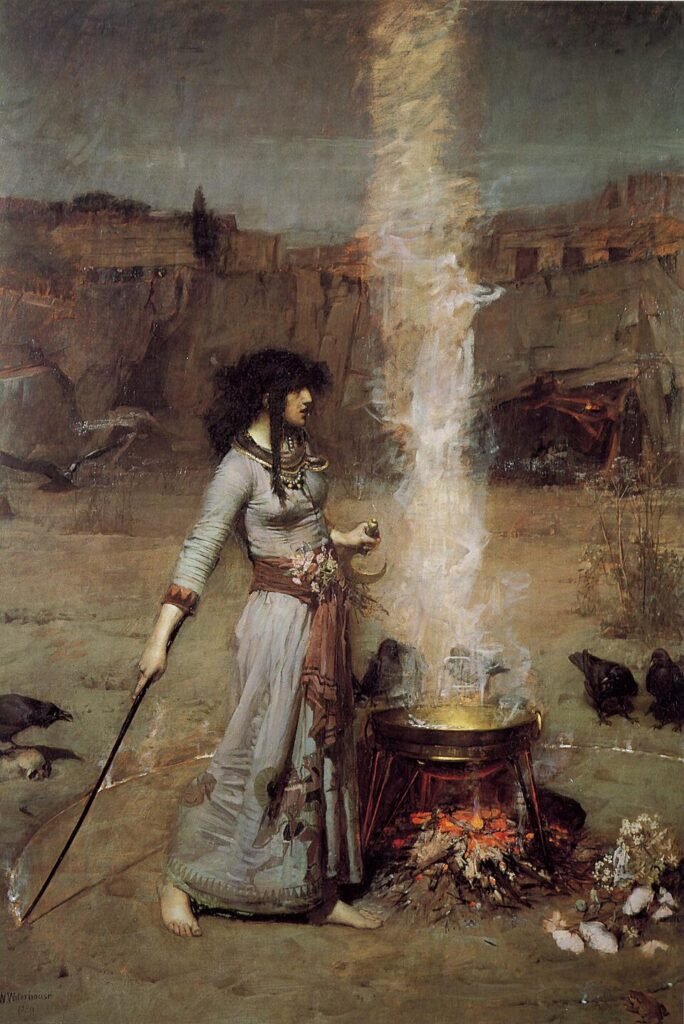
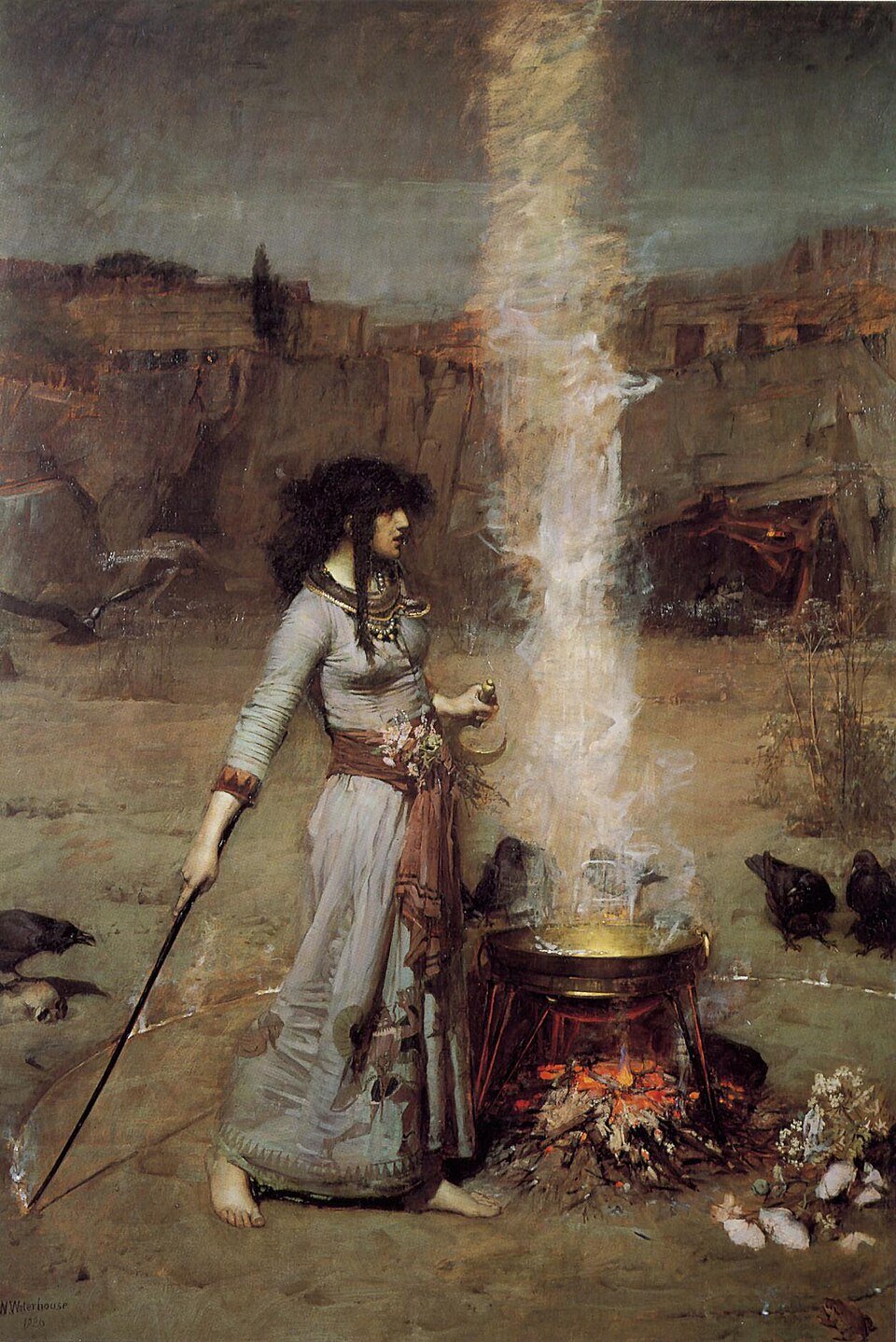
Waterhouse repeatedly returns to this kind of feminine power. In Circe Invidiosa, the sorceress pours poison into water with a cold, blue-green intensity that turns jealousy into atmosphere. In The Magic Circle, the woman marks out a ritual boundary while birds and smoke circle around her. These women are dangerous not because they are merely beautiful, but because they know how to transform the world.
Victorian art often loved the beautiful woman as object of desire, but Waterhouse’s magical women complicate that pleasure. They look, prepare, choose, manipulate, and withhold. They possess interiority in the form of ritual. Their beauty is not separate from power; it is one of power’s instruments.
This is why they continue to resonate in contemporary culture. Waterhouse’s sorceresses feel close to modern witch aesthetics, dark feminine iconography, and the visual revival of women who refuse to be harmless. They are not simply muses. They are systems of knowledge in human form.
7. Ophelia, Death, and the Erotic Calm of Tragedy

Waterhouse returned to Ophelia more than once, and it is easy to understand why. Shakespeare’s doomed young woman sits perfectly inside his imagination: flowers, water, madness, beauty, and death arranged into a figure of fragile theatrical stillness.
But Waterhouse’s Ophelia is not only a symbol of victimhood. She is a figure at the edge of transformation. The world around her feels almost too alive: leaves, flowers, water, fabric, and skin all participating in the atmosphere of impending loss. She has not yet disappeared into the river, but the painting already knows that she belongs to it.
This is part of the unsettling beauty of Waterhouse’s doomed women. He often paints them before the catastrophe fully arrives. The Lady of Shalott is in the boat, but not yet dead. Ophelia is by the water, but not yet submerged. Mariamne descends the stairs, but the fate implied by the judgment has not yet completed itself. Waterhouse loves the suspended second before myth closes.
That suspension can be troubling. Victorian art often aestheticized women’s suffering, turning death, madness, and surrender into objects of visual pleasure. Waterhouse is not innocent of that tradition. His paintings are too beautiful to be entirely comfortable. But that discomfort is part of why they remain interesting.
To love Waterhouse seriously is to recognize the danger of his beauty. He makes tragedy seductive. He makes doom decorative. He gives suffering flowers and luminous skin. The viewer has to ask why that is so appealing, and what exactly beauty is doing to the violence underneath.
8. The Male Viewer and the Woman Who Refuses to Be Simple

Any serious reading of Waterhouse has to confront the gaze. His paintings are filled with beautiful women, often arranged for contemplation by a viewer presumed, historically, to be male. They participate in Victorian fantasies of femininity: doomed maidens, dangerous seductresses, witches, nymphs, mermaids, and women caught in moments of erotic vulnerability.
And yet his women are rarely simple. They are looked at, but they do not always feel possessed by looking. Some meet the gaze. Some refuse it. Some look elsewhere, absorbed in knowledge unavailable to us. Some occupy the image so completely that the viewer’s desire becomes secondary to their stillness. Others, like Circe, stare with the quiet authority of someone who already understands the viewer’s weakness.
This is the tension that gives Waterhouse his modern afterlife. His paintings can be read as male fantasy, but not only as male fantasy. They are too unstable for that. Their women are beautiful, yes, but they often carry danger, knowledge, ritual, melancholy, or doom. They may be objects of desire, but they are also agents of atmosphere.

The viewer looks at them, but rarely owns them.
That distinction is important. Waterhouse’s women are not feminist icons in any simple contemporary sense, and forcing them into that role would flatten them. But neither are they merely decorative victims. Their power is often symbolic, theatrical, and psychological rather than social. They dominate because the painting makes the world bend toward them.
That may be Waterhouse’s great trick. He gives the viewer beauty, then lets beauty become a problem.
9. Why Waterhouse Still Works in Pop Culture

Waterhouse seems almost designed for the age of the moodboard. His paintings travel easily through Pinterest, Tumblr, dark academia, mythcore, witch aesthetics, fantasy illustration, book covers, perfume advertising, music-video imagery, and every corner of the internet that still believes a woman beside water with heavy hair might mean something.
His images are instantly legible. A Waterhouse woman is recognizable even before one knows the title: the long hair, the lowered gaze, the flowers, the robe, the water, the ritual object, the mythological tension, the faint sense that something irreversible is about to happen. His paintings provide an entire atmosphere in one glance.
But their popularity is not only aesthetic. Waterhouse works online because his images are narrative without requiring full explanation. They feel like fragments from stories the viewer almost remembers. A woman in a boat, a witch with a cup, nymphs in water, Cleopatra thinking, Ophelia waiting, Mariamne descending. Each image contains a before and after, even when the viewer does not know the source.
That quality makes him endlessly reusable. Fantasy artists borrow his mood. Fashion borrows his drapery and melancholy. Book design borrows his mythic femininity. Contemporary visual culture borrows his mixture of softness and threat. His paintings are old, but the emotional technology still works.
Waterhouse remains popular because he understood something that digital culture also understands: a powerful image does not need to explain everything. It needs to create a mood people want to enter.
10. The Problem With Loving Waterhouse

There is a problem with loving Waterhouse, and it should not be avoided. His paintings are almost too beautiful. They can feel like perfect machines for producing aesthetic surrender: pale skin, heavy hair, tragic eyes, symbolic flowers, mythological danger, and the old erotic calm of women who are either doomed, magical, unreachable, or dead soon enough.
That beauty can become suspicious. Is it too easy? Too pleasurable? Too bound up with Victorian fantasies of women as tragic spectacle? Does it turn female suffering into decoration? Does it make danger beautiful enough to consume? Does it ask us to confuse aesthetic intensity with emotional depth?
The answer, inconveniently, is sometimes yes.
But that does not make Waterhouse less interesting. It makes him more necessary to read carefully. His paintings endure not because they are innocent, but because they are unresolved. They sit at the point where beauty, desire, myth, and discomfort become inseparable. To dismiss them as merely pretty is shallow. To worship them without criticism is also shallow. The real work is to remain inside the tension.
Waterhouse is not a painter of safe beauty. His beauty has consequences. It pulls men into water, sends women toward death, gives sorceresses power, turns queens into icons, and makes judgment look theatrical. The paintings are seductive, but their seduction is rarely clean.
That is why they remain alive. Waterhouse gives us the pleasure of looking, and then quietly makes that pleasure suspect.
11. The Spell Remains

John William Waterhouse did not invent the myths he painted. He did something subtler and perhaps more dangerous: he gave them faces that continue to haunt the modern eye.
His women remain suspended in that impossible second before the story becomes irreversible. Mariamne descends from judgment. Cleopatra thinks behind a face history wants to possess. The Lady of Shalott enters the boat. Hylas bends toward the water. Circe offers the cup. Ophelia waits near the river. The mermaid sings. Narcissus looks. Echo fades.
Again and again, Waterhouse paints the threshold. The moment before surrender, before death, before spell, before recognition, before disappearance. That is his true subject. Not mythology itself, but the instant when myth begins to close around the human body.
This is why his paintings still work. They are beautiful, but not merely beautiful. They are literary, but not merely illustrative. They are decorative, but not empty. They carry inside them the old and persistent terror that beauty may know more than we do.
Waterhouse’s women do not merely appear inside myth.
They are the moment myth becomes impossible to escape.