
Some athletes enter history by winning. Muhammad Ali entered by arriving.
Before the punch, before the title, before the moral grandeur, before the exile, before the Parkinson’s tremor softened the once-furious body into something almost saintly, there was the entrance. Ali understood the frame before most athletes understood the camera. He did not merely stand inside it. He consumed it.
There is a reason photographs of Ali rarely feel like neutral sports documentation. Even when he is sitting still, the image seems to move toward him. The room adjusts. The faces around him become supporting architecture. The microphone looks borrowed from his own mythology. The boxing ring becomes a stage. The press conference becomes theatre. The interview becomes combat. The boast becomes literature. The body becomes a sentence.
Ali’s greatness cannot be reduced to boxing, although the boxing was astonishing. He was fast when a heavyweight was not supposed to be fast, elegant where brutality was expected, theatrical where discipline was demanded, and verbally dangerous in a sport that had long preferred its violence wordless. He did not simply defeat opponents. He authored the atmosphere in which they were defeated.
This is why Muhammad Ali remains so difficult to classify. He was an athlete, certainly. Also a performer, poet, provocateur, political symbol, comedian, exile, martyr, celebrity, Muslim icon, anti-war figure, humanitarian, and one of the most reproduced faces of the twentieth century. He was not only “The Greatest” because he said so. He was “The Greatest” because he turned self-naming into destiny, and then forced the world to argue with the label until the argument became pointless.
The Moving Frame
TikTok compilation embed slot: paste the clean TikTok compilation URL and video ID here. Ideally use a vertical compilation with minimal or no text overlay: Ali entrances, footwork, interviews, Liston, Foreman, Cosell, and Olympic torch footage.
@alphamotivation0 Words of wisdom from Muhammad Ali ⚡️ #muhammadali #inspiration ♬ orijinal ses – Alpha Motivation
1. The Fighter Who Understood Performance Before the Word Became Strategy

Ali’s charisma was not accidental. It was not merely a pleasant by-product of talent, good looks, youth, and a mouth that seemed to have its own electricity supply. It was a discipline. He performed confidence until confidence became a public fact. He understood that boxing was not only a sport of fists, but a sport of expectation. The fight began before the bell. It began in the dressing room, in the newspaper column, in the insult, in the prediction, in the rhyme, in the stare.
Before Ali, many fighters were marketed as dangerous. Ali marketed himself as inevitable. That was different. He did not simply promise victory; he staged it in advance, then invited the public to watch reality catch up with the script. His boasts were part prophecy, part comedy, part psychological warfare, and part American salesmanship sharpened into art. “I am the greatest” was not a statement of fact when he first said it. It was a spell.
The remarkable thing is how quickly he made the spell work. He was playful, but not harmless. He was funny, but never merely comic. He understood rhythm, pause, repetition, and the pleasure of shocking a room awake. In interviews, he moved like a boxer even when seated: feinting, dodging, jabbing, smiling, withdrawing, then landing a line before anyone had found their balance.
This is why Ali belongs not only to sports history, but to performance history. He anticipated the modern athlete as media author: the figure who does not wait for journalists to define him, but produces his own mythology in real time. Today, that feels normal. In Ali’s era, it was almost indecent.
2. The Body That Made Heavyweight Boxing Look Like Dance

Ali’s body was part of the myth because it contradicted the expectations attached to heavyweight boxing. Heavyweights were supposed to suggest mass, force, punishment, blunt pressure. Ali suggested speed, lightness, insolence, and escape. He made the largest division in boxing look briefly airborne.
His famous phrase, “float like a butterfly, sting like a bee,” survives because it is both slogan and accurate visual criticism. It describes not only a style, but a contradiction: delicacy and violence in the same body. Ali’s greatness was never just that he could hit. It was that he could make not being hit look like a form of beauty.
Watch him move and the first surprise is how much space he appears to own. He leans away from danger with theatrical calm. He drops his hands, not because the danger is absent, but because he wants the danger to feel foolish. He moves backward with arrogance. He turns defense into insult. He makes the opponent chase him, and then makes the chase look humiliating.
That physical intelligence is part of his pop-cultural afterlife. Ali does not need the full context of boxing strategy to remain legible. A few seconds of footage are enough: the shuffle, the lean, the rope, the fast hand, the smile. His body reads instantly, even to people who do not watch boxing. Like Chaplin’s walk or Michael Jackson’s moonwalk, Ali’s movement became a signature. It could be imitated, parodied, quoted, remembered.
This is rare. Most athletes need the scoreboard to explain them. Ali’s body explained itself.
3. The Mouth as Weapon, Music, and Mask

Ali spoke as if language itself were a combat sport. The rhymes, insults, jokes, predictions, and sudden moral declarations did not sit outside his boxing. They were part of it. He used speech to enlarge the stakes of the fight, to unsettle opponents, to seduce journalists, to divide audiences, to invent himself aloud.
There is a reason Ali is so often discussed as a precursor to hip-hop’s culture of braggadocio, rhythm, self-naming, and verbal combat. He turned boasting into performance poetry. He made arrogance musical. He understood that a line could travel faster than a punch because it did not require a ring, a referee, or an opponent. It could be repeated by children, printed in newspapers, replayed on television, and eventually turned into cultural memory.
But Ali’s mouth was not only a weapon. It was also a mask. The comedy protected the seriousness. The arrogance protected the vulnerability. The performance protected the man who knew exactly what it meant to be hated by people who preferred Black athletic excellence when it remained grateful, quiet, and politically convenient.
That is why Ali’s speech still feels dangerous. He was not simply loud. He was unmanageable. He refused the old contract in which the athlete performs physically and leaves meaning to others. Ali insisted on meaning himself. He named himself. He interpreted himself. He provoked his own audience into understanding that they were not merely watching a boxer, but confronting a personality too large to be comfortably consumed.
4. The Image That Took Over the Century

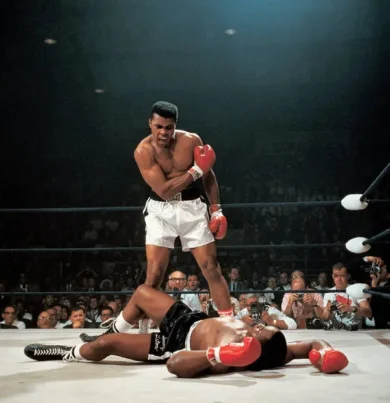
If one image explains Ali’s relationship to the camera, it is the famous photograph of him standing over Sonny Liston in 1965. The image is so overdetermined now that it almost resists description. Ali is above. Liston is below. The body of the champion is alive with command. The defeated opponent appears less like a man than a collapsed era. The ring becomes a theatre of dominance, and Ali does not merely occupy the center. He devours it.
The photograph works because it is not just a record of a knockdown. It is a composition of destiny. Ali appears to be shouting not only at Liston, but at history itself: get up, answer me, explain how you intend to survive this. The young champion had already been controversial, already loud, already impossible to ignore. In that instant, the camera caught what words had been trying to say.
This is what “consuming the frame” means. Some figures are contained by photographs. Others organize them. Ali belonged to the second category. His presence rearranged the visual hierarchy around him. Even in crowded scenes, he often appears to pull gravity toward himself. Photographers did not merely capture Ali. They chased the event of his presence.
The Liston image became one of the defining sports photographs of the twentieth century because it compresses so many Alis into one frame: the athlete, the performer, the provocateur, the beautiful young man, the threat, the joke, the prophet, the American problem. It is victory as visual grammar.
5. The Refusal That Turned Fame Into History

Ali could have remained a spectacular athlete. That would have been enough for ordinary immortality. But in 1967, at the height of his physical prime, he refused induction into the U.S. Army during the Vietnam War. The decision cost him his title, his boxing license, years of his career, and much of the country’s approval. It also transformed him from celebrity into historical figure.
There are many athletes who become symbols after they retire, when the danger has passed and their courage can be safely edited into inspiration. Ali became a symbol while the cost was still immediate. He did not wait for consensus. He did not soften the decision into public-relations language. He stood inside the consequences.
This is central to Ali’s charisma because it revealed that the performance had a spine. The boasts were not empty theatre. The self-belief was not merely promotional. When the state, the media, and much of the public demanded compliance, Ali refused to disappear into obedience. He chose exile from boxing rather than surrender the authority of his conscience.
That refusal changed how every earlier boast sounded. “I am the greatest” could have remained comic arrogance. After 1967, it became part of a larger self-possession. Ali had claimed the right to define himself in the ring, in religion, in politics, and before the government. His charisma stopped being simply attractive. It became dangerous, because it was attached to conviction.
That is why Ali’s historical value cannot be measured only by belts, wins, or famous fights. His career became a public argument about race, religion, war, patriotism, masculinity, celebrity, and the price of dissent. He made the athlete impossible to keep separate from politics, and many people have still not forgiven him for being right so early.
6. Rumble in the Jungle: Myth Under Floodlights

The Rumble in the Jungle did not feel like a boxing match so much as an imperial dream staged under tropical floodlights. Kinshasa, 1974. George Foreman, terrifying and undefeated. Ali, older than the myth preferred, politically scarred, supposedly too vulnerable to survive Foreman’s power. The event already felt impossible before anyone threw a punch.
Then Ali did what great performers do: he changed the rules of the spectacle while standing inside it. The rope-a-dope strategy was not merely tactical. It was theatrical humiliation disguised as endurance. He leaned, absorbed, whispered, taunted, invited Foreman to spend himself. He turned punishment into bait. He made apparent weakness into a trap.
The victory restored the heavyweight title, but more importantly it restored the myth under new conditions. Young Ali had been speed, insult, and beauty. The Ali of Zaire was cunning, suffering, intelligence, and resurrection. He no longer consumed the frame only through youth. He consumed it through narrative.
This is why the fight remains so culturally powerful. It contains nearly everything: sport, politics, Black internationalism, spectacle, music, dictatorship, media, danger, exhaustion, resurrection. Ali did not just defeat Foreman. He gave the twentieth century one of its cleanest comeback myths.
The chant “Ali boma ye” turned the fight into collective theatre. The crowd did not merely watch him. It helped produce him. Ali had always understood audiences, but in Zaire the audience seemed to become part of his body: chanting, urging, naming, willing the myth back into full power.
7. Pop Culture Did Not Borrow Ali. Ali Invaded Pop Culture.

Ali’s pop-culture impact is enormous because he did not wait to be absorbed by popular culture. He invaded it. He moved between sport, television, music, comedy, politics, advertising, film, comic books, photography, and public speech with unusual ease. He belonged everywhere because he behaved as if every space had been expecting him.
His meeting with The Beatles in 1964 remains one of those perfect historical collisions in which youth culture, celebrity, performance, and mass media suddenly recognize themselves in the same room. The Beatles and Ali were both in the process of becoming global phenomena. The photographs from that encounter feel less like publicity than prophecy: the old structures of fame were changing, and here were five young men who knew how to make the camera obey.
Ali later entered comic-book mythology itself through Superman vs. Muhammad Ali, a 1978 DC Comics event so absurd and perfect that it now feels inevitable. Of course Ali had to fight Superman. Ordinary opponents had stopped being enough. Pop culture required a cosmic scale for his ego, and the joke worked because the ego had always been part of the entertainment.
He also influenced the language of later performers. Hip-hop inherited something from Ali’s braggadocio: the self-naming, the verbal rhythm, the public boast as survival, the transformation of insult into art. The modern athlete’s media persona, the rapper’s exaggerated self-mythology, the activist-celebrity’s moral platform, the meme-ready interview moment — Ali stands somewhere near the beginning of all of them, smiling because he got there first.
The Muhammad Ali Center describes him as a magnetic pop-culture presence connected to figures such as Sam Cooke, The Beatles, Elvis Presley, and Andy Warhol. That range matters. Ali was not a sports celebrity who occasionally crossed into culture. He was culture, moving in boxing gloves.
8. The Olympic Torch and the Rewriting of the Public Body

By the time Ali lit the Olympic cauldron in Atlanta in 1996, the body had changed. The young man who once turned heavyweight boxing into dance now stood visibly affected by Parkinson’s disease. His hand shook. The flame moved. The world watched not athletic dominance, but vulnerability made ceremonial.
It remains one of the most moving public images in modern sports history because it rewrote the meaning of Ali’s body without diminishing it. The same body that had been speed, arrogance, beauty, and violence now became endurance, fragility, and grace. The frame did not pity him. It honored him. Or rather, Ali forced the frame to understand honor differently.
What made the moment so powerful was not nostalgia alone. It was the collision of every Ali at once. The Olympic gold medalist. The heavyweight champion. The anti-war exile. The comeback artist. The global humanitarian. The man who had once made the world listen through volume, now making it listen through silence.
This is the final proof of Ali’s command over image. Even stripped of speed, even without the old voice firing at full force, even under the visible pressure of illness, he remained visually sovereign. The tremor did not erase the charisma. It deepened it. The frame, once again, belonged to him.
9. Why Muhammad Ali Still Feels Modern

Ali still feels modern because he solved the central problem of contemporary fame before contemporary fame fully existed. He understood that visibility is not the same as power unless one controls the meaning of that visibility. He did not merely allow himself to be watched. He gave the watching a structure.
Every public figure today is expected to be more than one thing: performer, brand, moral speaker, entertainer, visual icon, archive, meme, and contradiction. Ali was all of this decades earlier, but with higher stakes and better timing. He made the athlete into a total cultural figure. He showed that sport could produce not only champions, but authors of public imagination.
His charisma was not politeness, not likability, not charm in the shallow sense. It was force. It attracted and irritated at the same time. It made admiration difficult to separate from argument. It demanded that people respond, and response is the oxygen of myth.
This is why Ali’s image survives in so many forms. In photographs, he is gesture. In interviews, he is rhythm. In boxing footage, he is contradiction. In politics, he is refusal. In pop culture, he is prototype. In memory, he is almost too large to keep in one category.
There have been greater technicians, greater punchers, perhaps even greater single-night fighters, depending on what one values in boxing. But very few athletes have ever understood so completely how to become an image without becoming empty. Ali consumed the frame because the frame was never large enough for him. He needed the ring, then the camera, then the press, then politics, then pop culture, then history itself.
And somehow, absurdly, magnificently, he got all of them.