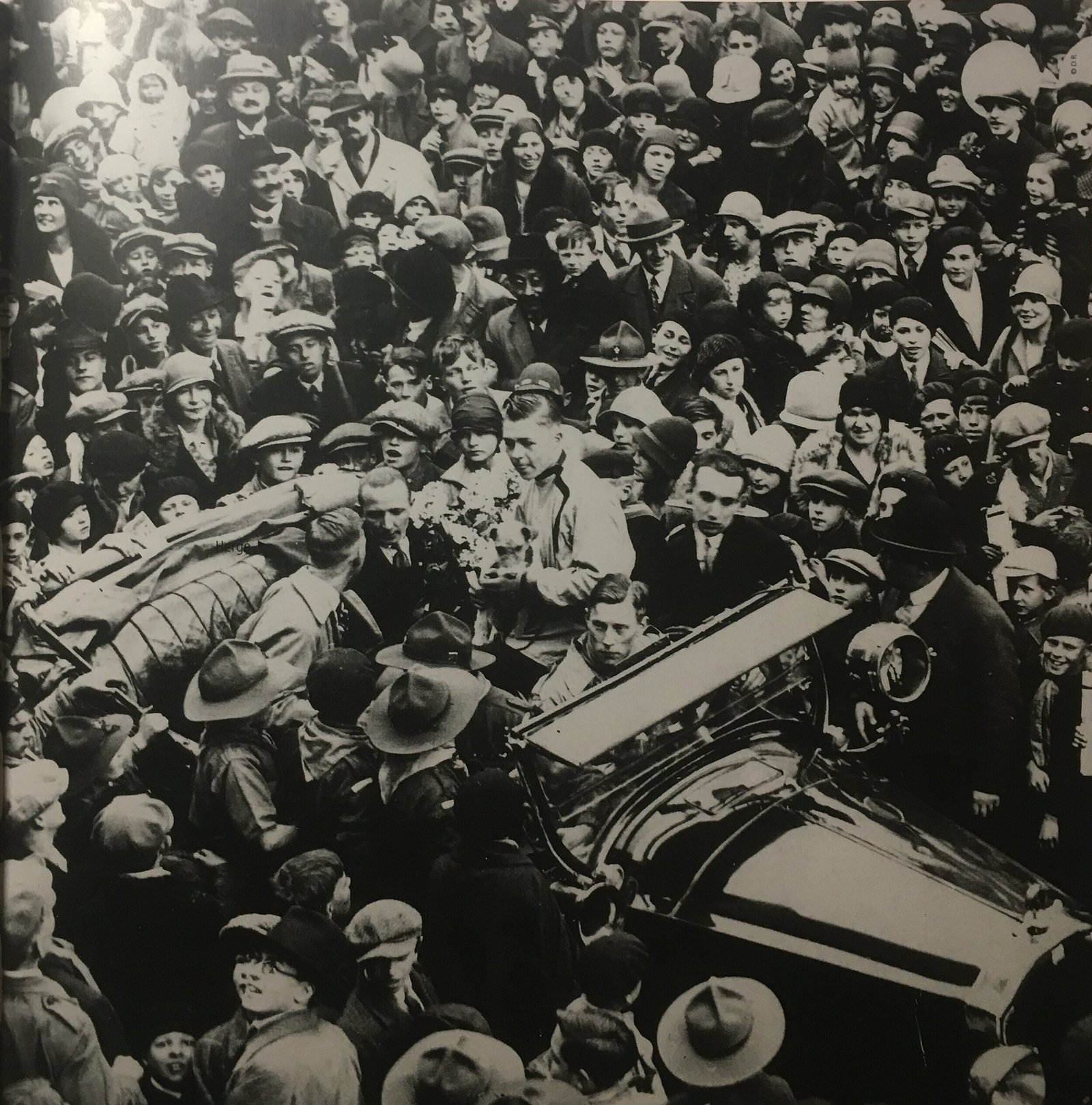
On 8 May 1930, Brussels welcomed home a boy who did not exist.
He arrived by train, supposedly from Soviet Russia, accompanied by a white dog and received by a crowd that behaved as though a comic-strip hero had somehow crossed the border between paper and public life. The boy was not Tintin, of course. Tintin was ink, contour, speech bubbles, moral certainty, and a suspiciously clean pair of trousers. The boy was Lucien Pepermans, a fifteen-year-old scout dressed for the part. But the crowd was real. The station was real. The excitement was real. And that is where the story becomes stranger than a publicity stunt.
From the beginning, Tintin was never only a character. He was presented as a reporter, treated like a public figure, welcomed like a returning traveller, and eventually surrounded by the kind of rituals usually reserved for institutions: passports, fan societies, symbolic embassies, consulates, national days, and a fictional country whose imaginary bureaucracy still somehow feels more charming than several real ones.
This is not simply a history of Tintin fandom. It is a history of pretending — seriously, affectionately, and with surprising administrative commitment — that Hergé’s young reporter is real.
1. Tintin, Reporter of a Newspaper That Needed Him to Be Real

Tintin’s strange reality begins with his profession. He was not introduced merely as an adventurer, a schoolboy, a detective, or a fantasy hero. He was introduced as a reporter. That distinction matters. A reporter belongs to the world of institutions, newspapers, dispatches, deadlines, foreign correspondence, and factual authority. Even before the reader entered the story, the format had already lent Tintin a borrowed legitimacy.
Le Petit Vingtième, the children’s supplement of the Belgian newspaper Le Vingtième Siècle, did not simply publish Tintin. It gave him a professional address. It placed him inside the machinery of journalism. In Tintin in the Land of the Soviets, the boy reporter is sent abroad on assignment, as if the comic strip were not pure invention but a sequence of visual reports arriving from elsewhere. Fiction borrowed the costume of correspondence.
This was one of Hergé’s most effective early tricks. Tintin was fantastical, certainly, but his fantasy was disguised as reportage. He travelled through recognizable political geographies. He encountered regimes, criminals, borders, trains, ships, airports, uniforms, passports, and state power. He moved through the twentieth century not like a mythological figure from nowhere, but like a young correspondent whose editor had given him an impossible assignment and no apparent adult supervision.
That journalistic framing allowed readers to pretend with unusual ease. Tintin did not arrive as a superhero. He arrived as a colleague. He had a job. He had a dog. He had a paper that seemed to stand behind him. The child reader could therefore imagine him not as a creature of pure fantasy, but as someone who might plausibly exist just beyond the next issue, reporting back from a world that was both political and cartoonishly obedient to narrative destiny.
This is why the early fiction of Tintin feels different from many adventure comics of the period. Its unreality is not built by escaping the real world, but by moving through it with suspicious clarity. Hergé understood that a fictional character becomes more powerful when he seems to have paperwork.
2. The Day Tintin Came Home

The most famous early act of pretending took place at Brussels’ Gare du Nord. When Tintin in the Land of the Soviets reached the end of its serialized run, the newspaper staged the hero’s return as though his adventures had actually happened. A boy scout, Lucien Pepermans, was dressed as Tintin and placed on a train. He arrived as the fictional reporter returning from Soviet Russia via Berlin. A white dog completed the illusion, because myth, like branding, understands the importance of silhouette.
According to the official Tintin site, Brussels was excited by the appearance of Tintin on 8 May 1930, when Pepermans stepped off the train in character. The same type of public reception would later be repeated after Tintin in America. What might have been a modest promotional gesture became something much larger: a crowd gathered, the boy was welcomed, and the fictional correspondent briefly became a public body moving through the city.
It is difficult not to see the scene cinematically. The train arrives. Children wait. A boy who is not Tintin appears as Tintin. The crowd agrees to the fiction. That agreement is the important part. The event did not deceive anyone in the strict sense. People knew, or could have known, that this was performance. But they participated anyway. The pleasure was not in being fooled. The pleasure was in behaving, together, as though the fiction deserved a reception.
This makes the 1930 event feel oddly contemporary. Long before immersive marketing, cinematic universes, alternate-reality campaigns, and carefully managed fan events, Tintin had already stepped off the page and into public space. The comic was no longer enough. The hero had to arrive.
That arrival changed the relationship between reader and character. Tintin was no longer only read in private. He could be witnessed. He could be welcomed. He could be pulled into civic ritual. He had become a little public myth with a train schedule.
3. Early Fandom Before Fandom Had a Name

It would be misleading to call this early Tintin culture “fandom” in the modern sense. There were no message boards, no fan edits, no algorithmic shrines, no conventions selling enamel pins to exhausted adults. Yet the basic emotional structure was already present. Readers did not merely consume Tintin. They gathered around him. They waited for him. They treated his movements as news.
This is what makes the early public receptions so fascinating. They reveal a transitional moment in media culture: the newspaper still belonged to the age of print, but the character had already begun to behave like a shared social object. Tintin was serialized, anticipated, discussed, and eventually staged. The readers were not passive. They became witnesses. Their presence helped complete the fiction.
The newspaper understood this instinctively. By organizing public appearances, it transformed reading into participation. Children were not just following Tintin’s adventures; they were entering the ritual atmosphere around them. They could point to the paper, then to the train station, then to the boy in costume, and feel that the line between the printed adventure and ordinary Brussels had briefly become porous.
That porosity is the beginning of fandom as a social force. A fictional figure becomes powerful when readers start arranging real feelings around him. They make time for him. They travel to see him. They collect him. They defend him. They speak of him with the peculiar seriousness reserved for things everyone knows are invented but nobody wants to treat as insignificant.
Tintin’s early readers were therefore not simply an audience. They were the first citizens of an imaginary republic — or, given what would follow, perhaps the first subjects of an imaginary monarchy.
4. Hergé as Myth-Maker, Not Just Cartoonist

Hergé is often discussed as a master of drawing, pacing, research, and visual clarity. All of that is true. But to understand why Tintin could be treated as real, one must also see Hergé as a maker of public myth. He did not merely invent stories. He created a system in which a fictional boy could acquire credibility through repetition, design, geography, and media ritual.
Part of this credibility came from the visual language of Tintin itself. Hergé’s clean line made the world unusually legible. Cities, trains, ports, castles, laboratories, streets, desert roads, uniforms, and machines were drawn with such compositional order that even the most improbable adventures seemed to occur inside a coherent reality. The reader might not believe in every event, but they could believe in the space through which the events moved.
The journalistic premise did the rest. Tintin was not simply wandering. He was reporting. He encountered the world as an observer, investigator, witness, and accidental participant in history. His adventures borrowed the seriousness of geopolitics while retaining the elasticity of comic fiction. That combination allowed him to become strangely credible: a boy too pure to be realistic, moving through worlds too carefully described to feel entirely fake.
This is where Hergé’s myth-making becomes most sophisticated. Tintin himself is psychologically sparse. He is not tormented like a modern antihero, not weighed down by biography, not obviously aging, changing, or collapsing under the moral difficulty of existence. He remains almost impossibly stable. That stability makes him less like a conventional character and more like an emblem. He is a function: reporter, witness, moral vector, clear shape moving through a complicated century.
For a broader look at Hergé’s creation and its legacy, our earlier Art-Sheep feature, The Timeless Legacy of Tintin: A Deep Dive into Hergé’s Masterpiece, explores how Tintin became one of the defining works of European comics. But the deeper oddity remains this: Hergé did not just make Tintin readable. He made him socially usable. People could gather around him and pretend, with great sincerity, that the boy reporter had somehow entered the room.
5. Syldavia: The Fictional Country That Behaved Like a Nation

If Tintin was the fictional reporter who behaved like a public figure, Syldavia was the fictional country that behaved like a nation. Introduced in King Ottokar’s Sceptre, Syldavia is one of Hergé’s most successful acts of world-building: a Balkan monarchy complete with royal history, political danger, national symbols, invented language, rival neighbor, and the kind of ceremonial gravity that makes imaginary states feel more convincing than some actual press conferences.
Syldavia is not merely a backdrop. It has institutions. It has a king. It has enemies. It has a motto, heraldry, borders, customs, and a capital. It has enough internal density to invite readers not only to believe in it while reading, but to continue believing playfully after the book is closed. That is the crucial difference between setting and world. A setting serves the story. A world keeps producing meaning after the story ends.
Hergé understood that fictional countries become compelling when they are over-specified. A name is not enough. The country must have rituals, anxiety, vocabulary, architecture, food, flags, uniforms, and bureaucratic flavor. It must seem as though it existed before the hero arrived and would continue existing after he left. Syldavia does exactly that. Tintin passes through it, but the kingdom feels like it has its own national weather.
This is why Syldavia has had such a long afterlife among readers. It is not merely a place in Tintin. It is an invitation to administrative fantasy. If there is a fictional kingdom, why should there not be fictional citizens? If there are citizens, why not passports? If passports, why not embassies? At some point, make-believe stops being childish and starts looking suspiciously like culture.
The official Tintin website has leaned into this beautifully with its Syldavian citizens page, where users can apply for a Syldavian passport after creating an account. The gesture is comic, of course, but also revealing. It continues the oldest Tintin ritual: treating a fictional world as though it deserves paperwork.
6. Embassies, Consulates, and the Diplomacy of Make-Believe

Some fandoms create costumes. Tintin fandom created paperwork.
Among the strangest and most charming extensions of the Tintin universe are the symbolic embassies, consulates, and diplomatic gestures surrounding Syldavia. These are not official institutions, because Syldavia is not an official country, and a sentence like that already suggests the delightful absurdity of the matter. Yet fans have repeatedly treated the kingdom as if it could sustain ceremony, correspondence, representation, and national pride.
The result is a form of fictional diplomacy. A fan may not merely dress as a character or collect editions of an album. He may speak as a consul. He may refer to national days, royal traditions, cultural heritage, and diplomatic courtesy. The joke becomes institutional. The fantasy moves from costume to bureaucracy, which is perhaps the most European form of devotion imaginable.
This matters because it shows how deep the Tintin illusion runs. Readers are not only attached to characters; they are attached to the systems surrounding them. Syldavia provides a political theatre in miniature. It allows fans to perform citizenship, loyalty, protocol, rivalry, and historical memory inside a country that exists nowhere except in books, websites, comments, rituals, and the highly organized part of the imagination that enjoys letterheads.
The official Tintin site’s 2025 post celebrating Syldavia’s national day even includes a comment from the “Consulate of Syldavia in Bangkok,” thanking the site for honoring Syldavian traditions. Whether read as roleplay, parody, affection, or micronational theatre, the effect is wonderful. A fictional state speaks in the voice of diplomacy, and everyone understands the rules of the game.
The remarkable thing is not that people know Syldavia is fake. Of course they do. The remarkable thing is that they also know pretending it is real creates a pleasure that mere factual correction cannot improve.
7. Tintinophilia: The Serious Business of Loving a Fictional Reporter

The word tintinophile sounds faintly comic, as all beautiful obsessions do when given a formal name. Yet tintinophilia is not casual nostalgia. It is a culture of preservation, collection, study, argument, classification, pilgrimage, and almost religious attention to the details of Hergé’s universe. For many readers, Tintin is not simply something they enjoyed in childhood. He is an archive they continue to inhabit.
The Belgian association Les Amis de Hergé, founded in 1985 by a group of enthusiasts, describes itself as one of the oldest and most important tintinophile associations, with members across many countries. That kind of organization tells us something important. Tintin’s afterlife is not only commercial, although it certainly is that. It is also scholarly, emotional, communal, and ritualistic.
Tintinophilia often appears charming because it is so precise. Fans care about editions, publication histories, character appearances, changes in color versions, translations, vehicles, maps, political references, fictional languages, and the complex moral weather around Hergé himself. This is not simply admiration. It is stewardship. Tintin’s world has become something people maintain.

There is a difference between loving a character and preserving a civilization of details around him. Tintin encourages the second kind of devotion because his universe is orderly enough to catalogue and mysterious enough to keep re-reading. Every object seems placed. Every line seems intentional. Every country, building, disguise, and recurring face can be treated as evidence.
That evidentiary quality is one reason Tintin can still feel real. Real people leave documents. So does Tintin. Real nations leave flags, maps, stamps, and ceremonies. So does Syldavia. Real cultural figures generate societies and museums. So does Hergé. The fiction has accumulated the material habits of reality.
8. Why Tintin Feels More Real Than Many Real People

Tintin feels real partly because he is not burdened by the instability of actual personhood. Real people contradict themselves, decay, disappoint, revise their opinions, age into complexity, and occasionally post things online that make everyone regret literacy. Tintin does almost none of this. He remains clear, available, unaged, and instantly recognizable. His lack of psychological evolution, often criticized, is also the source of his mythic durability.
Modern characters often become “real” through depth: trauma, contradiction, biography, interior conflict. Tintin becomes real through constancy. He is not deep in the confessional sense. He is durable in the emblematic sense. He does not reveal himself gradually because he was never designed as a modern interior self. He is a figure of action and recognition. A clear shape moving through a complicated world.
This is why people can project so much onto him. Tintin is morally legible but psychologically open. He is brave, curious, decent, stubborn, observant, and somehow almost empty of ordinary private life. No parents, no romantic entanglements, no visible aging, no inconvenient adolescence, no midlife collapse, no mortgage. He is less a person than a vessel for adventure, and vessels travel well.
That emptiness allows him to become socially full. Readers can treat him as reporter, friend, symbol, childhood companion, national export, collecting obsession, design icon, or myth. He is stable enough to hold all these meanings without breaking. In that sense, Tintin is real in the way myths are real: not because they happened, but because people continue to behave as if they matter.
And people have behaved that way for almost a century. They have welcomed him at train stations, built museums around his creator, joined associations in his honor, issued symbolic passports for his fictional kingdoms, and given his universe the kind of patient attention usually reserved for things with a birth certificate.
9. Fiction as Public Infrastructure

Tintin is not alone in this strange half-reality. Sherlock Holmes famously receives the treatment of a man who lived. Letters have been sent to 221B Baker Street. Visitors make pilgrimages to a fictional address with real museum signage. Dracula has reshaped tourism in Transylvania. Lovecraft’s invented geographies have become maps of atmosphere. Modern fandoms build wikis, calendars, timelines, currencies, flags, languages, family trees, and alternative histories with a seriousness that would terrify the casual reader and delight the anthropologist.
What makes Tintin special is how early and how elegantly this transformation began. His reality-effect did not emerge only decades later through nostalgic fandom. It was seeded almost immediately by the form of publication itself. The newspaper treated him as a reporter. The public treated him as someone who could arrive. The albums treated his world as geographically and politically legible. Later readers treated Syldavia as a country with citizens and consulates.
This is how fiction becomes public infrastructure. It starts as a story, but then it gathers places, rituals, dates, objects, names, institutions, and repeated social behaviors. People know it is invented, but they also know where to go, what to say, what to collect, and how to recognize one another through it. At that point, fiction stops being private imagination and becomes shared architecture.
The phrase “pretending Tintin is real” may sound childish. It is not. Or rather, it is childish in the best and most culturally productive sense. It is the child’s capacity for serious play preserved inside adult systems of collecting, scholarship, tourism, publishing, design, and bureaucracy. The joke becomes durable because the people telling it refuse to flatten it into mere joke.
A fiction becomes powerful when it stops being only a story and starts becoming a place people can visit together. Tintin’s world has done precisely that. It has stations, museums, murals, associations, passports, kingdoms, consulates, archives, arguments, and memories. This is not reality in the legal sense. It may be something more interesting.
10. The Character Who Refused to Stay Fictional

Return, finally, to the station.
The boy stepping off the train was not Tintin. The dog was not Snowy. The journey from Soviet Russia had not happened. The crowd, however, did happen. That is the paradox at the center of Tintin’s long cultural life. The fiction is false, but the behaviors around it are real. The character never existed, but the rituals did. The countries are imaginary, but the flags, passports, comments, and consulates have their own peculiar materiality. The performance is invented, but the devotion is not.
This is why Tintin’s reality is so difficult to dismiss. He is not real as a person. He is real as a practice. People have practiced believing in him, or at least behaving as though belief would be a worthwhile game. They have performed his arrivals, preserved his history, built institutions around his creator, treated fictional states as if they had ceremonial dignity, and turned the act of reading into a shared mythology.
Hergé may not have intended all of this from the start, but he understood something essential about modern myth. A character becomes larger than fiction when the world around him begins to act in response. Tintin did not need to be psychologically deep to become culturally deep. He needed to be clear, portable, repeatable, and surrounded by enough signs of reality that readers could keep extending the illusion.
That extension is still happening. Every Syldavian passport, every tintinophile meeting, every symbolic consulate, every mural, every reader who speaks of Tintin as though he belongs somewhere between childhood memory and European cultural history, continues the original gesture of 1930. The page opens. The train arrives. The crowd agrees to play.
Tintin never existed. But for almost a century, people have been remarkably willing to make room for him in the real world.