@source.io
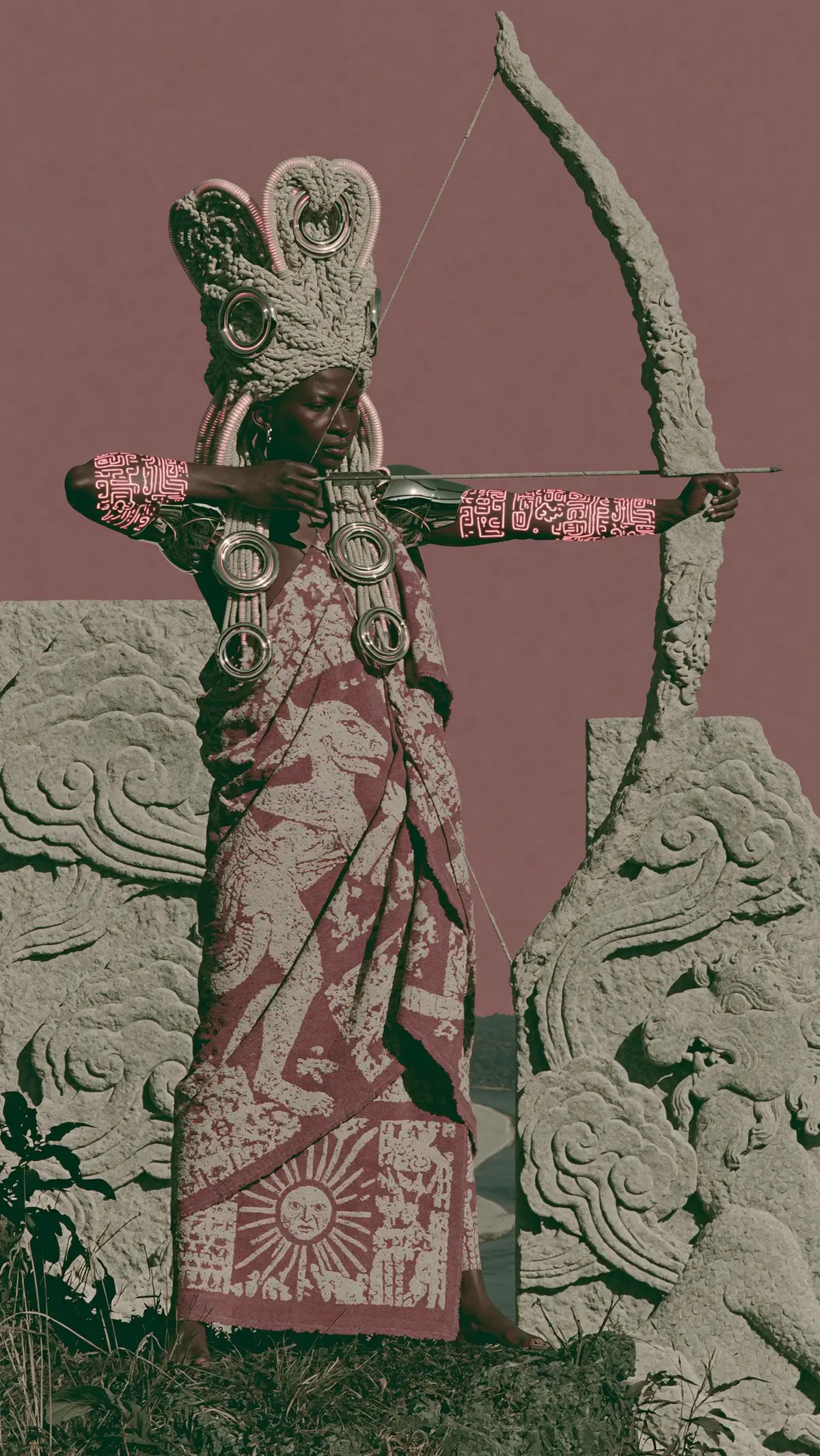
There is a strange new kind of fashion image circulating online. It does not look like a runway show, exactly. It does not look like costume design, either. It looks like a ceremony from a future empire that has not yet decided whether it is sacred, digital, or completely artificial.
The TikTok account source.io belongs to this new visual language. Its videos appear to build a world of silver priests, alien aristocrats, masked processions, monumental temples, impossible garments, synthetic animals, sacred architecture, and figures who look less dressed than initiated. The account’s own phrase — “conduit for connection” — is almost too perfect. This is not fashion presented as clothing. It is fashion presented as transmission.
What makes the imagery immediately compelling is not simply that it appears AI-generated or digitally constructed. The internet is already drowning in AI images, most of them impressive for about three seconds and forgettable by the fourth. What makes this account more interesting is its consistency. The videos do not feel like random prompts thrown at a machine. They feel like fragments from the same civilization.
White robes, metallic headpieces, ritual masks, black ceremonial silhouettes, red-lit interiors, impossible monuments, futuristic temples, and bodies arranged frontally as if waiting for worship: the visual system repeats itself until it becomes believable. Not realistic, necessarily, but coherent. It has rules. It has hierarchy. It has atmosphere. It has the most important thing most AI image accounts lack: a world.
The Rise of Synthetic Couture
Fashion has always been more than fabric. At its highest level, it is architecture for the body, theatre for status, and mythology for the self. Couture has never simply asked, “What can someone wear?” It has asked, “What can a human being become if the body is treated as a site of transformation?”
That is why AI fashion can feel both new and ancient. The tools are contemporary, but the impulse is old. A figure covered in silver, crowned with an impossible halo, standing before a futuristic altar, is not really that far from religious vestments, royal regalia, ceremonial armour, carnival masks, or the theatrical extremity of high fashion. Technology changes the image. The desire remains familiar.
This is also why the account’s strongest videos do not feel like ordinary fashion fantasy. They feel devotional. The garments are not styled as products to be bought, but as signs of rank, initiation, or power. The figures appear as priests, queens, warriors, or messengers from a society whose rules we do not know but immediately sense.
The result sits somewhere between Dune, Byzantine ceremony, Afrofuturist monarchy, alien liturgy, brutalist architecture, and couture editorial. It is excessive, but not chaotic. It is futuristic, but not clean in the corporate sense. It has dust, shadow, scale, and a kind of digital incense.
When Fashion Becomes Religion
The connection between fashion and religion is not an internet accident. Clothing has long been one of the most powerful ways societies make hierarchy visible. Crowns, robes, veils, armour, uniforms, vestments, masks, and ceremonial textiles tell the body what role it is expected to perform. They turn people into offices, symbols, threats, icons, or myths.
This relationship has been explored directly in institutional fashion history. The Metropolitan Museum of Art’s exhibition Heavenly Bodies: Fashion and the Catholic Imagination examined the dialogue between fashion, medieval art, devotional traditions, and Catholic visual culture. The point was not merely that designers borrow religious imagery. It was that fashion and religion both understand spectacle, hierarchy, beauty, repetition, and belief.
@source.io
The source.io aesthetic appears to operate in that same territory, but without a single historical religion anchoring it. Its world feels syncretic and invented. There are echoes of liturgy, empire, pilgrimage, coronation, military order, science fiction, and luxury runway presentation, but no stable doctrine. This is religion after image culture: all ritual, no scripture.
That absence is part of the appeal. The viewer does not need to understand what is happening. The imagery works because it suggests that something is happening. A procession is taking place. A figure is being crowned. A gate is opening. A creature is being presented. A city is waiting. A ceremony has begun, and we have arrived too late to know its rules.
The AI Image as Myth Factory
Most AI-generated imagery fails because it confuses detail with meaning. It offers elaborate surfaces without symbolic pressure. Beautiful armour, huge buildings, glowing eyes, impossible dresses, cinematic fog: the parts are there, but they do not add up to a world.
The stronger pieces in this account avoid that trap by returning again and again to the same emotional architecture. The images are frontal, ceremonial, symmetrical, and hierarchical. The bodies are often still. The camera does not behave like a tourist; it behaves like a witness. The figures do not seem to be posing for us. They seem to be fulfilling a role that existed before we arrived.
This is what gives the work its mythic charge. Myth is not created by weirdness alone. It is created by repetition, structure, and withheld explanation. The viewer feels that behind each image there is a larger system: a political order, a religion, a caste, a prophecy, a fashion house from another planet, perhaps all of them at once.
In that sense, AI becomes less a tool for producing images and more a tool for manufacturing impossible cultural memory. It can create artifacts from civilizations that never existed, ceremonies no one performed, garments no one sewed, and monuments no one built. The danger, of course, is emptiness. The promise is a new kind of visual folklore.
Why It Feels More Serious Than AI Slop
The phrase “AI slop” exists for a reason. Much of what fills social platforms now is synthetic abundance without taste: hyper-polished images, fake luxury, impossible faces, smooth lighting, invented interiors, and endless variations of the same empty astonishment. It is content that looks expensive and feels spiritually broke.
What separates source.io from that broader swamp is direction. Even if the images are artificial, the taste is not random. The account understands palette, scale, rhythm, costume, monumentality, and repetition. It knows that a world is more persuasive when it does not show every possible thing, but returns obsessively to a few chosen symbols.
This is closer to editorial worldbuilding than casual prompting. It feels less like “look what AI can make” and more like “look where this civilization lives.” That difference matters. The first is novelty. The second is authorship, or at least the beginning of it.
Contemporary fashion is already negotiating the presence of AI, from design processes to marketing imagery and digital experimentation. Vogue has reported on how AI has entered the fashion conversation, not as a distant future but as something already shaping production, presentation, and debate. The question is no longer whether AI can make fashion images. The question is whether those images can carry taste, meaning, and a recognizable point of view.
The Problem of Authorship
This is where the account becomes more complicated.
With AI-driven visual culture, authorship is often blurry. Who is the artist? The person writing the prompt? The person curating the feed? The model trained on countless existing images? The designers, photographers, architects, stylists, filmmakers, and cultures whose visual languages have been absorbed into the machine? The answer is rarely comfortable.
@source.io
That discomfort should not be ignored. The visual pleasure of AI fashion often depends on the ghost labor of fashion history, cinema, photography, museum collections, religious art, science fiction, and non-Western ceremonial dress. A synthetic image can feel original while carrying thousands of uncredited echoes inside it.
At the same time, curation is not nothing. Taste is not nothing. The ability to build a coherent visual language from generative tools is already becoming a form of creative labor. The mistake is pretending this labor is identical to traditional photography, couture, styling, or filmmaking. It is not. It is a different practice with different debts.
The best way to read an account like this is therefore neither blind worship nor lazy dismissal. It is not enough to say “the computer made it,” because the computer did not choose this mythology by itself. It is also not enough to say “this is a new fashion house,” because no fabric exists, no runway exists, no garment has been engineered for a real body. It is something in between: a synthetic visual universe, authored through selection, repetition, and atmosphere.
The Body After the Body
One of the most fascinating things about this kind of AI fashion is how little it seems to care about ordinary wearability. The body is present, but often as a pedestal, relic, avatar, or sacred container. The garments do not serve the body. They transform it into an emblem.

This has always been part of extreme fashion. Alexander McQueen, Thierry Mugler, Iris van Herpen, Hussein Chalayan, and many others have treated clothing as metamorphosis rather than utility. But AI accelerates this impulse until the body becomes almost optional. The headpiece can be impossible. The silhouette can defy gravity. The architecture can merge with the costume. The person can become a monument.
That freedom is seductive. It allows fashion to detach itself from the practical compromises of material, weight, movement, cost, and construction. But it also risks removing the very tension that makes real fashion powerful. A garment becomes more interesting when it has to exist against the stubborn reality of the body.
The account’s images are therefore most compelling when they keep some trace of that tension: a standing figure, a procession, a garment that looks almost wearable, a ritual that suggests weight and rank. The further the image drifts into pure digital impossibility, the more it risks becoming spectacle without consequence.
Why We Want These Worlds
The popularity of accounts like source.io says something about the present moment. People are not only looking for images. They are looking for worlds.
This is why moodboards, fantasy edits, AI fashion universes, fictional archives, digital folklore, and invented aesthetics travel so easily online. The real world often feels overexplained and under-enchanted. Synthetic worldbuilding offers the opposite: too little explanation, too much atmosphere. It gives viewers the pleasure of entering a place without having to understand it fully.
There is also a hunger for ceremony. Contemporary life has become visually saturated but ritually thin. We have endless images and very few shared symbols that still feel powerful. AI ceremonial fashion steps into that gap. It invents hierarchies, costumes, sacred spaces, and processions because the modern viewer still responds to the old grammar of awe.
@source.io
That may be the most interesting thing about the account. Its future does not feel modern in the clean, optimistic, corporate sense. It feels archaic. It suggests that even when machines dream for us, they dream in temples, crowns, masks, animals, fire, and robes.
The New Sacred Machine
source.io is not important because it proves that AI can make beautiful fashion images. We already know that. It is interesting because it shows how quickly AI imagery moves toward myth when guided by consistent taste.
The account’s strongest videos feel like fragments from a synthetic religion: processions without doctrine, garments without bodies, architecture without history, royalty without nations, and ceremonies without explanations. It is fashion stripped of commerce and returned to one of its oldest functions: making power visible.
That does not make it innocent. AI imagery carries real questions about authorship, labor, originality, and cultural borrowing. But the questions are part of the work’s relevance. The future of visual culture will not be decided only by whether machines can make images. It will be decided by whether those images can mean anything once the initial astonishment fades.
In the case of source.io, the answer is not final, but it is more interesting than usual. The account gives us a glimpse of synthetic couture as ceremony, AI fashion as religion, and the algorithm as a myth factory.
It may not be real fashion. It may not be real cinema. It may not be real religion.
But it understands the old truth behind all three: people will always gather around images that make the body look like it belongs to a larger mystery.