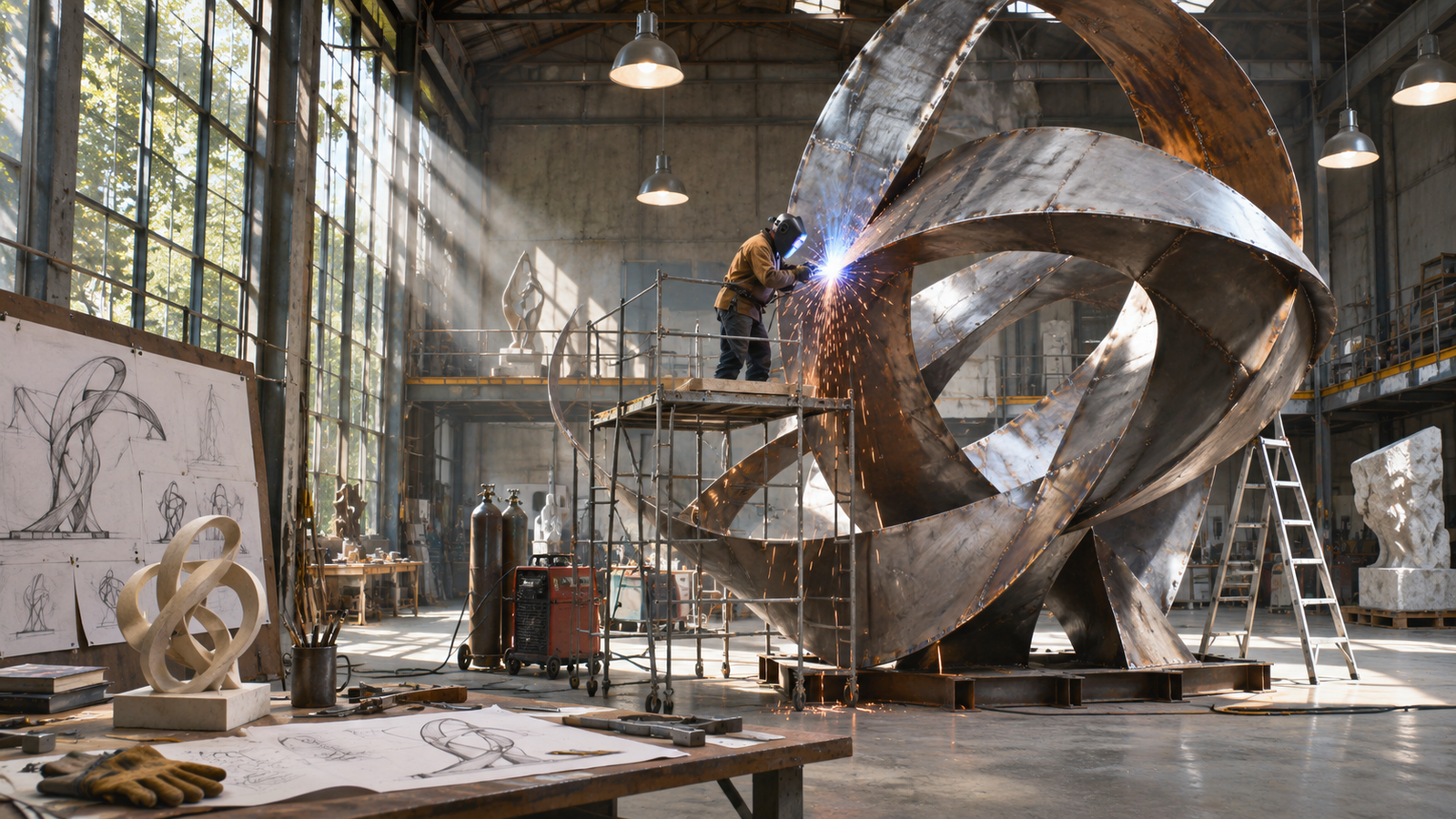
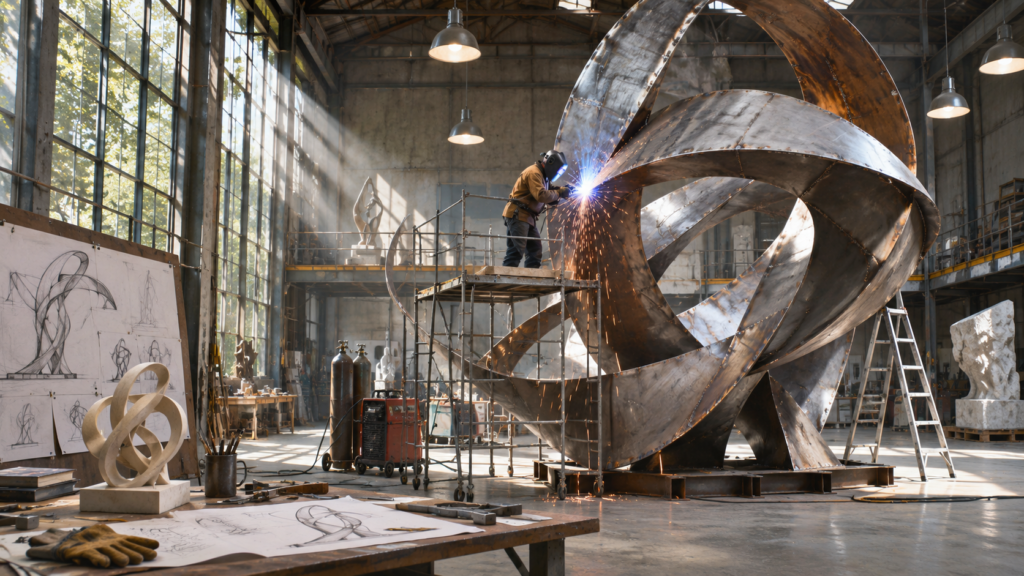
A large public sculpture looks like it arrived fully formed, as if the artist had a vision and the city found a plaza for it. In fact, between the approved maquette and the ribbon cutting sits a chain of handoffs: artist to engineer, engineer to fabricator, fabricator to installer. Those handoffs are where a project’s plans meet weight, weather, and budget.
The Model Is Not a Build Document
A maquette proves an idea. It does not show whether the finished piece will survive wind, heavy snow or a curious crowd. That job usually belongs to a structural engineer, who works out how the artist’s model will carry its own weight.
Material is the first big decision. Stainless steel, weathering steel, bronze and aluminum behave differently outdoors, and each limits which shapes are practical. A thin, sweeping curve that looks effortless in clay may need a hidden internal frame at full scale. A proportion may shift, or a seamless surface may need a discreet joint.
What the Budget Has to Cover
In Denver, a public art commission starts with a budget rule before it starts with an artist. The city’s program sets aside 1% of the budget for qualifying city capital improvement projects over $1 million, and Denver Arts & Venues reports more than 400 pieces and 50+ projects in progress. Because that money comes out of the project’s capital budget, it typically has to cover the artist’s fee, the engineering, the fabrication, and the installation. Denver’s own guide for artists lists site preparation, shipping, and installation as separate steps and warns that engineers are busy and materials can take time.
Choosing the Crew
Once the design is engineered, someone has to build it. Some artists run studios with a regular crew, others hand the work to a fabrication shop, and some commissions mix the two: a core team for delicate work and extra hands for the weeks of heavy lifting.
The extra hands are where planning can slip. Short build windows can be hard to staff from a standing team, particularly when several projects reach fabrication in the same season, and a delay in one trade can hold up the others. For a Denver commission, bringing in outside crews is one way to cover that gap, and skilled trades staffing in Denver, Colorado covers contract and temp-to-hire placements in roles including welders, fabricators, riggers, ironworkers, and electricians, from a single specialist to a full crew.
Whoever gets the job needs to be free in the right weeks and qualified for the material the piece is made from.
In the Shop: Welds, Seams and Finish
Large sculptures are often built in sections inside a shop, sized to travel by truck and joined later on site.
Welds on a hidden frame mainly need to be sound. Welds on a visible surface are part of the artwork, so they tend to be ground, blended and polished until the seam disappears, or left exposed on purpose. The finish, whether brushed, mirror-polished, or, with weathering steel, allowed to rust into a protective layer, is usually decided here and is hard to change later.
Some teams build a test section or a full-size mock-up of the trickiest area first. It costs time up front, and it can save the more expensive discovery that a curve cannot be formed the way the drawings assumed. Fabricators commonly test-fit and label sections before they leave, so the first time two pieces meet is not on a crane hook.
Protective coatings are often applied in the shop too, under controlled conditions, because wind, dust, and rain on site can interfere with a fresh finish.
Getting the Piece Into Place
The ground has to be ready first, which means a foundation designed for the piece’s weight and its exposure to wind. Concrete gains strength over weeks, with 28 days the usual benchmark for reaching its full rated strength. The engineer decides how long the foundation has to wait before it takes the load, so it goes in well ahead of the lift.

Transport needs its own planning. Oversized sections may need permits, a route survey and escort vehicles, depending on their size and the jurisdiction, and a piece that cannot clear a bridge or a tight turn has to be rethought before the sections leave the shop.
A site walk usually checks ground conditions, overhead lines, and room for the crane. On installation day, sections arrive by truck and go up by crane. Alignment is slow, careful work: a few millimeters of error at the base can become a visible lean at the top. Anchors are tightened to the engineer’s specification, and if the piece is lit, the electrical connections are finished and tested before handover.
Wind can overrule the whole plan. Every crane has wind limits, so a windy morning can halt a lift, and a calm one is often the most valuable item on the schedule.
After the Unveiling
The ribbon cutting is not the end of the work. Outdoor metal needs periodic cleaning and inspection and, depending on the finish, may need recoating or another surface treatment. Bolts are checked, lighting is serviced, and any damage or graffiti has to be repaired in a way that matches the original surface. The fabricator’s drawings, material specifications, and finish records can matter here, because they tell a future conservator what the piece is made of when a repair has to match.
A piece with no maintenance plan can fade quietly because nobody owns the job, so asking who will look after a sculpture in year ten is a fair test of how seriously the commission was planned.