Toronto’s Floating Convenience Store and the Strange Poetry of Everyday Life
There are few buildings more ordinary than a convenience store.
They sit on corners, glow through the night, sell cigarettes, chips, lottery tickets, aspirin, batteries, and countless other things we forgot we needed until the moment we needed them. They are rarely photographed, almost never celebrated, and virtually invisible to the people who pass through them every day.
Which is precisely why Global Convenience is so interesting.
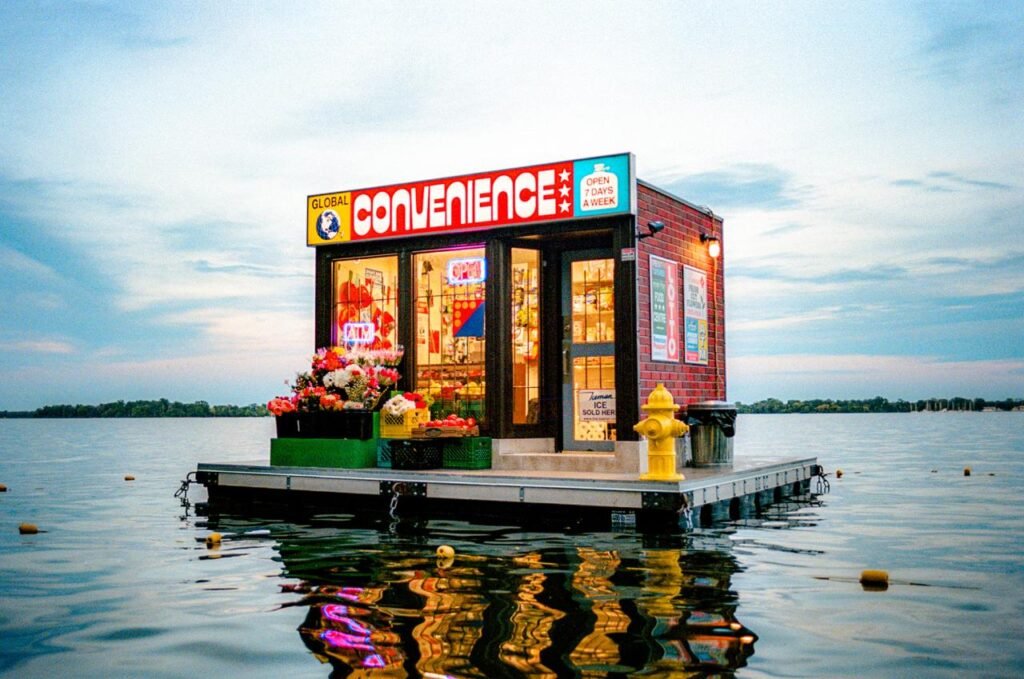
Floating quietly in Toronto’s Harbour Square Park Basin, just beside the Jack Layton Ferry Terminal, the installation by artists Trevor Wheatley and Cosmo Dean, in collaboration with Puncture (Rashad Maharaj and Spencer Cathcart), takes one of the most familiar structures in urban life and removes the one thing that gives it meaning: function.
The result is a convenience store that cannot conveniently provide anything.
A store that sells nothing.
A monument to accessibility that is deliberately inaccessible.
And somehow, that contradiction makes it far more fascinating than an actual store could ever be.
The Inconvenience Store
The internet immediately did what the internet always does.
Instead of discussing artistic intent, thousands of people began asking practical questions.
View this post on Instagram
Can you buy beer there?
Can a boat pull up beside it?
Does it sell cigarettes?
Can someone paddle over and get snacks?
Within days, locals had already given it a new nickname:
“The Inconvenience Store.”
The joke is funny because it accidentally identifies the artwork’s central idea.
Everything about contemporary urban life revolves around convenience. Food arrives at our doors. Cars arrive at the press of a button. Entire industries exist to eliminate friction from everyday experience.
Global Convenience reverses that logic.
It presents a familiar promise and then refuses to fulfill it.
The building remains visible.
The products remain visible.
The desire remains visible.
Only access disappears.
A Corner Store Floating Between Cultures
According to the artists, the convenience store was chosen precisely because it is one of the most universally recognizable spaces in modern cities. Whether called a bodega, corner store, market, kiosk, or mini mart, nearly every culture possesses some variation of it. Wheatley described it as “one of the most familiar and universally understood spaces in a city.”
That familiarity becomes particularly significant on Toronto’s waterfront.
The installation coincides with the city’s role as a FIFA World Cup host city, and the artists deliberately filled the structure with products, signage, and visual references from multiple countries. The store becomes a symbolic crossroads where cultures, languages, products, and identities coexist within a single compact space.
In that sense, Global Convenience is less about retail than migration.
Less about commerce than exchange.
The building resembles a neighborhood store, but it behaves more like a metaphor.
The Architecture of Recognition
One of the most remarkable aspects of the installation is how little information the viewer needs to understand it.
A red-and-white storefront.
View this post on Instagram
A cooler.
A fire hydrant.
Some flowers.
A cluttered window.
A hand-painted sign.
Immediately, the brain identifies the structure.
Convenience store.
The recognition is instantaneous.
This is where the artwork begins operating almost like conceptual sculpture. The artists strip the building down to its most recognizable visual cues and then place it in a context where those cues become absurd. As Wheatley explained, engineering constraints forced the team to focus only on the essential elements that make a convenience store instantly identifiable.
The result resembles a memory more than a building.
Why Everyone Wanted It To Be Real
Perhaps the most revealing aspect of the public response is how many people wished the installation actually functioned.
Commenters imagined buying chips from a paddleboard.
Beer from a jet ski.
Lottery tickets from a kayak.
They were disappointed when they learned it was merely art.
This reaction may be the artwork’s greatest success.
Because it demonstrates how thoroughly the convenience store has embedded itself into our collective imagination. We do not merely recognize these spaces; we depend upon them. They have become modern civic infrastructure.
Historically, cities organized themselves around churches, marketplaces, and public squares.
Today, many neighborhoods organize themselves around coffee shops, gas stations, pharmacies, and corner stores.
Global Convenience quietly asks whether these spaces have become the true gathering places of contemporary urban life.

A Floating Monument to Everyday Rituals
Public art often seeks grand statements.
Global Convenience does the opposite.
Its subject is humble.
Its architecture is generic.
Its symbolism emerges through repetition rather than spectacle.
The artists describe neighborhood stores as places where conversations begin, cultures mix, and daily rituals unfold. Positioned on the waterfront, the structure echoes historical points of arrival where people, goods, and ideas first entered the city.
Seen from this perspective, the installation becomes surprisingly emotional.
Not because it is beautiful.
But because it is familiar.
Everyone has a convenience store in their memory.
The one they visited after school.
The one that sold their favorite candy.
The one run by the same family for decades.
The one that disappeared when the neighborhood changed.
Global Convenience gathers all of those stores together and places them adrift.
The Store That Sells Reflection
At night, solar-powered lights illuminate the structure, casting reflections across the water. The effect transforms the familiar storefront into something almost dreamlike—a floating memory hovering between architecture and illusion.
And perhaps that is the real achievement of the work.
Not that it looks like a convenience store.
But that it reveals how strange convenience stores have always been.
Tiny buildings packed with products from every corner of the world.
Places where languages mix.
View this post on Instagram
Where strangers briefly become neighbors.
Where globalization quietly unfolds beneath fluorescent lighting.
For a structure designed around immediate transactions, the floating store manages to create something remarkably rare:
a moment of pause.
And in a culture obsessed with convenience, that may be the most inconvenient thing of all.