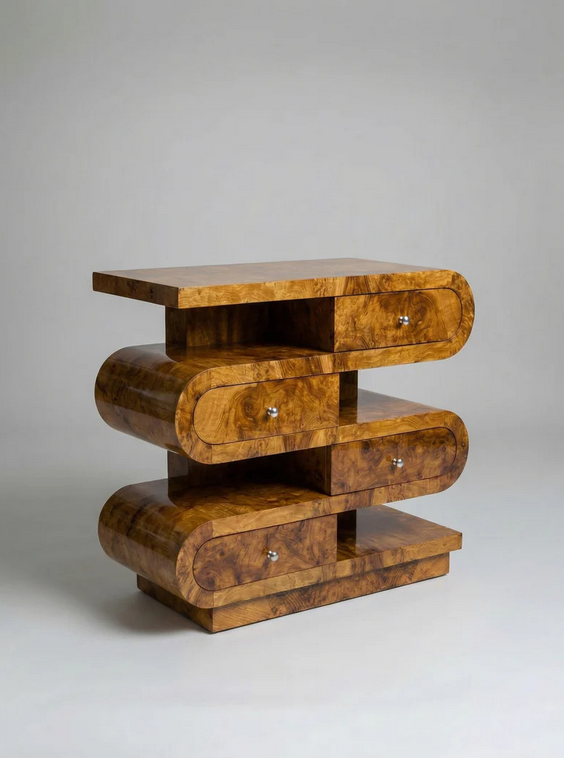
In April 1925, Paris threw a party for the future. Between the Esplanade des Invalides and the Grand Palais, the Exposition Internationale des Arts Décoratifs et Industriels Modernes opened its gates. Sixteen million people came through. They left having watched the birth of a style that wouldn’t name itself for decades, but already knew exactly what it wanted to be: the future, made beautiful.
We call it Art Deco now. The cabinetmakers, lacquerers, and ironworkers behind it would have put it more simply: they were trying to invent a modernity that didn’t have to be ugly. That ambition has been mostly forgotten — and in 2026, for the first time in nearly a century, the wider field of sourced Art Deco furniture is being looked at seriously again, by collectors, designers, and a new generation of buyers tired of beige minimalism.
A vocabulary carved in geometry
To stand before an authentic Art Deco piece is to feel a system asserted at you. Where Art Nouveau grew vines across every surface, Deco imposed order. Chevrons, sunbursts, zigzags, stepped pyramids. Lines were dead straight or perfectly mathematical. Symmetry was a rule, not a preference.
The materials were another matter. Macassar ebony, amboyna burl, galuchat — the pebbled stingray skin polished until it glowed. Lacquer in forty coats, each polished before the next, in the technique Jean Dunand brought back from Japan. Wrought bronze from Edgar Brandt’s forge. The strictness of the drawing argued with the lushness of the surface, and that argument is the whole charge of the period.
The masters who built the style
Émile-Jacques Ruhlmann is the name collectors reach for first. He took a handful of commissions a year and made furniture so expensive his clients sometimes balked. A single cabinet could take eighteen months. He refused industrial production, casting himself as the last of the old French ébénistes in new clothes.
Eileen Gray got there from another direction. Irish, trained in lacquer in London and Paris, she designed with a harder, more architectural mind. Her 1926 Bibendum chair is modernity with nothing to apologise for. Her E-1027 side table from 1927 looks like something from twenty years later.
Then the specialists: Dunand, who lacquered until panels looked wet. Brandt, who dragged the blacksmith’s craft into the drawing room. Pierre Chareau, who built furniture like small architecture. Armand-Albert Rateau, whose bronze animal-leg consoles for Jeanne Lanvin’s apartment remain among the most extravagant objects of the twentieth century.
From the salon to the ocean liner
The style spread fast. The 1930s gave it a second life in public space. The cinemas of London, New York, and Mumbai borrowed its vocabulary. The SS Normandie, launched in 1935, was a floating Deco palace — its first-class dining room ran 86 metres, longer than the Hall of Mirrors at Versailles.
Then it planted its own decline. The Bauhaus opened in 1919. By 1933, its alumni were spreading a different gospel: ornament wasn’t just unnecessary, it was morally suspect. The post-war world belonged to that argument. Deco came to look like the indulgence of a civilisation that hadn’t yet figured out what was coming.

Why the style is coming back
The appetite in 2026 isn’t nostalgia. Twenty years of Scandinavian-leaning minimalism have produced beautiful rooms that all look like the same room. One Macassar ebony cabinet can do more work in a contemporary apartment than a whole wall of paintings.
There’s also craft. You cannot fake a forty-coat lacquer panel. You cannot automate marquetry. As the wider market fills with furniture optimised for shipping costs, the objects that obviously contain human time mean something different.
What keeps Art Deco alive is what its critics never quite admitted. It was the last style that thought the modern world owed something to beauty. A hundred years on, looking at our own rooms, it makes sense we’re listening again.