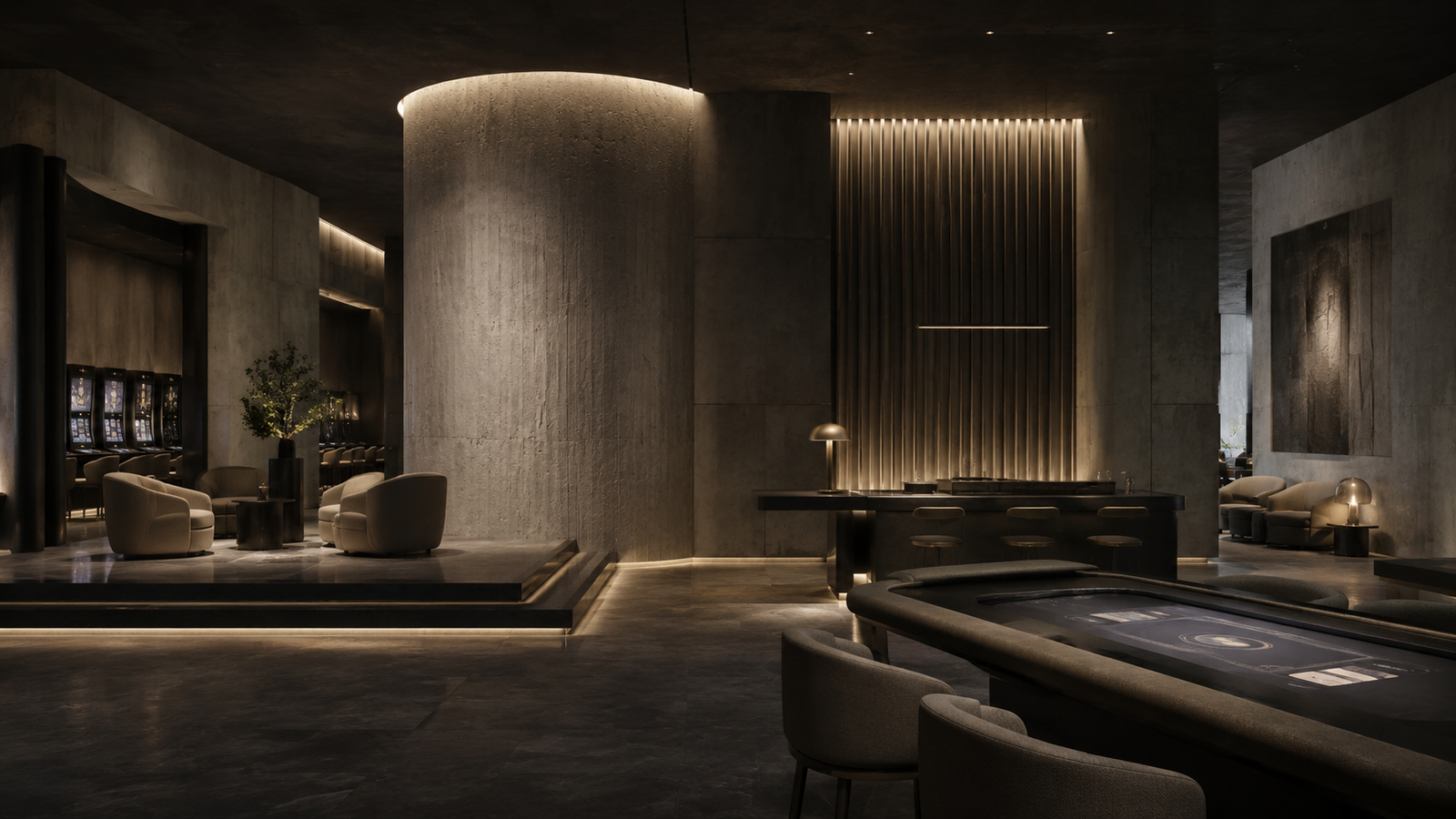
The casino used to be designed as a room. Light, sound, color, carpet, signage and spatial flow worked together to create an environment that could hold attention. In 2026, much of that architectural challenge has moved onto a screen. The modern casino lobby is increasingly a digital interface, and every card, animation, menu, recommendation and transition contributes to the atmosphere.
That makes online casino design more interesting than the familiar stereotype of dark backgrounds, gold lettering and flashing slot graphics suggests. These platforms have become dense digital ecosystems where branding, game discovery, payments, promotions, account tools and personalized content compete for the same limited space. Even utilities outside the casino show why information design matters. A shuffle bonus calculator, for example, lets users work through variables behind estimated rewards rather than judging an offer by a promotional headline alone. It is a small but useful illustration of a larger design principle: complex information becomes more valuable when people can actually understand it.
The most compelling casino interfaces now have to do two apparently contradictory things. They must create an immersive world while making that world easy to navigate. In an era of mobile-first layouts, personalized recommendations and increasingly sophisticated gaming platforms, visual spectacle alone is no longer enough. The real design work lies in turning complexity into an experience that feels intentional.
Why Online Casino Design Is Changing
Casino websites are becoming less like conventional websites and more like entertainment platforms.
A single interface can contain thousands of casino games, live dealer rooms, promotions, payments, account information, rewards, search tools, filters, support systems and responsible-play controls. Some platforms add sports betting, social elements, challenges, personalized lobbies or real-time activity on top of that.
That changes the designer’s problem.
The challenge is no longer simply deciding whether a button should be purple or whether a hero image needs another animation. It is deciding what deserves attention when almost everything on the page would like to be noticed.
Current iGaming product development is increasingly shaped by mobile-first thinking, richer personalization and interfaces that respond to player behavior. That makes hierarchy more important, not less. As digital platforms become better at deciding which games, categories or promotions to surface, designers also have to make those recommendations understandable and prevent the interface from feeling as though it is constantly shouting.
This is why the next phase of casino website design is fundamentally about experience design.
Why Design Matters in Online Casinos
A traditional portfolio or editorial website may have a relatively small number of meaningful destinations. An online casino website can contain an enormous inventory of games and features before the visitor even reaches account settings.
The design must organize that complexity.
A useful casino interface needs to establish the brand, help people understand where they are, make casino games discoverable, distinguish essential controls from promotional material and adapt cleanly across screen sizes.
That is an information architecture problem before it becomes a decoration problem.
A stunning casino website may create an impressive first five seconds, but visual impact means little if finding roulette requires opening three confusing menus. At the other extreme, a perfectly functional grid can be forgettable when every card, icon and button looks interchangeable with another casino site.
Great casino design operates between those extremes.
The interface needs enough personality to feel like a place, but enough discipline to remain a tool.
What Makes a Winning Online Casino Design
There is no single visual formula for the best casino experience.
One brand may use a purple color scheme, illustrated characters and exaggerated animation. Another may rely on monochrome surfaces, cinematic photography and restrained typography. A third might borrow the visual language of gaming dashboards, streaming platforms or futuristic financial apps.
What successful approaches tend to share is consistency.
The logo, color palette, icons, game cards, buttons, menu, promotional banners and account areas should feel like parts of the same system. A unique online casino does not need to use the loudest possible graphics. It needs a design language that remains recognizable even when promotions and game content change.
A Brand That Survives Beyond the Hero Banner
Casino branding has long relied on familiar symbols such as cards, chips, crowns, diamonds and roulette wheels. They communicate the category immediately, but they also create a problem.
If everyone uses the same symbols, how does anyone become memorable?
More interesting illustrations and branding begin with personality.
A playful casino might use custom characters, expressive iconography and energetic motion. A premium brand might choose disciplined spacing, subtle metallic accents and editorial typography. A technology-focused brand could work with geometric forms, data-like graphics and sharper digital transitions.
Typography deserves particular attention because casino websites make type perform two very different jobs.
Display type creates attitude. Interface type communicates game titles, balances, categories, terms and account information. The former can be theatrical. The latter needs to be relentlessly readable.
The brand’s identity has succeeded when it can still be recognized after the giant promotional artwork disappears.
Navigation That Makes Abundance Feel Manageable
A large variety of games sounds attractive until all of those games need to fit inside an interface.
This is one of the defining UX problems of casino websites.
Useful navigation might separate slots, new releases, table games, live casino rooms, roulette, blackjack, favorites and recently played titles. Search needs to be prominent enough to find quickly. Filters need to behave predictably. Repeated journeys should become easier rather than forcing users through the homepage every time.
Game cards need hierarchy too.
Artwork may attract the eye, but the title, provider, category and interaction state still have to be understood. Hover effects and animated previews can add polish on desktop, while mobile interfaces need equivalent information without relying on hover at all.
The goal is not to expose the entire casino simultaneously.
The goal is to make the next relevant choice easy to discover.
| Interface element | Question it needs to answer | Useful design response |
| Main navigation | Where can I go? | Short labels and predictable categories |
| Game library | What can I play? | Search, filters and recognizable cards |
| Wallet | What is my balance? | Persistent but restrained access |
| Promotions | What is being offered? | Clear hierarchy and accessible conditions |
| Account controls | Where are my settings? | Consistent profile navigation |
| Safer-play tools | How can I control my activity? | Visible and understandable controls |
How Casino Websites Turn Interfaces Into Experiences
Casino design allows for more visual experimentation than many other digital products because entertainment is part of the product itself.
A banking dashboard is usually expected to feel calm. A productivity tool often succeeds by disappearing into the background. A casino is different. The interface may deliberately contribute to the sense of anticipation.
That creates room for ambitious design work.
A casino slot can build a miniature cinematic universe. A live casino lobby can resemble a broadcast studio. A brand may borrow from retro arcades, science fiction, luxury travel, street culture, sports graphics or surreal illustration.
The danger is confusing immersion with intensity.
If every game card moves, every promotion pulses and every navigation element competes for attention, the page eventually becomes flat. Everything is emphasized, which means nothing is.
Good motion design is selective.
Animation can reveal that a menu has opened, show that information has changed, confirm an interaction or help a transition feel spatially coherent. Decorative movement can create mood, but it works best when the underlying hierarchy remains intact.
The same applies to sound, gradients, glow effects and oversized typography.
A memorable virtual casino does not necessarily contain more effects. It contains better-directed effects.
The Casino Lobby Is Becoming More Personal
One of the more significant design changes in 2026 is that the casino lobby does not have to be identical for every visitor.
Recommendation systems and behavioral data can influence which games or categories appear first, which parts of the interface receive emphasis and how content is ordered.
From a UI perspective, that creates fascinating possibilities.
Instead of treating the homepage as a fixed poster, designers can think of it as a changing composition. Recently played titles, preferred categories and contextual information can shorten navigation and make a large library feel less overwhelming.
But personalization introduces a new design responsibility.
When an interface changes dynamically, it still needs a stable structure. Users should not feel as if the building rearranges its doors every time they enter.
Persistent navigation, recognizable categories and predictable account controls become even more important when other parts of the page are personalized.
The best casino website design therefore combines a changing content layer with a dependable structural layer.
Five Casino Design Approaches Worth Studying
Designers searching for examples of casino websites will quickly notice a handful of recurring aesthetics.
None is automatically superior.
| Design approach | Visual character | Main UX strength | Main risk |
| Cinematic dark interface | Deep backgrounds, neon accents, dramatic artwork | Makes game art feel vivid | Too many glowing elements become tiring |
| Minimal casino design | Neutral surfaces, restrained motion, simple cards | Improves scanning and hierarchy | Can feel generic |
| Entertainment-led design | Characters, illustration and playful animation | Builds a memorable brand world | Decoration can overpower function |
| Premium interface | Refined typography, whitespace and subtle metallic detail | Communicates sophistication | Can become visually repetitive |
| Mobile-first interface | Compact navigation and card-based content | Handles small screens efficiently | Desktop layouts need thoughtful expansion |
The useful lesson is not to copy the surface.
If a particular stunning casino website feels unusually easy to navigate, study why. Does it reduce the number of competing colors? Does it use scale to separate promotions from game discovery? Are filters visible without dominating the layout?
Those relationships are more valuable than any individual gradient or icon.
UX and UI Design Best Practices for Casino Websites
Good UI design makes individual components attractive and understandable.
Good UX makes those components work together across an entire journey.
Casino web design needs both.
A beautiful registration screen followed by a confusing wallet is not a seamless experience. Neither is an impressive desktop layout that becomes an endless tower of banners on a phone.
Design Mobile as Its Own Environment
Responsive design is essential because small screens expose weak information architecture very quickly.
Desktop interfaces can hide poor prioritization behind abundant space. Mobile cannot.
Designers have to decide what deserves permanent visibility, what belongs inside expandable navigation, how large tap targets need to be and how much information a game card can carry without becoming unreadable.
A fully responsive casino website should not simply shrink its desktop version.
Promotional artwork may require different crops. Horizontal navigation may become a bottom bar. Dense tables may need expandable alternatives. Search, wallet and profile controls may move into more accessible positions.
Mobile design is not the final adjustment after the real design is finished.
For many users, it is the real design.
Make the Next Action Obvious
A user-friendly interface does not make people guess.
Buttons performing similar tasks should look and behave consistently. Selected states need to be visible. Loading states should communicate what is happening. Search results should be clear. Closing a panel should not require hunting for an almost invisible icon.
This sounds basic, but complexity makes basic design more valuable.
When account information, live games, promotions and recommendations occupy the same screen, ordinary clarity becomes a competitive visual advantage.
Let Motion Explain Something
Casino websites have permission to be expressive, but animation still needs a purpose.
Useful motion can show that:
- a menu has expanded
- a game has been saved
- a transaction is processing
- new content has loaded
- an interaction has succeeded
- a section has changed
Decorative animation can add personality around those actions.
The dividing line is simple.
Movement should either communicate or enrich. It should not merely demand attention because the technology allows it.
Responsible Interaction Is Part of the Design
Some interface choices are more important than fonts or color palettes.
Gambling products involve money, repeated decisions and potentially harmful behavior. Responsible interaction therefore belongs inside the design system rather than being treated as a disclaimer placed below everything else.
The UK Gambling Commission’s responsible product design standards say gambling products should be designed to minimize the likelihood of encouraging problem gambling behavior. They also address interface choices such as encouraging people to chase losses, increasing stakes or continuing after deciding to stop.
Those are design questions.
A withdrawal process can contain friction or remove it. A limit control can be visible or buried. A message can communicate neutrally or attempt to pull somebody back into play. Important information can be legible or deliberately overshadowed by a bright promotional layer.
Responsible product design asks what the interface is persuading someone to do, not only whether the interface technically functions.
That makes it one of the most important developments in the visual language of gambling products. Sophisticated casino design is increasingly about knowing when not to add friction, urgency or spectacle.
How to Create an Online Casino Website
Creating an online casino website involves far more than selecting a dark template and adding game thumbnails.
The process begins with positioning.
Who is the intended audience? What personality should the brand communicate? Which gaming categories need the greatest prominence? What should make the experience recognizable when placed beside competing casino websites?
Information architecture comes next.
Before designers polish finished screens, they need to map important journeys such as account creation, game discovery, payments, promotions, account settings, support and responsible-play controls.
Wireframes can establish hierarchy before visual decoration makes problems harder to notice.
Once the structure works, the design system can begin to develop. Typography, spacing, color, cards, iconography, illustrations, buttons and interaction states should become reusable components rather than one-off decisions.
A simplified design and development process looks like this:
- Define the audience and brand
- Map the information architecture
- Identify essential user journeys
- Produce wireframes
- Build the UI system
- Prototype desktop and mobile experiences
- Develop and integrate platform features
- Test usability and accessibility
- Review applicable regulatory requirements
- Test performance before launch
Real-money online gambling businesses also have licensing, payment, security and compliance requirements that vary by jurisdiction. Designing the visible website is only one layer of an operational casino platform.
What Technologies Power Modern Casino Websites
There is no universal technology stack behind an online casino.
The architecture depends on scale, jurisdiction, platform infrastructure, game providers and whether the product is custom-built or based on existing systems.
The visible interface may use modern JavaScript frameworks and reusable components. APIs can connect the front end to user accounts, payments, game libraries, promotions and analytics. Content management systems can handle editorial pages and campaigns.
Real-time experiences add another dimension.
Live casino games, changing balances, activity feeds and other dynamic features need data to update without forcing a complete page reload. Performance systems such as caching, optimized media and content delivery networks can help keep image-heavy libraries responsive.
Security and authentication need to be considered from the beginning.
Users do not care which framework rendered a menu.
They care that it appears immediately, behaves predictably and does not make them wonder whether the last tap worked.
Templates Versus Custom Casino Design
Templates can be useful, particularly when a project uses existing gaming infrastructure.
They provide ready-made layouts and familiar components, reducing the amount of work required to establish basic screens.

The tradeoff is differentiation.
| Factor | Template approach | Custom approach |
| Initial production | Usually faster | Requires more design work |
| Brand distinctiveness | Limited by the base system | Can be highly distinctive |
| UX flexibility | Depends on template structure | Can follow custom journeys |
| Development effort | Often lower | Usually higher |
| Customizable features | Platform-dependent | Greater control |
| Design consistency | Strong with careful use | Strong with a mature design system |
A template does not automatically produce a bad website.
Likewise, custom development does not automatically produce a great website.
The quality lies in the decisions made within the system.
How Long Does Casino Design and Development Take?
There is no responsible universal answer.
A branded front end using established infrastructure may be relatively straightforward. A platform requiring custom UX, original branding, user accounts, payment flows, game-provider integrations, analytics, responsive interfaces and compliance testing is an entirely different design project.
Review cycles also matter.
User testing can expose problems in navigation. Mobile prototypes may reveal that desktop information architecture does not translate. Integrations can introduce states that were not visible in early mockups.
Useful project planning therefore breaks the work into stages rather than promising an arbitrary number of weeks.
How Much Does It Cost to Create a Casino Website?
Cost depends on scope for the same reason.
A template-based casino website design cannot sensibly be compared with a custom-built virtual casino containing bespoke graphics, integrations and platform technology.
Major cost factors include:
- visual identity and logo work
- number of page and screen types
- original illustrations
- animation and motion design
- UX research and prototyping
- responsive UI design
- web development
- payment and gaming integrations
- quality assurance
- security work
- compliance
- ongoing maintenance
One less obvious factor is the design system itself.
An inconsistent interface can become expensive every time a promotion, game category or feature is added. Investing in reusable components early may require more planning, but it can make future expansion substantially easier to control.
How to Create a Casino Logo That Does More Than Say Casino
Casino logos frequently fall into the same visual vocabulary.
Crowns, cards, chips, dice, diamonds and metallic lettering immediately communicate gaming, but they also make differentiation difficult.
A better starting point is personality.
Should the brand feel playful, technological, cinematic, rebellious, luxurious or understated?
Only then should designers move toward symbols, typography and color.
Scalability is equally important. An elaborate logo that looks spectacular across a desktop header may collapse when reduced to a mobile navigation icon.
The strongest identity works at both sizes.
Good Promotional Design Needs Transparency Too
Promotions are among the most visually aggressive parts of many casino websites.
Bonus cards may use bold colors, animated artwork, countdowns and oversized numbers because they need to compete with casino games for attention.
But attracting attention is only half the design problem.
Users also need enough information to understand what an offer represents. Reward type, eligibility, relevant conditions and other important details should not disappear behind a dominant headline.
This is where design can either clarify or obscure.
Readers who want to examine offers beyond promotional graphics can use Fair Gambling to compare casino information and explore tools intended to make rewards and other gambling mechanics easier to evaluate before making a decision.
Good promotional design does not require every condition to occupy equal visual space.
It does require a clear path from the promise to the information needed to understand that promise.
What Good Casino Websites Have in Common
After all the animations, illustrated worlds and technology are stripped away, the best casino websites tend to share one quality.
They know what deserves attention.
The logo establishes identity without fighting the content. Navigation remains accessible without consuming the screen. Promotions can be visually assertive without making the game library disappear. Account and responsible-play controls remain understandable even when the surrounding design is theatrical.
Good casino websites also use repetition intelligently.
Once somebody learns what a game card looks like, how filters behave or where account controls live, the platform should not make them relearn those interactions from page to page.
Consistency makes a complex product feel simpler than it is.
That may be the most important casino design trick of all.
Common Questions About Online Casino Design
Why is design important for online casinos?
Online casino design has to organize dense content while creating a recognizable identity. Effective design makes games, navigation, account controls and important information easier to understand while supporting the overall atmosphere of the brand.
What makes a good casino website?
A good casino website combines clear navigation, responsive layouts, readable typography, consistent UI elements and distinctive branding. It should be visually engaging without making ordinary tasks difficult.
What are the key steps to create an online casino website?
The process generally moves from brand positioning and information architecture into wireframing, UI design, responsive prototypes, development, integrations, testing and launch preparation. Real-money platforms also need to address licensing, security and regulatory requirements in their relevant markets.
What are the best practices for UX and UI design in online casinos?
Useful practices include prominent search and navigation, consistent interactions, mobile-first thinking, restrained visual noise, clear system states and accessible responsible-play controls.
What factors should be considered when designing an online casino?
Designers should consider brand identity, game discovery, information hierarchy, mobile behavior, accessibility, performance, account journeys, promotional clarity and responsible interaction. Technical and regulatory requirements also affect what can be designed.
Are there tools or builders available to help design an online casino website?
Yes. Teams can use general interface-design and prototyping software, component libraries, templates, content-management systems and specialist casino platforms. The appropriate combination depends on how much of the product is being built from scratch.
What technologies are used in online casino website development?
Modern platforms can combine JavaScript-based front ends, APIs, databases, authentication systems, payment technology, game-provider integrations, analytics and performance infrastructure. There is no single technology stack shared by every casino.
How can I create a logo for an online casino?
Start with brand positioning rather than generic gambling symbols. Build typography, color and iconography around that identity, then test whether the design remains distinctive at desktop and mobile sizes.
What Designers Should Remember
Online casinos have quietly become some of the web’s more complicated digital environments.
They combine characteristics of entertainment platforms, marketplaces, financial interfaces, live media products and branded virtual spaces. In 2026, personalization and mobile-first product thinking are adding another layer to that complexity.
That makes the category worth studying even for designers with little interest in gambling itself.
A casino can contain beautifully rendered illustrations, cinematic transitions and dramatic typography, but the professional design work is incomplete if people cannot understand the interface. The opposite is also true. A technically flawless grid with no personality may be easy to use and instantly forgettable.
The strongest online casino design does both.
It creates a world without losing the map. It uses spectacle selectively, gives the brand a recognizable voice and understands that clarity, transparency and responsible interaction are not limitations on creativity.
They are part of the design.