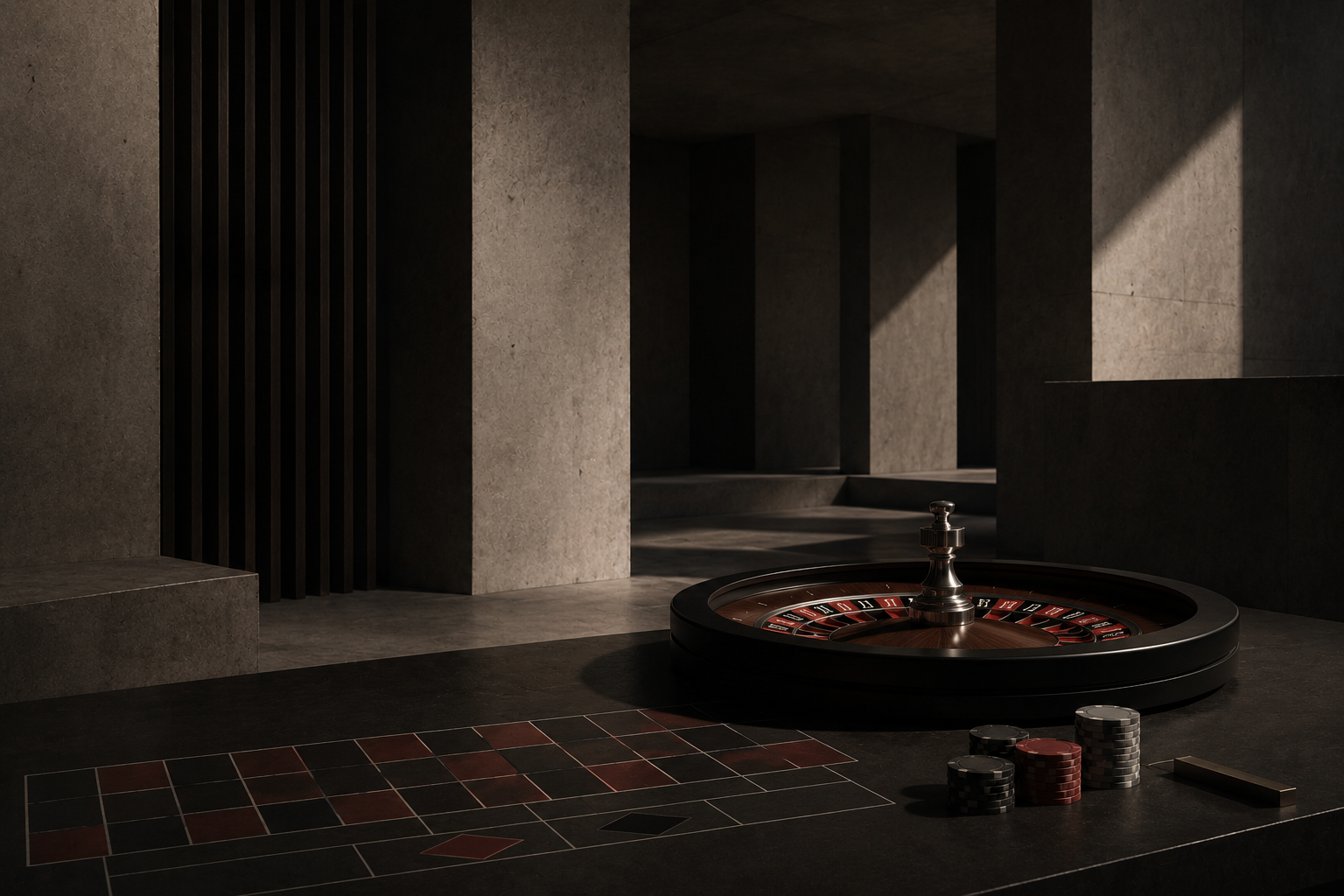
Few casino games have an image as instantly recognizable as roulette. A polished wheel, a small white ball, a grid of numbers and a table covered in colored chips can make the game look complicated at first. In reality, learning how to play roulette is surprisingly straightforward once you understand what happens during each spin.
The basic process is simple. Players place bets on the roulette table, the dealer spins the roulette wheel, and the ball travels around the wheel before landing in one numbered pocket. That winning number determines which bets receive a payout. Once the table layout and main betting options make sense, the game becomes much easier to follow.
Roulette also translates naturally to digital play. Winna offers a modern, crypto-friendly casino experience with table games and other formats available through a streamlined interface. The visual side of the game matters too, something Art-Sheep has previously explored in its look at how aesthetics influence the digital gaming experience.
Whether you are approaching a roulette table for the first time or want to understand what the different bets actually mean, the game can be broken down into a few simple ideas.
How to Play Roulette Step by Step
A roulette round follows a predictable sequence. Physical casinos, online games and live roulette may present that sequence differently, but the basic rules remain largely the same.
Choose a Roulette Table
Start by checking which type of roulette is being played.
European roulette has numbers 1 to 36 plus a single 0. American roulette normally adds both 0 and 00. French roulette also uses a single-zero wheel but may introduce additional rules for certain even-money bets.
The type of wheel matters because the number of pockets affects the mathematical odds.
Online players may also encounter live roulette, where a real dealer operates the wheel through a video stream, as well as fully digital games where the round is handled electronically.
Get Your Roulette Chips
At a traditional casino, players generally obtain roulette chips before joining the game.
Roulette tables often use different color chips for different players. This makes it easier for the dealer to distinguish between wagers when several people place chips on the same number or section of the table.
If you are new to the game and uncertain about table procedure, ask the dealer before placing a wager.
Place Your Bets on the Table
Before the wheel is spun, players place bets on the table layout.
A wager can cover a single number, two adjacent numbers, several numbers, a color, odd or even numbers, a range such as 1–18 or 19–36, or one of several other groups.
Each betting option comes with its own probability and payout.
Watch the Dealer Spin the Wheel
Once players have placed their bets, the dealer spins the roulette wheel in one direction and sends the ball around the track in the opposite direction.
As the ball begins to slow, the dealer closes betting with a call commonly expressed as “no more bets.”
The ball eventually drops from the outer track and comes to rest in one of the numbered pockets.
That pocket produces the winning number. Winning wagers are paid before betting opens for the next spin.
Understanding the Roulette Table Layout
The roulette table becomes easier to read when you divide it into separate betting areas rather than viewing it as one large collection of numbers.
The main grid contains numbers from 1 to 36 arranged across three columns. Each number is either red or black. The 0 is green, while an American roulette table also contains a green 00.
Around the number grid are the outside betting sections.
These include wagers covering:
- Red or black
- Odd or even
- 1–18 or 19–36
- 1–12, 13–24 or 25–36
- One of the three numbered columns
Where you place your chip communicates the exact wager.
A chip directly on one number is a straight-up bet. A chip on the line between two adjacent numbers covers both. Chips can also be positioned at intersections or along the edge of groups to cover three, four or six numbers.
Learning these positions is one of the most useful things a beginner can do before placing a real wager.
Inside and Outside Roulette Bets Explained
Roulette bets fall into two main groups known as inside bets and outside bets.
Inside bets focus on individual numbers or relatively small groups. Outside bets cover larger sections of the roulette table.
Inside Bets
A straight-up bet covers one single number. If you put a chip directly on 17, for example, the ball must land on 17 for the wager to win.
A split bet covers two adjacent numbers. The chip is placed on the line between them.
A street bet covers three numbers in a horizontal row.
A corner bet covers four numbers meeting at the same intersection.
A six-line bet covers two neighboring rows for a total of six numbers.
Because inside bets cover relatively few possible outcomes, they generally offer larger payouts than broader bets.
Outside Bets
Outside bets cover larger groups of numbers.
Common examples include:
- Red or black
- Odd or even
- 1–18 or 19–36
- First, second or third dozen
- One of three columns
Red or black and odd or even each cover 18 numbered pockets.
Outside bets therefore hit more frequently than a single-number wager, but their payouts are smaller. Neither category is automatically better. They simply offer different balances between the number of outcomes covered and the size of a potential payout.
Roulette Bets and Payouts
Roulette payouts become easier to understand when you compare the number of pockets covered by each wager.
| Roulette bet | Numbers covered | Standard payout |
| Straight up | 1 | 35 to 1 |
| Split | 2 | 17 to 1 |
| Street | 3 | 11 to 1 |
| Corner | 4 | 8 to 1 |
| Six line | 6 | 5 to 1 |
| Dozen or column | 12 | 2 to 1 |
| Red or black | 18 | 1 to 1 |
| Odd or even | 18 | 1 to 1 |
A higher payout does not mean a bet has better odds of winning.
A straight-up bet pays 35 to 1 because only one pocket can produce a win. A red or black wager covers 18 numbers, so the chance of winning on a single spin is much higher, but the standard payout falls to 1 to 1.
Zero is important here. It is neither red nor black and does not count as odd or even. That is why apparently balanced outside bets are not true 50-50 propositions.
On a European wheel, for example, red covers 18 of 37 pockets, giving it a probability of about 48.65% on an individual spin. On an American double-zero wheel, it covers 18 of 38 pockets, or about 47.37%.
What Happens If You Bet $100 on Red?
A standard wager on red pays 1 to 1.
If you put $100 on red and the ball lands on a red number, the winning payout is $100. Your original $100 stake is also returned, so $200 comes back to you in total.
That does not mean you have won $200 in profit. Your profit is $100.
If the ball lands on black or a green zero pocket, the standard red bet loses.
European, American and French Roulette Compared
The wheel variant is one of the most important details to check before you play roulette.
| Feature | European roulette | American roulette | French roulette |
| Zero pockets | 0 | 0 and 00 | 0 |
| Total pockets | 37 | 38 | 37 |
| Straight-up payout | 35 to 1 | 35 to 1 | 35 to 1 |
| Standard house edge on most bets | About 2.70% | About 5.26% | About 2.70% |
| Distinctive feature | Single-zero wheel | Double-zero wheel | May include La Partage or En Prison |
European roulette uses 37 pockets because it contains numbers 1 to 36 plus a single zero.
American roulette normally has 38 pockets because it adds 00. Standard payouts do not increase to compensate for the additional pocket, which produces a higher house edge.
French roulette also uses a single-zero wheel. Some French tables apply special rules such as La Partage or En Prison to even-money wagers when zero appears. Exact rules can vary by table, so they should always be checked before betting.
For a beginner choosing between otherwise standard European and American games, the European single-zero version has the lower mathematical house edge.
How Roulette Odds and the House Edge Work
The house edge explains why payout odds are slightly less favorable than the mathematical probability of the outcomes.
The Responsible Gambling Council explains house edge and payout odds as part of the built-in mathematical advantage associated with casino games.
Take a straight-up European roulette wager as an example.
There are 37 possible pockets, but a winning single-number wager pays 35 to 1 rather than matching the full mathematical odds against winning. That difference creates the house advantage.
The same principle applies throughout the roulette table.
Changing from a straight-up bet to red or black changes how frequently a wager might win and how much it pays, but it does not remove the underlying house edge.
Is Roulette a Game of Skill or Luck?
Roulette is fundamentally a game of chance.
Players can make informed decisions about how much to wager, what type of bet to place and which roulette variation to choose. Those decisions affect exposure, payout size and the mathematical house edge.
They do not determine where the ball will land.
Understanding roulette can still make someone a more informed player. Knowing the table layout prevents accidental bets. Recognizing the difference between American and European roulette helps with comparing odds. Understanding payouts makes it easier to see the trade-off between covering more numbers and chasing a larger return.
What knowledge cannot reliably do is predict the next winning number.
Previous results do not make a particular color or number “due.” Each properly conducted spin should be treated as a new event.
Can You Win at Roulette With a Strategy?
Roulette strategies generally do not attempt to change the wheel itself. Instead, most tell players how to adjust their wager size after wins or losses.
That distinction is essential.
A betting system can change the pattern of your stakes. It does not change the probability attached to the next spin.
Martingale
The Martingale is one of the best-known roulette strategies.
Its basic form uses an even-money bet, with the wager increased after each loss, commonly by doubling it. A subsequent win is intended to recover previous losses and leave a profit equal to the original betting unit.
The difficulty is that wager sizes can rise extremely quickly during a losing sequence. Available funds and table limits prevent endless progression.
D’Alembert
D’Alembert uses smaller changes in betting size.
A player typically increases the next wager by one unit after a loss and reduces it by one unit following a win.
That produces a slower progression than Martingale but still has no effect on which pocket the ball reaches.
Fibonacci
The Fibonacci approach connects wager sizes to the familiar number sequence in which each new number is based on the previous two.
Players move through that sequence according to results.

The method changes money management, not the odds of the underlying roulette bet.
Labouchere
Labouchere is also known as a cancellation system.
The player starts by writing down a sequence of numbers, with each representing a betting unit. A wager is commonly calculated using the first and last numbers in the sequence.
After a win, those numbers are crossed off. Following a loss, another figure is added to the sequence.
The system may create an orderly betting pattern, but that pattern still cannot make red, black or any single number more likely to appear.
What Is the Smartest Bet in Roulette?
There is no single roulette bet that is smartest in every sense.
If “smartest” means covering a relatively large number of possible winning outcomes, even-money outside bets such as red or black, odd or even and 1–18 or 19–36 each cover 18 numbers.
If the aim is a larger payout from one winning spin, a single-number bet offers 35 to 1. The trade-off is that only one numbered pocket can win.
The clearest mathematical choice comes from the wheel itself. If the options are otherwise equivalent, a standard European single-zero roulette game has a lower house edge than standard American double-zero roulette.
The useful question is therefore not which wager can guarantee a win. None can. It is which combination of probability, payout and stake size suits the way you want to approach the game.
How Roulette Differs From Slots and Other Casino Games
Roulette is distinctive because a single wheel outcome can settle many different kinds of bets around the same table.
Slots use a very different structure. Instead of placing chips on betting sections before a shared wheel spin, players interact with reels, symbols and game-specific features.
Anyone curious about the contrast can try a demo slot super scatter and compare its reel-based format with roulette’s numbered table and wheel.
Game presentation can be just as important as the underlying format. Art-Sheep’s exploration of what makes game design work looks at how themes, sound, visuals and interfaces shape the experience of modern games.
Live roulette sits somewhere between digital convenience and the traditional table experience. Players still see a dealer, roulette wheel and betting layout, but the game is presented through an online interface.
Beginner Tips Before Your First Roulette Spin
Knowing the rules is only part of learning to play roulette. A few practical habits can make a first game much easier to follow.
Learn the table layout first. Find the numbered grid, zero, dozens, columns and outside betting areas before placing chips.
Check the roulette variation. A wheel with one zero differs mathematically from one containing both 0 and 00.
Know what your chip covers. Make sure you understand whether you are betting on a single number, several numbers or a broader outside outcome.
Read the payout before betting. Different roulette bets offer different odds and payouts.
Choose your wager size in advance. Increasing bets simply because the previous spin lost does not improve the probability of the next outcome.
Do not treat recent results as a prediction tool. Several consecutive black numbers do not make red certain or overdue on the next spin.
Ask the dealer when necessary. At a physical roulette table, the dealer can explain table-specific procedures and chip placement.
Check the rules of the particular game. Table limits and special rules can differ between casinos and roulette variations.
Once those points are familiar, there is relatively little a beginner needs to memorize. Roulette’s appearance is more complicated than its core rules.
Common Questions About Playing Roulette
How do you play roulette for beginners?
Choose a roulette table, obtain chips if required and place your wager on the table layout. The dealer spins the roulette wheel and sends the ball around it. Once betting closes, the ball eventually lands in a numbered pocket. Bets matching the winning outcome are paid according to the rules of the table.
What are the basic rules of roulette?
Players place bets on individual numbers, groups of numbers or characteristics such as red or black before betting closes. The wheel is spun, the ball lands in a pocket, and the result determines which bets win.
Is roulette a game of skill or luck?
Roulette is primarily a game of chance. A player can make informed decisions about bet type, wager size and roulette variant, but those decisions cannot determine the next winning number.
How much do you win if you put $100 on red in roulette?
Red normally pays 1 to 1. A winning $100 bet therefore earns $100 in profit, while the original $100 stake is returned. The total amount returned is $200.
Is there a trick to roulette or can you win with a strategy?
No conventional betting system changes the mathematical probability of the next spin. Martingale, Fibonacci, D’Alembert and Labouchere alter how wagers are sized or sequenced, but they do not make a particular number or color more likely to win.
What are the different types of bets in roulette?
Inside bets include straight-up, split, street, corner and six-line wagers. Outside bets include red or black, odd or even, low or high numbers, dozens and columns. They cover different numbers of outcomes and therefore offer different payouts.
How do roulette payouts and odds work?
Bets covering fewer numbers generally offer larger payouts because they are less likely to win. A straight-up number normally pays 35 to 1, while red or black pays 1 to 1. Zero and double zero are central to the house edge because they sit outside many common even-money bets.
What is the difference between American and European roulette?
European roulette normally has 37 pockets, including one zero. American roulette normally has 38, adding both 0 and 00. Because standard payouts remain similar despite the extra pocket, American double-zero roulette has a higher house edge.
Where do you place chips in roulette?
It depends on the bet. Place a chip directly on a number for a straight-up wager, on the line between two numbers for a split, or at intersections and marked outside sections for other types of bets. The precise position tells the dealer which outcomes the wager covers.
What is the smartest bet to make in roulette?
There is no bet that guarantees a favorable result. Even-money outside bets cover more numbers than inside bets, while straight-up bets offer larger payouts at much lower hit rates. When choosing the game itself, standard European single-zero roulette has a lower house edge than standard American double-zero roulette.
Knowing the Wheel Makes Roulette Much Simpler
Roulette looks elaborate because dozens of possible wagers can occupy the same table, but every round ultimately revolves around one simple question: where will the ball land?
Learn the table layout, understand the difference between inside and outside bets, check the payout before placing your chips and know which roulette wheel you are playing.
Those fundamentals are more useful than trying to memorize complicated betting systems. Once the relationship between the wheel, the table and the available bets becomes clear, it is much easier to follow each spin and understand exactly what your wager represents.