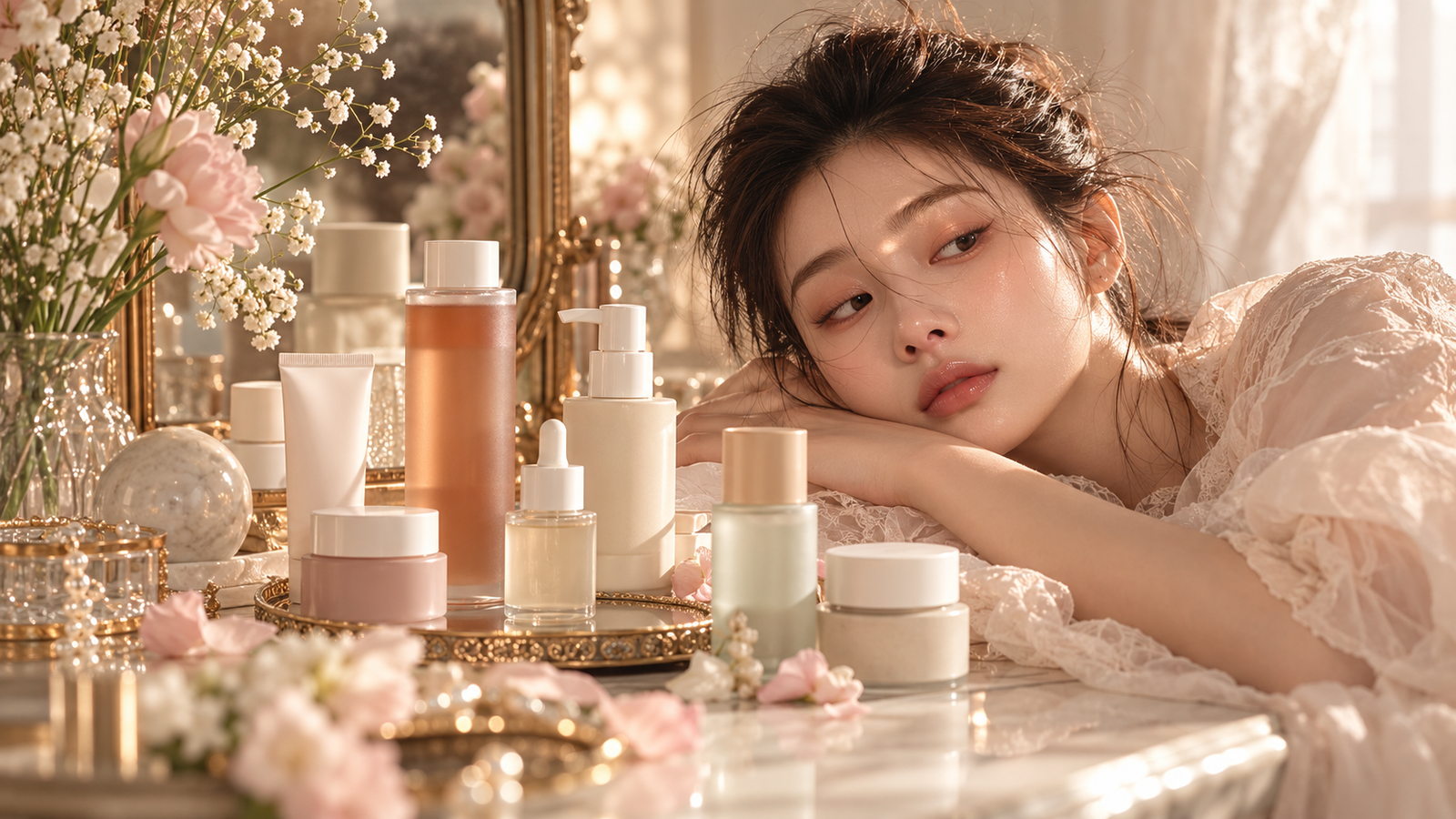
Pick up a Korean skincare product and a drugstore moisturizer from anywhere else, and you can usually tell them apart before reading a single word. Something about the proportions, the restraint, the way the object asks to be kept on the shelf rather than hidden in a cabinet. K-beauty conquered the global market through formulation — but it seduced it through design.
Objects Meant to Be Seen
Western skincare historically styled itself as medicine: clinical whites, pharmacy typography, packaging that communicated seriousness through blandness. Korean skincare made a different bet — that a product used twice a day, every day, is a domestic object, and domestic objects deserve the design attention of furniture or ceramics.
The results read like product-design case studies. Soft-matte tubes in muted clay tones. Cushion compacts that compressed an entire makeup step into a clickable object. Glass weighted to feel substantial without feeling precious. The aesthetic is frequently minimalist, but it is a warm minimalism — closer to Scandinavian domestic design than to tech-industry sterility.
Where the Look Comes From
The visual language did not appear from nowhere. Korean packaging draws quietly on a long national design vocabulary: the muted celadon and clay palette of traditional ceramics, the deliberate emptiness prized in East Asian composition, hangul typography whose geometric letterforms sit naturally in minimalist layouts. Run through Seoul’s hyper-competitive consumer market — where a shelf position is won or lost on a glance — that heritage got compressed into objects that photograph beautifully and age slowly. It is vernacular tradition, industrialized.
Texture as Craft
The design thinking goes deeper than packaging. Korean formulation treats texture — what designers would call the material experience — as a primary feature, not a side effect. Watery gels that break on contact, essences engineered for a specific speed of absorption, sunscreens whose entire innovation is that they feel like nothing. An enormous amount of R&D goes into the first three seconds of sensation, because Korean brands understood early that people abandon products that feel wrong long before products that merely work slowly.
This is craft logic applied to chemistry: the conviction that how something feels to use is inseparable from what it does.

Curation as the New Design Problem
The movement’s success created its own aesthetic problem: abundance. Thousands of beautifully designed products form, collectively, an undesigned experience — an overwhelming wall of options with no hierarchy. The frontier of K-beauty design is no longer the bottle but the choosing.
The interesting responses are curatorial. ThePicks, for instance, approaches Korean skincare discovery the way a well-edited gallery approaches a sprawling art scene — recommendations from real creators, organized by skin type, so the encounter starts with a considered selection rather than the entire warehouse. It is design thinking applied to the catalog itself: reduce, contextualize, match the object to the person.
The Lesson for Everything Else
K-beauty’s design story is ultimately about respect for the everyday. It took a mundane category — cleansers, creams — and decided the daily ritual around it deserved beauty, tactility, and thought. The principle travels well beyond skincare: the objects we touch most often are precisely the ones worth designing best. A toothbrush, a kettle, a jar of cream — none of them needs to be beautiful, which is exactly why it matters when they are.