We greatly appreciate LiFO for the feature on Art-Sheep.com and metaNEPHTHYS, exploring themes of art, design, independence and creative identity. Below, we reproduce the feature in full, translated into English. The original Greek article can also be read on LiFO here.
 Aristidis-Lithoxoidis-Αριστείδης-Λιθοξοΐδης-metanephthys.com-art-sheep.com_
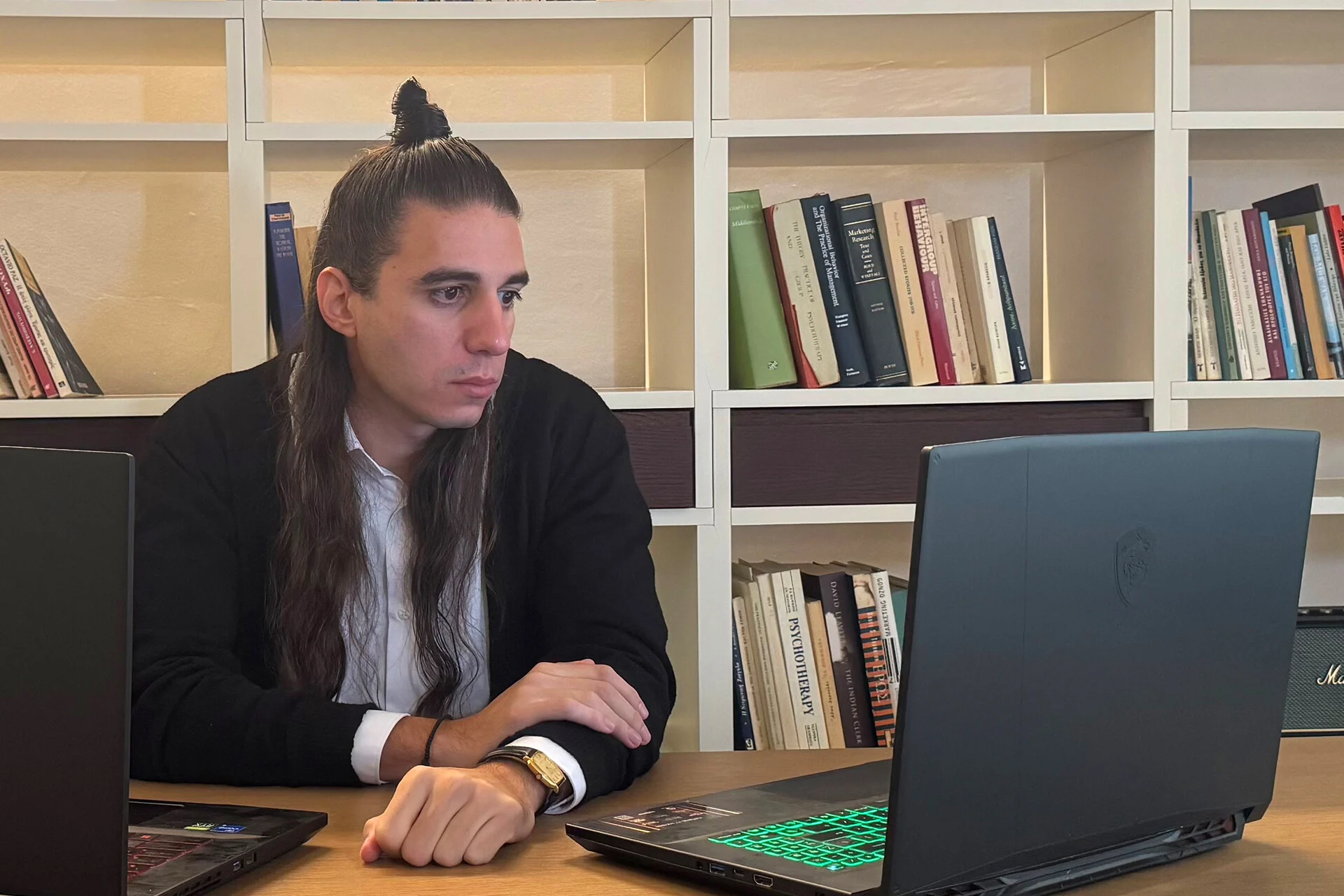
Aristidis G. Lithoxoidis has spent years moving between different creative and professional fields. On one side stands Art-Sheep.com, the English-language art & culture platform founded in 2012, which to this day has preserved its independence, its ironic gaze, its dark humor, and its distinctive relationship with art, culture, and pop culture. On the other is metaNEPHTHYS, working across digital identity, design, and technology.
If there is one thing connecting the two, it is an insistence on identity: the belief that a project should develop a character before deciding how it will present itself, whom it will speak to and, perhaps most importantly, what it refuses to become.
The Path of Aristidis G. Lithoxoidis
There is no perfectly straight line leading from literature and art to digital design and from there to entrepreneurship. Image, writing, aesthetics, technology, and the need to build something from the ground up recur throughout Lithoxoidis’ path in different forms.
Speaking about that trajectory, Aristidis G. Lithoxoidis explains that it was anything but a carefully orchestrated plan.
“People who really know me know how meticulously I tend to plan almost everything. But in this particular case, many situations simply happened. Some had more literary value in the way they came about; others had none whatsoever.”
The absence of an initial master plan did not mean the absence of continuity. Of everything that emerged along the way, Art-Sheep and metaNEPHTHYS were the two projects that remained and became firmly established. Lithoxoidis attributes this partly to the fact that both were closely aligned with his temperament and way of thinking from very early on. They developed personalities of their own and were never simply projects designed to satisfy a temporary need.
More importantly, both allowed him a generous degree of freedom. Art-Sheep could remain idiosyncratic and independent, while metaNEPHTHYS could choose the projects that suited it rather than simply chase volume.
Both began when he was considerably younger. Looking at them today, he does not believe he was fully “ready” for what they would eventually become or for the demands they now carry. He describes their relationship more as a parallel evolution: as the projects grew, he changed with them, and every new demand forced him to develop something he had not previously needed.
He puts it more simply: “We were shaped together.”
Adaptability therefore became a necessity. At Art-Sheep, it is now regarded as one of the platform’s fundamental values — not as a willingness to dilute its tone or content, but as an ability to survive in an internet that has undergone several radical transformations since 2012. At metaNEPHTHYS, the same demand for adaptability came through the relentless pace of change in information technology.
Lithoxoidis connects that ability in part to having grown up in different places and changed schools several times. Alongside adaptability, he points to constant exposure to art from an early age, an understanding of hard work and, perhaps above all, rigorous self-criticism. New Microsoft Word Document(1)
Art-Sheep.com: The Weird, Dark-Humor Kid of the Internet’s Previous Decade
Art-Sheep was created in 2012, at a time when independent online publishing still had more room for eccentricity. A digital magazine could have a difficult name, an unusual tone and a strong personality without every decision having to pass through the filter of reach and engagement.
English-language and international from the outset, Art-Sheep developed its own language across visual art, literature, design, architecture, history and culture — pop and otherwise.
Irony and dark humor were never merely decorative features; they became part of its editorial identity. Its interest in art could remain entirely sincere without being accompanied by the solemnity that so often surrounds the art world.
Perhaps Art-Sheep.com’s most unusual characteristic is that it has stubbornly remained independent. In strong months, its views may reach into the millions, yet its independence remains arguably one of its most admirable qualities.
Asked what Art-Sheep gained by refusing to become part of a larger media brand — as so many independent digital publications eventually did — and what that decision cost, Lithoxoidis says:
“The main thing it gained is that it remained Art-Sheep. It seems impossible to imagine it preserving its identity in any other form.
There were opportunities along the way to incorporate it into more conventional structures, and of course there was a cost to not doing so: financially, in terms of growth, access, and perhaps opportunities that under different circumstances might have led elsewhere.
But every such agreement carries a price of its own. You begin by removing the strange elements because ‘they don’t work,’ then some of the humor because it isn’t safe enough, then something from the language, and eventually you are left with a far more digestible product that simply isn’t the same thing anymore.
Views generate excitement, but only temporarily. At least for me. What I have always considered more important is something I have heard described as ‘pride of ownership’ — a kind of dignity, always subjective, in what you do.”

As for whether he has ever regretted any of those “noes,” he is equally unequivocal:
“Quite the opposite.”
metaNEPHTHYS: Different From the Name Alone
The world of digital design and digital architecture has a curious habit of producing companies that promise unique identities while bearing names that often sound remarkably similar: Something-Web, Something-Net, Something-Digital.
metaNEPHTHYS distinguishes itself from the name alone, but more importantly through the way it defines growth.
The company takes on projects for major companies and organizations, ranging from websites and e-shops to applications, digital advertising, branding and broader digital identity systems. Its logic, however, is not based on mass production.
Aristidis Lithoxoidis says they never thought of themselves as competing for “appearances” or for the largest possible number of clients. The ability to choose projects remained more important than the revenue that sheer volume can generate.
On larger projects, the work does not end with delivering a website. It may extend from the design of an entire digital identity and custom applications to campaigns, advertising materials and the technical infrastructure supporting them.
For Lithoxoidis, however, this range has value only when the individual parts serve the same central logic rather than becoming a collection of disconnected services.
Growth, in his view, does not mean doing ten times more of exactly the same thing. It can mean more difficult work, more demanding collaborations and more time devoted to a project.
metaNEPHTHYS therefore approaches digital presence less as a catalogue of services and more as the construction of a coherent identity. Before the website, the application or the campaign comes a more fundamental question: who exactly is speaking?
Mass production may make economic sense. It does not always make creative sense. New Microsoft Word Document(1)
Do Art and Design Ever Truly Meet? And If So, Where?
In recent years, the word “art” has been used with remarkable generosity. A logo, an interface, a poster, a sneaker or an advertising campaign can all rather easily acquire the label.

Lithoxoidis believes design does not need that kind of elevation. Its value lies precisely in the fact that it operates within constraints: it has an audience, a purpose and a function.
“I think we have made the word ‘art’ so broad that it risks meaning almost nothing.
An exceptional logo can be beautiful, intelligent and original. We do not need to call it art in order to give it value.
Art can be contradictory. It can solve nothing at all and have no interest in whether you understood what it was trying to say. Design does not have that luxury.
Where the two do meet, however, is in the education of the eye.
You cannot speak seriously about aesthetics without history, references and philosophy. When creating a corporate identity, for example, I find it far more interesting to begin by asking: if this company belonged to an artistic movement, which one would it be? If it had a philosophical lineage, what would that be? What does it consider beautiful? What does it consider vulgar?
If you answer those questions, you have already made many of the decisions that will later appear as color, typography, photography or interface.
Art and design do not need to become the same thing in order to have a meaningful dialogue.”
That, he argues, is also why the urge to describe every outstanding piece of design as “art” may ultimately diminish design more than it elevates it. New Microsoft Word Document(1)
What Remains When All the Tools Change?
Artificial intelligence and the new generation of creative tools are dramatically reducing both the cost and the difficulty of production. Images, texts, code and layouts can now be generated in quantities that, only a few years ago, would have required entire teams.
For Lithoxoidis, the less production itself remains a distinctive skill, the more valuable judgment, taste, education and the ability to choose become.
The fact that someone can now accomplish in fifteen minutes what once required fifteen hours does not trouble him; there was never any particular moral virtue in the suffering involved.
The real problem begins afterwards.
If you can produce one hundred images in an hour, producing one hundred images is no longer impressive. The difficult part is knowing which one is worth keeping — or having enough judgment to decide that none of them are.
Tools can flatten technical differences far more easily than they can provide historical references, philosophical grounding or aesthetic education.
And perhaps that is the paradox of our time:
the easier it becomes to create anything, the more important it becomes to know what is actually worth creating.