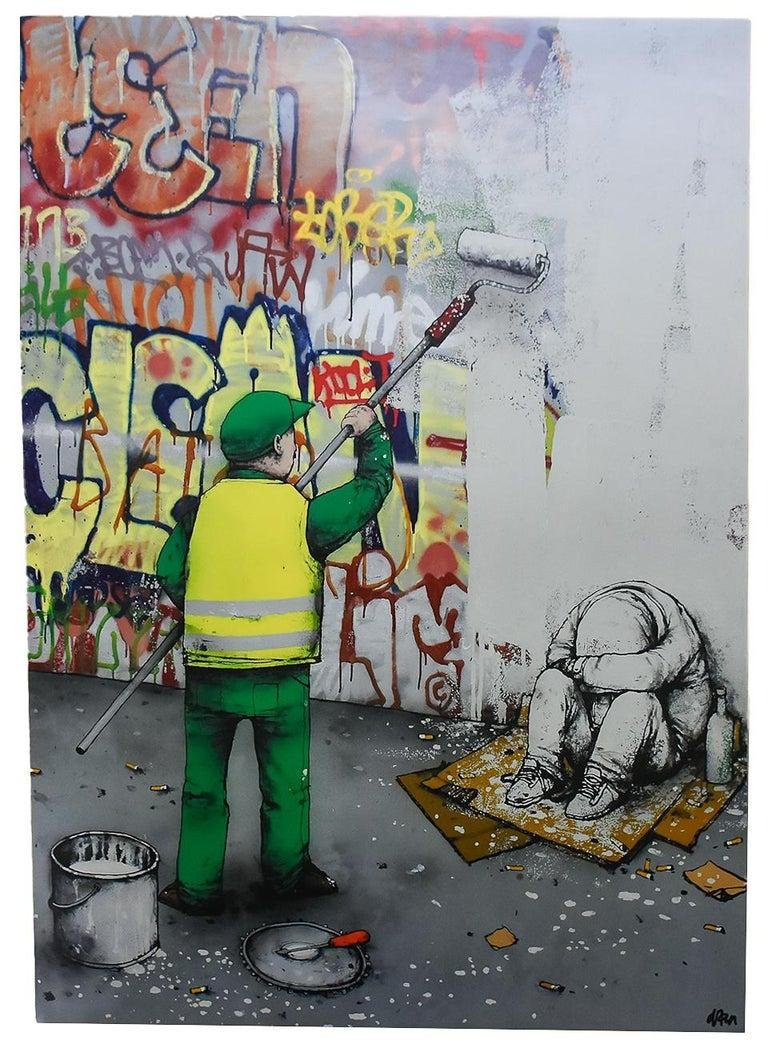
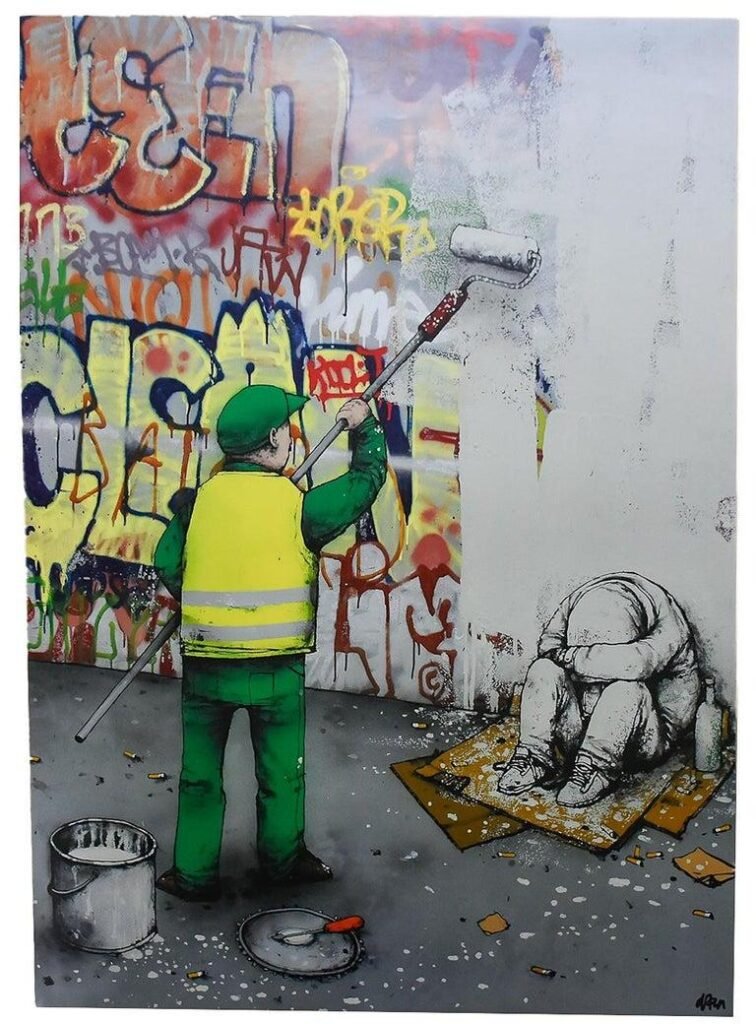
Behind the innocent faces, colorful crayons, and apparently cheerful drawings of French street artist Dran lies a world of social hypocrisy, broken dreams, and beautifully uncomfortable truths.
Childhood is traditionally regarded as a period of innocence, imagination, and blissful ignorance. A wonderful time when the world appears to be filled with infinite possibilities, adults seem to possess all the answers, and the most pressing responsibility of the day might involve deciding which color to use for the sky.
Then, of course, we grow up.
We discover that adults have very few answers, society is held together by a questionable collection of conventions, and the world is considerably less interested in our happiness than the advertisements suggested.
For French street artist Dran, this rather disappointing revelation provides an endless source of artistic inspiration.
Born in Toulouse in 1979, Dran has developed a distinctive visual language that combines the aesthetics of children’s illustration with biting satire, surrealism, and an exceptionally dark sense of humor. His characters inhabit a world in which imagination regularly collides with authority, commercialism, environmental destruction, and the general absurdity of contemporary existence.
At first glance, his drawings might resemble illustrations from an eccentric children’s book. There are bright colors, exaggerated expressions, playful compositions, and figures that appear to have escaped from a particularly mischievous cartoon.
Look a little closer, however, and the joke becomes considerably less innocent.
In Dran’s universe, children are confronted with the machinery of consumer culture, artistic freedom becomes a contested privilege, and the most ordinary aspects of everyday life reveal themselves to be profoundly ridiculous.
It is a world in which the innocence of childhood has not yet disappeared, but has been forced to confront the spectacular incompetence of adulthood.
And the results are frequently hilarious, provided one has developed a sufficiently healthy appreciation for despair.
The French Banksy Who Doesn’t Need to Be Banksy
Dran is frequently introduced as the “French Banksy,” a convenient comparison that has followed his work throughout his career.
The similarities are understandable. Both artists employ humor, recognizable visual imagery, and sharp social criticism. Both have produced works in public spaces, questioning the authority of institutions and the contradictions of contemporary culture.
But reducing Dran to a French variation of another artist does little justice to his distinctive approach.
Where Banksy’s most recognizable works often employ visually economical stencils and immediately legible political messages, Dran’s artistic vocabulary frequently draws upon the traditions of comic books, illustration, and deliberately unsettling children’s imagery.
His compositions possess an unusual emotional ambiguity. They can be amusing, disturbing, sentimental, and deeply cynical, sometimes within the same image.
Dran studied at the School of Fine Arts in Toulouse, where comics, caricature, and graffiti became increasingly important to his artistic identity.
According to the Palais de Tokyo, drawing became a means through which he could construct a parallel world and communicate with a reality in which he did not always feel he belonged.
This observation offers an interesting introduction to his work. Dran is not merely interested in producing clever visual jokes. His illustrations frequently suggest the perspective of someone observing the ordinary rules of society and finding them almost inexplicably absurd.
His artistic practice extends across graffiti, painting, illustration, printmaking, and installations, while his publications include La télévision (2005), Ma ville, je l’aime (2005), and 100 jours et quelques (2010).
The titles themselves suggest his fascination with everyday existence, the urban environment, and the systems through which modern society presents itself.
But it is his recurring use of childhood imagery that gives his work much of its emotional power.
The children in his drawings often seem more perceptive than the adults surrounding them. They question rules that everybody else has accepted, imagine alternatives to the existing world, and behave as though creativity might still possess the capacity to alter reality.
Naturally, this makes them rather inconvenient members of society.
Crayons Against the World: The Strange Innocence of Dran’s Art
One of Dran’s most recognizable visual motifs is the child holding a crayon.
It is a wonderfully modest instrument of rebellion.
No elaborate machinery, expensive technology, or institutional permission is required. A simple piece of colored chalk can transform a blank surface into an imaginary universe.
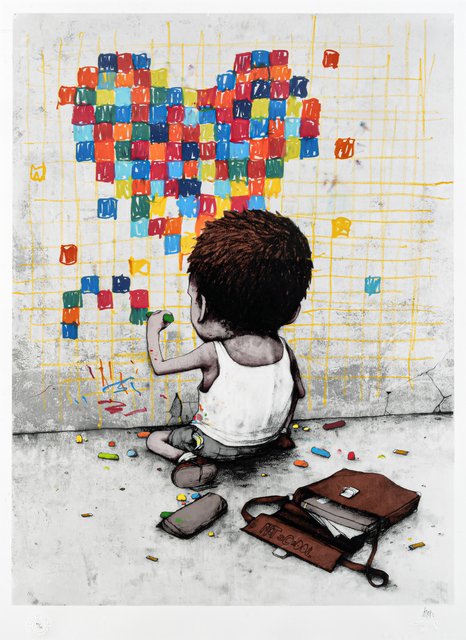
In I Have Chalks (2010), a child sits before a wall, assembling a colorful image from small squares of color. Around the figure lie the ordinary materials of artistic activity: scattered chalks and a bag containing more of them.
The composition is quiet, almost tender. Yet it also presents a subtle argument about the extraordinary imaginative freedom that children possess before society begins teaching them which forms of expression are acceptable.
Artwork © Dran. Image reference:
Artsy / Tate Ward Auctions.
The work can be understood as a celebration of creativity, but there is also an element of melancholy beneath its cheerful colors.
Children draw because they want to. They invent without worrying about critical reception, market value, or whether their work might be sufficiently conceptual to justify a press release.
Professional artists, on the other hand, are expected to navigate an elaborate system of galleries, collectors, reputations, commercial expectations, and institutional approval.
Somewhere between the first childhood drawing and the contemporary art market, the simple pleasure of making something can become remarkably complicated.
Dran repeatedly returns to this tension between the imaginative freedom of children and the restrictions imposed by adult society.
His visual universe is populated by figures whose apparent innocence becomes a tool for exposing the artificial nature of social conventions.
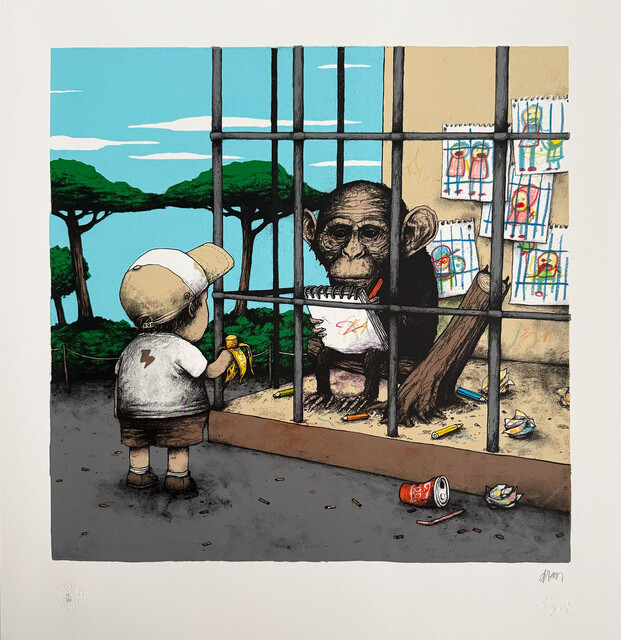
In another work, Exhibit (2010), a child stands before a caged chimpanzee that appears to be drawing pictures of its own.
The scene plays with our assumptions about intelligence, artistic expression, and captivity.
Artwork © Dran. Image reference:
Artsy.
Who is really being exhibited? The animal behind the bars, the creative act itself, or the human visitor attempting to understand it?
It is the kind of visual question that Dran appears particularly fond of asking.
His imagery rarely requires an elaborate explanation to be understood. The joke is immediately accessible, but its implications can extend considerably further.
It is this combination of simplicity and psychological discomfort that makes his illustrations memorable.
Unlike much contemporary conceptual art, Dran does not demand that the viewer first read a four-page curatorial statement explaining why an ordinary household object should be understood as a radical examination of late capitalism.
He simply draws something funny.
And then allows the realization that it is not particularly funny to arrive a few seconds later.
The Beautiful Absurdity of Modern Civilization
Beyond childhood and creativity, Dran’s work addresses a wide range of contemporary concerns, including consumerism, environmental destruction, social inequality, the commercialization of culture, and the relationship between individuals and institutions.
These subjects have become familiar territory for contemporary artists, but Dran’s approach is distinguished by his refusal to abandon humor in the pursuit of seriousness.
He recognizes something that political commentary occasionally forgets: human civilization is often so absurd that an accurate description can resemble a joke.
Consider En Cage (2016), an image in which children appear trapped within the metal structure of a shopping cart.
It is a simple but deeply uncomfortable visual transformation.
An ordinary object associated with shopping becomes an instrument of confinement, suggesting how consumer culture can shape and restrict human experience from an early age.

Artwork © Dran. Image reference:
Stowe Gallery.
The shopping cart is an especially appropriate symbol because it is among the most ordinary objects in modern commercial life.
It represents choice, convenience, abundance, and the comforting illusion that happiness might be located somewhere between the household appliances and the discounted breakfast cereals.
By turning it into a cage, Dran reverses its usual meaning.
Consumption becomes confinement. An object designed to transport purchases becomes a structure that restrains the individuals inside it.
The image offers no elaborate economic theory. It does not require one.
Sometimes the difference between social criticism and an exceptionally effective cartoon is simply the willingness to make the metaphor visible.
Elsewhere in Dran’s artistic universe, familiar figures from popular culture find themselves removed from their reassuring fictional environments and placed in situations shaped by the contradictions of contemporary life.
The effect is frequently uncomfortable because these characters carry memories of childhood entertainment, innocence, and imagined moral simplicity.
Dran takes these familiar associations and introduces a world that is considerably less polite.
His work shares this interest in visual satire with other street artists whose interventions expose the strange contradictions of modern society. Art-Sheep previously explored the similarly uncomfortable relationship between childhood and contemporary culture in the socially critical street art of iHeart.
Both artists demonstrate how the visual language of childhood can reveal the psychological absurdities of adulthood.
Yet Dran’s humor possesses a particularly melancholic quality.
His characters do not always appear angry about the world they inhabit.
Sometimes they simply seem disappointed.
And disappointment, when illustrated with sufficient precision, can be considerably more devastating than outrage.
When the Gallery Becomes Part of the Joke
Dran’s relationship with contemporary art institutions introduces another fascinating dimension to his practice.
Like many artists emerging from graffiti and urban culture, he has moved between public spaces and the commercial gallery system.
In 2015, his London exhibition Public Execution approached the traditional gallery format in an unusually playful manner.
Presented in Soho through Pictures on Walls, the exhibition initially opened as a largely empty gallery, with painted frames suggesting the locations where artworks might eventually appear.
Over the course of the exhibition, Dran developed illustrations directly on the walls, gradually transforming the space itself into the artwork.
The process was documented by Brooklyn Street Art, which described the unusual evolution of the exhibition from an almost empty room into a densely illustrated environment.

It was an entertaining reversal of conventional exhibition expectations.
Rather than presenting completed objects to an audience, Dran exposed the creative process within the institutional setting.
The gallery became a place where the artwork developed in front of visitors, and the distinction between artistic production and exhibition gradually disappeared.
In another institutional context, Dran transformed a staircase at Paris’s Palais de Tokyo into a dark graphical environment for the exhibition Inside.
The intervention, painted entirely in black and deprived of natural light, transformed a transitional architectural space into something resembling a descent through the artist’s private imaginative universe.
These projects demonstrate how Dran’s work extends beyond individual drawings and prints.
His artistic vocabulary can occupy architecture, alter the atmosphere of a building, and turn ordinary movement through a space into a narrative experience.
There is also a particularly satisfying irony in seeing an artist known for questioning authority become the subject of serious institutional recognition.
The art world has a remarkable ability to absorb criticism of itself, place it beneath carefully adjusted lighting, and eventually offer it to collectors.
This tension is hardly unique to Dran. As explored in Art-Sheep’s examination of street art’s place in art history, the movement occupies an increasingly complicated position between rebellious public intervention and established cultural legitimacy.
Perhaps the contradiction is unavoidable.
Street art challenges the boundaries of ownership, authority, and cultural value, even as some of its most recognizable practitioners become valuable figures within the international art market.
Dran’s work does not necessarily resolve this contradiction.
But it seems particularly well equipped to laugh at it.
Laughing at the End of Innocence
What makes Dran’s work compelling is not simply its capacity to criticize modern society.
Contemporary culture has no shortage of artists willing to explain that capitalism is problematic, authority is hypocritical, and modern life has become psychologically exhausting.
Such observations are not necessarily incorrect. They are merely becoming rather familiar.
Dran’s achievement lies in his ability to transform these concerns into images that retain their emotional accessibility.
He does not always present society as an elaborate political system that must be decoded.
Instead, he presents it as a place where children discover that the adults have constructed an unusually ridiculous world.
There is sadness in this perspective, but also affection.
His young protagonists are not merely symbols of innocence destroyed by civilization. They frequently possess an extraordinary capacity to imagine alternatives to the conditions surrounding them.
Even when the world appears hostile, creativity remains a form of resistance.
A child can still pick up a crayon.
An ordinary object can still become a joke.
A blank wall can still be transformed into an unexpected invitation to reconsider reality.
And perhaps that is why Dran’s work continues to resonate with audiences who have long since abandoned the uncomplicated optimism of childhood.
His images acknowledge the cruelty, stupidity, and contradictions of contemporary existence without surrendering entirely to them.
They suggest that imagination remains possible even when the surrounding world seems determined to eliminate it.
There is something deeply humane about that position.
After all, the truly frightening aspect of adulthood is not necessarily discovering that the world is absurd.
It is discovering how many people have become perfectly comfortable with the absurdity.
Dran’s children have not yet learned that particular social skill.
And thank goodness for that.
The world may be a beautiful nightmare. But at least somebody remembered to bring the crayons.