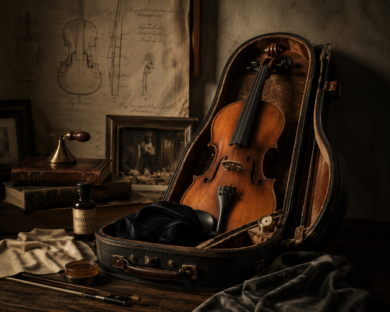
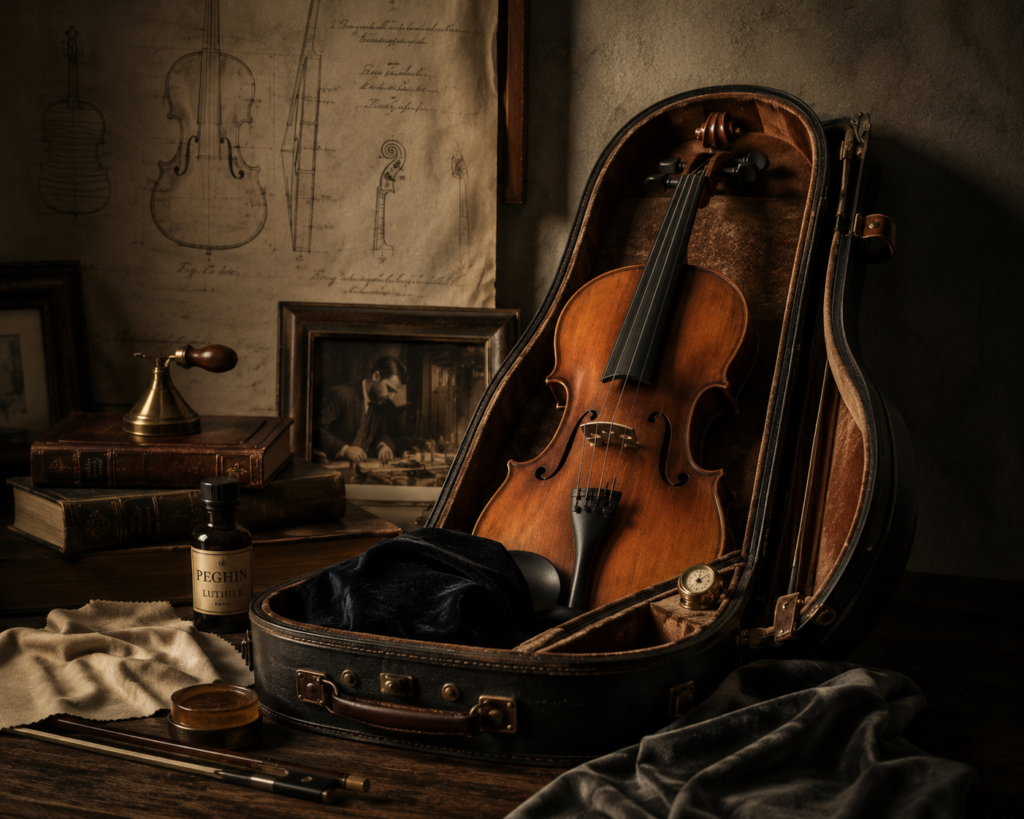
There is something almost theatrical about a violin resting on a velvet stand backstage, lit from above, waiting for its turn under the lights. Audiences fall in love with the sound, the bow work, the way a soloist’s shoulder dips into a phrase. What rarely gets a second thought is everything that happens before and after that moment of performance, the long stretch of silence in which the instrument is simply being kept alive. Violins are fragile, temperamental objects, and the culture that surrounds them has quietly built an entire art form around the act of protecting them.
An Instrument Built Like Sculpture
A violin is, in essence, a wooden sculpture engineered to vibrate in a very specific way. Luthiers spend years learning to carve spruce tops and maple backs so thin that a careless thumbnail could leave a dent, all in service of a tone that depends on tension, humidity, and the precise curvature of an arched plate. Visit any serious violin shop and you will notice the same reverence you find in a sculptor’s studio, calipers and gouges laid out like surgical tools, varnish recipes guarded like family secrets.
That obsession with material and form is part of why violins occupy such a strange cultural space. They are functional objects, yes, but they are also collected, photographed, and discussed the way paintings are discussed, in terms of provenance, school, and hand. A Stradivari is not simply an old instrument. It is treated as a museum piece that happens to also need to be played, which creates an unusual tension between display and use that few other art objects have to negotiate.
Museums have started to lean into that tension rather than avoid it. Several major collections now display historic violins alongside the tools and patterns used to build them, treating the workshop process as part of the exhibit rather than a footnote to it. Visitors who would normally walk past a glass case of antique furniture will linger over a 300 year old violin neck, partly because the object still has a job to do somewhere out in the world. Few pieces of decorative woodwork carry that same sense of ongoing purpose, and curators have noticed that audiences respond to it.
Where Craftsmanship Meets Practicality
For players trying to navigate that balance between protection and personality, the market has become surprisingly specialized. Boutique makers now build cases the way custom tailors build suits, taking measurements of the specific instrument rather than relying on generic interior molds, and offering finish options that range from understated to genuinely luxurious. A resource like Great Violin Cases is a useful starting point for anyone trying to understand what separates a case that merely holds a violin from one that is actually built around it, since the differences in interior fit, climate control, and exterior durability tend to be far more significant than they appear in a quick online listing.
That kind of research matters more than most new players expect. A case purchased without much thought can quietly undo years of careful playing and maintenance, while the right one becomes an almost invisible partner in the instrument’s long-term health. Spending time comparing construction methods, suspension systems, and materials before buying is less about luxury and more about basic stewardship of an object that, in many cases, will outlive the person carrying it.
It is a strange kind of artistry, one that never takes a bow or signs a program, yet it shapes every concert that ever happens. The luthier shapes the sound. The performer shapes the moment. And somewhere in between, often overlooked entirely, the case shapes whether either of those things gets to happen again tomorrow. Violins survive centuries not purely because they were built well, but because somebody, somewhere along the way, took the unglamorous work of protecting them just as seriously as the work of playing them.
When the Violin Becomes the Performance
That tension has occasionally pushed artists to treat the violin itself as the medium rather than the tool. Instead of using the instrument to make music in the traditional sense, some performers have turned the violin into the subject of the piece, questioning what the instrument is even made of and whether its parts could be something else entirely. One striking example of this approach is an artist who replaced the violin’s strings with strands of his own hair, fixing them to the instrument’s body and then attempting to coax sound out of a material never meant for tension or pitch. The result was less a concert than a meditation on fragility, captured in an unusual performance that reframed the violin as raw material rather than finished tool.
Pieces like that one tend to circulate widely in art circles, not because they sound pleasant, but because they expose how much of a violin’s identity is bound up in its physical construction. Once you remove or substitute a single element, whether that is the strings, the varnish, or the wood itself, the whole object starts to feel unfamiliar. It is a reminder that what we call a violin is really a very specific, very deliberate arrangement of parts, and that arrangement is worth taking seriously even outside of a concert hall.
The Forgotten Art of the Case
If the instrument itself gets all the attention, the case it travels in gets almost none, despite doing an enormous amount of quiet work. A violin can be ruined by a thirty minute car ride in winter if the wood is exposed to a sudden temperature swing, or by a single bump against an airport conveyor belt if the body isn’t properly cushioned. Professional players think about their case the way a diver thinks about a wetsuit, as something that has to function perfectly and invisibly so the person inside it can focus on something else entirely.

The better cases borrow heavily from industrial design and even aerospace materials, layering carbon fiber or molded composite shells with interior suspension systems that keep the instrument floating rather than resting against a hard surface. Humidity control inserts, shock absorbing corners, and locking mechanisms rated for cargo handling have all become standard features on serious cases, the same way crash test engineering quietly shapes the cars we drive without most people ever thinking about it. None of that complexity is visible from across a room, which is exactly the point. A well designed case disappears into the background of a performer’s life until the one day it prevents a catastrophe.
There is also a quieter, more personal layer to case design that has nothing to do with engineering. Many players choose a case the way someone chooses a wallet or a watch, as a small, private expression of taste that nobody else really sees. Leather exteriors, custom monogramming, and color choices that have nothing to do with protection still matter to the people who carry these things across airports and concert halls for decades. The case becomes part of the relationship between musician and instrument, a second skin that travels everywhere the violin goes.
This is also where case design quietly intersects with the same conceptual questions raised by performances like the hair-strung experiment. If a violin’s identity can be destabilized just by swapping out its strings, then the container around it is doing more than transporting an object from one stage to the next. It is preserving the very specific physical conditions that allow the instrument to remain recognizably itself, the exact tension, curvature, and material integrity that any conceptual reinterpretation depends on having intact in the first place. Strip away the protection for long enough and there may be nothing stable left to reinterpret at all.