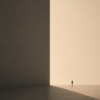
There is something deeply human about the way we look at houses.
We rarely see them as structures alone. We project onto them stories, families, forgotten conversations, and versions of ourselves that may never have existed. A single isolated building on the horizon can feel strangely alive, carrying an emotional weight completely disproportionate to its bricks and mortar.
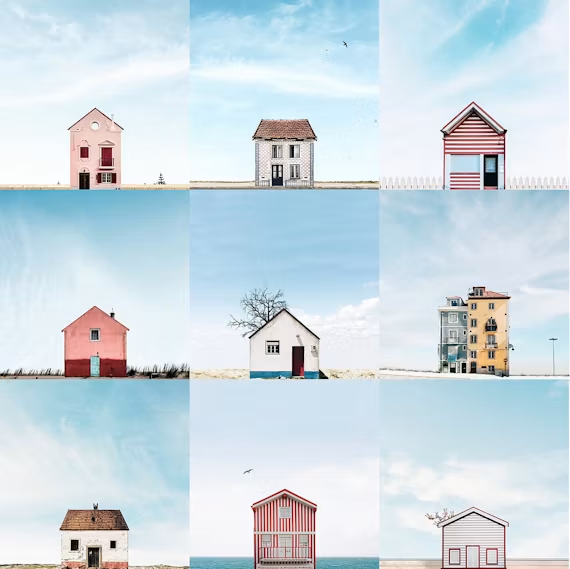
This peculiar phenomenon lies at the heart of Sejkko’s celebrated photographic series “Lonely Houses.”
Created by Portuguese photographer and scientist Manuel Pita, known professionally as Sejkko, the project transforms ordinary vernacular architecture into something almost surreal. Through careful composition and subtle post-processing, houses become solitary protagonists floating within minimalist landscapes, suspended somewhere between documentary photography and dream. As Sejkko himself explains, the images are edited to bring them “as close as possible to the way my eyes see them.” The series was widely introduced to international audiences through ArchDaily. (Authority reference: https://www.archdaily.com/634821/lonely-houses-sejkko-s-surreal-photos-of-traditional-portuguese-homes)
When a Building Becomes a Portrait
Portrait photography traditionally begins with a face.
Sejkko begins with a façade.
Yet the emotional mechanics remain remarkably similar. His isolated Portuguese homes appear to possess personalities. Some seem stubborn, others melancholic, others quietly resilient against landscapes that stretch endlessly around them.
Nothing dramatic occurs inside the frame.
And yet everything feels charged.
The absence of surrounding buildings removes geographical context and forces the viewer into a more intimate relationship with architecture itself. The house stops functioning as shelter and begins functioning as character.
Memory Rendered Through Light
Perhaps the most striking quality of the series is its relationship with memory.
The colors are softened. The skies often appear impossibly clean. Shadows feel less physical than psychological.
Rather than documenting Portugal objectively, Sejkko seems interested in documenting recollection.
Many of the photographs resemble places one half-remembers from childhood vacations or recurring dreams—locations that cannot be pinpointed geographically because they exist primarily within emotional memory.
This subtle manipulation explains why the images feel surreal without becoming fantastical.
Nothing impossible happens.
Reality simply becomes quieter.
Portuguese Vernacular as Universal Language
Although the buildings belong unmistakably to Portugal, their emotional resonance extends well beyond national identity.
Whitewashed walls.
Terracotta roofs.
Simple geometries.
These architectural elements become visual archetypes rather than regional specifics.
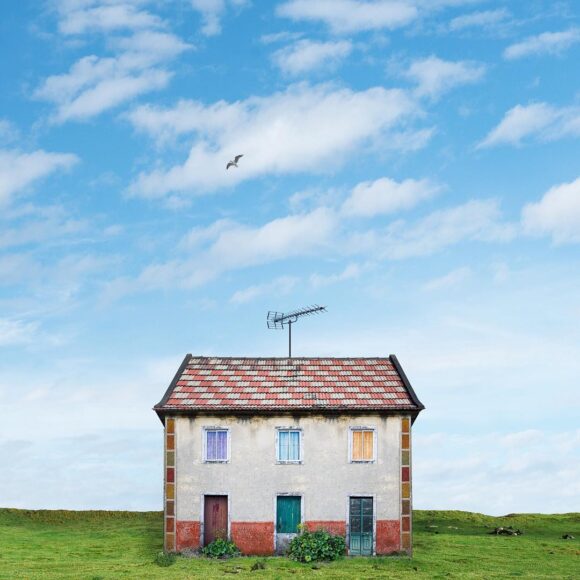
Viewers from entirely different continents often report recognizing these houses despite never having visited Portugal.
The explanation may be simple: every culture possesses its own version of the solitary home standing against an open landscape.
The architecture changes.
The emotion does not.
Isolation Without Loneliness
The title Lonely Houses invites immediate interpretation.
Yet the houses rarely appear lonely in the tragic sense.
Instead, they seem self-sufficient.
Comfortable with silence.
Their isolation resembles contemplation more than abandonment.
This distinction transforms the series from melancholy documentation into something almost meditative.
In an era defined by constant visual noise, Sejkko photographs absence itself.
And absence, paradoxically, becomes presence.
Photography That Refuses Spectacle
Contemporary architectural photography often emphasizes scale.
Glass towers stretch toward impossible skies.
Museums become monuments.
Luxury residences become lifestyle fantasies.
Sejkko rejects all of this.
His subjects are modest.
Sometimes almost anonymous.

The visual drama emerges not through architecture itself but through framing.
By removing distractions, he asks viewers to reconsider buildings they would ordinarily pass without notice.
The extraordinary is revealed inside the ordinary.
The Geometry of Silence
Composition plays a decisive role throughout the project.
Most houses occupy the center of the frame with almost mathematical precision. Surrounding negative space expands around them, producing visual tension through emptiness rather than complexity.
The resulting images recall modernist painting as much as photography.
One is reminded of artists who understood that what remains outside the subject often matters as much as the subject itself.
This dialogue between emptiness and structure echoes broader questions explored in contemporary visual culture—including our own examination of Edward Hopper and the Architecture of Loneliness, where buildings similarly become emotional landscapes rather than physical environments.
Home as Psychological Territory
Sejkko has suggested that the project emerged partly from personal reflections on the meaning of home.
That theme quietly permeates every image.
The photographs do not merely depict places where people live.
They depict the idea of belonging.
Or perhaps more accurately, the impossibility of defining belonging completely.
The isolated structures become metaphors for identity itself:
stable yet vulnerable,
grounded yet exposed,
permanent yet surrounded by infinite space.
The Dream Hidden Inside Documentation
Perhaps the greatest achievement of Lonely Houses is that it resists categorization.
It is not straightforward documentary photography.
Nor is it digital fantasy.
Instead, it occupies a rare middle ground where reality is gently adjusted until it reveals emotional truths invisible under ordinary observation.
The photographs do not fabricate beauty.
They uncover it through subtraction.
Final Reflection
Architecture usually serves people.
In Sejkko’s work, people disappear entirely.
And somehow the buildings begin speaking for themselves.
His lonely houses stand quietly beneath endless skies, asking viewers to reconsider what “home” actually means—not as property, not as geography, but as memory.

Perhaps that is why the series continues to resonate a decade after its release.
Because everyone carries inside them a solitary house they can no longer fully remember.
And when Sejkko photographs one in rural Portugal, for a brief moment, it feels uncannily like our own.