Hold a modern deck up to the light and you are holding six centuries of graphic design. The red heart, the black spade and the stiff little king all had to be invented. So did the green felt, the gold lettering and the grand rooms built around the tables. Each one is a design decision that hardened into habit.
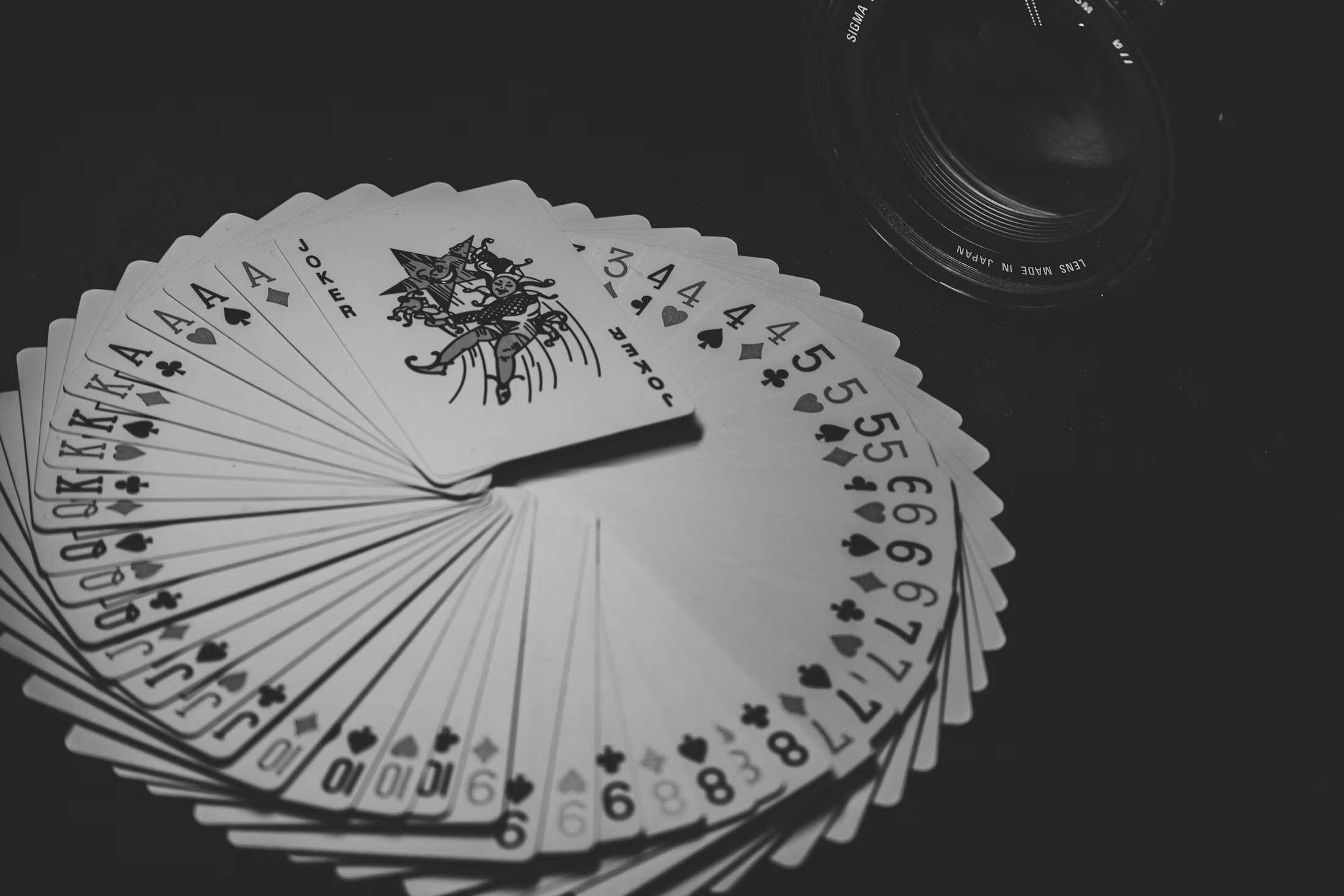
Photo by Ben Marler on Unsplash
Alt text: Scattered playing cards with kings, queens, and jacks
That visual language now lives on screens too. Commercial listings such as เว็บบาคาร่าออนไลน์, meant for adults only where online gambling is lawful, borrow the same felt and card imagery. It appears here as an example, with no endorsement. Whether that market is legal depends on where you live, since some governments license it, some keep it as a state monopoly, and some forbid it. This article is design history, not legal or financial advice.
Where Did the Card Designs We Know Begin?
Cards reached Europe from the Islamic world, and by the late 1370s they show up in city records from Florence to Switzerland. The earliest surviving model is a Mamluk deck now held in Istanbul. Its suits were cups, coins, swords and polo sticks, drawn with fine abstract ornament.
European makers adapted that scheme in different ways:
- Italy and Spain kept cups, coins and swords, and turned polo sticks into batons.
- German lands used hearts, bells, acorns and leaves.
- Switzerland chose roses, shields, bells and acorns.
Every region made the deck look like its own streets and fields. A card was a small mirror of local taste.
Why Did the French Suits Win?
Around 1480, French makers settled on four plain shapes. Hearts, tiles, clovers and pikes became the hearts, diamonds, clubs and spades we use now. They won on production, not on beauty.
A flat red or black silhouette could be applied with a stencil in one pass. Cups and acorns needed more detail and more colors. Cheaper decks traveled further, and the simple shapes spread with them.
How Did Woodcut Printing Shape the Court Cards?
Early decks were painted by hand and cost a fortune. Then printers in southern German cities began cutting them into wood. Cards and devotional prints were among the first popular products of the woodcut, decades before movable type.
Photo by Nihar Bhagat on Unsplash
Alt text: Chrysler building gargoyle against a bright blue sky
The workflow left visible marks on the design:
- A carver cut the outlines into a block, often pearwood.
- The printer pressed sheets of uncolored figures.
- Workers brushed color through stencils, one hue at a time.
That is why old court cards look so graphic. Bold outlines and flat fields suited the knife and the brush. You can study surviving sheets in the Rijksmuseum’s playing card holdings, where misregistered color still shows the hand at work.
What Turned the Court Cards Upside Down?
For centuries, kings and queens were printed full length. Players flipped them to read them, which gave a hand away. In the nineteenth century, printers mirrored the figures top and bottom, and the double-headed court became standard.
The English pattern traces back to designs from Rouen, copied and recopied until the faces grew stiff and symbolic. The ornate ace of spades has its own story. From 1765, English cards carried an official duty stamp on that ace, so it grew fancier than its siblings.
How Does a Baccarat Table Work as Graphic Design?
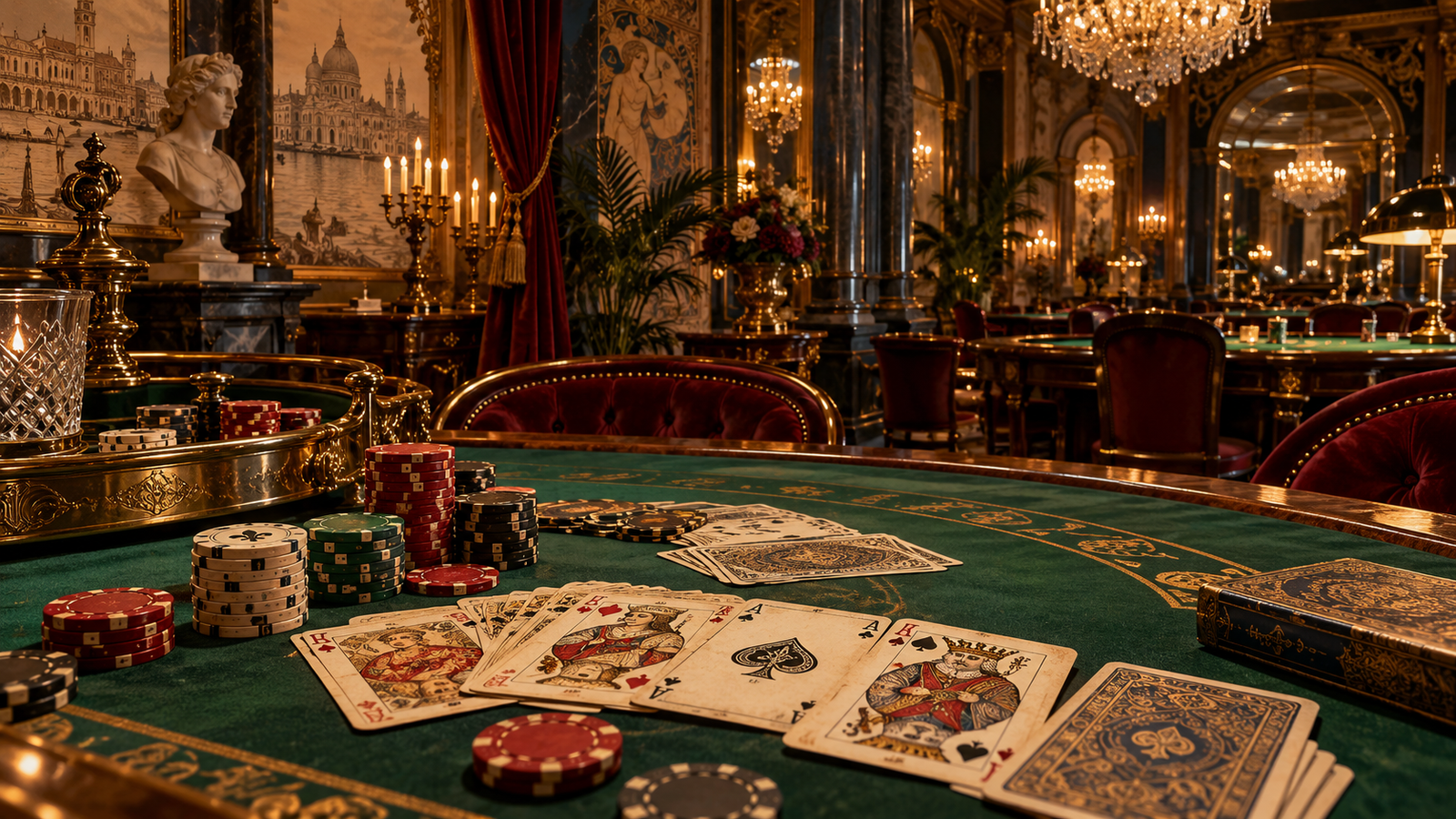
Look at a full baccarat table as a print, not a game. Its layout carries a few fixed elements:
- Gold lettering that names the Player, Banker and Tie areas.
- Deep green or red felt that makes white cards pop under lamps.
- Numbered seat boxes ringing the edge, where many tables skip 13.
The layout is information design. Everything a dealer needs sits in a fixed place, readable from the far end. The scorecards kept beside the table add their own grids of colored dots, like a printed chart.
Why Did Casino Rooms Swing From Gilt to Art Deco?
Monte Carlo set the pattern. In 1878 Charles Garnier, the architect of the Paris Opera, reworked its casino with gilt, frescoes and a concert hall. It was the confident spectacle of the Belle Époque, built to make leisure look grand.
Fifty years later the style changed completely. The tomb of Tutankhamun opened in 1922, and the European fever for Egypt fed straight into Art Deco. Sunbursts, stepped forms and stylized gods appeared on cinemas, liners and ballrooms.
The best surprise sits on Santa Catalina Island in California. The round, Art Deco Catalina Casino opened in 1929 with a ballroom and a cinema, and it has never been used for gambling. In Italian, “casino” first meant a small house for gathering. In 1953, René Magritte painted a panoramic mural for the casino at Knokke in Belgium. The building as patron, it turns out, outlasted the tables.
Frequently Asked Questions About Card and Casino Design
Why Are Hearts and Diamonds Red?
The French scheme split its four suits into two red and two black. Two inks made printing cheaper and the suits easy to tell apart at a glance.
Who Are the Kings and Queens Supposed to Be?
French decks once named them after heroes such as Charlemagne and David. Modern English courts carry no names, and their faces are copies of copies.
Why Is Casino Felt Usually Green?
Green baize was cheap, durable and calm under lamplight. Billiards used it first, and card rooms followed. Red and blue are now common on newer tables.
Is the Catalina Casino Really Free of Gambling?
Yes. It was built as a ballroom and theater, and “casino” there carries its older meaning of a gathering place.
What a Deck Teaches About Design
A deck shows how constraints shape style. Ink, wood, tax law and the dealer’s sightline all left their mark. Real-money card play is a different matter: it is for adults only, it is entertainment rather than income, and the house always keeps an edge. If gambling stops feeling like fun, the 1-800-GAMBLER helpline offers free, confidential support in the United States.