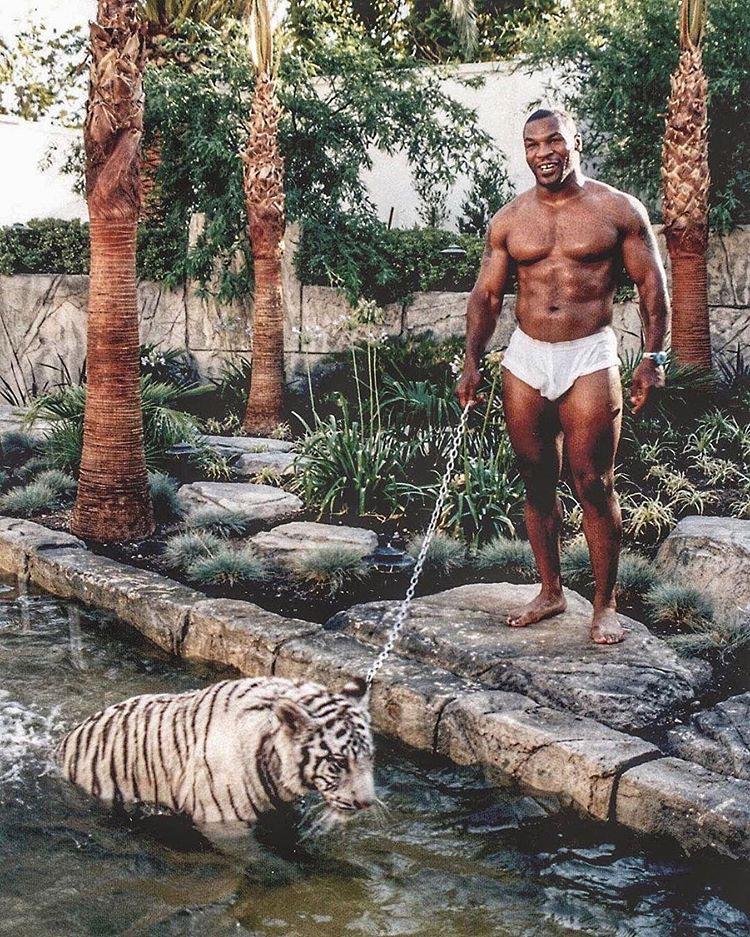
Some athletes enter the frame with grace. Some with glamour. Some with intelligence, charm, beauty, rhythm, or the slow authority of someone who knows history is already making room for them.
Mike Tyson entered it like a warning.
At his peak, Tyson did not merely appear on camera. He changed the temperature of the image. The ring seemed smaller around him. The opponent seemed already in danger before the first bell. The crowd did not watch only to see who would win, but to see how quickly fear would become physical. There was something almost obscene in the compression of it: the black trunks, the crouched movement, the heavy shoulders, the head slipping from side to side, the violence arriving not as chaos but as technique.
Tyson was not boxing’s most elegant speaker, its cleanest hero, or its easiest legend. That is precisely why he remains so difficult to look away from. He was a prodigy, a spectacle, a champion, a convicted rapist, a pop-cultural character, a cautionary tale, a damaged public man, and one of the most frightening images modern sport has ever produced. Any serious reading of Tyson has to hold all of those things at once, without sanding down the violence and without turning the tragedy into decoration.
This places him naturally inside Art-Sheep’s Consuming the Frame series: figures whose charisma did not simply occupy the camera, but overwhelmed it. Maradona consumed the frame with myth and disorder. Anthony Bourdain consumed it with appetite and doubt. Tyson consumed it with impact.
He did not simply win fights. For a few terrible years, he made the frame flinch.
1. Before the Myth: Brownsville, Fear, and the Making of a Weapon

Before Tyson became an image of fear, he was a child surrounded by it.
The Tyson myth often begins too late, with the black trunks and the knockouts, as though the terrifying champion simply appeared fully formed in the ring. But the more important story begins in Brownsville, Brooklyn, where childhood was not protected from violence, poverty, shame, and the brutal education of the street. Tyson’s later aura cannot be separated from that early environment. He did not become frightening because a marketing department found the right nickname. He came from a world where fear was practical knowledge.
That is what makes the arrival of Cus D’Amato so central to the story. D’Amato did not merely train Tyson’s body. He gave fear a system. He took a frightened, explosive, physically gifted teenager and built around him a philosophy of attack, discipline, confidence, intimidation, and psychological control. Tyson was taught not simply to punch, but to inhabit danger so completely that opponents felt it before contact.
There is something almost tragic in that construction. Boxing saved Tyson by turning his violence into form, but it also made that violence marketable. The ring became a place where trauma could be organized, applauded, monetized, and replayed. The wounded boy became a weapon, and the weapon became a business.
This is the first contradiction of Tyson’s image. The thing that made him extraordinary was also the thing that made him vulnerable to exploitation. He was not just a natural destroyer. He was a manufactured force, shaped by love, fear, discipline, need, and the dream of escape.
2. The Youngest Heavyweight Champion and the Speed of Terror
On November 22, 1986, Mike Tyson defeated Trevor Berbick and became the youngest heavyweight champion in boxing history. He was twenty years and 145 days old, a detail that still feels less like a statistic than a threat issued to the rest of the division.
What made early Tyson so horrifying was not only power. Heavyweights had power before him. What Tyson had was speed compressed into violence. He was not the tallest man in the division. He did not create fear through length, elegance, or majestic distance. He created it by entering the space where opponents thought they were safe and removing that safety in a second.
 Mike Tyson pictured with his tumbler pigeon during a photoshoot Credit: Michael Brennan/Iconic Images
His style was built around pressure, head movement, compact explosions, hooks to the body, uppercuts through the center, and a terrifying refusal to waste time. The famous peek-a-boo system taught by D’Amato made Tyson’s defense look like attack in disguise. His head moved as he came forward, and each slip seemed to load the next punch. He did not merely close distance. He collapsed it.
This is why so many early Tyson fights feel less like contests than interruptions. The opponent arrives with strategy. Tyson arrives with weather. A round begins, the frame tightens, the body moves, the punch lands, and suddenly the fight has stopped being a narrative and become an impact event.
Guinness World Records still lists Tyson as the youngest world heavyweight boxing champion. The record matters, but the image matters even more. It was not simply that Tyson was young. It was that he seemed too young to contain the force passing through him.
3. Charisma Without Warmth
Tyson’s charisma was never clean.
It did not come from warmth in the usual sense, nor from polished media intelligence, nor from the kind of open charm that makes a public figure easy to love. Tyson’s charisma came from contradiction: the destroyer who often sounded like a frightened child, the terrifying body paired with a surprisingly soft voice, the champion who looked invincible but seemed emotionally unprotected, the public man who could be brutal, funny, awkward, sincere, cruel, ashamed, and strangely philosophical within the same cultural lifetime.
That contradiction made him magnetically watchable. He was never simply performing confidence. At times, he seemed possessed by confidence. At others, he seemed to be repeating the language of dominance in order to keep terror away from himself. The viewer could never fully decide whether Tyson was the threat or the threatened thing wearing the threat as armor.
This is different from Muhammad Ali, whose charisma was verbal, theatrical, prophetic, and self-authored. Tyson’s charisma was more involuntary. He did not seduce the camera with language. He made the camera nervous. His pauses felt dangerous. His stare seemed to contain weather. Even when he said little, the silence around him became charged.
That is why Tyson became more than a fighter. He became an atmosphere. The phrase “Iron Mike” worked because it sounded both childish and mythological, like a comic-book name attached to a very real man. It reduced him and enlarged him at once. It turned flesh into material.
Tyson’s charm came from the feeling that something unresolved was always standing behind him.
4. The Body as Mythology
Tyson’s body became one of the most recognizable visual objects in modern sport.
He did not look like the classical heavyweight ideal. He was not long and towering. He was compact, thick-necked, heavily shouldered, built close to the ground, and terrifyingly efficient. His proportions made him seem compressed, as though all the force that might have been spread across a taller frame had been packed into a smaller one and given no safe place to go.
The visual language around him was minimal. Black trunks. Black shoes. Often no socks. No theatrical robe in the grand tradition. No decorative ceremony required. At times, the entrance looked less like entertainment than execution. Tyson understood, instinctively or otherwise, that the less he added, the more frightening he became.
@whybxng
This minimalism mattered. Many fighters build spectacle around themselves to enlarge the self before the fight begins. Tyson did the opposite. He stripped the image down until nothing remained but body, movement, and threat. His body had already become spectacle. Anything extra would have weakened the message.
In this sense, Tyson’s ring image belonged not only to sport, but to design. It was brutal, reductive, iconic, and almost anti-glamorous. The silhouette did the work. The body carried the mythology. The absence of decoration made the violence feel purer, which is precisely what made it so disturbing.
He did not need spectacle because his body had already become one.
5. The Knockout as Pop Image

Tyson was made for replay before culture became addicted to replay.
His knockouts were not only athletic outcomes. They were images designed by accident for endless repetition. The opponent falling backward. The legs failing before the mind understands the punch. The referee arriving too late to restore order. The audience rising as one body. The replay showing what the eye missed the first time. Again. Again. Slower. Closer. More brutal.
Before the internet made every dramatic moment instantly recyclable, Tyson already existed as highlight culture. His violence did not require long explanation. It could be consumed in seconds. A person unfamiliar with boxing could understand what had happened because Tyson’s greatness was visually immediate. Strategy was there, of course, but the popular imagination rarely paused long enough to study it. What it remembered was impact.
This is part of Tyson’s cultural danger. He made violence legible and thrilling. He reduced complex athletic craft to moments of terrifying clarity. A full fight could vanish behind a single punch. The knockout became an image, the image became a clip, the clip became mythology.
There is artistry in that, but there is also something morally uneasy. Boxing has always depended on the transformation of harm into spectacle. Tyson did not invent that bargain. He simply made it impossible to ignore. His best years showed the sport’s beauty and brutality with almost unbearable efficiency.
To watch Tyson was to watch the human body become punctuation.
6. The Fall: When the Image Lost Control
No serious article about Tyson can remain inside the ring.
The danger with writing about him is that his athletic prime is so visually overwhelming that it tempts the viewer into myth. The early knockouts, the title belts, the stare, the entrance, the body: all of it encourages a language of force and destiny. But Tyson’s story also contains real damage, real victims, real criminality, and real consequences that cannot be absorbed into sports romance.
In 1992, Tyson was convicted of rape and served prison time. That fact cannot be treated as a footnote, softened by nostalgia, or placed politely outside the frame of his legend. It belongs inside the frame because it changed what the public image meant. The violence that had made him marketable could no longer be safely contained as athletic metaphor.
This does not mean every reading of Tyson must collapse into one fact. It means no honest reading can exclude it. The spectacle of Tyson was always built around controlled danger: violence framed by rules, rounds, referees, contracts, gloves, lights, and paying audiences. His conviction shattered any easy separation between the ring’s mythology and the world outside it.
@nr.1motivation
The tragedy of Tyson is not simply that he fell. Many champions fall. The tragedy is that the same culture which sold him as danger then acted shocked when danger could not be kept theatrical. Boxing had turned his aggression into product. Fame had amplified it. Money had surrounded it. The machine profited from the image of the monster, then pretended innocence when the human consequences became impossible to ignore.
Tyson remains difficult because he refuses the comfort of a single reading. He can be exploited and guilty. Gifted and destructive. Vulnerable and violent. A product of brutal systems and responsible for brutal acts. The hard part is refusing to let one truth erase another.
7. Holyfield, the Ear, and the Moment the Myth Became Grotesque
The 1997 rematch with Evander Holyfield remains one of the most infamous images in sports history.
Tyson bit Holyfield’s ear during the fight and was disqualified. The incident has been replayed, joked about, memeified, moralized, and absorbed into pop culture so completely that its original shock can be hard to recover. But at the time, it was horrifying because it broke the agreement.
 Police officers tried to restrain Tyson after the boxer bit off part of Holyfield’s ear in Las Vegas in 1997 Credit: Michael Brennan/Iconic Images
Boxing permits violence only as long as violence obeys the ritual. That is the strange contract at the heart of the sport. Two people hurt each other under rules that transform harm into competition. The gloves, the referee, the bell, the scoring, the corners, the rounds: all of these create a symbolic border between sport and assault.
The bite tore through that border. It was not simply another foul. It was a sudden collapse of the ritual itself. The controlled destroyer became uncontrolled spectacle. The violence stopped looking organized and became grotesque.
This is why the moment still clings to Tyson’s legacy. It took the fear that had always powered his image and turned it from cinematic to ugly. The early Tyson frightened the imagination because he seemed like violence perfected into form. The Holyfield bite frightened the imagination because form failed.
The frame did not merely flinch. For a moment, it lost its rules.
8. Pop Culture: Monster, Meme, Philosopher, Cartoon of Himself
One of the strangest things about Tyson is how completely pop culture learned to keep watching him.
He moved through phases that would have destroyed a simpler celebrity identity: terror, scandal, prison, comeback, humiliation, self-parody, confession, podcasting, acting, documentary, meme, and a kind of late public affection that remains uncomfortable if examined too closely. Few athletes have travelled so far across the spectrum of public meaning.
The later Tyson became a character partly detached from the young champion. He appeared in films, interviews, animated formats, podcasts, wrestling events, and comic conventions. He could be frightening, funny, absurd, wise, incoherent, tender, theatrical, and brutally candid. The public that once feared him learned to laugh with him, then at him, then with him again.
 Mike Tyson pictured with famous promoter Don King in 1991 Credit: Michael Brennan/Iconic Images
This transformation is fascinating because it did not erase the earlier Tyson. It depended on him. The joke only works because the old danger remains somewhere underneath it. The self-parody is never entirely safe because the original image was never harmless. When Tyson plays himself, he is not merely performing celebrity. He is performing the cultural memory of fear.
Pop culture did not forgive Tyson exactly. It learned how to reuse him.
That distinction matters. Reuse is not redemption. It is a form of survival inside the entertainment machine. Tyson became a symbol flexible enough to be terrifying in one decade and comic in another, which says as much about the appetite of the audience as it does about him.
9. The Older Tyson and the Age of Spectacle
The older Tyson is compelling because he seems haunted by the young man everyone still wants to replay.
In interviews and public appearances, he has often spoken with a kind of exhausted metaphysical frankness about fear, ego, death, regret, discipline, and the self he once inhabited. Sometimes this later persona feels deeply moving. Sometimes it feels like another performance shaped by the culture around him. Usually, it is both.
@3amquiet
That ambiguity reached a strange new stage with the 2024 Netflix event against Jake Paul. The fight was not only a boxing match. It was a spectacle about spectacle: a 58-year-old former heavyweight champion drawn back into the ring opposite a much younger internet celebrity, streamed globally by a platform that understood perfectly what it was selling. The product was not simply competition. It was memory, curiosity, discomfort, nostalgia, and the question of whether the old image of Tyson could still summon fear.
The answer was complicated. The event proved less that Tyson remained dangerous than that Tyson remained consumable. The body had aged. The aura had not disappeared, but it had changed shape. The young destroyer could no longer be present, so culture summoned his ghost and asked it to perform under lights.
Netflix described the Tyson-Paul event as a record-breaking live spectacle, and that fact matters because it reveals what Tyson has become in the streaming age: not only a former champion, but an archive of impact that platforms can reactivate. The audience was not watching only for boxing. It was watching to compare memory with flesh.
That may be the saddest dimension of late Tyson. He survived the image, but the image keeps calling him back.
10. Why Mike Tyson Still Frightens the Imagination
Tyson still frightens the imagination because he reveals something uncomfortable about spectatorship.
We like to pretend that sport is clean because it has rules. We like to pretend that celebrity is harmless because it entertains. We like to pretend that violence becomes civilized when it is lit professionally, scored officially, and sold at scale. Tyson disturbs these comforts because his life shows how thin those borders can be.
He was the perfect spectacle and the warning against spectacle. As a fighter, he embodied one of sport’s most intoxicating fantasies: the body disciplined into overwhelming force. As a public figure, he exposed the cost of turning a damaged person into a profitable image of danger. The same culture that wanted him terrifying also wanted him funny, repentant, available, nostalgic, and endlessly reusable.
 Mike Tyson, and his trainer Cus D’Amato, before his first professional fight
This is not unique to Tyson. Modern culture often creates monsters and then demands that they become human in public. It wants the thrill of danger without responsibility for the systems that cultivate it. It wants confession after consumption. It wants redemption arcs because redemption makes earlier enjoyment feel less compromised.
Tyson refuses to make that easy. His greatness was real. His crimes and violence were real. His vulnerability is real. His theatrical afterlife is real. His exploitation by boxing and entertainment machines is real. None of these truths cancels the others.
That is why he remains more disturbing than a simple villain and more complicated than a fallen hero. He is not a symbol that can be cleaned into usefulness. He is a problem the culture keeps staging because it has never fully understood what it was watching.
11. The Frame After Impact
Mike Tyson did not consume the frame the way Ali did. He did not talk it into submission. He did not turn the camera into a stage for prophecy. He did not consume it like Bourdain, through appetite, attention, irony, and the melancholy of the outsider. Tyson consumed it through pressure.
The frame around him seemed to shrink. Time compressed. Opponents disappeared into impact. The viewer felt the violence before fully understanding the technique that produced it. Tyson’s presence made boxing look less like a sport and more like a warning about what the body can become when fear, trauma, discipline, commerce, and rage are organized into a single moving form.
That is the terrible beauty of Tyson. Not beauty as innocence. Not beauty as goodness. Beauty as force, structure, rhythm, compression, and dread. The beauty of a machine one knows has been built for harm. The beauty that unsettles because it implicates the viewer’s pleasure.
Tyson’s legacy cannot be redeemed by aesthetics, and it should not be erased by condemnation alone. It has to be read in its full discomfort. He remains one of the clearest examples of modern culture’s ability to transform damage into spectacle, spectacle into profit, profit into myth, and myth into endlessly replayed image.
In the end, the most frightening thing about Tyson may not be that he made the frame flinch.
It may be that we kept pressing replay.