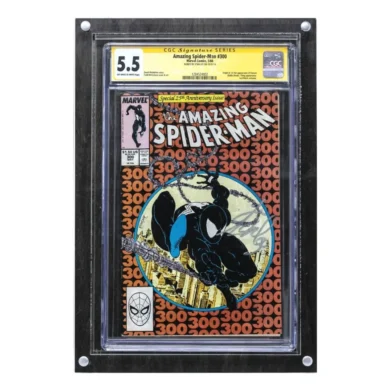
Comic-book covers double as pop-art posters, but every burst of light chips away at their ink. The Canadian Conservation Institute warns that paper damage is cumulative—even under museum-low UV—so a “99 percent” filter can only slow the fade.
In this September 7, 2026 guide, we compare five in-stock comic-book display options—from a $12 IKEA RÖDALM hack to a gallery-ready magnetic mount. You’ll learn who each frame fits, what the UV numbers really mean, and what a 12-slot wall actually costs, so you can hang your heroes with confidence.
How we compared comic-book display frames
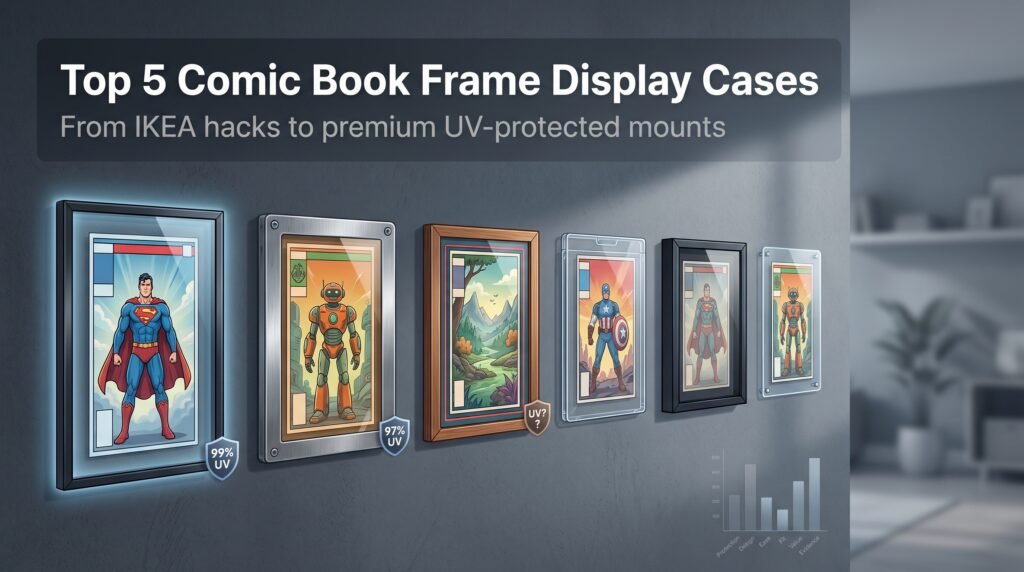
We began with 23 products that were in stock for U.S. buyers on September 7, 2026. For each one, we captured only hard details: listed dimensions, UV-transmission claims, street price, and stock status. We then mapped those numbers to the eight questions collectors ask most often.
Those questions roll up into six weighted scoring pillars:
-
- Protection & conservation – 25 percent
- Display design & aesthetics – 20 percent
- Ease of swapping & installation – 20 percent
- Fit & format compatibility – 15 percent
- Value at single-frame and wall scale – 15 percent
- Evidence & availability – 5 percent
If a maker lists “97 percent UV resistance”, we log it as a claim, not gospel, and deduct points when a rival publishes no figure at all. Anything on preorder or labeled “coming soon” moves to an alternatives box so you don’t waste time chasing vaporware.
The result is a lean, apples-to-apples scorecard that helps you match the right frame to both your comic and your budget while cutting through the marketing fog.
1. Vaulted Comic Display Plus
For readers who want both finishes and pack sizes, you can browse the full collection.
Why it tops our design-focused scorecard
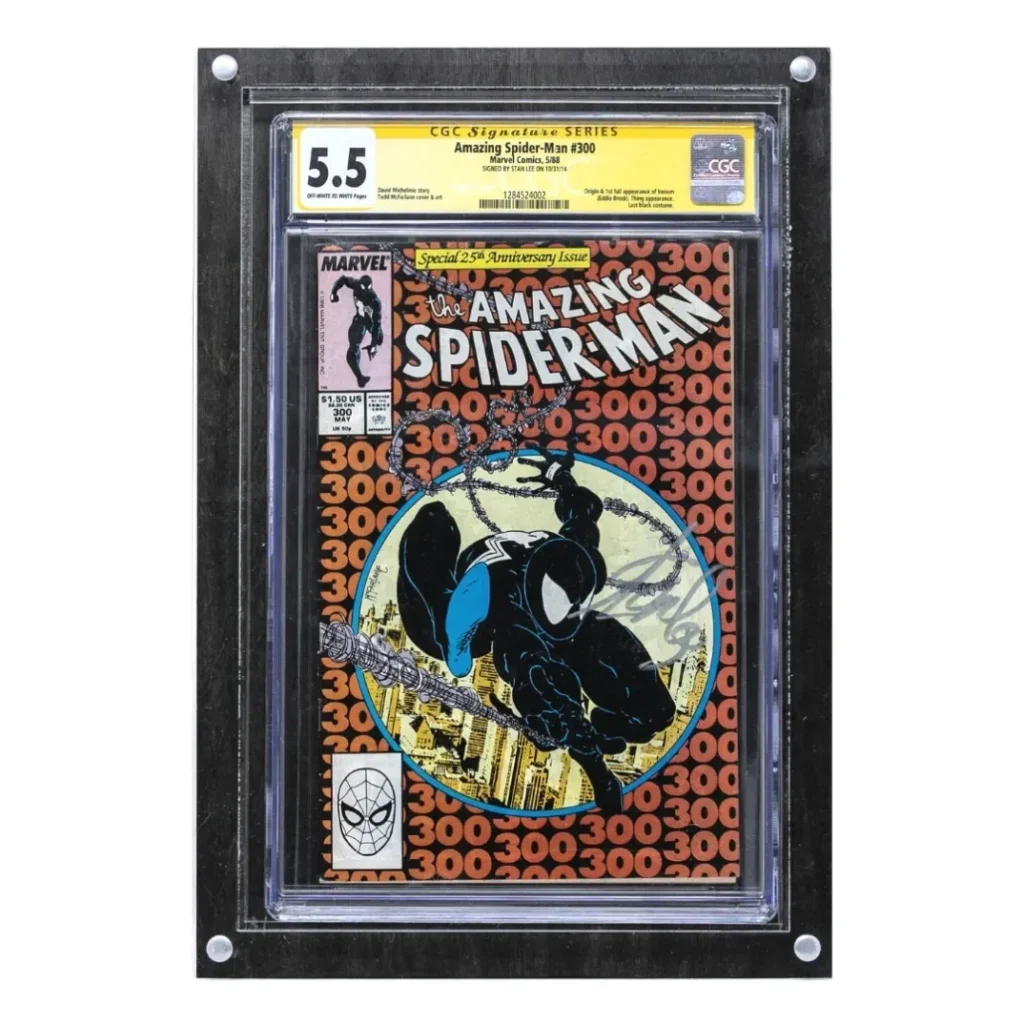
Vaulted’s Plus frame feels like gallery hardware, not hobby-store plastic. The satin-black shell all but disappears on the wall, so the cover—not the bezel—pulls focus. A magnetic acrylic window lifts off in seconds, letting you swap a new CGC slab before your coffee cools and keep cumulative light exposure low.
Key facts: the Carbon-Fiber finish lists a sale price of $63.99 (regular $74.99) and measures 14.19 × 9.50 × 1.28 inches. The product page promises “UV protection” but publishes no stated percentage or lab test, so we treat that as an unverified claim.
Because the cavity is CNC-cut for current CGC holders, each slab sits snug yet pressure-free, which is great for collectors who dread edge crush. Just remember that CBCS or magazine slabs won’t fit, and you’re paying premium dollars for style without a quantified UV spec. For readers who want both finishes and pack sizes, you can browse the full collection.
Drawbacks to weigh: premium price adds up fast on a multi-comic wall; compatibility is CGC-only; UV performance remains unquantified.
2. Crafti Comics FLEX Frame
Want a slab-style wall display without paying for CGC? Crafti’s FLEX Frame wraps a raw comic in a recessed acrylic window so the cover floats edge to edge, with no clamp-down glare and no grading bill.
Crafti Comics FLEX Frame official product photo showing raw comic display
Key specs: the Modern FLEX starts at $25, fits books up to 6.69 × 10.25 inches, and lets you add 99 percent UV-blocking Tru Vue Conservation Clear acrylic for an extra $10. A separate Classic FLEX handles Golden–Bronze books up to 7 × 10.25 inches.
Customization is the hook: swap birch stains, click in color-pop border inserts, or add Crafti’s NFC Curator tag for digital provenance. Assembly takes about three minutes: remove four screws, drop in a bagged-and-boarded comic, and use the twin mounting holes in portrait or landscape.
Pricing lands in the middle of our lineup at $35 for the UV version, or roughly $420 for a 12-frame wall, a sensible stretch for keys you will not seal forever.
Trade-offs to note: the UV panel is optional, Modern versus Classic sizing demands careful measuring, and extra depth (add $10) may be needed for thicker Mylar setups. Still, no other raw-comic frame in this bracket lets you color-match, protect, and quick-swap with this much polish.
3. Red Wolf EZ Slab Frame
If your first question is “How much UV does it block?”, Red Wolf gives a precise answer: 99 percent, thanks to museum-grade OP-3 acrylic. That figure is the highest disclosed protection in our Top 5.
A neodymium-magnet front plate pops off in seconds, so you can swap a CGC or CBCS slab without removing the frame from the wall. The cavity accepts holders up to 0.8 inch thick, covering modern and most Silver Age books.
Key numbers: the frame lists at $44.99, a color-matched desk stand adds $5, and a custom logo holder runs $22. Mounting stays simple, because a single sawtooth hanger centers the weight, letting you level a grid in minutes.
Visually, the brushed-edge, visible-screw look leans rustic and industrial. It pairs with wood shelves and darker rooms but lacks Vaulted’s gallery-white minimalism. Oversized magazine slabs still need a different solution, yet for standard CGC or CBCS plastics, Red Wolf offers strong protection without a museum-grade price tag.
4. BCW Comic Book Showcase UV
BCW proves that documented protection does not have to be pricey. The Showcase lists 97 percent UV-resistant polystyrene and fits modern comics up to 6 ¾ × 10 ¼ inches (171 × 260 mm). That spec appears right on the product page, so a current-era issue will slot in without guesswork.
The two-piece shell snaps together like a clamshell: pop it open, slide in a bagged comic, click it shut, and hang the built-in keyhole over a drywall screw. The whole move takes about a minute, which is why collectors order 25-packs at $12.74 each, turning a hallway into a gallery for under $320 before tax.
Trade-offs appear on close inspection. The black polystyrene back thickens the bezel, so a tight grid looks more storage bin than gallery frame, and the backing is not archival grade. If you are hanging a four-figure key, add an acid-free board or rotate the book on a schedule.
For everyday covers, though, BCW remains the budget-friendly option that actually publishes its numbers and sticks to them.
5. IKEA RÖDALM frame hack
Vintage guides still praise the retired RIBBA, but the current U.S. catalog lists RÖDALM 12 × 16-inch (30 × 40 cm) frames at $11.99 in black, white, birch, or walnut finishes. Think of it as a shadow-box shell you can retrofit for comics.
Here’s the quick hack:
- Remove the undersized 8 × 10 mat.
- Drop in a custom-cut, acid-free backing board.
- Float your bagged comic on top.
- Add one-quarter-inch foam spacers so the cover never touches the plastic glazing.
- Flip the insert to its deeper side; you gain roughly one and one-eighth inches (28 mm) of internal clearance, enough to defeat static cling.
RÖDALM quotes no UV figure; its glazing is clear polystyrene, so treat this as décor, not conservation. Use it for facsimiles or week-to-week reads and rotate anything valuable back into dark storage.
Why bother? A dozen frames cost $143.88—less than one row of Vaulted Plus. Combine them with IKEA’s MOSSLANDA ledge and you can reshuffle an entire story arc before lunch. For renters and budget designers, RÖDALM nails the look; for Silver-Age grails, it is the stylish understudy, not the star.
At-a-glance: which frame fits your wall and your wallet?
Prices and specs verified September 7, 2026.
| Frame | Best for | Raw / slab | Street price (USD) | UV disclosure | Swap style | Score* |
| Vaulted Plus | Design-first slab walls | Slab | $63.99 sale ($74.99 reg.) | Unquantified “UV protection” | Magnetic window | 86 |
| Crafti FLEX + UV | Color-matched raw display | Raw | $25 base / $35 with 99 percent UV | 99 percent Tru Vue add-on | Screw-back panel | 84 |
| Red Wolf EZ Slab | Highest published UV for slabs | Slab | $44.99 | 99 percent OP-3 acrylic | Magnetic front | 83 |
| BCW Showcase UV | Budget protection at scale | Raw | $16.99 (bulk $12.74) | 97 percent stated | Snap shell | 80 |
| IKEA RÖDALM hack | Large décor walls | Raw | $11.99 + mat / spacers | None | Rear load | 68 |
*Score out of 100: 25 percent protection, 20 percent design, 20 percent swapping ease, 15 percent fit, 15 percent value, 5 percent evidence.
Quick takeaways:
- Want gallery polish for CGC slabs? Vaulted still wins on looks and ease.
- Need color-matched raw frames? Crafti brings the paint swatches.
- Chasing the highest published UV figure? Red Wolf’s 99 percent OP-3 leads the pack.
- Filling a hallway on a budget? BCW keeps cost per slot under $13 in bulk.
- Decorating a playroom with facsimiles? IKEA delivers the look for pennies, just add spacers and rotate the books.
Even 99 percent UV acrylic only slows fading. Total light dose ages ink, so rotate treasures or dim the lights to stay ahead of cumulative exposure.
Strong alternatives that almost cracked the list
Great products missed the podium for fixable reasons. Most-requested runner-up first:
Ultra PRO Comic UV ONE-TOUCH
Ultra PRO’s magnetic card holders are hobby staples, and the ONE-TOUCH comic version (listed at $23.99 when in stock) aims to bring that one-click convenience to raw books up to 6 ⅝ × 10 ¼ inches (168 × 260 mm). A slide-in hinge plus dual magnets make swaps truly “one touch,” and the company recommends its proprietary Comic Preserver sleeve to cushion the spine.
So why isn’t it in our Top 5 (price and specs verified September 7, 2026)?
- Unavailable: the official store and major retailers showed the SKU as out of stock during our check.
- Unquantified UV: Ultra PRO says the shell has “UV-blocking additives” but publishes no percentage or test standard, so we cannot stack it against BCW’s ninety-seven percent or Red Wolf’s ninety-nine percent claims.
If Ultra PRO restocks and publishes a verified UV figure, it could jump straight into the value slot, especially for collectors who already trust the brand’s magnetic cases.
Buying guide: what actually matters in a comic display
1. Which comic format are you framing?
Answer first: match the holder to the enclosure, not the publishing era.
- Raw comic (bagged and boarded) → rigid raw holder such as Crafti FLEX or BCW Showcase.
- Graded slab (CGC / CBCS) → purpose-built slab frame like Vaulted or Red Wolf.
- Hybrid “capsule” → raw holder that opens magnetically or with screws.
Measure the outer width of the bag, board, or slab—one Reddit horror story reports a Silver Age bag just one-eighth inch (three mm) too wide for a “modern” holder. Break out the ruler first; your corners will thank you.
2. How much trust should you place in a “ninety-nine percent UV” claim?
A “ninety-nine percent UV” label usually covers wavelengths below 400 nm only; visible light still fades ink over time. The Canadian Conservation Institute notes that highly sensitive colours can bleach even at fifty lux with zero UV present, because damage is cumulative. Treat the number as a speed limit, not a force field—room placement, exposure hours, and rotation finish the job.
3. Acrylic, polystyrene, or glass—what’s the trade-off?
| Material | Pros | Cons | Best use |
| Acrylic (PMMA) | Light, shatter-safe, up to ninety-nine percent UV | Scratches; needs anti-static care | Most purpose-built frames |
| Polystyrene | Cheap, light | Lower UV block, scuffs easily | Décor frames, short rotation walls |
| Glass | Scratch-resistant, crystal clarity | Heavy, breakage risk; ninety-nine percent UV costs more | Custom museum builds |
4. Why must the cover float clear of the glazing?
Contact invites Newton rings, trapped moisture, and pigment lift. Purpose-built frames recess the comic; if you DIY, add one-quarter inch (six mm) foam spacers and an acid-free mat so paper never touches plastic.
5. Mounting hardware: what keeps the wall safe?
- Drywall: use metal anchors rated higher than the loaded weight.
- Renter-friendly: IKEA MOSSLANDA ledge spreads load and limits holes.
- Quake zones or kids: add a bottom retaining clip or museum wax.
- Pro tip: snap a laser level line, pre-mark pilot holes with painter’s tape, and you will hang a twelve-frame grid in one afternoon.
6. How often should you rotate valuable books?
Museums often cap display for sensitive paper at three months on and nine months off. Pair that with low ambient light (fifty lux when the room is occupied, lights off when empty) to slow cumulative exposure. Photograph the cover on day one and compare colours each cycle to spot fading early.
7. Quick checklist before you click “buy”
- Confirm outer dimensions of bag, board, or slab.
- Check the maker’s published UV figure and material.
- Verify in-stock status and shipping cost; preorders trap budgets.
- Plan wall hardware for the frame’s loaded weight.
- Budget for spacers, mats, or archival backings if the frame does not include them.
Follow the checklist and you will spend more time enjoying the wall and less time patching holes or nursing sun-bleached covers.
Raw comic, rigid holder, or graded slab?
Your first decision is which enclosure you are hanging; every other choice—glass, UV filter, wall hardware—follows from this step.
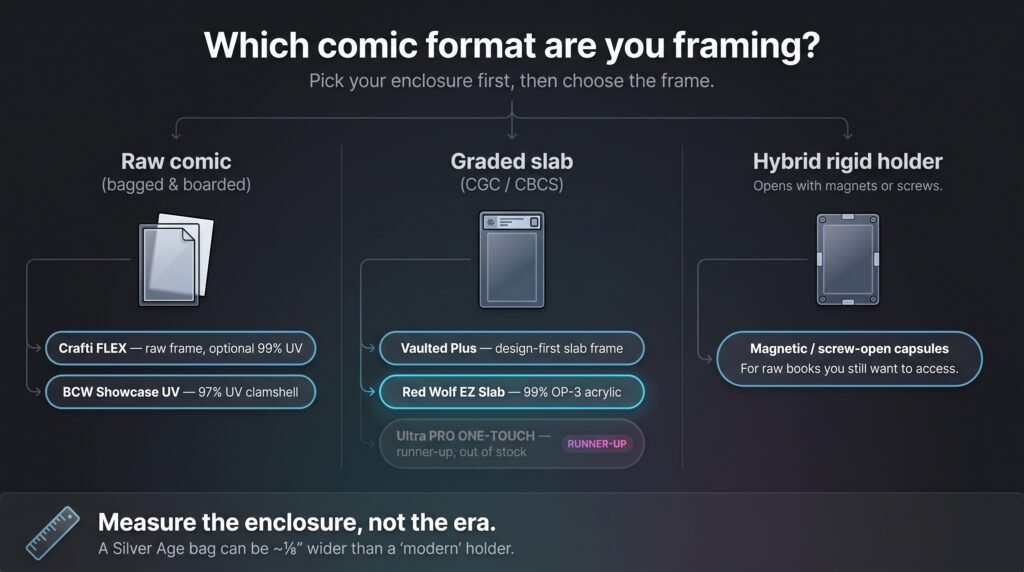
- Raw comic (bagged and boarded, still openable)
- Best in a purpose-built rigid holder, such as Crafti FLEX or BCW Showcase, which adds structure and optional UV filtering without sealing the book.
- Ideal for signatures, pressing, or frequent reading.
- Graded slab (CGC or CBCS)
- The book is sonically welded in plastic and given a numeric grade.
- Your frame—Vaulted, Red Wolf, or Ultra PRO—only needs to protect the slab, keep the label visible, and look sharp on the wall.
- Hybrid rigid holder
- Looks like a slab but opens with magnets or screws.
- Lets you rotate covers, avoid grading fees, and lower handling risk for full-run displays.
Pro tip: measure the enclosure, not the era.
A Silver Age bag can be just one-eighth inch (about three millimetres) wider than a “modern” holder; one Reddit user learned that the hard way. Grab a ruler before you click “buy”, and your corners will thank you.
What a UV percentage really means
“Ninety-nine percent UV” sounds bulletproof, but the number hides two big caveats.
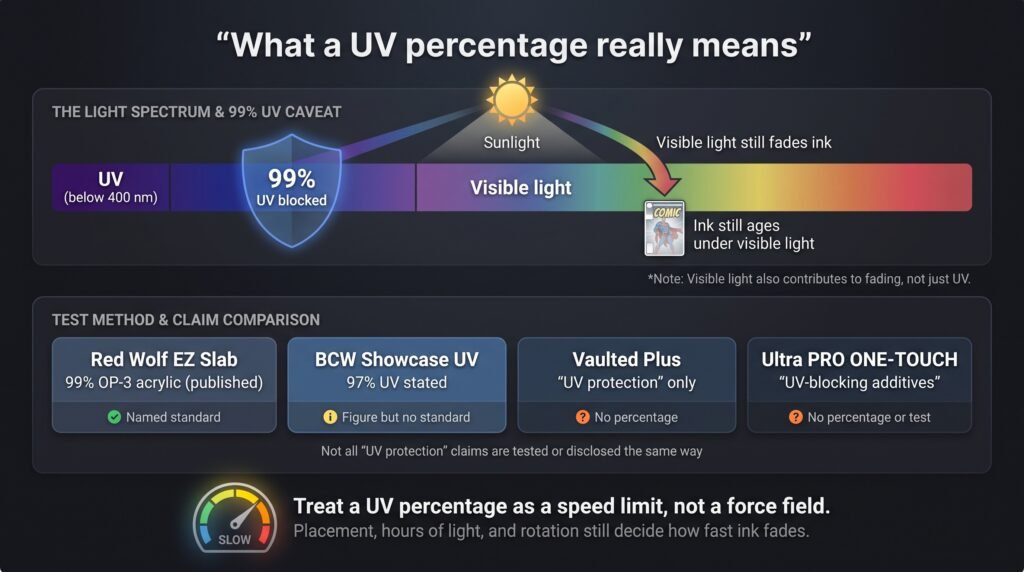
- Bandwidth: most lab tests stop at 400 nm, filtering only ultraviolet. Visible light—everything your eyes see—still carries enough energy to fade ink. The Canadian Conservation Institute warns that highly sensitive colours can fade even at fifty lux with zero UV present, because light damage is cumulative.
- Test method: Red Wolf quotes OP-3 acrylic with a published ninety-nine percent block, while BCW lists ninety-seven percent without naming the standard. Vaulted and Ultra PRO simply say “UV protection.” Comparing those claims without the underlying test (ASTM D1003 haze, ISO 9050 transmittance, and so on) is like racing cars without measuring the track.
Bottom line: treat a UV percentage as a speed limit, not a force field. It slows fading, but room placement, lighting hours, and rotation seal the deal. Keep frames off sun-blasted walls, limit display to fifty lux where possible, and rotate grails on a schedule. The glazing buys time; your habits lock in colour.
Keep the comic away from the glazing
Glass or acrylic protect best when they never touch the paper. Direct contact can cause Newton rings (those oily-looking interference patterns), trap moisture, and lift pigment when heat or pressure rises.
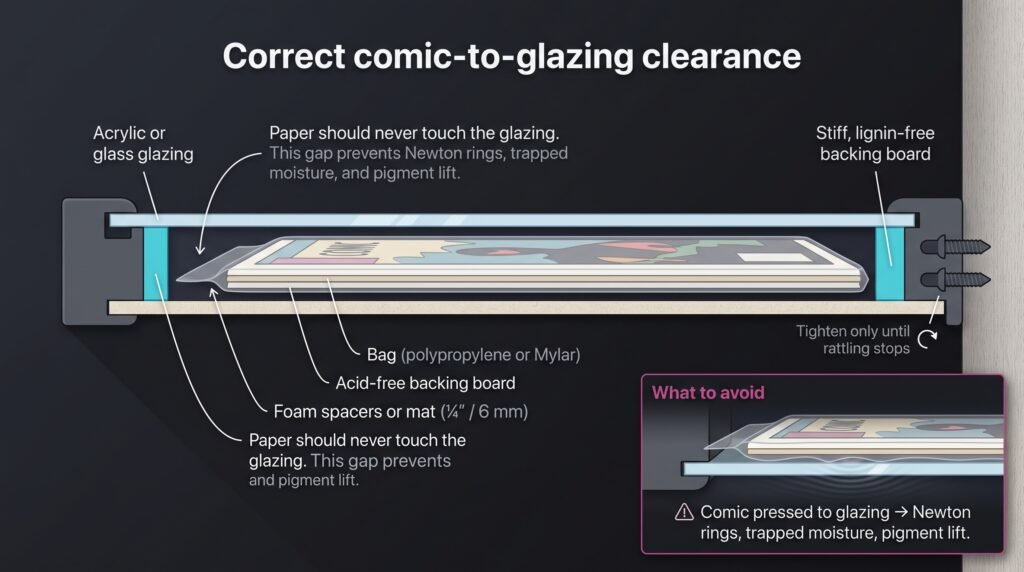
Purpose-built frames create the gap for you:
- Vaulted recesses a CGC slab by one-quarter inch (about six millimetres).
- Crafti FLEX drops a raw comic behind an inner lip.
- Red Wolf suspends the slab under a magnetic lid that never pinches the label.
Building your own IKEA RÖDALM setup? Match that clearance. Add an acid-free mat or six-millimetre foam spacers around the perimeter, then insert a stiff, lignin-free backing board to stop sagging.
Skip double-sided tape; even “archival” adhesives can stain when humidity shifts. Instead use:
- Polyethylene or Mylar corner pockets
- Polyester mounting strips
- Or simply let the bag-and-board float inside a rigid shell
Goal: zero direct adhesion and even support, so gravity, not glue, does the holding.
Tighten screws only until rattling stops. Over-cranking bows acrylic inward and can pinch the spine. Shake the frame gently; silence means you set it up correctly.
Mounting and wall security
The safest frame is only as strong as the hardware behind it, so tackle the wall first.
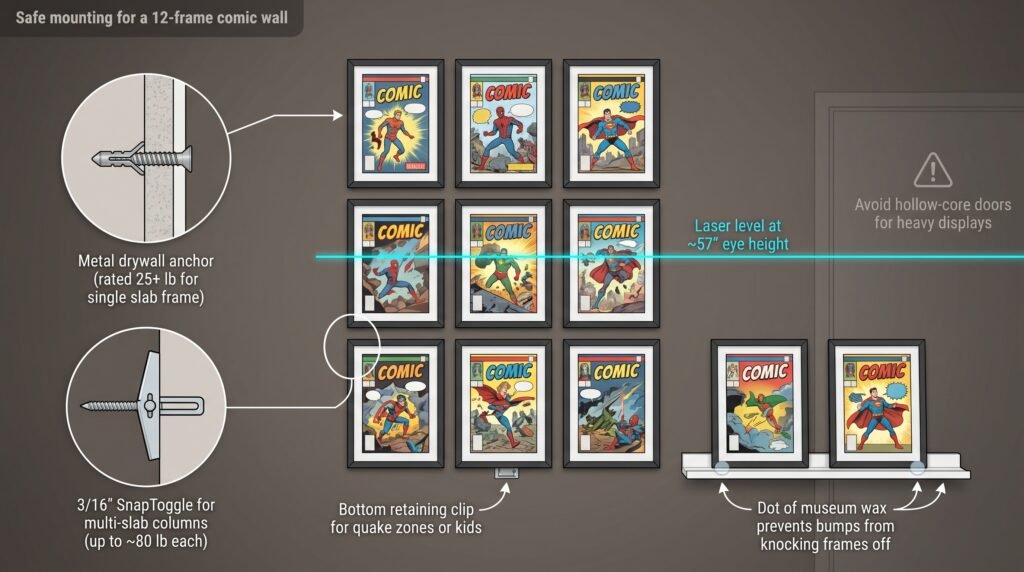
- Match anchor to load
- Single CGC frame (about three pounds / one point four kilograms loaded): use a metal drywall anchor rated for at least twenty-five pounds (eleven kilograms).
- Multi-slab column: choose three-sixteenth-inch SnapToggle bolts rated for eighty pounds (thirty-six kilograms) each. Missing one stud can bring the whole grid down.
- Hanger types
Most comic frames arrive with a keyhole slot or sawtooth hanger—fine for drywall if paired with the right anchor. Vaulted and Red Wolf include stainless screws; anchors are up to you.
- Renter workaround
IKEA’s MOSSLANDA ledge spreads the load over two or three anchors and lets you reshuffle frames without peppering the plaster. Add a pea-size dot of museum wax under each frame to stop bumps.
- Extra security zones
- Earthquake regions or homes with kids: add a bottom retaining clip, such as a small zinc L-bracket, to keep a valuable slab from jumping off the wall.
- Hollow-core doors: avoid mounting here, because vibration loosens screws over time.
- Layout once, duplicate forever
Snap a laser at fifty-seven inches (one hundred forty-five centimetres) eye level, mark pilot holes with painter’s tape, and you will hang a twelve-frame grid in an afternoon, not a full weekend. Straight horizons save your eyes and the drywall.
What a 12-frame wall really costs
Prices verified September 7, 2026; tax and shipping extra.
| Product | Unit price (USD) | 12-unit total | Notes |
| Vaulted Plus (Carbon Fiber) | $63.99 sale | $767.88 | White finish adds five dollars each |
| Red Wolf EZ Slab | $44.99 | $539.88 | Desk stand adds five dollars each (optional) |
| Crafti FLEX + ninety-nine percent UV | $35.00 | $420.00 | Classic size adds five dollars each |
| BCW Showcase UV | $16.99 | $203.88 | Bulk twenty-five pack drops to $12.74 each |
| IKEA RÖDALM hack | $11.99 | $143.88 | Add about three dollars per slot for mat and spacers |
Why it matters: a Vaulted wall can cost four times a BCW grid before mats or lighting. Decide early whether you are showcasing five grails or fifty floppies, and pick a frame tier that still leaves budget for the comics themselves.
Conservation reality check: display doesn’t end at the frame
Frames slow damage; they do not stop it. The Canadian Conservation Institute notes that highly sensitive colours can fade even at fifty lux with zero UV present, because light damage is cumulative.
What you do next matters as much as the glazing:
- Placement. Choose an interior wall with no direct sun. Add curtains or smart shades in multipurpose rooms and switch display lights off when the room is empty.
- Light level. Keep accent lighting around fifty lux (about five foot-candles); raise it briefly for visitors, then dim again.
- Rotation. Treat premium issues like museum loans: display for three months, rest for nine months, adjusting for actual light dose recorded by your lux meter. Snap a reference photo on day one and compare colours each cycle.
- Climate. Aim for eighteen to twenty-four °C (sixty-four to seventy-five °F) and no more than sixty percent relative humidity; spikes accelerate acid breakdown and ink bleed. A twenty-five dollar data logger tells you more than any marketing brochure.
Control the room environment and the frame’s promise becomes real insurance instead of a hope.
Art-direction tips for a gallery-worthy comic wall
- Choose one unifying story. Select an artist, era, character, or dominant cover colour. A row of Jim Lee X-Men in crisp white Vaulted frames looks intentional, while a random mix of romance and horror issues feels busy.
- Lock your sight line. Centre the middle row at fifty-seven inches (one hundred forty-five centimetres) from the floor—eye level for most adults. Raise it slightly if everyone in the house is tall; lower it for a child’s reading nook.
- Standardise the gap. Pick a spacer—two inches (five centimetres) is common—cut a wood off-cut or 3-D-print a block, then butt every frame against it before you drive the screw. Consistent negative space calms the eye and lets covers breathe.
- Mind depth and texture. Break the plane with one or two three-dimensional items, such as a Funko Pop on a slim shelf or a mini spinner rack, but keep ninety percent of the wall flat comics. Every extra object should echo the comics’ palette or theme; otherwise, leave it out.
- Test the layout before drilling. Lay frames on the floor or use painter’s tape silhouettes on the wall, adjust until the composition clicks, then grab the drill. Your plaster—and nerves—will thank you.
Frequently asked questions
Do CGC slabs already block UV?
Not reliably. CGC has used several holder formulations since 2000 and does not publish a UV-transmission percentage for each generation, so assume some UV and visible light reach the book. A separate UV-rated frame plus smart room placement is the safer bet.
Should the comic stay bagged and boarded inside the frame?
Yes, as long as the holder’s internal width is at least six and three-quarter inches (one hundred seventy-one millimetres) for a modern comic in a standard polypropylene bag and backing board. That fits Crafti FLEX and BCW Showcase but is too wide for Ultra PRO’s ONE-TOUCH unless you use its proprietary Preserver sleeve. Always measure the bag, not just the book.
Can I squeeze a comic into an ordinary eight by ten picture frame?
No. A modern issue is about ten and one-quarter inches (two hundred sixty-one millimetres) tall, so an eight by ten frame will crimp the edges. Step up to a twelve by sixteen frame like IKEA’s RÖDALM or choose a purpose-built comic holder.
How often should I rotate books on display?
Many conservators suggest three months on display and nine months in dark storage for light-sensitive paper objects. If ambient light often exceeds fifty lux, cut that window in half.
Is acrylic better than glass?
Acrylic wins on weight and shatter resistance for multi-frame walls. Glass resists scratches and offers crisper clarity, but standard soda-lime glass blocks far less UV and weighs about twice as much. Conservation-grade glass fixes the UV issue but increases cost and weight.
Will magnets damage my comic or slab?
No, when used properly. In Vaulted and Red Wolf frames, magnets hold only the frame parts; the slab or raw book floats in a recessed cavity, so magnetic force never touches the paper.
What’s the safest way to mount on drywall?
Use metal anchors rated higher than the loaded weight (for example, a twenty-five-pound toggle for a three-pound slab frame), level with a laser, and add a bottom clip or museum wax in quake zones. One good anchor beats two undersized screws.
Can I display Golden Age or magazine-size books in these frames?
Most off-the-shelf holders top out at Silver Age dimensions. For larger formats, look to custom framers like Level Frames or build a DIY shadow box with acid-free materials and OP-3 acrylic.
Conclusion
Choose the frame that matches your budget, your comic’s enclosure, and your wall space, then control light and climate to lock in colour for decades. Measure twice, mount once, and rotate your grails on a sensible schedule—the combination of smart hardware and careful habits is the real key to a fade-free gallery.