There are buildings that behave politely, and then there are buildings that arrive like an opera.
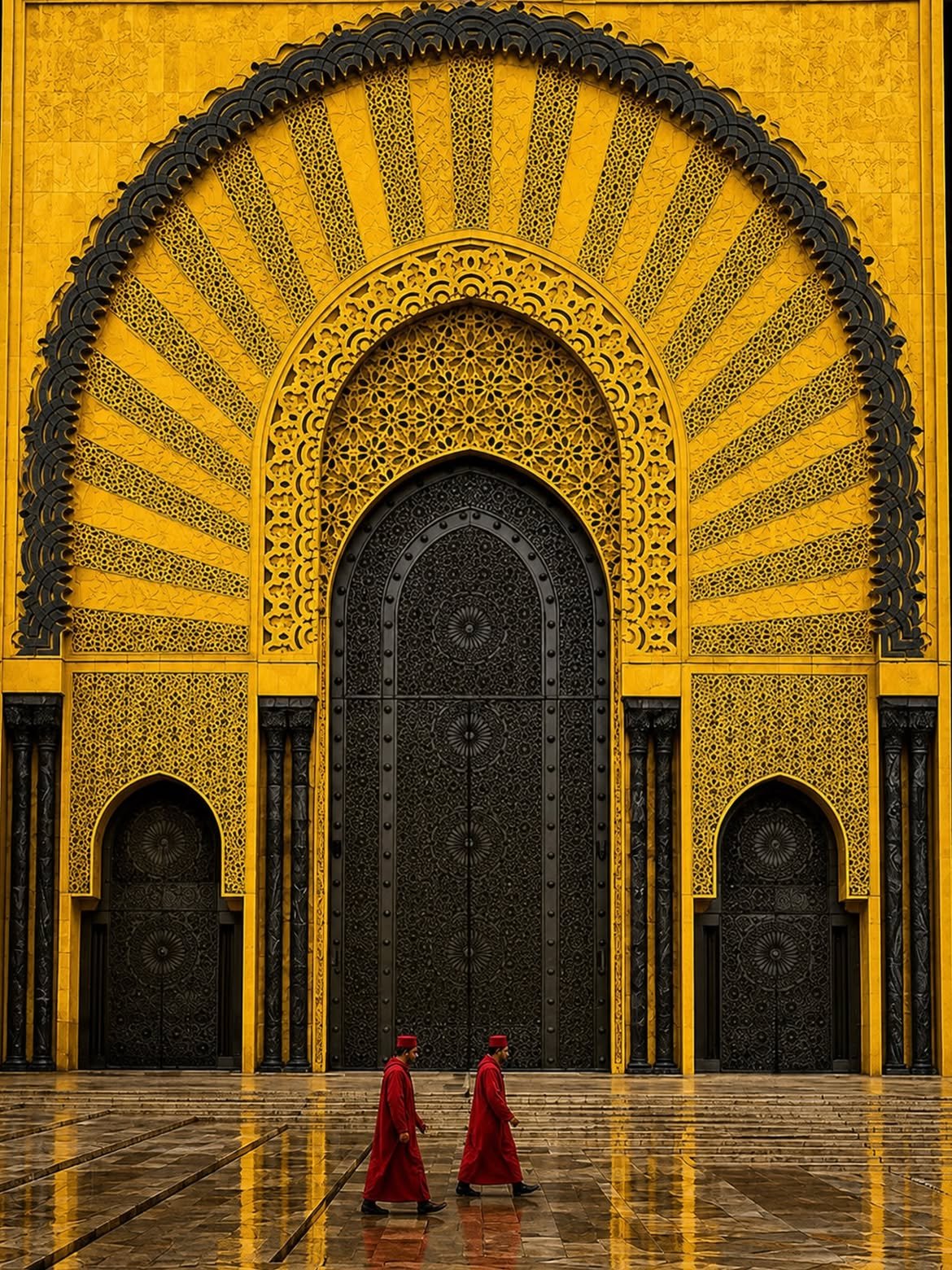
The Moroccan architecture shared by Aseel Swaid belongs proudly to the second category. It does not whisper minimalism into the void. It does not apologise for pattern, colour, ornament, symmetry, gold, scale, ceremonial entrances, wet marble, carved surfaces, black doors, monumental arches, or the very dramatic idea that a façade should look like it is expecting a royal procession at any moment.
And honestly, thank God.
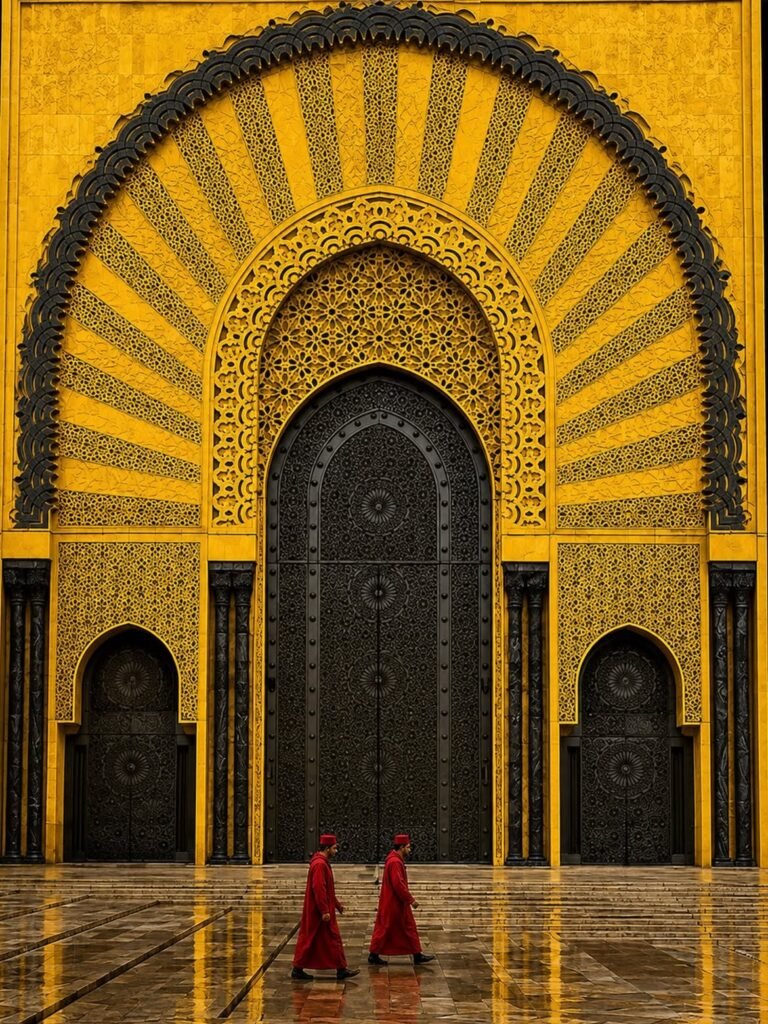
In one recent post captioned simply “Moroccan architecture,” Swaid presents a façade that looks almost too theatrical to be real: a great golden horseshoe arch, black carved doors, intricate surface decoration, rain-polished ground, and two red-clad figures walking across the foreground like they have been hired by history to improve the composition. The image is not subtle. It is not trying to be. Its power comes from the fact that Moroccan architecture, when seen through this kind of visual eye, understands something many contemporary buildings have tragically forgotten: restraint is not the only path to elegance.
Sometimes elegance needs to make an entrance.
Architecture With a Sense of Occasion
What makes Swaid’s image so effective is not simply the building itself, but the way the building is allowed to perform.
The façade is treated almost like a stage. The arch becomes a proscenium. The doors become a dark centre of gravity. The golden surface turns into light, ornament, skin, and atmosphere all at once. The reflection on the ground doubles the spectacle, because apparently one monumental façade was not enough and Morocco, sensibly, ordered a second one in the rain.
This is where the image becomes more than travel photography. It enters the territory of visual theatre. The eye does not simply identify architectural features. It moves through drama: gold against black, verticality against human scale, wet stone against carved surface, symmetry against the accidental movement of two passing figures. The whole thing feels composed, even if the street itself supplied the final details.
Architecture here is not background. It is the main character.
That is why the photograph works so well online. It gives the viewer instant visual reward — colour, scale, detail, drama — but it also carries the slower pleasure of ornament. You can look at the image quickly and understand its impact. You can also remain with it and let the patterns begin to take over.
The Beautiful Excess of Moroccan Architecture
Moroccan architecture has never depended on the modern fantasy that beauty must be quiet to be serious.
Its visual language often moves through arches, tilework, carved stucco, cedarwood, courtyards, fountains, geometric rhythm, calligraphic surfaces, shadow, privacy, and revelation. The exterior may conceal; the doorway may announce; the courtyard may unfold inward like a secret with very good craftsmanship. The Metropolitan Museum of Art has described the classic Moroccan combination of zellij, stucco, and wood carving as central to the country’s architectural richness, and Swaid’s post lives inside exactly that visual inheritance.
The excess is not random. That is the important part. Bad ornament is noise. Good ornament is discipline pretending to be abundance. Moroccan architecture at its best does not throw decoration at a wall and hope for applause. It organizes surface through geometry, repetition, material, light, and hierarchy. Pattern becomes structure. Detail becomes rhythm. The façade does not merely decorate the building; it teaches the eye how to move.
This is the difference between luxury and vulgarity, a line contemporary design crosses daily with the confidence of a drunk man carrying marble samples. Swaid’s image feels rich not because it is expensive-looking, but because every surface appears to belong to an older grammar of making. The ornament has memory. The symmetry has authority. The colour has nerve.
In an age of glass boxes and beige interiors pretending to be spiritual, that nerve feels almost rebellious.
The Arch as Drama Machine
The horseshoe arch may be one of architecture’s most reliable drama machines.
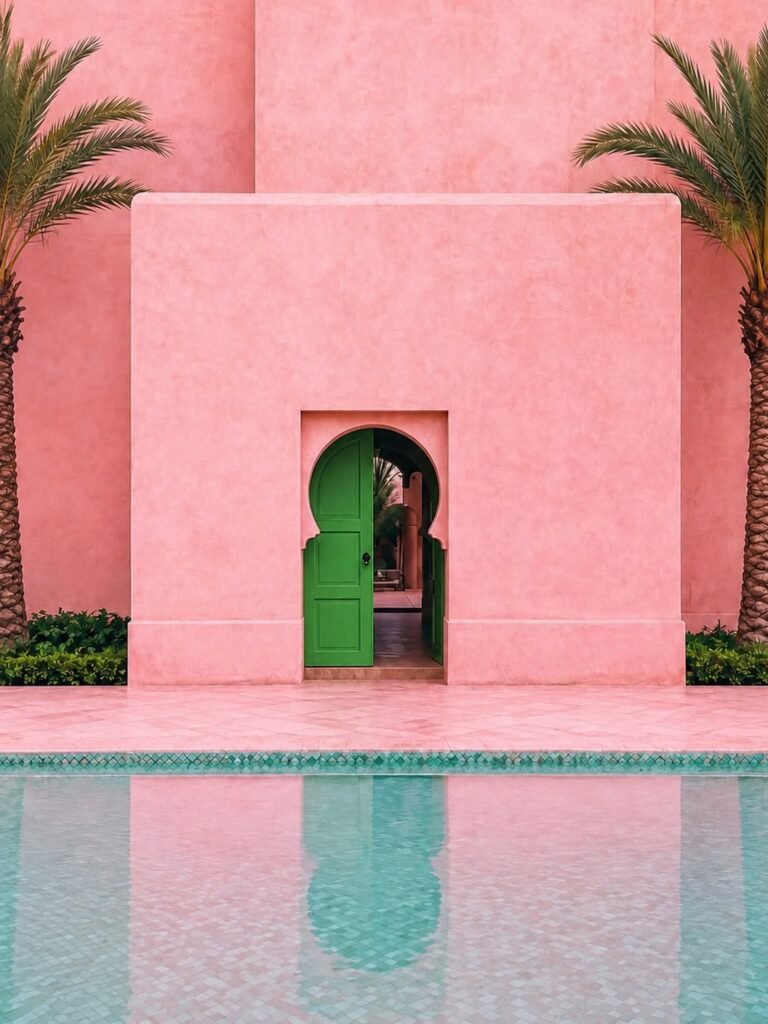
It frames space while exaggerating arrival. It turns a doorway into an event. It makes entering and exiting feel ceremonial, which is useful because human life, frankly, needs all the ceremony it can get. In Moroccan and wider western Islamic architecture, arches are not merely structural solutions. They are visual thresholds: between street and interior, public and private, ordinary life and controlled splendour.
In Swaid’s image, the arch dominates everything. It is not just a shape. It is a gesture. The building seems to open itself like a fan, radiating gold and pattern around the dark door at its centre. The smaller side arches repeat the motif at a lower register, giving the façade hierarchy and rhythm. The whole composition behaves almost musically: main theme, variation, echo.
This is why Moroccan architecture photographs so well. It gives the camera forms that already understand framing. The photographer does not have to invent drama from nothing. The drama is built into the entrance, the surface, the repetition, the shadows, the tile, the calligraphy, the polished floor after rain. The task is not to make the building interesting. The task is to survive how interesting it already is.
Aseel Swaid’s eye seems especially suited to this kind of visual language because he lets the architecture remain excessive without treating it like a postcard cliché. The image is theatrical, yes, but not cheap. It understands the façade as spectacle and as craft.
Two Red Figures and the Genius of Scale
The two red-clad figures in the foreground are the small miracle of the image.
Without them, the architecture would still be magnificent. With them, it becomes cinematic. They provide scale, movement, contrast, and a hint of narrative. They are not posing heroically. They are simply crossing the space, which is almost always better. Nothing ruins architecture faster than a person trying too hard to look meaningful in front of it.
The red garments cut through the gold and black like a visual chord. They activate the ground. They make the façade taller, the doorway darker, the surface more monumental. They remind the viewer that buildings are not only objects to be admired; they are spaces through which people pass, work, pray, guard, clean, wait, and disappear.
This is a trick old architectural images have always understood. Human figures make monuments more powerful because they restore proportion. David Roberts did it with ruins, temples, camels, guards, and travellers. In Art-Sheep’s feature on David Roberts and the lithographic dream of the East, the tiny human figure becomes a way of measuring awe. Swaid’s image works through a similar instinct, whether consciously or not: the building becomes larger because the people remain small.
But there is also humour here, the good kind. The figures look almost too perfect for the scene, as if Morocco has a municipal department responsible for sending elegantly dressed walkers across reflective stone whenever a visual artist opens the camera.
Some countries have traffic control. Others apparently have composition control.
Instagram and the Return of Ornament
There is a reason images like this travel well on Instagram.
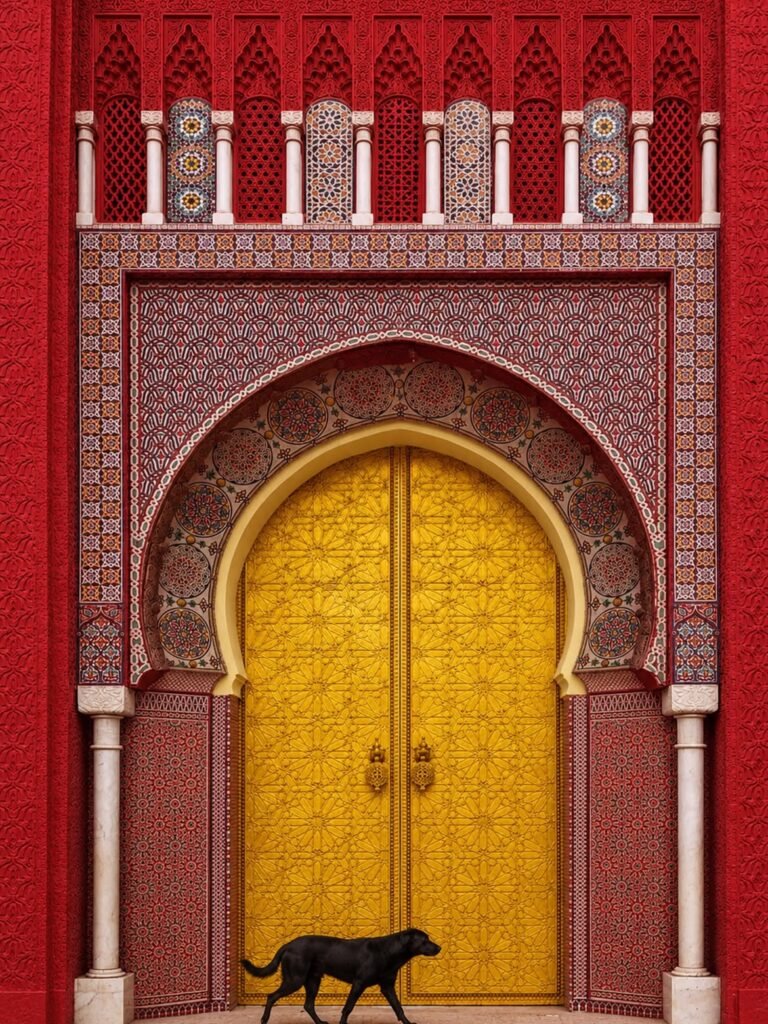
The platform rewards immediacy, and Moroccan architecture offers immediacy without emptiness. A golden façade, a carved door, a tiled courtyard, a monumental arch, a blue street, a patterned ceiling: these are images that catch the eye before the brain has time to pretend it is too sophisticated for pleasure.
But the best of them also outlast the scroll. That is where Swaid’s visual world becomes interesting. His posts are not just about “beautiful places.” They are about architecture as spectacle, architecture as cultural memory, architecture as surface intelligence. The images understand that ornament is not a weakness. It is a technology of attention.

Modern architecture spent much of the twentieth century trying to convince us that decoration was suspicious. Sometimes it was right. Much decoration is criminal and should be tried in The Hague. But the broader suspicion of ornament also produced a lot of buildings that look like they were designed by accountants experiencing mild weather.
Moroccan architecture offers a useful correction. It reminds us that pattern can be serious. Colour can be intelligent. Symmetry can be sensual. A door can be more than an entry point. A façade can be a face.
And some faces, mercifully, know how to wear gold.
Theatre, Not Tourism
The danger with photographing places like Morocco is that beauty can become too easy.
A camera can turn culture into decoration very quickly. It can flatten lived spaces into exotic mood. It can make architecture appear as pure spectacle, stripped from history, labour, religion, maintenance, class, weather, tourism, and the ordinary people whose daily lives give these spaces meaning. Every visual culture account that works with architecture faces this problem, whether it admits it or not.
What makes Swaid’s image effective is that it leans into spectacle without feeling completely hollow. The post does not give us a full architectural history, and it does not pretend to. It gives us visual intensity. That is its language. The question is whether the intensity opens curiosity or ends it.
At its best, this kind of image should make viewers want to know more: about Moroccan craft traditions, zellij, carved plaster, monumental gates, religious and civic architecture, the relationship between ornament and geometry, and the way buildings create public emotion. The Museum With No Frontiers offers useful context on Moroccan architectural elements such as horseshoe arches, sculpted plaster and zellij decoration, showing how the details that look spectacular on screen belong to deep traditions of craft and design.
The post works, then, when it is treated not as the end of looking but as the beginning of it.
When a Building Knows It Is Being Watched
The great pleasure of Swaid’s Moroccan architecture image is that the building seems fully aware of its own drama.
This is not always a virtue. Some buildings know they are being watched and behave terribly. They flex. They sparkle. They make shapes no one asked for. They confuse expensive materials with personality. But the Moroccan façade in Swaid’s post has a different kind of confidence. It does not feel like a stunt. It feels like the survival of an architectural language that always understood public beauty as a serious act.
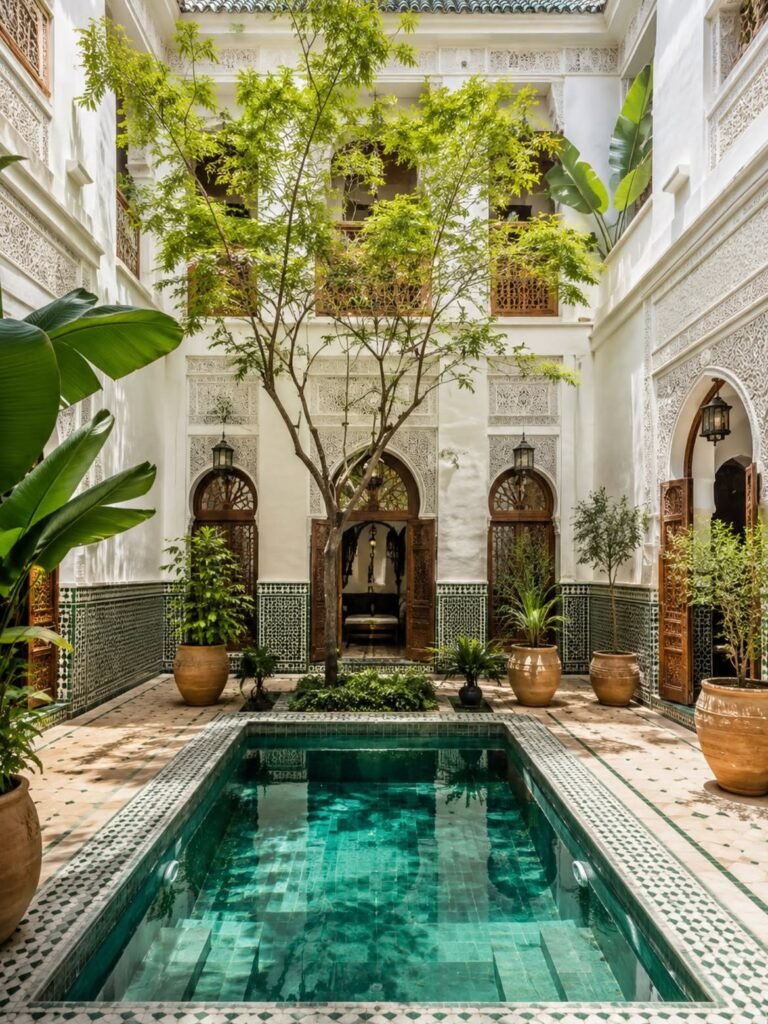
The image is slightly over the top, yes. Gloriously so. But “over the top” is sometimes just what people call beauty when it refuses to behave like a Scandinavian chair.
Aseel Swaid’s photograph reminds us that architecture can still be theatrical without being fake, ornamental without being stupid, monumental without becoming cold. It can create awe through surface as much as through size. It can use gold without apologising to minimalism. It can turn a doorway into an event and two walking figures into a tiny procession.
Most importantly, it reminds us that some buildings do not simply stand there.
They perform.