The Dictator Who Collected Bordeaux
History has a peculiar habit of preserving the wrong things.
Manifestos disappear. Empires collapse. Statues are pulled down, archives burn, borders shift. Yet sometimes, hidden beneath layers of dust and political upheaval, something entirely unexpected survives.
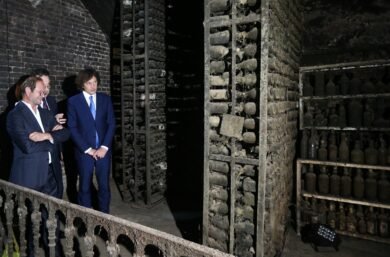
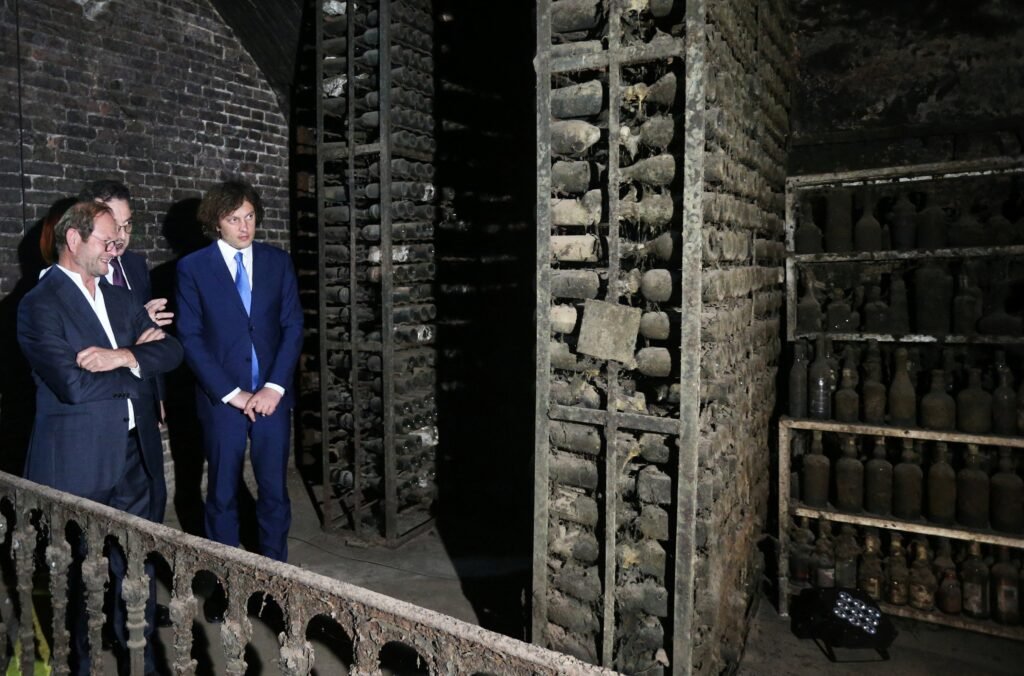
This week, deep beneath the streets of Tbilisi, Georgia, a sealed wine vault containing approximately 40,000 bottles once associated with Joseph Stalin was opened to the public for the first time in decades. Inside: rare French vintages, prized Georgian wines, imperial collections seized during revolution, and bottles that have quietly outlived the century that produced them.
The discovery feels almost fictional.
A dictator responsible for one of the most brutal regimes in modern history remembered not through speeches or monuments — but through wine.
The Cellar Beneath History
According to Georgian authorities, the collection contains French and Georgian wines dating back as far as the early nineteenth century. Some bottles once belonged to the Romanov imperial family, including Tsars Alexander III and Nicholas II, before being confiscated following the Russian Revolution of 1917. Eventually, portions of these collections came under Stalin’s stewardship, where they remained and gradually expanded over time.
The descriptions emerging from journalists allowed inside read more like gothic literature than contemporary news reporting:
cobwebs hanging from ceilings, fading labels, amber liquid resting behind dust-covered glass, and the lingering scent of age suspended in darkness.
It sounds less like a wine cellar and more like a mausoleum.
Georgia’s Most Famous Son
The irony is impossible to ignore.
Stalin remains perhaps the most infamous figure ever born in Georgia. While modern Georgia has often struggled with the legacy of its most controversial son, wine remains one of the country’s greatest cultural achievements.
Georgia frequently describes itself as the birthplace of wine, with archaeological evidence suggesting an uninterrupted winemaking tradition stretching back nearly 8,000 years.
In a strange way, the cellar represents both histories simultaneously:
- Georgia the ancient wine civilization
- Georgia the birthplace of Stalin
Two narratives trapped in the same room.
The Taste of Power
Wine and political power have shared a long relationship.
Napoleon collected wine.
The Romanovs collected wine.
European aristocracies built entire social rituals around wine.
Yet Stalin’s cellar feels different.
Not because dictators are incapable of appreciating luxury, but because Stalin carefully cultivated an image of austerity. Public mythology portrayed him as practical, disciplined, almost indifferent to extravagance.
The cellar complicates that image.
Behind the carefully managed persona was a collector.
A man who apparently appreciated great wine enough to preserve thousands of bottles while simultaneously overseeing one of the most extensive systems of repression in modern history.
The contradiction feels almost too perfect.
When Objects Outlive Ideology
Perhaps the most fascinating aspect of the collection is not the wine itself.
It is survival.
The Soviet Union disappeared.
Its symbols were dismantled.
Its political certainties collapsed.
Yet the bottles remained.
Silent.
Waiting.
Unlike propaganda, wine does not argue. It simply ages.
And over enough time, even the most powerful ideologies begin to look temporary beside a bottle that has survived two centuries.
The Collector’s Dream
For wine collectors, the discovery borders on mythological.
Victor Chen, a collector who traveled from Texas to view the cellar, compared the experience to an Indiana Jones expedition — opening a cave without knowing whether it contains treasure or disappointment.
The comparison feels appropriate.
The cellar sits somewhere between archaeology and collecting.
Between history and speculation.
Between museum and marketplace.
Because unlike most historical discoveries, this one comes with price tags.
From Vault to Auction
The Georgian government plans to auction portions of the collection, using proceeds to establish a wine education school in Georgia. Officials hope the sale will elevate Georgia’s position within the global collector market while simultaneously funding future generations of winemakers.
It is a remarkably modern solution.
Transform the relics of dictatorship into educational infrastructure.

Convert authoritarian luxury into public knowledge.
History, occasionally, enjoys irony.
A Cellar of Ghosts
There is something almost haunting about the images emerging from Tbilisi.
Not because of Stalin himself.
But because the cellar functions as a time capsule of vanished worlds.
Imperial Russia.
Revolutionary upheaval.
The Soviet Union.
Post-Soviet Georgia.
Each regime left traces.
Each disappeared.
The bottles remained.
In this sense, the collection resembles less a private cellar and more a condensed history of Eastern Europe, preserved in glass.
Final Reflection: Red Terror, Red Wine
The discovery of Stalin’s wine collection is not important because of its monetary value.
Collectors will calculate that.
Auction houses will estimate it.
Historians will catalogue it.
What makes the story fascinating is the collision of opposites it represents.
A man associated with fear and control remembered through objects associated with pleasure.
A regime obsessed with permanence reduced to a cellar of aging bottles.
An empire that vanished while its wine quietly endured.
History rarely offers symbolism this obvious.
Sometimes it simply leaves 40,000 bottles underground and waits for somebody to open the door.