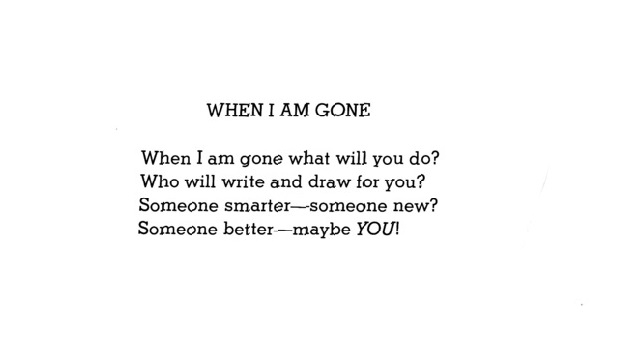
20 of Our Favorite Shel Silverstein Poems
Shel Silverstein belongs to that rare category of writers who appear, at first glance, wonderfully simple. The drawings are loose. The poems are short. The jokes arrive quickly. Children laugh before adults have decided whether they are allowed to laugh.
And yet, beneath that apparently effortless surface, Silverstein’s work remains strangely resistant to age. His poems are funny, certainly, but they are also mischievous, melancholic, slightly anarchic, and often more emotionally intelligent than the “serious” literature adults like to pretend formed them.
He understood childhood not as innocence, but as intensity. Children in Silverstein’s poems are greedy, frightened, brave, lazy, inventive, lonely, stubborn, and occasionally absurd in ways adults prefer to call “imaginative” because the alternative would be admitting children are often more honest about human nature than we are.
A poet, cartoonist, songwriter, children’s author, and illustrator, Silverstein created a body of work that moved between nonsense and wisdom with unusual ease. His best-known books — including Where the Sidewalk Ends, A Light in the Attic, Falling Up, and Every Thing On It — did not merely entertain young readers. They taught them that language could misbehave.
Below are twenty of our favorite Shel Silverstein poems — not because they are cute, although many are, but because they reveal how strange, tender, rebellious, and quietly devastating his work can be.
Why Shel Silverstein Still Feels Different
Many children’s writers speak down to children without realizing it. Silverstein rarely did. His poems do not treat childhood as a soft, pastel waiting room before adulthood begins. Instead, they treat it as a complete psychological universe with its own fears, rituals, jokes, cruelties, and private laws.
That is part of why his work still circulates so widely. His poems are easy to remember, but difficult to exhaust. A child may laugh at the absurdity; an adult, returning years later, may suddenly notice the loneliness, the satire, or the uncomfortable little truth hiding behind the rhyme.
This double register is central to Silverstein’s power. He wrote poems that could sit comfortably in a classroom, on a refrigerator, or in the memory of someone who has not opened one of his books in twenty years. And still, somehow, they bite.
For a broader overview of Silverstein’s career as a poet, cartoonist, songwriter, and children’s author, the Poetry Foundation offers a useful profile of Shel Silverstein.
1. “Where the Sidewalk Ends”
Perhaps Silverstein’s most iconic poetic landscape, “Where the Sidewalk Ends” imagines a place beyond ordinary boundaries — beyond asphalt, rules, noise, and the sensible adult machinery of the world. Its power lies in how lightly it handles escape. It does not announce rebellion. It simply suggests that somewhere, just beyond the expected path, another world may still be possible.
The poem remains one of Silverstein’s clearest statements of artistic faith: imagination is not decoration. It is a form of departure.
2. “Masks”
Few Silverstein poems are as quietly devastating as “Masks.” In only a few lines, he turns identity, fear, and missed connection into something almost unbearably simple. The poem’s premise is easy enough for children to understand, but its emotional implications are painfully adult: people often hide the very thing that might allow them to be loved.
We have previously featured the poem separately on Art-Sheep in “Masks” by Shel Silverstein, and it remains one of the clearest examples of his ability to compress an entire emotional tragedy into a childlike form.
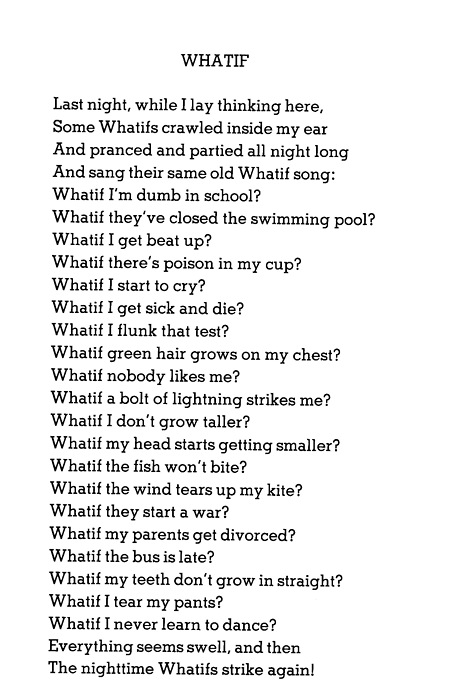
3. “Whatif”
“Whatif” captures anxiety with comic precision. The voice of the poem is haunted by hypothetical disasters, each one arriving with the familiar rhythm of an overactive mind. It is funny because it is exaggerated; it is memorable because it is not exaggerated enough.
Every child knows this feeling. So does every adult awake at 3 a.m. pretending to be reasonable.
Silverstein’s genius here is tonal. He makes fear sound musical without making it disappear.
4. “Sick”
“Sick” is one of Silverstein’s great comic monologues. The poem builds through a glorious catalogue of fake symptoms, transforming laziness, performance, and childhood strategy into miniature theatre. The speaker is not merely avoiding school; she is building a medical epic.
The twist works because Silverstein understands the psychology of childhood excuse-making. Children may lie badly, but they often do so with astonishing artistic commitment.
5. “Sarah Cynthia Sylvia Stout Would Not Take the Garbage Out”
One of Silverstein’s most famous comic cautionary tales, this poem takes a simple household chore and turns it into escalating catastrophe. The garbage becomes grotesque, mythological, almost operatic. What begins as domestic laziness expands into an apocalypse of neglect.
It is moralistic, yes, but deliciously excessive. Silverstein understood that if a lesson must be taught, it might as well arrive buried under a mountain of comic filth.
6. “The Voice”
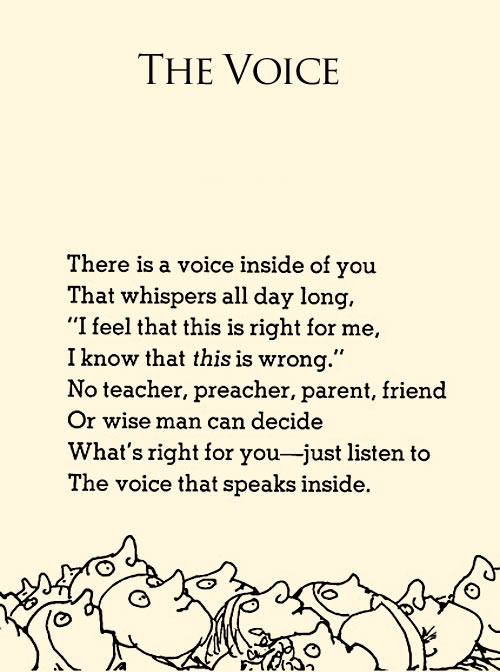
“The Voice” is one of Silverstein’s most direct poems about conscience and self-trust. It avoids the absurd machinery of some of his funnier work and instead offers something almost aphoristic. The poem’s emotional center is the idea that one’s inner voice matters more than the noise of approval, instruction, or expectation.
It is the kind of poem that seems simple enough to embroider on a classroom wall — and serious enough to survive the indignity.
7. “Invitation”
“Invitation” functions almost like a doorway into Silverstein’s world. It welcomes dreamers, liars, wishers, magic-bean buyers, and other suspiciously promising types. In doing so, it establishes the moral climate of his poetry: the imaginative outsider is not merely tolerated, but invited in.
The poem feels light, but it contains a serious artistic principle. Silverstein’s universe belongs to those willing to suspend respectability.
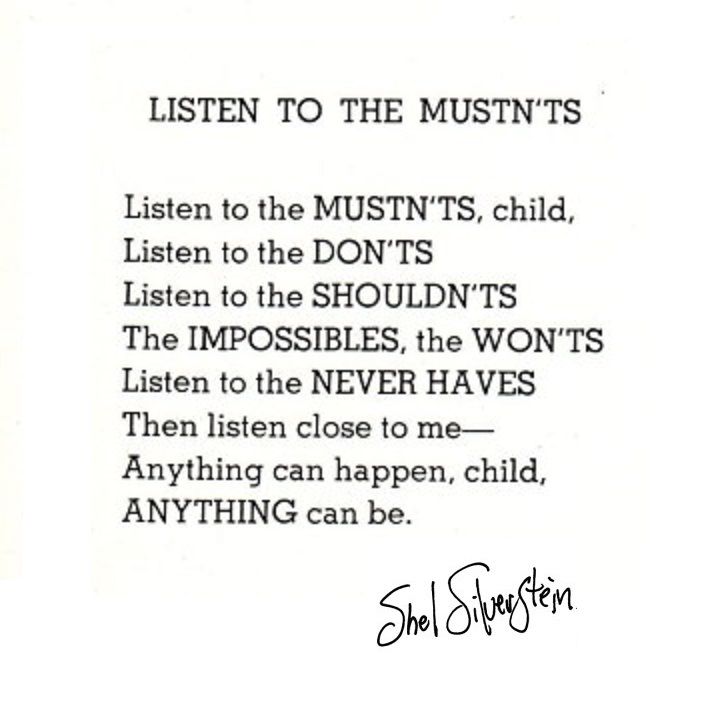
8. “Listen to the Mustn’ts”
This poem is one of Silverstein’s great miniature manifestos. It challenges prohibition, skepticism, and the dull chorus of voices that tell children what cannot be done. Its charm lies in its speed and clarity. It does not argue at length; it simply opens a door.
In a culture that often confuses obedience with wisdom, Silverstein’s insistence on possibility still feels quietly rebellious.
9. “Hug O’ War”
“Hug O’ War” is Silverstein at his gentlest. It reimagines conflict not as conquest, but as affection. The pun is obvious, but the emotional reversal is effective: competition becomes tenderness, war becomes embrace, victory becomes shared delight.
It is one of his most openly sweet poems, though even here, the sweetness works because it is balanced by wit rather than sentimentality.
10. “Smart”
“Smart” is a perfect example of Silverstein’s comic understanding of childish logic. The speaker believes he is making increasingly clever trades, while the reader quickly understands that the opposite is happening. The poem turns arithmetic into comedy and self-confidence into farce.
It is also, perhaps unintentionally, a brutal little study of bad decision-making. Some adults spend entire careers behaving like the narrator of “Smart,” though usually with better shoes and worse consequences.
11. “Boa Constrictor”
Absurd, rhythmic, and slightly horrifying, “Boa Constrictor” captures Silverstein’s talent for making danger funny without fully removing its danger. The poem’s progression is simple, almost cartoonish, but its bodily comedy gives it a peculiar force.
Children love it because it is ridiculous. Adults may notice that it is also a poem about being consumed, which is less comforting, but there we are.
12. “Peanut-Butter Sandwich”
This poem turns a common childhood food into a comic disaster. Like many Silverstein pieces, it begins with something ordinary and pushes it past reason until it becomes surreal. The humor depends on escalation, repetition, and the sheer stubbornness of appetite.
Silverstein often wrote about desire this way: funny, physical, exaggerated, and just a little dangerous.
13. “Messy Room”
“Messy Room” is a wonderful poem because it weaponizes judgment. The speaker examines a chaotic bedroom with mounting disgust, only to discover the room belongs to him. The joke is classic, but Silverstein’s pacing gives it life.
The poem also captures one of his recurring themes: self-knowledge usually arrives late, embarrassingly, and after we have already made a speech.
14. “Falling Up”
“Falling Up” is one of Silverstein’s most beautiful reversals. The phrase itself is impossible, and that impossibility becomes the poem’s engine. Like much of his best work, it turns ordinary physical logic upside down and asks the reader to accept the reversal as emotionally plausible.
Silverstein’s world often behaves this way. Gravity is negotiable. Meaning is elastic. The impossible is not an escape from reality, but a better description of how childhood sometimes feels.
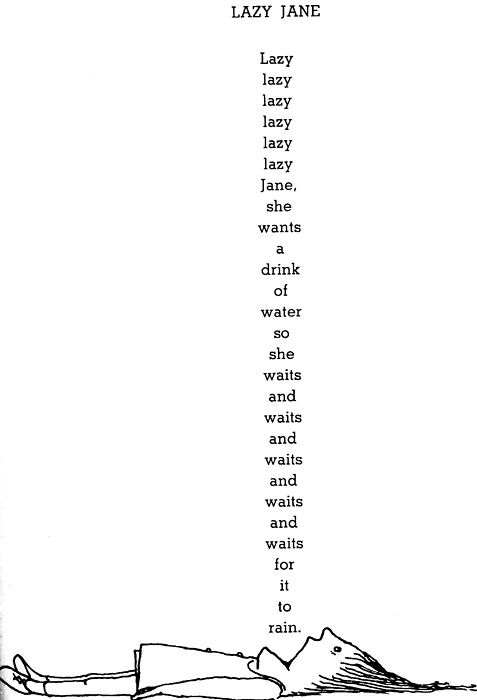
15. “Lazy Jane”
“Lazy Jane” is almost brutally economical. It is funny because it refuses to explain itself. A tiny domestic situation becomes a complete portrait of absurd passivity. The poem’s simplicity is its cruelty.
Silverstein did not always need elaborate setups. Sometimes a single joke, stripped down to its bones, was enough.
16. “The Little Boy and the Old Man”
This poem is among Silverstein’s most tender. It draws a quiet parallel between childhood and old age, suggesting that both stages of life share forms of vulnerability adults in the middle often ignore. The result is gentle, but not sentimental.
It is one of those Silverstein poems that seems designed for children and then ambushes adults years later.
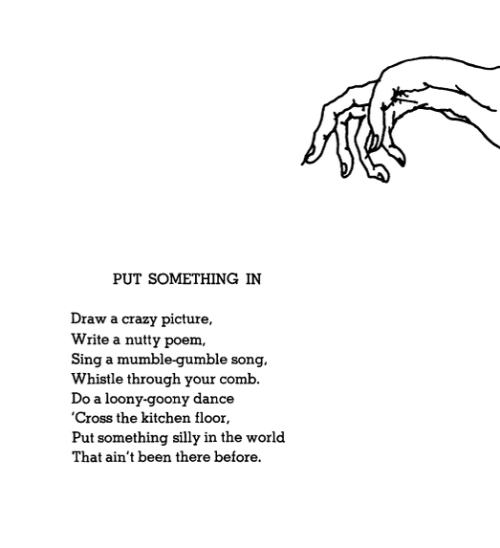
17. “Put Something In”
“Put Something In” is Silverstein’s ars poetica in miniature: make something, risk something, add something to the world. It is a poem about creation without pomp. No grand theory of art is required. Just the act of placing one’s strange contribution into existence.
For readers who grew up with Silverstein, this poem may be one of his most quietly formative. It suggests that creativity is not the privilege of geniuses, but the responsibility of anyone with an imagination and the nerve to use it.
18. “Every Thing On It”
“Every Thing On It” shows Silverstein’s delight in excess. The poem takes the idea of abundance and pushes it toward absurdity, reminding us that wanting everything is both funny and faintly tragic. Desire, in Silverstein, is rarely elegant. It is sticky, loud, hungry, childish — which is to say, honest.
That honesty is part of why his poems still feel alive.
19. “The Missing Piece”
Strictly speaking, The Missing Piece exists as a picture book rather than a conventional poem, but it belongs unmistakably to Silverstein’s poetic universe. Its spare language and philosophical simplicity make it one of his most enduring meditations on incompleteness.
The story’s power lies in its refusal to offer an easy moral. Is the missing piece something we need? Something we imagine we need? Something we outgrow? Silverstein wisely refuses to tidy the question.
20. “The Giving Tree”
Like The Missing Piece, The Giving Tree is not simply a poem in the usual sense, but no list of Silverstein’s most powerful works feels complete without it. Few children’s books have inspired such affection, discomfort, debate, and rereading.
Some see it as a story of unconditional love. Others see exploitation, self-erasure, or emotional imbalance. That tension is precisely why it endures. Silverstein’s best work rarely behaves like a clean moral lesson. It stays alive because it refuses to settle comfortably into one meaning.
Why These Poems Still Matter
Shel Silverstein’s poems remain popular because they respect the intelligence of children and the unresolved feelings of adults. They are not afraid of nonsense, but they are not trapped inside it. They understand that jokes can reveal fear, that rhyme can carry loneliness, and that a cartoonish drawing may sometimes tell the truth more efficiently than a polished illustration.
His work also reminds us that children’s literature is often at its strongest when it refuses to be merely “nice.” Silverstein gave young readers absurdity, rebellion, tenderness, grotesque comedy, and emotional ambiguity. He trusted them with contradiction.
That may be why his poems continue to circulate decades later — in classrooms, family bookshelves, social media posts, and the private memory of readers who first encountered them long before they had words for what they meant.
Silverstein did not write poems that simply explained childhood.
He wrote poems that remembered how strange childhood actually was.
Sheldon Allan “Shel” Silverstein (1930-1999), also naming himself Uncle Shelby in some works was an American poet and writer of children’s book, also known for his cartoons and song-writing, as well as screen-writing. The artist is most famous for works such as The Giving Tree, Where the Sidewalk Ends and The Missing Piece.
If you also like the artist Shel Silverstein and his poems and comics, you can consider expressing your love for him by customizing Metal Keychains. You can choose keychains of different sizes and patterns, and add your favorite words and elements on the keychains, such as inspiring mottos, beautiful poems, etc.
Custom Metal Keychains Bulk are not just decorations, but also loving tributes to the great artist Shel Silverstein, allowing his works to integrate into your life in another form. As soon as you see these keychains, you will think of the great artist Shel Silverstein, and the connection between you will deepen.