MASKS by Shel Silverstein
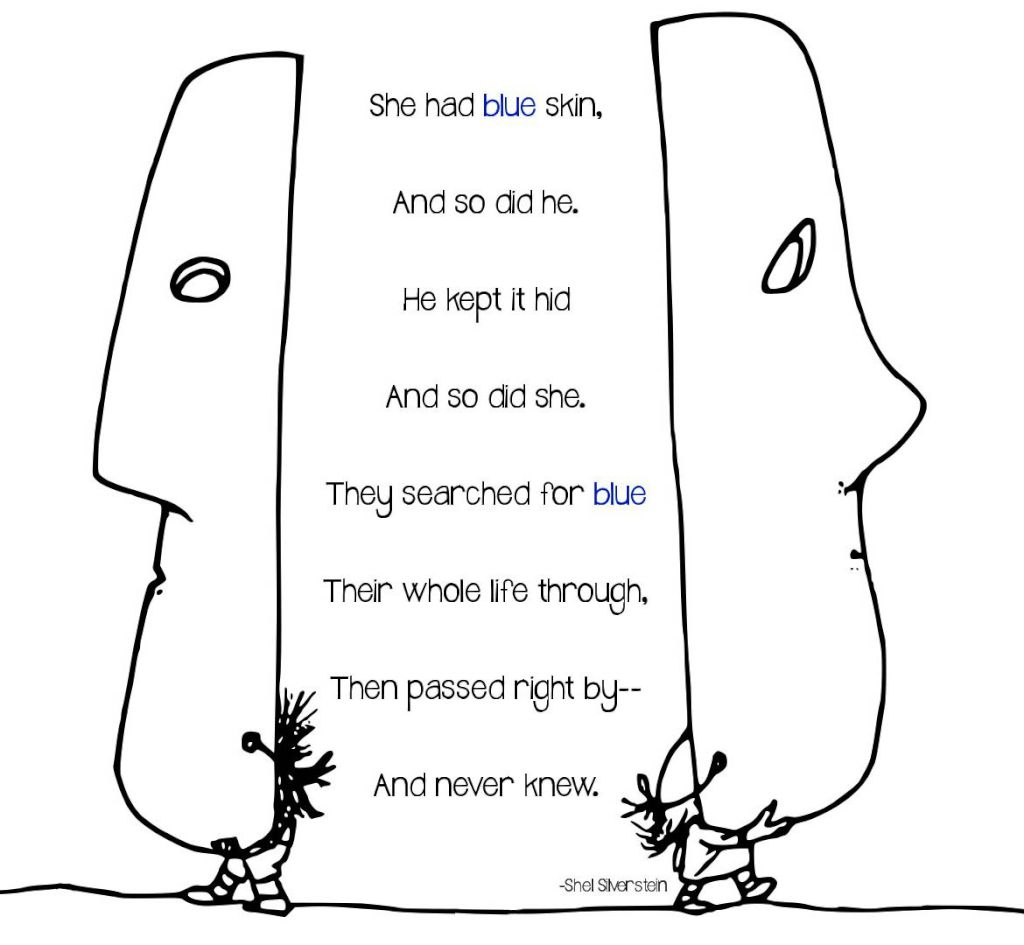
She had blue skin,
And so did he.
He kept it hid
And so did she.
They searched for blue
Their whole life through.
Then passed right by–
And never knew.
Shel Silverstein (September 25, 1932 – May 10, 1999)
Some poems do not need many words to become unbearable.
Shel Silverstein’s “Masks” is one of them.
It is brief enough to be read in a few seconds, simple enough for a child to understand, and sharp enough to follow an adult around for the rest of the day. Like much of Silverstein’s best work, it appears almost too small to be dangerous. A few lines, a childlike drawing, an idea so clear it seems harmless at first.
And then, quietly, it does what real poetry often does: it turns into a mirror.
Silverstein understood that people rarely hide because they have nothing to reveal. They hide because what is most intimate, strange, vulnerable, or beautiful in them feels too risky to expose. “Masks” captures that tragedy with almost comic economy. It does not lecture. It does not decorate itself with seriousness. It simply places two hidden selves near each other and lets the reader feel the cost of concealment.
That is why the poem continues to resonate. Not because it is sweet. Because it is accurate.
The Cruel Simplicity of Silverstein
Shel Silverstein’s genius often lies in the way he makes emotional complexity look like a nursery rhyme. His drawings appear casual, almost messy. His language feels conversational. His poems move quickly, sometimes like jokes, sometimes like playground songs, sometimes like tiny philosophical traps disguised as children’s literature.
That simplicity is deceptive.
A lesser writer would have expanded “Masks” into a moral lesson about honesty, self-expression, or being brave enough to show the world who you really are. Silverstein does the opposite. He refuses to explain too much, and because of that restraint, the poem becomes larger.
Its emotional force depends on what it leaves unsaid.
We do not know who the figures are. We do not know why they hide. We do not know what exactly they fear. Silverstein gives us only the essential structure: two people might have recognized each other, but they did not, because both were hidden behind what they believed they needed to wear.
It is devastating precisely because it is so ordinary.
A Children’s Poem for Adult Cowards
It would be easy to call “Masks” a poem about childhood insecurity. Children do, after all, understand masks very well. They know what it means to pretend, to perform, to hide embarrassment, to become louder or quieter depending on the room. Childhood is not the innocent paradise adults like to invent when they are tired of paying taxes. It is often a brutal apprenticeship in self-presentation.
But “Masks” is not only about children.
If anything, it becomes more uncomfortable with age.
Adults become extraordinarily skilled at disguise. We hide behind taste, politics, intelligence, sarcasm, beauty, competence, indifference, professional identity, and carefully arranged versions of ourselves that can survive public inspection. We learn which parts of ourselves are convenient, which are marketable, and which should be buried beneath manners.
Silverstein’s poem understands this before we have even admitted it.
It suggests that the tragedy is not merely that we hide from others. The greater tragedy is that others may be hiding the same thing, and we pass them by without ever knowing.
The Mask as Social Technology
The mask is one of the oldest symbols in art and culture. It belongs to theatre, ritual, carnival, religion, protest, performance, and survival. A mask can conceal identity, but it can also create one. It can protect, distort, exaggerate, liberate, or imprison.
Silverstein uses the mask in its most psychologically elegant form: not as spectacle, but as defense.
There is no elaborate costume here. No grand theatricality. The mask is not glamorous. It is not even particularly dramatic. It is simply the barrier between the self and the world.
That is what makes it powerful.
The poem recognizes that concealment is often not malicious. People hide because they are afraid of being seen incorrectly, or worse, being seen correctly and rejected anyway. The mask promises safety. It also guarantees distance.
A useful prison, then. Humanity has always been fond of those.
Why “Masks” Still Circulates Everywhere
The enduring popularity of “Masks” is not accidental. It has become one of Silverstein’s most shared poems because it translates beautifully across contexts. It can be read as a poem about friendship, love, identity, loneliness, shame, neurodivergence, queerness, childhood, adulthood, social anxiety, or the quiet exhaustion of performing normality.
That range is not a weakness. It is the reason the poem survives.
Silverstein does not narrow the interpretation. He opens it.
This is also why the poem fits so naturally within his broader body of work. As a writer, cartoonist, songwriter, and illustrator, Silverstein repeatedly returned to outsiders, dreamers, misfits, liars, lonely children, strange bodies, impossible desires, and people who did not quite fit inside the polite machinery of the world. A useful overview of his career and major books can be found through the Poetry Foundation’s profile of Shel Silverstein.
His work often begins in play, but it rarely remains there. Beneath the jokes and rhymes is a deep sympathy for people who are too strange, too tender, too frightened, or too imaginative to move comfortably through the world.
“Masks” may be one of his clearest expressions of that sympathy.
The Poem’s Secret Violence
The most painful thing about “Masks” is that nothing dramatic happens.
There is no betrayal. No argument. No death scene. No grand confession. The tragedy is almost invisible: two people simply fail to recognize one another.
That is the poem’s secret violence.
It understands that life is not shaped only by catastrophic events. It is also shaped by missed recognitions, by conversations that never happen, by people who might have loved each other but remained hidden at the wrong moment.
Silverstein compresses all of this into a structure so small it almost disappears.
And yet the emotional implication is enormous.
How many people have passed through our lives carrying something we might have understood? How many times have we hidden the very thing someone else was searching for? How many connections have failed not because of difference, but because of mutual concealment?

The poem does not answer. It does something worse.
It lets us answer for ourselves.
The Childlike Line That Cuts Deepest
Silverstein’s visual style matters here as much as his language.
His drawings rarely aim for polish. They look immediate, loose, almost impatient. That roughness allows the emotional content to arrive without ornament. The figures in his world often seem vulnerable because they are not overdesigned. They feel like ideas caught in the act of becoming people.
In “Masks,” this visual simplicity reinforces the poem’s central idea.
The image does not distract from the meaning. It makes the meaning feel even more exposed. The drawing seems innocent, which makes the emotional wound more surprising. Silverstein was very good at that: placing adult sadness inside a form adults had already decided was safe.
Naturally, adults were wrong.
Why We Keep Returning to Shel Silverstein
Silverstein remains powerful because he never fully separated childhood from adulthood. He understood that the child’s world and the adult’s world are not opposites. They are continuations of each other, filled with many of the same fears, hungers, vanities, and secret hopes.
That is why his poems age so well.
A child reads them and sees a strange little story.
An adult reads them and sees evidence.
In our broader selection of favorite Silverstein works, we explored how poems like “Where the Sidewalk Ends,” “Whatif,” “Sick,” and “The Voice” reveal his unusual ability to move between comedy, tenderness, rebellion, and psychological truth. You can read that companion piece here: 20 of Our Favorite Shel Silverstein Poems.
“Masks” belongs firmly among those essential works because it shows Silverstein at his most economical. Nothing is wasted. Nothing is explained more than necessary. The poem trusts the reader to feel the damage.
The Smallest Poems Often Know the Most
There is a reason “Masks” refuses to leave people alone.
It identifies one of the central dramas of human life: the desire to be seen and the terror of being seen.
Most of us want recognition, but only under conditions we can control. We want intimacy without risk, honesty without exposure, love without the possibility of rejection. So we build selves that can survive the room. We become presentable. Acceptable. Legible.
And then, occasionally, we wonder why we still feel unseen.
Silverstein’s poem does not offer comfort. It offers clarity.
The mask protects us.
The mask costs us.
And sometimes the thing we hide is the very thing that would have allowed someone else to find us.