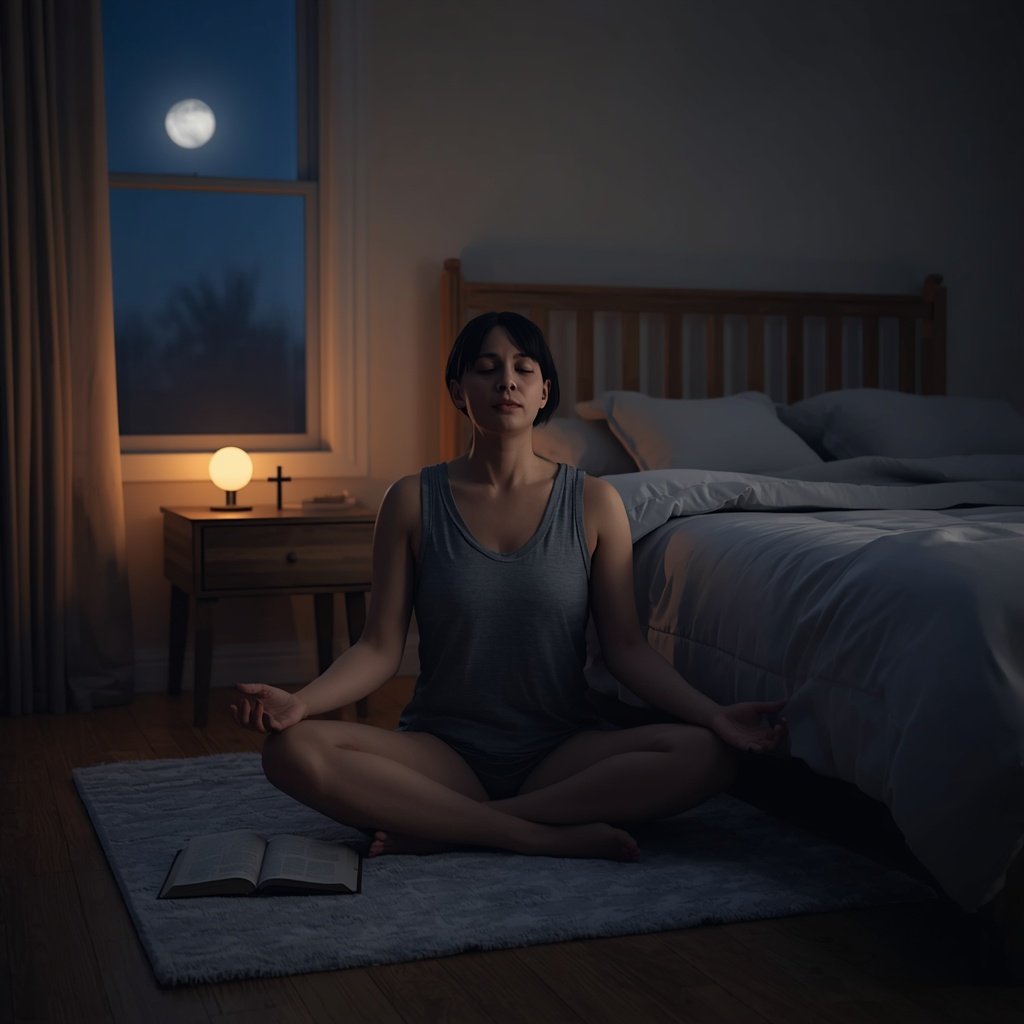
You know the feeling. Body’s exhausted, but your brain picks 11 p.m. to relitigate everything — that email you never sent, the thing you snapped at your kid about over nothing, tomorrow’s to-do list running on a loop like it’s going to solve itself if you just stare at the ceiling long enough. It won’t. And you probably already know that, which somehow makes it worse.
Scripture’s been dealing with this exact problem a lot longer than sleep apps have. Christian meditation for sleep isn’t some wellness trend wearing a cross. It’s Psalm 4:8, plain and old: “In peace I will lie down and sleep, for you alone, LORD, make me dwell in safety.” David wasn’t calm when he wrote that. He was hunted, exhausted, probably scared out of his mind — and he trusted God with the night anyway. That’s really the whole thing, right there.
What Christian Meditation Really Means
Okay, quick detour, because the word “meditation” makes some folks in church circles twitch a little. Fair enough. But Christian meditation isn’t about emptying your head or floating off into some blank nothing-space. It’s basically the opposite move. You’re not clearing your mind. You’re loading it — slowly, on purpose — with something true.
Psalm 1:2 talks about the person who “delights in the law of the LORD” and “meditates on his law day and night.” The Hebrew word there, hagah, actually means something closer to muttering, or chewing. Like turning a piece of food over in your mouth before you swallow it. Not exactly peaceful and blank, is it? It’s more like wrestling with something slowly until it actually sinks in.
So meditating before bed isn’t checking out. It’s leaning in — letting one verse be the last thing your mind is holding onto right before it lets go for the night.
How Scripture Meditation Calms the Mind Before Sleep
Nighttime anxiety has a texture to it. You know the one. It’s rarely about something you can actually fix in that moment — it’s just the same three worries running laps in the dark. Philippians 4:6-7 speaks straight into that: “Do not be anxious about anything, but in every situation, by prayer and petition, with thanksgiving, present your requests to God. And the peace of God, which transcends all understanding, will guard your hearts and your minds in Christ Jesus.”
Notice the order. Prayer first. Naming the actual worry — out loud, if you can stand it, not just stuffing it back down. Peace comes after. Not because the problem vanishes. It usually doesn’t. But because you’ve handed it to someone bigger than you, and you’re not carrying it alone anymore.
There’s a physical piece to this too, honestly. Slowing your breath. Letting your thoughts settle around one true sentence instead of ten scattered ones. That calms your body the same way any breathing exercise would. Except here you’re not just calming down for its own sake — you’re remembering who’s actually on watch while you sleep.
A short, repeatable habit beats a perfect one every time. Read a psalm slowly. Close your eyes. Sit with one line — “The LORD is my shepherd, I lack nothing” (Psalm 23:1) — and just let it be there. That alone can change the whole shape of your last fifteen minutes awake.
Creating a Peaceful Christian Bedtime Meditation Routine
Consistency beats complexity. Nobody has forty-five quiet, uninterrupted minutes most nights. Certainly not me. A few things that’ve actually helped, more from trial and error than any expert playbook:
Dim the lights before you even start. Feels like nothing. But your body reads low light as a cue to slow down, and it makes the jump from scrolling your phone to actually being still a lot less abrupt.
Pick one verse. Not a chapter, not five verses — one. Trying to meditate on too much right before bed just adds more noise to a mind that’s already noisy. One verse, read slow, maybe twice through, does more than skimming a whole psalm half-asleep with your eyes barely open.
Match it to your breathing if that helps you. In on the first half of the verse, out on the second. Small thing. Keeps your mind from wandering off the way it does the second you go quiet.
And some nights — plenty of nights, if we’re being honest — reading anything at all feels like too much to ask of yourself. That’s where something like a Christian meditation app earns its keep. Just having a voice read Scripture over you, instead of you finding the energy to do it yourself, can be exactly what a worn-down mind needs. No shame in that. Rest doesn’t have to be earned the hard way every single night.

Bible Verses and Prayer Practices for Restful Sleep
A few worth keeping close. Write one on a sticky note. Save it in your phone. Wherever you’ll actually see it at 11 p.m. when your brain’s misbehaving.
“I lie down and sleep; I wake again, because the LORD sustains me.” (Psalm 3:5)
“You will keep in perfect peace those whose minds are steadfast, because they trust in you.” (Isaiah 26:3)
“Come to me, all you who are weary and burdened, and I will give you rest.” (Matthew 11:28)
Try this with any of them: name the actual worry, specifically, out loud if you can. Hand it over. Then read the verse slow, like it’s being said directly to you. Because — it kind of is.
There’s a rest that has nothing to do with your mattress or your pillow or any of it. It’s the rest of a mind that’s finally stopped arguing with the dark. That’s remembered, somewhere in there, that someone else is still awake tonight, keeping watch, long after you’ve closed your eyes.