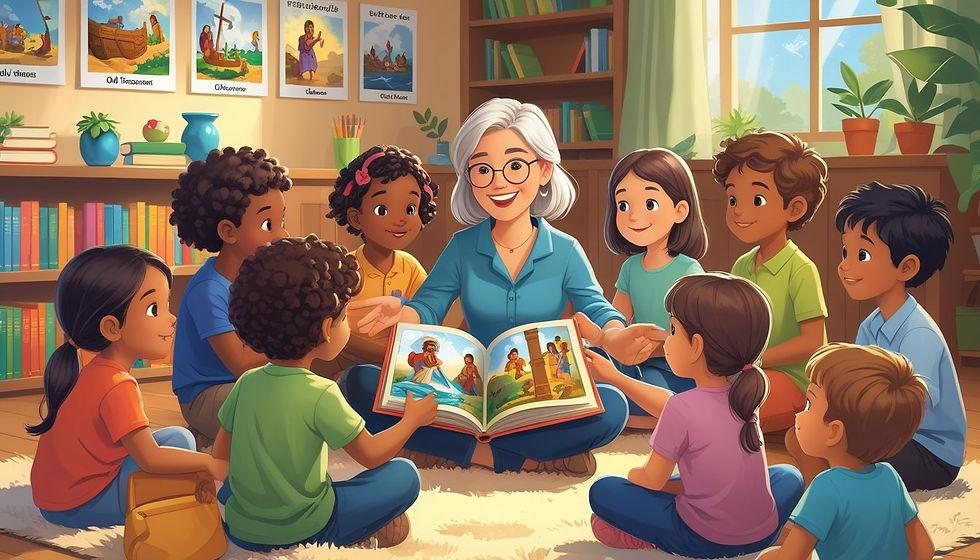
My daughter asked me last week why God doesn’t just “show himself” so everyone would believe. We were in the car, she was eating crackers, and I nearly missed the exit trying to figure out how to answer a four-year-old’s theology question with cracker crumbs flying everywhere. I didn’t have a great answer. But that night I pulled out one of her Christian children’s books about Thomas doubting the resurrection, and somehow the story did what I couldn’t do in the car.
That’s the thing about faith and little kids. You can’t hand them a doctrine. You have to hand them a story.
Why Early Faith Foundations Matter for Children
Kids this age aren’t building a theology. They’re building a sense of who God is — and whether he’s someone safe to know. That sense gets formed early, and it gets formed through repetition, not through one big talk you have when they’re older and “ready.”
Here’s what surprised me: my son didn’t ask a single question about God until he was almost five. Then it was like a dam broke. Where does God live? Can he see me in the bathtub? Does he like dogs? None of these are small questions to a five-year-old. They’re the beginning of a whole framework he’s going to build his life on, one brick at a time, and most of the bricks get laid down long before he can read a Bible on his own.
That’s not pressure. It’s actually kind of freeing. You don’t need to explain the Trinity to a toddler. You just need to keep showing up with the same message, in different forms, until it sticks: God made you, God loves you, God is good even when things are hard.
How Christian Books Help Kids Understand God and the Bible
Little kids think in pictures and stories, not concepts. Tell a three-year-old that God is “omnipresent” and you’ll get a blank stare. Tell her a story about David hiding from a giant king, scared but not alone, and she gets it — not the vocabulary word, but the actual truth underneath it.
Good books do the translation work for you. They take something enormous — a God who’s always existed, who somehow knows every person on earth — and hand it to a kid in a form small enough to hold. A picture of Noah counting animals two by two. A drawing of Jesus picking up a kid nobody else wanted to touch. Those images stay. My daughter still remembers a book about Jonah from two years ago, mostly because of the illustration of the whale’s giant eye. She doesn’t remember the theology. She remembers the eye. And somehow, through the eye, she remembers that God chases people down even when they run the wrong way.
This is also where a book earns or loses trust fast. A story that oversimplifies scripture to the point of getting it wrong doesn’t build faith — it just builds confusion you’ll have to untangle later. The good ones respect the source material even while they simplify it.
Choosing Christian Children’s Books That Grow With Your Child
Not every book works at every age, and honestly, figuring that out took some trial and error in our house. A board book about creation is perfect for a two-year-old and painfully boring for a seven-year-old who wants to know why God let the flood happen in the first place.

A few things I’ve learned to look for: Does the book leave room for questions, or does it wrap everything up too neatly? Kids notice when a story pretends hard things aren’t hard. Does it treat the Bible characters like real people — flawed, scared, brave in small moments — rather than flattening them into cartoons with halos? And does it grow with your kid, or will you be replacing the whole shelf every eighteen months?
We’ve also leaned on screen time here more than I expected to, mostly out of exhaustion. Some nights reading a whole book feels like climbing a mountain, and that’s when the AbbaKid app has actually been useful in our house — short animated Bible stories our kids can watch on their own, organized by themes like kindness and bedtime, without ads interrupting every few minutes. It’s not a replacement for books. It’s more like a backup singer. Some nights we need one.
Making Faith-Based Reading Part of Everyday Family Life
We don’t have a perfect system. I wish I could tell you we read scripture every night at 7:15 like clockwork, candle lit, everyone cross-legged and attentive. Most weeks we forget two or three nights entirely. Sometimes “reading time” is just me reading the same three pages of a story my son has memorized, while he corrects me if I skip a word.
What’s worked better than any plan is just keeping the books around — on the coffee table, in the car, stacked by the bathtub. Faith formation isn’t really about the big planned moments. It’s about the fact that the book is there when the question shows up, whenever that happens to be. In a car. At a bathtub. At 9 p.m. when nobody planned on talking about heaven.
Some nights the story lands. Some nights he falls asleep halfway through and you close the book on a cliffhanger about Daniel and the lions, and that’s fine too. He’ll ask about it in the morning. He always does.