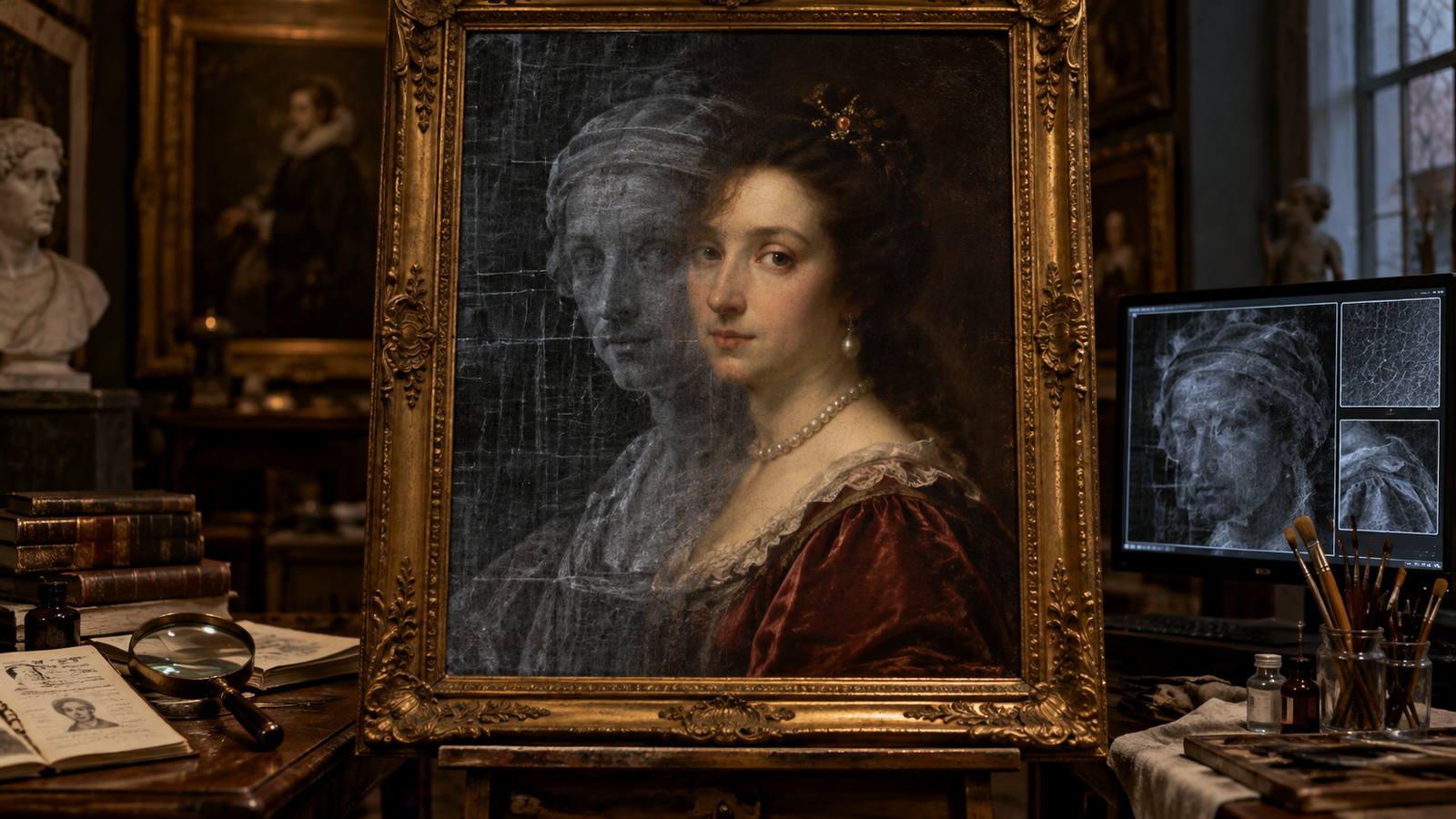
Put a painting under an X-ray and it stops keeping secrets. Lead white, the pigment every portraitist used for flesh and lace and linen, blocks the beam the way bone does, so a radiograph of a canvas is a map of everywhere a face was ever painted. Very often it shows two.
Conservators have been finding second heads for as long as they have had the equipment to look. The pattern is consistent enough that it has stopped being surprising and started being a category: the portrait in which the body was finished, approved and paid for, and the head was then changed.
Bodies Were Stock. Heads Were the Commission.
The reason the second head is so common is that the portrait trade did not work the way its finished products imply. A sitter did not sit for the whole picture. They sat for the face, for a few hours, and the rest was produced afterwards from studio stock: a pose the workshop had used before, drapery painted from a lay figure, hands borrowed from a pattern book or from an assistant who could hold still.
Some studios went further and kept bodies ready-made. Eighteenth-century British practice included painters who supplied finished figures in fashionable dress with the face left blank, so that a client could be fitted with a portrait in the time it took to paint a head. The body was inventory. The head was the only part that was ever really about the sitter.
Which is why, when a commission went wrong, the fix was almost never to start over. The body still worked. You changed the head.
Why a Head Got Changed
The reasons cluster into a few types, and each has left examples that conservators can point to.
The sitter died, or fell out of favour, or could not pay, and a canvas already representing a considerable investment in drapery and background was reassigned to someone who could. In the great Dutch group portraits of guilds and militia companies, where each man paid for his own inclusion, a member who dropped out could be overpainted with one who bought in, and the arrangement of the group would be quietly revised to keep the composition balanced.
The likeness was rejected. A face is the one part of a portrait the client is qualified to judge, and a painter who got the drapery magnificent and the face wrong would repaint the face rather than argue.
The record needed adjusting. Jacques-Louis David’s enormous canvas of Napoleon’s coronation includes the emperor’s mother seated in the gallery, presiding over the occasion. She was not there. She had refused to attend. She appears in the painting because the painting was the version of events that was going to survive.
The Same Operation, Faster
It is worth being clear about what the workshop was doing in each of these cases, because it is precisely what a certain class of software does now. The pose, the costume, the setting, the light on the fabric: all of that stayed. Only the region that carried identity was replaced, and the join was blended so that the finished surface gave nothing away to a viewer without a radiograph.
The modern descendant works on moving footage rather than on a single canvas. What is now sold as head swap ai keeps the body, the clothing, the gesture and the motion exactly as filmed and exchanges only the head, hair included, matching it through every frame of the clip. iMideo’s version is one instance of the idea, and the studio that supplied ready-dressed bodies with the face left blank would have recognised it at once; the idea itself is older than the medium. A workshop that could swap a head in three weeks has become a process that takes a few minutes, and the thing being done has not changed.
What has changed is who can see it. The workshop’s second head stayed hidden for centuries until a beam of radiation went looking. A generated video carries no such underlayer, which is a real difference, and it is the difference that makes disclosure a rule rather than a courtesy.

What the Radiograph Teaches About Honesty
Nobody accuses Gainsborough or the Dutch masters of fraud for reusing bodies, because the convention was understood by everyone who commissioned a portrait. The body was never a claim about the sitter. The head was the claim, and the head was painted from life.
The trouble arose only where the painting was presented as a record of something that did not happen. Napoleon’s mother in the gallery is the interesting case precisely because it is a lie told in the medium that was supposed to remember. That was the line then, and it is a serviceable line now. Exchanging who is in a picture, with the consent of everyone involved and without pretending otherwise, is something painting has done since it had patrons. Exchanging what happened is the older and more serious offence, and a faster brush does not make it a smaller one.
Every Portrait Is Provisional
The lasting lesson of the second head is not that the old masters cheated. It is that a portrait was always a composite, assembled from parts of different origin and finished to look whole, and that the appearance of unity was the painter’s craft rather than a property of the sitting.
The radiograph makes this visible, and once it is visible, the current tools look less like a rupture and more like the workshop’s oldest trick with the waiting time removed. The head has always been the part that could be painted twice. Now it takes an afternoon, and it would be foolish to pretend the four centuries before were doing something purer.