Cappadocia looks as though architecture arrived before architects did. Valleys break into cones, cliffs and stone towers that seem almost deliberately composed, though their shapes began with volcanic activity, erosion and time. Then people began working with what the landscape had already made, cutting directly into the rock instead of building over it.
Homes, churches, monasteries, storage rooms and underground settlements emerged inside the stone. In Cappadocia, geology became something people could enter, alter and inhabit. The line between landscape and architecture has been blurred ever since.
Architecture by Subtraction
Most architecture grows through accumulation. Stone is stacked, timber is joined, walls rise. Cappadocia often developed in the opposite direction.
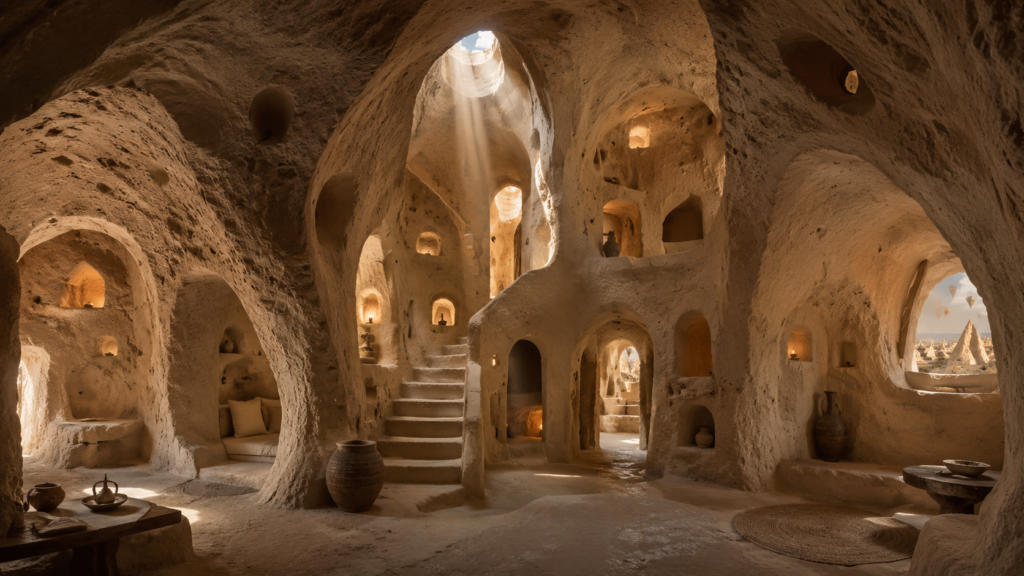
The region’s relatively soft volcanic tuff could be excavated to create rooms, passages and places of worship within existing formations. In and around Göreme, this produced dense clusters of carved spaces whose outer forms remained closely tied to the valleys and pinnacles around them.
The region’s rock-cut sanctuaries and settlements reveal how deeply human habitation became embedded in the terrain. Architecture here was created by taking material away, leaving rooms inside cliffs and cones that had already been shaped by erosion.
There is something almost sculptural about the process. Instead of deciding where a building should stand, people discovered how much space could be released from the rock.
The Interior Was a Canvas Too
The surprise continues inside Cappadocia’s churches. Rough stone gives way to painted saints, biblical scenes, geometric motifs and carefully organized compositions. Some of the most important surviving interiors around Göreme preserve evidence of Byzantine art from the centuries after Iconoclasm.
Their effect depends heavily on place. This is where seeing art in person changes the experience. An image reproduced on a screen loses the curved ceiling above it, the uneven wall beneath it and the dimness of the chamber around it.
In these churches, painting and architecture work together. Figures bend with arches and vaults. Color interrupts the muted surface of volcanic stone. Even imperfect light becomes part of how the room is read.
The art belongs to the space that holds it.
Cities Hidden Beneath the Landscape
Above ground, Cappadocia feels expansive. Below it, the scale changes completely.
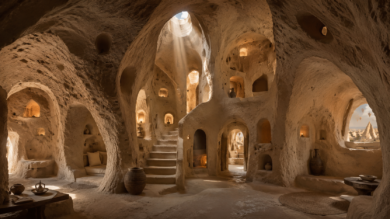
Underground settlements such as Derinkuyu and Kaymaklı contain networks of carved rooms and connecting passages that extend beneath the surface. Their enclosed spaces offered communities shelter and places for everyday activity, turning the same geology visible in the valleys into an interior world.
That contrast is one of Cappadocia’s strangest qualities. A landscape known today for open skies and dramatic silhouettes also contains architecture defined by compression, darkness and depth.
Much of the architecture was created from material already in place. The act of making space meant removing enough of the rock to make life possible inside.
Reading Cappadocia as a Cultural Landscape
No single church, valley or underground city explains Cappadocia on its own. Its character comes from the relationship between them.
Rock-cut religious spaces reveal one use of the landscape. Underground settlements reveal another. Villages, pottery traditions and workshops add further layers to a region where local materials have long shaped both practical life and visual culture.
The geography matters because these elements are spread across the region rather than gathered into one monumental site. Travelers who want to see those layers in relation to one another can book Cappadocia private tours that connect rock-cut churches, underground settlements, villages and craft traditions within a broader cultural itinerary.

Seen together, these places tell a more interesting story than any single postcard view. Cappadocia becomes a record of repeated human responses to an unusual landscape.
Where Nature Ends and Design Begins
The most compelling spaces in Cappadocia resist a clean distinction between natural form and human design. A cliff becomes a façade. A hollow becomes a chapel. A stone formation can contain rooms and passages without losing the shape that erosion gave it.
That ambiguity is part of the region’s visual power. Human intervention changed the landscape from within rather than covering it with an entirely separate architectural language.
Some spaces appear discovered and designed at the same time.
An Architecture That Could Only Exist Here
Cappadocia turns a familiar architectural idea inside out. Instead of placing buildings onto the land, generations of people created space within it.
That relationship gives the region its extraordinary coherence. The architecture cannot be separated from the volcanic rock that contains it, just as the paintings inside its churches cannot be separated from their carved surroundings.
Here, geology became shelter, sacred space and canvas. The landscape supplied the form, and human hands found the rooms inside it.