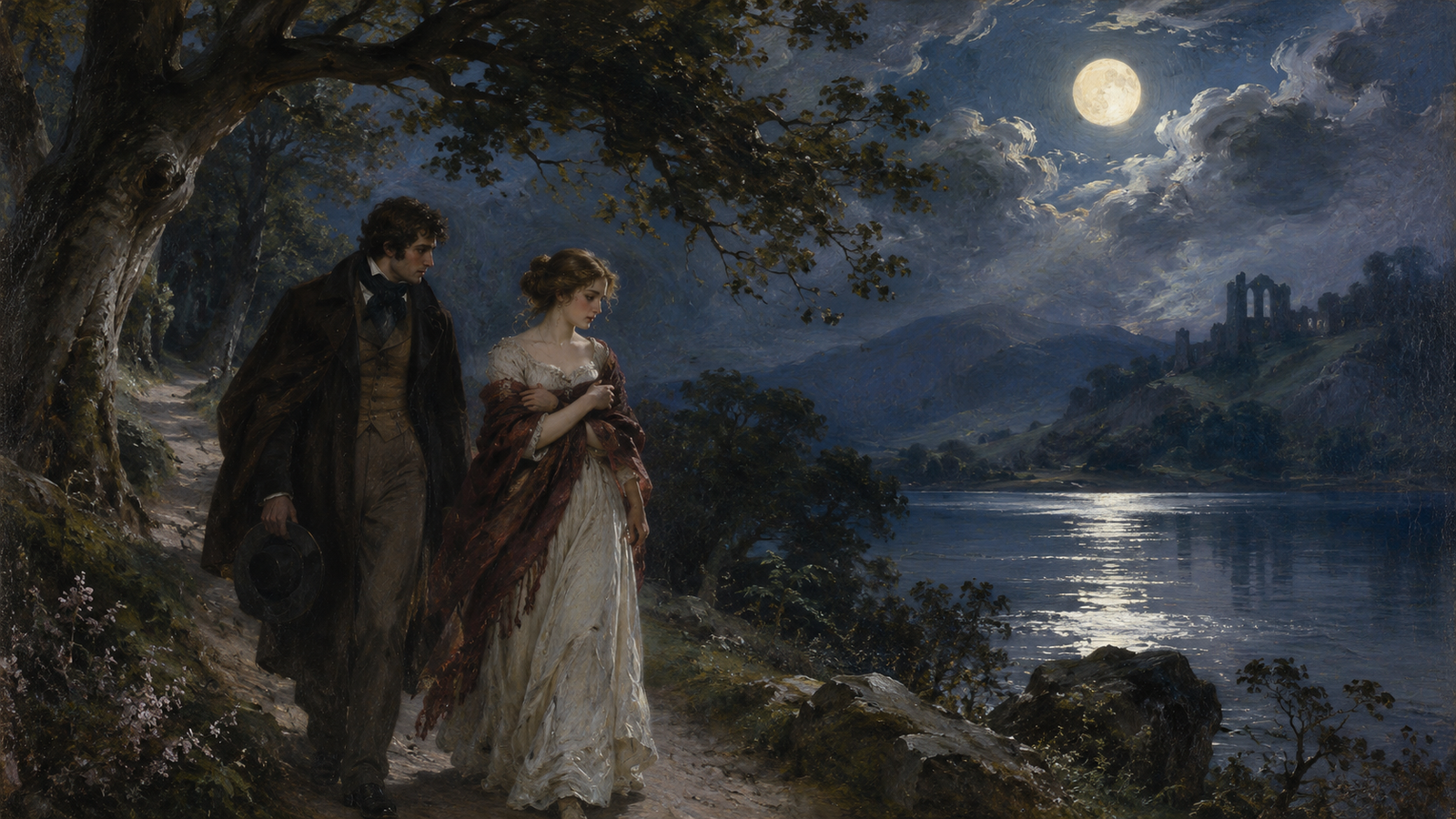
Behind its deceptively simple ballad rhythm, classic Romantic poetry uses nocturnal landscapes and subtle shifts in perspective to build quiet suspense.
You know that sudden chill when an ordinary evening walk takes an unexpected mental turn. At the turn of the 19th century, Romantic poets reshaped traditional folk ballad forms into intimate psychological narratives, using quiet night journeys and soft moonlight to mirror sudden emotional dread.
Instead of relying on dramatic battles or haunted castles, these writers showed how your own imagination can turn a peaceful path into a source of quiet panic. You step into a calm scene, and before you realize it, a fleeting shadow shifts your entire mood.
https://www.pexels.com/photo/open-book-with-pictures-and-poem-next-to-red-roses-20544571/
How did Lyrical Ballads reshape English poetry?
Before 1798, much of English poetry relied on stiff, ornate language that kept readers at a polite distance. William Wordsworth and Samuel Coleridge upended that tradition when they published Lyrical Ballads, pairing plain, everyday speech with deep interior emotion. You do not need a classical education to feel the heartbeat of their stanzas because the words sound like real human thought.
Research shared by the British Association for Romantic Studies notes that Wordsworth spent his life writing verse out of genuine care for humanity and a belief in nature’s healing power. By rooting poems in common life, he invited you to see your own private fears reflected in simple rural scenes.
Who was the mysterious muse behind the Lucy poems?
Among Wordsworth’s most haunting works is a 5-poem sequence centered on a young woman named Lucy. Readers and scholars have debated her identity for more than 200 years, wondering whether she represented a childhood friend, Wordsworth’s sister Dorothy, or a purely fictional figure.
A travel feature in The Guardian highlights how walking through England’s Lake District lets you follow Wordsworth’s daily footsteps and see the rural scenery that inspired his writing. Whether Lucy lived in those hills or existed only in his mind, keeping her unnamed allows you to project your own feelings of love and fragile attachment onto the page.
Why does steady ballad meter build quiet suspense?
When you read a short Romantic ballad aloud, you can feel how steady meter lulls your mind into a calm trance. You notice this hypnotic pull right away while exploring Wordsworth’s Strange Fits of Passion, where a lover rides toward his beloved’s cottage beneath an evening moon. Each hoofbeat matches the predictable beat of the stanza, making the quiet journey feel safe and familiar before anything goes wrong.
Traditional ballads alternate lines of 4 beats and 3 beats, creating a song-like forward motion. Because the rhythm feels so gentle and steady, you naturally lower your guard right along with the speaker.
How the descending moon mirrors sudden emotional dread
As the rider approaches Lucy’s cottage, his eyes stay locked on the bright moon sinking toward the roof. Nothing threatens him on the road, while the poem turns an ordinary celestial event into an emotional shock.
Tracking the visual shift
You watch the scene through the rider’s narrowed gaze as the moon drops closer to the cottage eaves. Focusing on 1 single detail pulls you deeper into his private headspace and shuts out the rest of the dark countryside.
Facing the sudden drop
When the moon abruptly vanishes behind the roof, the sudden darkness triggers a wave of irrational fear that Lucy might be dead. The poem shows how your mind can link an innocent sight in nature to your deepest personal terror in a split second.
https://www.pexels.com/photo/a-folded-heart-shaped-book-page-14789508/

Spot psychological storytelling in classic Romantic verse
You can uncover the quiet suspense inside short Romantic poems by paying close attention to how the poet controls time and focus. Try these 3 habits the next time you read a classic ballad:
- Listen for pace changes: Notice when steady, song-like rhythms abruptly pause or stumble during a quiet scene.
- Watch the natural setting: Track how shifts in light, shadow, or weather mirror what the speaker feels inside.
- Question the closing twist: Ask whether the real shock happens in the outer plot or inside the narrator’s head.
What makes short Romantic ballads feel modern today?
Modern thrillers and psychological dramas still use the same techniques Wordsworth perfected over 2 centuries ago. A quiet setting, a repetitive routine, and a sudden sensory shift can unsettle you far more than loud spectacle ever could. Short Romantic ballads prove that suspense does not require complicated plots when a writer captures how quickly human confidence can waver.
The lasting appeal of Romantic ballads lies in how effortlessly they capture universal human vulnerability within a few memorable stanzas. When you slow down and notice how rhythm, nocturnal scenery, and perspective work together, a simple moonlit walk becomes an unforgettable portrait of the human mind.