Your notebook brims with sharp images—a rusted balcony, rain pooling on a forgotten coat, a stolen line of dialogue. Most “write-it-for-me” apps sand those edges smooth, serving beige plot instead.
We’re here to spotlight the best AI writing tool for short stories—systems that let you pivot mid-sentence, preserve ambiguity, and still drive the pace. The seven picks below keep your hands firmly on the wheel.
How We Picked
We skipped the speed contest and reviewed pricing pages, changelogs, privacy policies, and community threads instead. Each tool earned a score based on controls short-story writers use.
Weighting
- Steering granularity – 25 percent
- Continuity & context memory – 20 percent
- Voice and prose craft – 15 percent
- Character & world tools – 10 percent
- Short-story workflow fit – 10 percent
- Pricing clarity – 10 percent
- Onboarding speed – 5 percent
Below is the quick-scan matrix of the seven finalists.
| Tool | Best for | Control style | Cost structure | Main limitation |
| DreamGen | Inline plot steering | Scene-by-scene edits | Tiered credits | No mobile app |
| Novelcrafter | Codex-level control | Custom prompts + BYOK | Software fee + model cost | Steeper setup |
| Sudowrite | Sensory prose | Guided write & rewrite | Bundled credits | Credit burn at scale |
| NovelAI | Branching continuations | Short retries + Lorebook | Flat subscription | Less guided outlining |
| Laterpress | Structure-first drafting | Beats → scenes workflow | Built-in model use | Limited third-party reviews |
| Claude | Whole-draft critique | Conversational projects | 20 dollars monthly (US) | No manuscript hierarchy |
| Squibler | Fast outline-to-draft | AI Smart Writer | Tiered credits | Higher price for hobbyists |
1. DreamGen: Best for Inline Plot Steering and Multi-Character Worlds
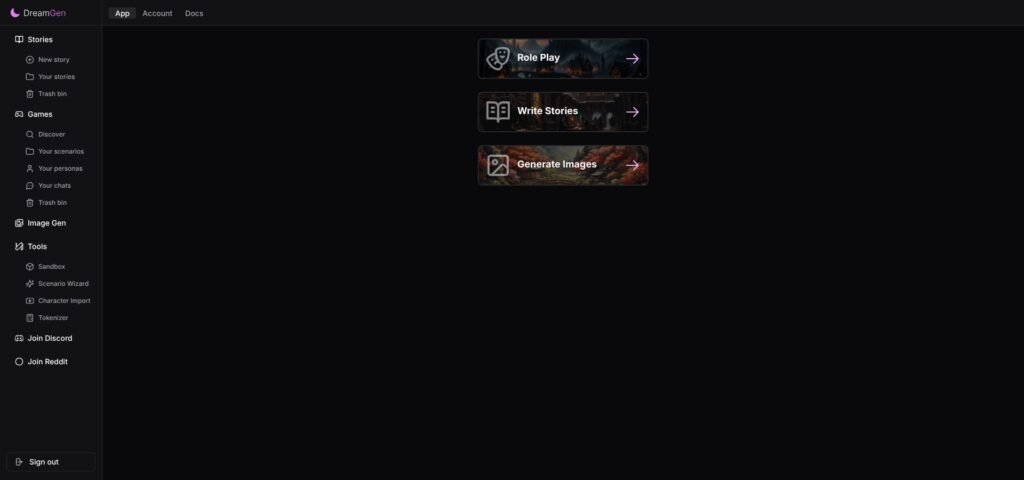
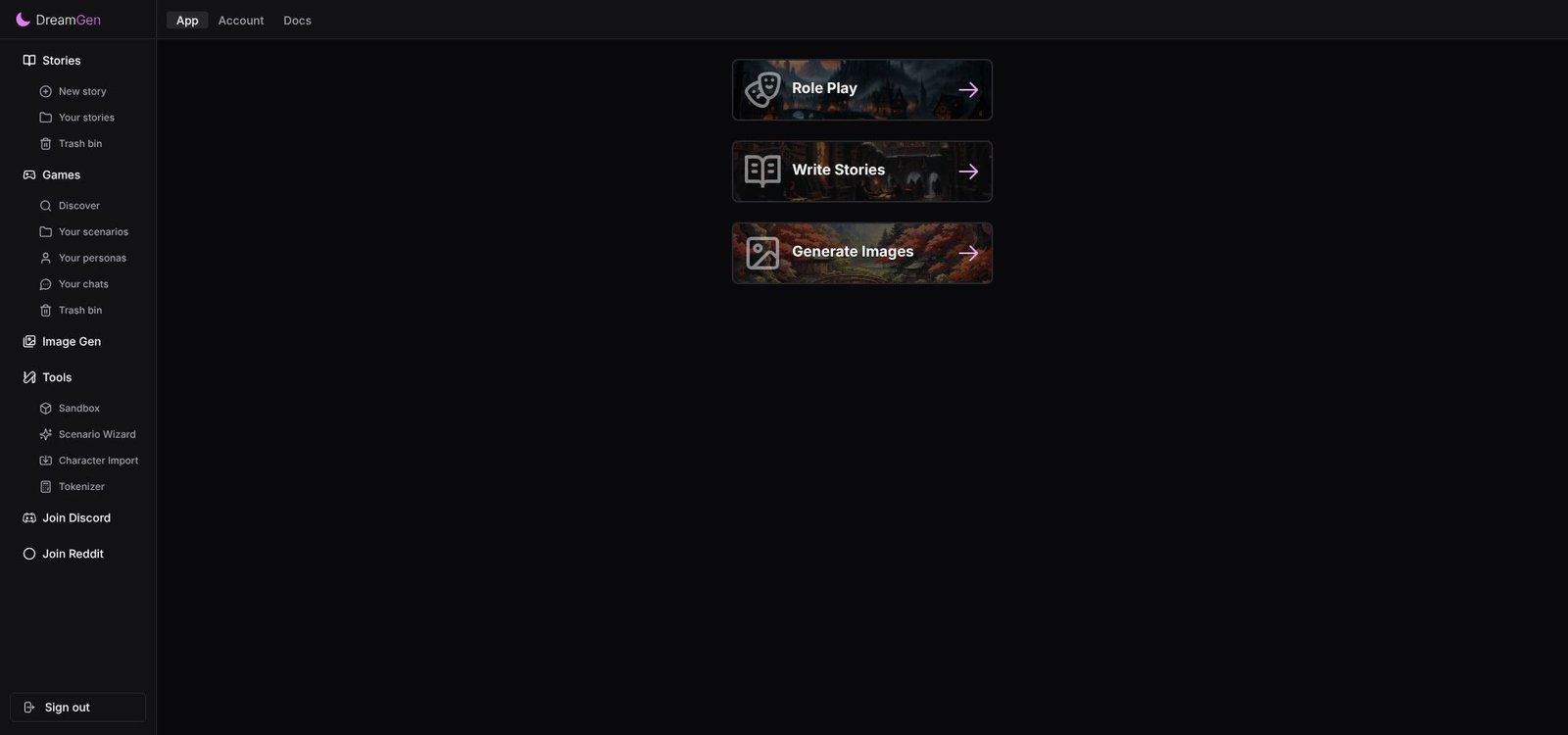
DreamGen dashboard with Write Stories, Role Play and the Scenario Wizard tool
Why It Works for Short Stories
Open DreamGen’s AI Story Generator. The interface feels like a workshop partner. Type your first image, tag it as a scene, and continue writing while the AI waits for clear cues. Need a twist? Slip an inline note in brackets [[reveal the balcony floods]], click Generate, and watch a single beat shift while every line you already love stays put.
Behind the curtain, the Scenario Codex feeds GLM 4.7 (or any third-party model you choose) with character bios, style notes, and setting fragments. A storm-soaked railing therefore stays slick across pages. Role-Play Mode lets you chat with multiple characters to tighten dialogue before you lock it down.
With context windows from 5,000 – 30,000 tokens, DreamGen can remember a full draft plus revision notes. Many tools regenerate whole scenes when an ending sours; here, you redirect one beat and keep moving.
2. Novelcrafter: Best for Codex-Level Story Control
Novelcrafter homepage
Why It Works for Short Stories
Think of Novelcrafter’s Codex as a private backstage where every prop, scent, and line break waits on cue. Drop a character, recurring image, or stanza-style note inside, and the software injects that detail whenever the name appears, so you never need to remind the model that the coat still drips in scene 4.
Control goes further: write scene-specific prompts, choose the model (OpenAI, Anthropic, or a local LLM), and set the exact context window, up to 32,000 tokens on most providers. The Hobbyist plan costs $8 per month. Generation fees then follow your chosen provider’s rates.
For poets who guard crooked, ambiguous imagery, this fine-grained pipeline keeps the metaphor yours from first draft to final polish.
3. Sudowrite: Best for Sensory Prose and Scene Expansion
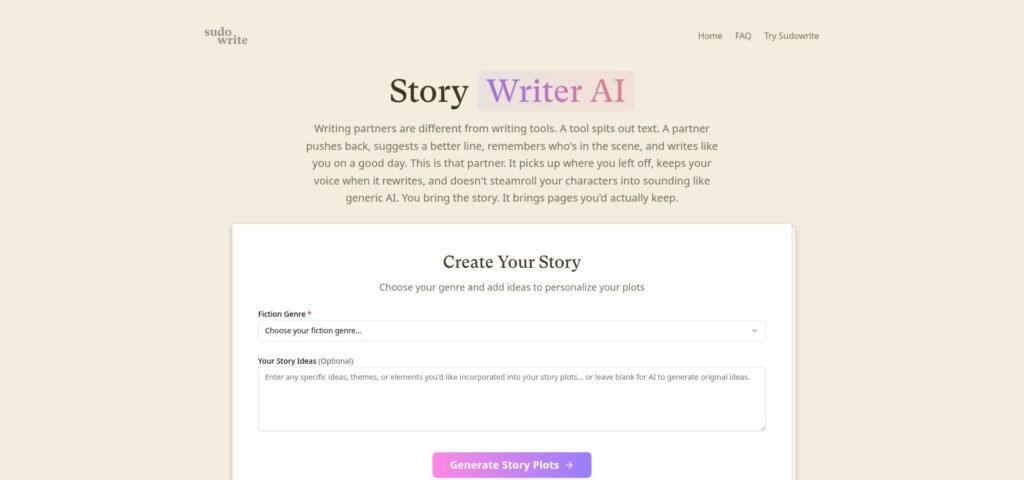
Sudowrite Story Writer AI page
Why It Works for Short Stories
Sudowrite works like an in-house stylist, revising until each sentence sings. Drop a flat paragraph into Describe and you see five vivid rewrites from its fiction-trained Muse model, keep the phrases you love, discard the rest, and stay in control.
Write and Draft modes read up to 20,000 words of your manuscript, so continuity lands before a single new token appears. Need texture? Rewrite lets you target beats, dialogue tags, even sentence length, sharpening prose without inflating word count.
Privacy matters. The company states it neither trains on nor claims rights to user drafts, a relief when you are workshopping risky pieces. Plans start at $10 a month. Every tier provides the full toolkit, and you pay extra only if you run through the bundled credits, making it ideal for poets who want to polish cadence and image without committing to bulk words.
4. NovelAI: Best for Branching Continuations and Private Drafting
Why It Works for Short Stories
NovelAI shines at the fork in the road. Write a 100-word opener, press Generate, and you get a crisp next paragraph. If it falls flat, hit Retry to review three side-by-side branches; keep the spark, trim the rest, and continue.
Continuity rests on three layers: Memory for world facts, Author’s Note for scene tone, and the Lorebook for deep back story. Combined with the Xialong model’s 28,672-token context window, characters stay consistent right through “The End.”
Privacy stands out. Stories are end-to-end encrypted in your browser, and NovelAI states it does not store generation prompts. Subscriptions start at 10 dollars (Tablet), rise to 15 dollars (Scroll), and 25 dollars (Opus) per month. Tokens roll over if you skip a week. You supply the outline; NovelAI supplies unlimited, private what-if moments.
5. Laterpress: Best for a Structure-First Workspace
Why It Works for Short Stories
Laterpress asks for bones before flesh. Sketch a beat such as “balcony floods, coat drips, stranger knocks,” lock the sequence, and the platform turns it into prose only when you click Generate. Beats roll into scenes, scenes into an outline, all visible in one sidebar, so pacing never slips. A built-in wiki pins character and setting notes beside the text, ending the tab shuffle.

Cost stays simple. The editor is free, and AI access runs on a metered pool. Subscriptions at $10, $20, or $40 per month buy credits (about 10,000 credits per dollar) that expire monthly. There is no bring-your-own-model option yet, and independent reviews remain thin. If you want visible scaffolding before dressing a scene in lyric prose, Laterpress offers the clearest blueprint in this lineup.
6. Claude: Best for Whole-Draft Critique and Revision
Why It Works for Short Stories
Claude feels less like a fiction factory and more like a tireless line editor. Drop a 3,000-word draft into a Project, add notes, then ask, Where does the tension sag? Which metaphors repeat? Claude reads the entire file (up to a 200,000-token context) and answers with line-specific feedback.
Projects can store research snippets, character dossiers, and rejected endings. The assistant retrieves only the relevant pieces, so private material stays out of unrelated prompts. Picture a smart margin where you and the AI hold an ongoing conversation about one living document.
After the first pass, ask Claude to compress a sluggish paragraph, swap in three sharper verbs, or pitch an alternate ending that keeps the storm-balcony image intact. Responses arrive in paste-ready sentences.
Heads-up: on consumer plans, toggle data-sharing off before uploading unpublished work. Once done, the 20-dollar-per-month Pro tier offers a budget-friendly way to get limitless, on-demand editorial notes.
7. Squibler: Best for Fast Outline-to-Draft Momentum
Why It Works for Short Stories
Squibler is the lineup’s sprinter. Start a project, jot your premise, click AI Smart Writer, and within minutes you receive a full scene list, character arcs, and a rough draft ready for sanding. That speed matters when a submission clock is ticking.
Everything lives in one pane: outline, manuscript, character cards, and research notes. Change a name on the sheet, and the manuscript updates instantly, a relief for poets juggling dense imagery.
Pricing follows an AI-credit model. Free plans include 1,000 credits. Plus plans offer 10,000 credits for $29.99 per month, or $15.83 when billed annually. Pro provides unlimited credits at $89.99 per month. Every paid tier exports to DOCX and PDF. Because speed can flatten nuance and credit burn rises if you chase endless rewrites, treat Squibler as a rapid-prototype forge: shape the clay fast, then refine by hand.
Which AI Writing Tool Should a Poet Choose?
Ask the only question that matters: Where in your process do you lose control?
- Scenes feel unwieldy? Reach for DreamGen or Novelcrafter to steer each beat before the draft drifts.
- Imagery running thin? Sudowrite adds fresh sensory color in seconds.
- Plot threads knot midway? NovelAI lets you test “what-if” detours without erasing the map.
- Need bones before flesh? Laterpress secures structure first, keeping pacing tight.
- Draft complete but still soft? Claude spots weak lines one by one.
- Deadline tomorrow? Squibler delivers a ready outline you can shape into voice fast.
Try it tonight: feed any two tools above one charged image, one character desire, and one strict “do not” rule. Keep the output that leaves your story sharper, stranger, unmistakably yours.