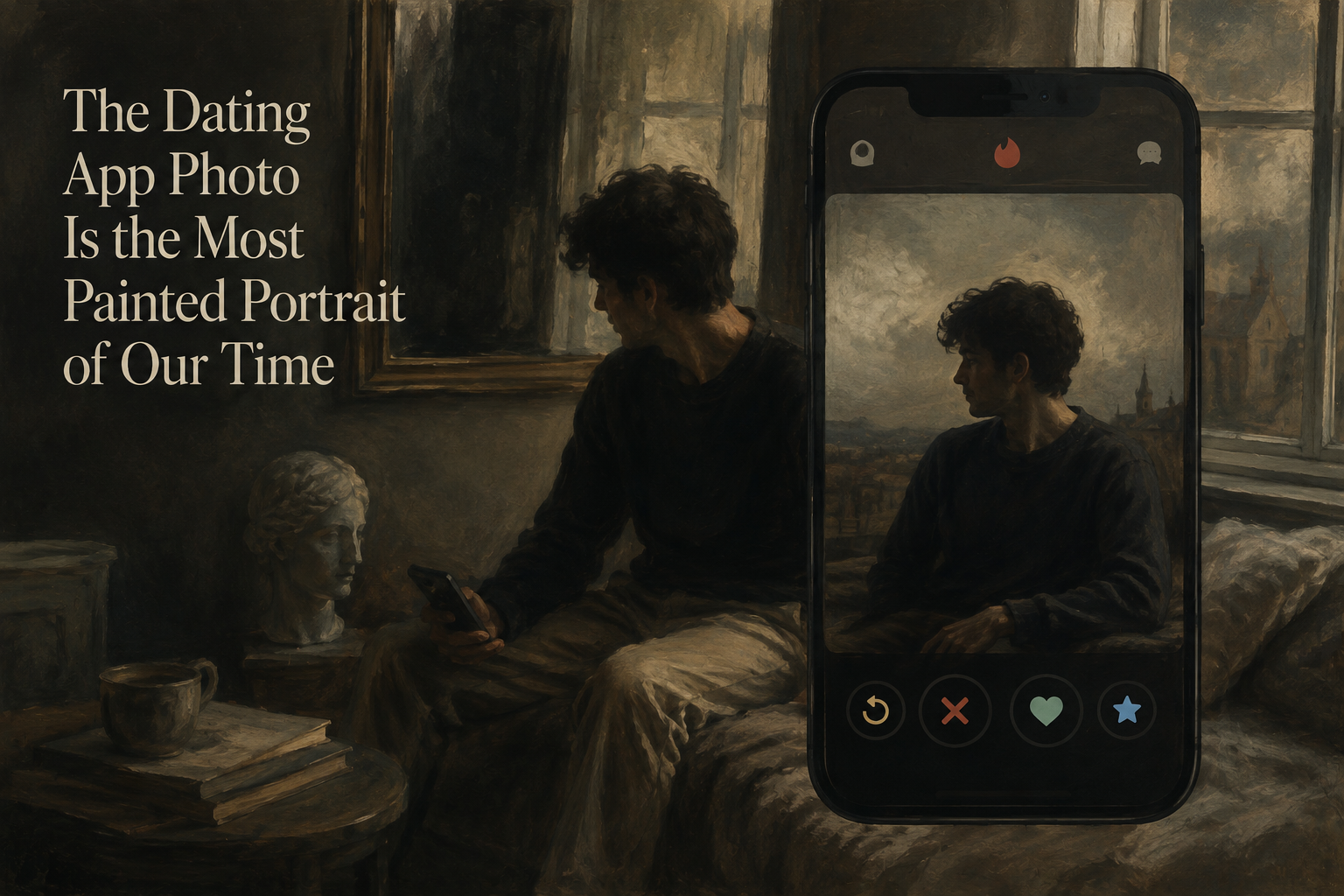
For most of history, having your likeness made was a transaction with an expert. You sat for a painter if you could afford one, for a daguerreotypist after 1839, for the neighborhood portrait studio after that. Someone else controlled how you would be seen, and the sitting itself was an event.
That entire apparatus has collapsed into a gesture. The most consequential portrait most people will ever commission is the first image on their dating profile, and they are the artist, the sitter, and the patron all at once.
The Job Has Not Changed in Five Hundred Years
Strip away the technology and the dating app photo is doing exactly what the commissioned portrait always did: presenting a self to strangers who will make a decision about you.
The Tudor court portrait existed so that marriage prospects across Europe could evaluate a face they would never meet. Holbein was dispatched to paint Anne of Cleves precisely because Henry VIII wanted to see before committing. The entire genre was, functionally, a profile picture with better framing.
And the failure modes were identical too. Holbein’s portrait flattered. The match soured on first meeting. The gap between the painted self and the actual self has been wrecking first impressions since the sixteenth century, and every era has renegotiated how much idealization a portrait is allowed to carry before it becomes a lie.
Every Portrait Technology Democratized the Same Promise
Each technical leap in portraiture made the same offer to a wider audience: you, but presented properly.
Oil painting made it available to anyone with a title. The daguerreotype brought it to the merchant class, and the carte de visite of the 1860s turned likenesses into something you printed by the dozen and handed out, which is about as close to a swipe deck as the nineteenth century got. The photo studio put a velvet curtain and good lighting within reach of nearly everyone. The front camera finished the job and removed the last expert from the room.
The dating app photo sits at the end of this line, and by volume it has no rival. No portrait form has ever been produced, distributed, and judged at this scale, by this many people, this quickly.
The Newest Chapter Removes the Sitting Entirely
Which brings the story to its current page. AI photo generation now occupies the position the portrait studio once held: you provide the face, the apparatus provides the craft.
Tools like DatePhotos, an AI dating photo generator built for Tinder, Bumble and Hinge, take a handful of casual selfies and return between 80 and 180 images across dozens of settings in under half an hour, for a one-time 29 to 79 dollars. Where a Victorian sitter chose between the painted backdrop of a garden or a library, someone rebuilding a dating app photo set today chooses between a coffee shop, a coastline, or an evening street. The logic is the studio’s logic. The velvet curtain just got bigger.
What is genuinely new is not the artifice. Portraiture was never innocent of artifice. What is new is the feedback loop: these tools score each generated image from 0 to 100 on how natural it reads, which means the tension every portraitist managed by instinct, how far to flatter before the likeness breaks, now has a number attached to it.
Dorian Gray, Reversed
The nineteenth century’s great anxiety about portraits was that the image might reveal too much truth. Wilde’s Dorian Gray hid his portrait in the attic because it kept the honest record while the man wore the flattery.
The dating app inverts the arrangement. Now the flattering image goes public and the honest face stays home, and the reckoning arrives not over a lifetime but at a bar on Thursday. Everyone who has dated online knows the small vertigo of a first meeting where the person and the portrait are cousins rather than twins.
This is why the instinct to over-polish is self-defeating in a way it never was for a court painter. Holbein’s sitter would never stand next to the canvas. A dating profile’s sitter always does. The portrait that wins the meeting and loses the introduction has failed at its actual job, which was never to be admired. It was to be recognized.

What the Old Masters Would Say About Your Six Slots
The working rules of good portraiture translate to the profile grid with almost no adjustment.
A portrait needed a clear likeness above all, so one photo should be nothing but your face in honest light. The full-length portrait existed to show bearing, so one image should show your whole frame. The conversation piece, that eighteenth-century genre of subjects doing things among friends, argued that context is character: one photo mid-activity, one in company. And painters always smuggled in an attribute, the globe, the hound, the letter, something for the viewer to ask about. Your version is the photo that hands a stranger their opening line.
Even the sequencing has precedent. Galleries hang the strongest canvas at eye level on the entry wall, because it decides whether the visitor keeps walking. Your first photo is the entry wall. The attribute picture, the one with the guitar or the summit or the espresso machine, belongs deeper in the set, where the viewer who has already decided to stay can find it and start a conversation about it.
Five centuries of portrait convention, compressed into six slots on a phone.
The medium changed hands, from oil to silver to pixel to model weights. The commission never changed at all: show them who you are, a shade better than the mirror, and never so much better that the door opens and the portrait dies of embarrassment.