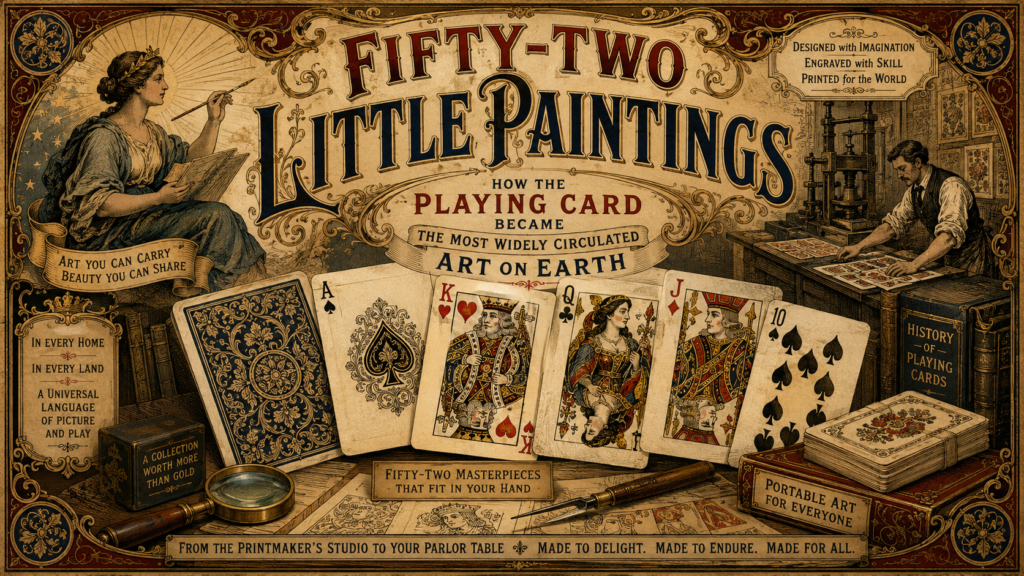
There is almost certainly a deck of cards somewhere in your house right now. Bottom of a drawer, in with the spare batteries and the takeaway menus and the little allen key from a chair you built in 2019. Nobody thinks of it as art. It is a thing you drag out at Christmas to play rummy with an aunt, and by January it is missing the seven of clubs.
But stop for a second and look at what it actually is. Fifty-two illustrations, drawn to a design brief that has barely shifted in five hundred years, printed and reprinted more times than any painting that ever hung on any wall anywhere. If we are counting eyeballs, and honestly why would we not count eyeballs, the court cards have been looked at more than the Mona Lisa by a margin so daft it is hard to even write down properly.
So let us take the drawer seriously for ten minutes. It has earned it.
It Came From Cairo, Not Paris
The first thing that surprises people is that the deck is not a European invention at all. Cards drifted into Europe in the late 1300s, arriving through the trading ports, and the design they arrived in was Mamluk. Egyptian. There is a surviving set, forty three cards of it, sat in the Topkapi Palace Museum in Istanbul, and it is the closest thing we have to a missing link.
The Mamluk suits were cups, coins, swords and polo sticks. Look at that last one for a moment, because it explains something. Europeans took the deck, copied it fairly faithfully, and then hit a problem with the polo sticks, on account of nobody in medieval Europe having the faintest idea what polo was. So the sticks quietly became batons. Then clubs. A whole suit of a modern deck exists in the shape it does because a fifteenth century copyist was looking at a sport he had never seen and guessing.
That is the sort of accident that runs right through this. The deck was never designed. It accumulated.
The Only Complete Deck Left From the 1400s
Here is the one that stops art historians in thier tracks. Almost every early European deck we know about survives as fragments. A knave here, half a queen there, mostly rescued out of old book bindings where printers had glued the misprints in as stiffening.
Except for one. The Cloisters Playing Cards, made in the Southern Netherlands somewhere around 1470 to 1480, are the only known complete set of illuminated ordinary playing cards to come down to us from the fifteenth century, and the Met have written up the whole strange story of the deck rather nicely. The suits are not hearts and spades. They are hunting gear. Horns, dog collars, hound tethers and game nooses, four suits pulled straight out of the aristocratic hunt.
And the figures on them are, frankly, taking the mickey. The costumes are exaggerated to the point of silliness, all piled up sleeves and ridiculous hats, and the general reading is that somebody was gently lampooning the fashions of the Burgundian court. Which I find genuinely lovely. The oldest complete deck in the world is a bit of satire. Somebody five hundred years ago sat down to draw fifty two cards and could not resist having a dig at how the posh lot were dressing.
It sold at Sotheby’s in 1983 for a hundred and forty three thousand dollars. Not bad for a pack of cards.
Cheap Beat Beautiful, and It Was Not Close
Now, the mediaeval decks were hand painted and gorgeous and cost about as much as a horse, which meant roughly nobody owned one. What changed everything was not an artistic breakthrough. It was a manufacturing one.
The French figured out that if you reduced your suit marks to flat, simple, solid shapes, hearts and diamonds and clubs and spades, you could stencil the whole lot at speed. No fine linework. No skilled illuminator. Just a stencil, some ink and a lad who could be trained in an afternoon. German and Italian decks kept their lovely detailed acorns and cups and batons, and they lost. Not on beauty. On price.
There is a proper design lesson buried in there and it is a slightly uncomfortable one. The suit symbols we all know are not the prettiest ones anybody came up with. They are the ones that survived contact with a printing press. Reproducibility is a design constraint the way gravity is a design constraint, and the French pattern is what you get when you let it win completely.
The Ace of Spades Is Basically a Tax Receipt
This bit is my favourite and hardly anyone knows it. Ever wondered why one card in the pack, always the ace of spades, is dressed up in all that curly ornamental nonsense while the other aces are plain?
Tax. That is the whole answer. Card duty was extended in Britain in 1711 under Queen Anne, and from 1712 the ace of spades got stamped by hand to show the duty had been paid. In 1765 the hand stamping was dropped and the Stamp Office simply printed the official ace themselves, coat of arms and all. By 1828 they had made the thing even more intricate and stuck the maker’s name on it, specifically to make forgery harder, because people were absolutely forging it. The duty did not finally go away until 1960.
So the most decorated card in the deck is decorated for a reason that has nothing whatsoever to do with art. It is an anti-counterfeiting measure that outlived the tax by more than sixty years and is now just, well, tradition. Nobody kept it because it was beautiful. They kept it because it was there.
Where the Design Lives Now
Cards did not stop being drawn when printing stopped being the main way people met them. They moved onto screens, and the odd thing is how little the drawing had to change to get there.

Watch a card game running on a phone. The pip layouts are the French pattern, unaltered. The kings and queens are still those flattened, double headed figures that got that way in the 1800s so a player could not read your hand by watching you turn a card the right way up. Operators like The Online Casino run blackjack, baccarat and poker tables where the card faces are, for all practical purposes, a nineteenth century Paris design rendered at 1080p. The felt is fake and the dealer is on a video feed, but the artwork is inherited.
You may possibly find that a bit deflating. I think it is the opposite. Five centuries of copying, and the design is so thoroughly solved that a screen has almost nothing left to add to it.
The People Still Drawing Decks
The thing that surprised me most, when I started poking at this, is that custom deck design is having a proper moment. Crowdfunding turned out to suit it perfectly. An illustrator draws fifty two faces plus the backs and the box, runs a campaign, prints a few thousand.
What nobody warns them about is what happens after. A lot of these designers are one person with a scanner, and the day the parcels go out is the day the questions start. Where is mine? Can I swap the blue for the red? The tuck box arrived bent. And the questions do not land in one place, they land across Instagram, the campaign comments, a personal email and whatever contact form is on the site. Two people answer the same question differently and you have made a mess in ninety seconds that takes an evening to unpick.
Which is why a fair few tiny creative studios end up on ticketing software far earlier than you would guess. The old blocker was pricing, because most help desks charge per agent, so the illustrator plus the mate doing the packing pays twice over for the privilege. Maxdesk has gone the other way with free helpdesk software priced per workspace instead of per person, unlimited agents and tickets on the free plan, so everyone helping with a print run can sit in the same queue without the bill climbing. It is email only, no live chat, and the free tier carries ads with a rolling three month history rather than the full archive. Which is a perfectly fair trade for not sending two different answers to the same annoyed backer.
Not a glamorous recommendation for an art blog, I know. Ask anyone who has shipped a deck.
Go and Open the Drawer
None of this turns a pack of cards into a masterpiece, obviously. But it does make it a genuinely strange object, one that carries a guessed-at polo stick from Cairo, a stencil economy from France, a tax stamp from Queen Anne and a joke about Burgundian hats, all folded into something you can buy in a petrol station for two quid.
Go and find yours. Look at the ace of spades properly, and at the little sword the King of Hearts appears to be putting through his own head, which is a copying error nobody ever bothered to correct. Fifty two little paintings sat under the takeaway menus.
Best gallery in the house, that drawer!