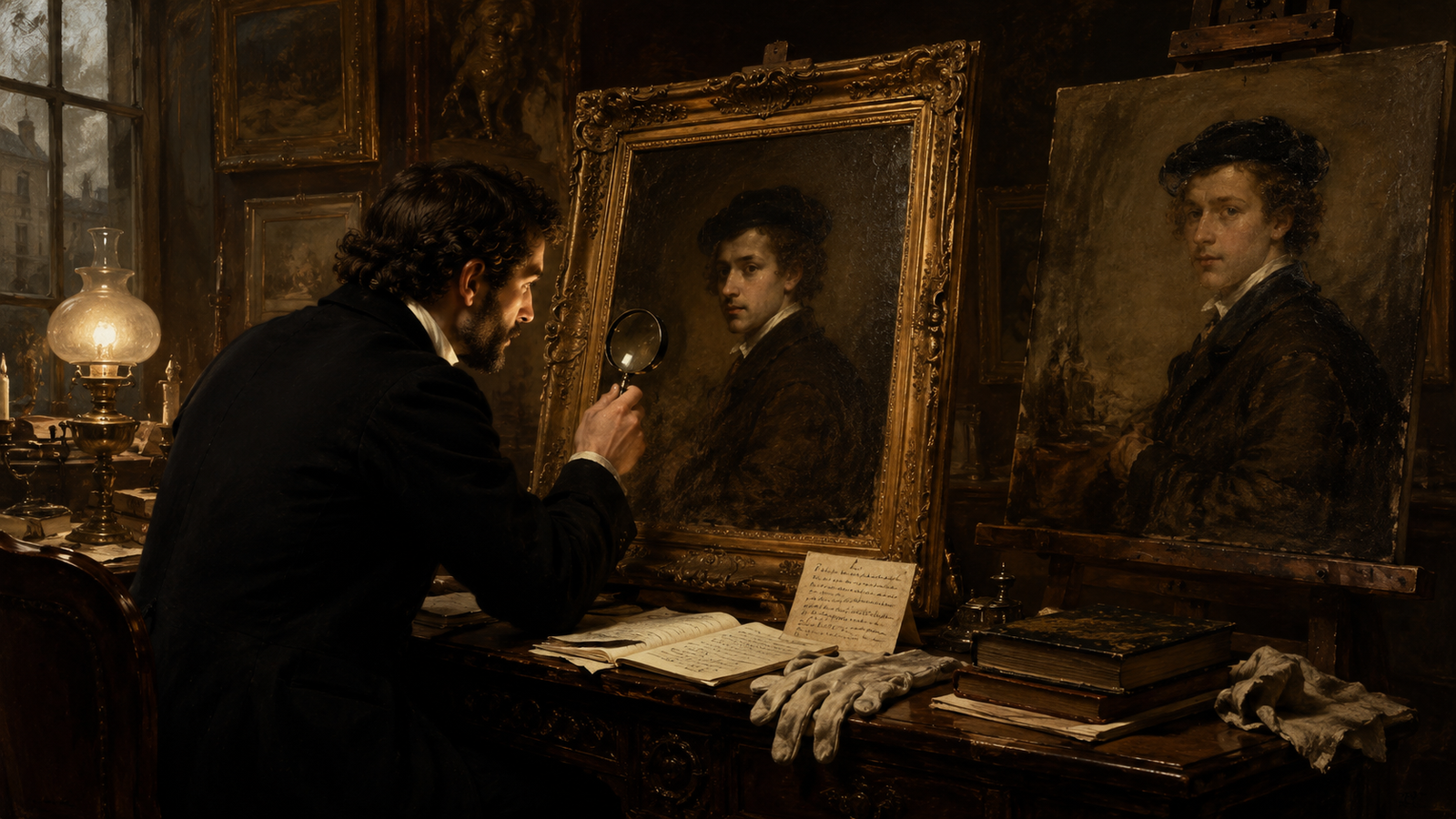
Open any auction catalogue and read the artist lines carefully. Some say only “Rembrandt van Rijn”. Others say “Attributed to Rembrandt van Rijn”. Further down there is “Studio of”, “Circle of”, “Follower of”, “Manner of”, and at the far end, “After”.
Those are not stylistic variations in how the cataloguer felt like writing that day. They are a formal scale, and the distance between the first phrase and the last one is the distance between a masterpiece and a copy.
Every Catalogue Entry Is a Confidence Rating
The system is standardised across the major houses, and each phrase carries a specific claim about evidence.
The artist’s name alone asserts that the work is by that hand. “Attributed to” means probably, with reservations somebody thought worth recording. “Studio of” places it in the artist’s workshop, possibly with their involvement, possibly not. “Circle of” means an unidentified contemporary working close enough to have known them. “Follower of” drops the contemporary requirement, and “Manner of” drops it further, describing a later imitation. “After” is a copy of a known composition.
Seven grades, and none of them is about whether the painting is any good. They are entirely about how much weight the evidence bears.
The Words Are Load-Bearing
The distinction is not academic, because these phrases move money.
A canvas catalogued under the artist’s own name and a visually similar canvas catalogued as “Circle of” can differ in price by two orders of magnitude. Same pigments, same period, often the same level of skill. What separates them is the strength of the documentary chain and the confidence of the scholarship, not what your eye reports when you stand in front of them.
Which is why the vocabulary exists at all. Buyers needed a way to price uncertainty rather than pretend it away, and a market that could only say yes or no would have collapsed under its own disputes.
Rembrandt Lost Hundreds of Paintings Without a Brushstroke Changing
The most instructive demonstration ran for over forty years.
The Rembrandt Research Project, a team of Dutch scholars formed in 1968, set out to systematically re-examine works attributed to Rembrandt. Their conclusions moved a large number of paintings out of the accepted corpus and into workshop or follower status. Museum wall labels were rewritten. Insurance valuations changed. Some institutions found that a centrepiece of their collection was now, officially, by somebody else.
The paintings themselves did not change. Nothing was repainted. What changed was the evidence and the reading of it, and the catalogue vocabulary was flexible enough to absorb that without anyone having to claim the old label had been a lie.
That is a system working correctly. It recorded a confidence level, and when the confidence moved, the label moved with it.
The Machines Skipped This Step Entirely
Now consider how a language model answers a question about a painting, an artist, or anything else.
It has one register: fluent, complete, and evenly confident. A well-documented fact and a shaky inference arrive in the same tone, in the same paragraph, with the same grammar. There is no “attributed to” in the output. There is no equivalent of “Circle of”, no way for the sentence itself to tell you the evidence behind it is thin.
This is not a complaint about accuracy. Models are often right. The problem is narrower and more structural: the format has no channel for doubt. Five hundred years of art-market practice concluded that such a channel is necessary, and the newest information technology shipped without one.
What a Cataloguer Would Ask
The discipline the catalogue enforces is simple enough to borrow.
For any claim, a cataloguer asks three things. What is the documentary chain behind this, and where does it break. Who made the judgement, and on what grounds. And what would have to be true for the attribution to change.
That third question is the one almost nobody asks of an AI answer, and it is the most useful. An assertion that cannot name the evidence that would overturn it is not a conclusion. It is a guess wearing better clothes.
A few tools have started building this in rather than treating it as an afterthought. Tracetify, which reconstructs how a company built its public visibility, attaches a dated source to every individual claim and makes its verdicts state a confidence level along with the specific data that would change them. Whether or not you need that particular tool, the shape is right, and it is the shape a Sotheby’s cataloguer would recognise immediately.
Confidence Is Information, Not Weakness
There is a cultural obstacle to any of this, and it is worth naming.
Hedged language reads as weak. A paragraph that says “probably, on this evidence, subject to these gaps” sounds less authoritative than one that asserts without qualification, and in most contexts the confident version wins the room. Product teams know this, which is part of why answers come out flat and certain.
The art market went the other way, and it went that way because the stakes were high enough to force honesty. When a mislabel costs a collector a fortune and an institution its reputation, “we are not sure, and here is exactly how unsure” becomes the professional standard rather than a hedge.
The incentives in software point the opposite direction, which explains a lot. Nobody has ever been sued over an overconfident chatbot answer about a Dutch painter. The cost of false certainty is spread thinly across everyone who reads it, while the benefit of sounding authoritative accrues directly to the product. Auction houses had no such asymmetry available to them, because the person harmed by a bad label was standing right there holding the receipt.
That is the real reason the catalogue is more rigorous than the machine, and it has nothing to do with which one is more advanced.
Uncertainty, expressed precisely, is information. “Attributed to” tells you far more than a bare name does, because it tells you the name and the doubt at the same time.
The Catalogue Got There First
Art history is not usually where people look for lessons about machine-generated text. But it spent centuries on a problem the technology industry has only just encountered at scale, which is what to do when you must publish a claim you cannot fully verify.
Its answer was not to stop publishing, and not to publish with false confidence. It was to build a vocabulary precise enough to carry the doubt along with the claim, and to make everyone learn it.
The next time an answer arrives sounding certain, the useful question is the one the catalogue trained curators to ask automatically. Is this the artist’s name, or is this “Manner of”?