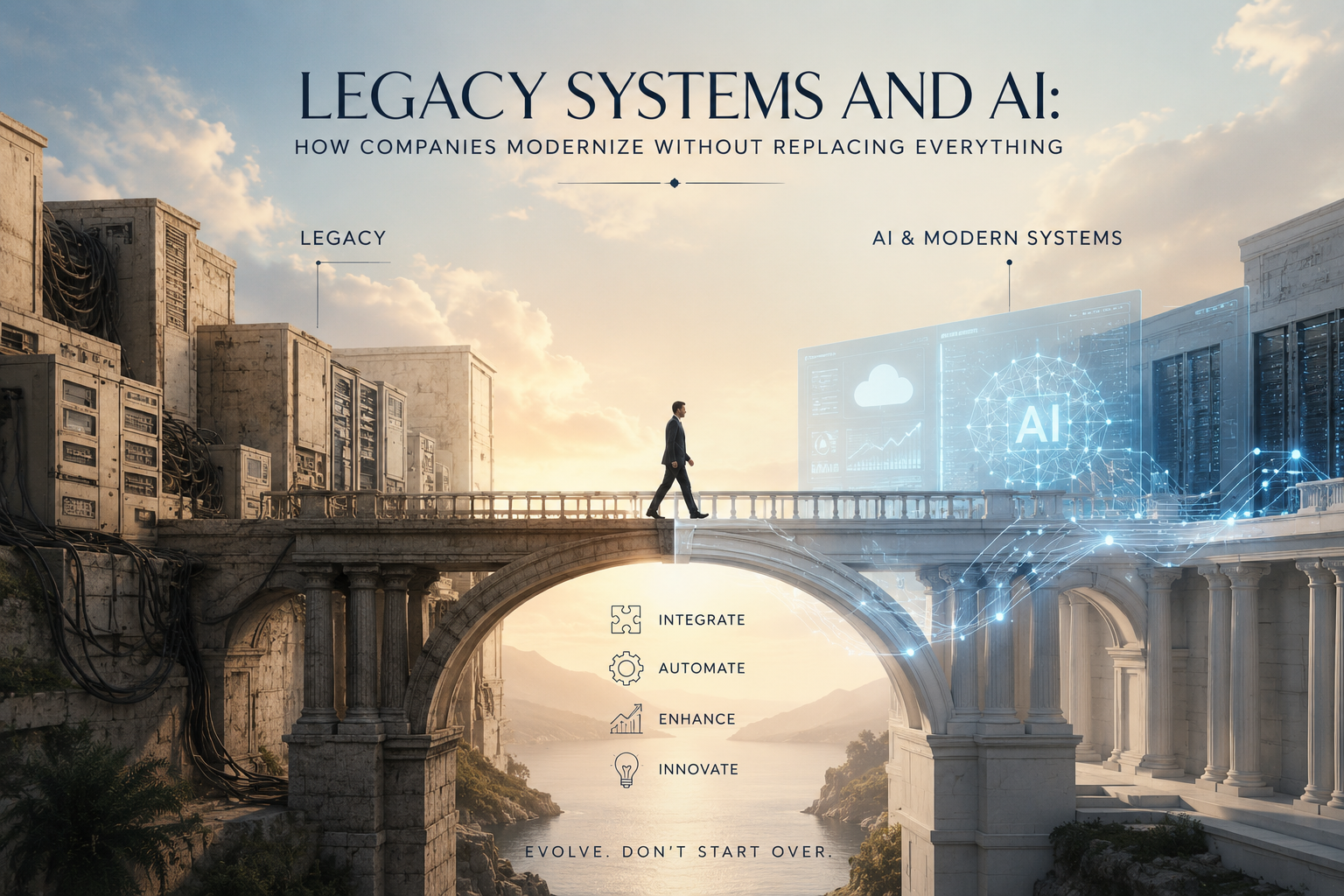
For many established companies, adopting AI sounds straightforward until someone looks at the technology already running the business.
A manufacturer may depend on an ERP installed more than a decade ago. An insurer might have policy data spread across a mainframe, databases, spreadsheets, and newer cloud applications. A logistics company could rely on software that works reliably but was never designed to communicate with machine learning models or generative AI tools.
Replacing all of it is rarely a realistic starting point. Large migrations are expensive, disruptive, and capable of creating new problems in systems that currently perform critical jobs well.
Fortunately, AI transformation does not require a complete rebuild. In many cases, the more practical approach is to leave stable systems in place and build modern data, integration, and AI capabilities around them.
How can companies use AI with legacy systems?
The first misconception to address is that old software and AI are fundamentally incompatible. Usually, they are not.
An AI model does not necessarily need direct access to every application inside the company. It needs reliable access to the right data and a controlled way to return predictions, recommendations, or generated content to employees and business processes.
That creates several possible integration points.
A company might extract data from an existing ERP into a modern analytics environment, run forecasting models there, and send the resulting recommendations to a dashboard used by planners. Another organization might connect a customer service platform to an AI assistant through APIs without changing the underlying customer database.
The important question therefore becomes less “How do we replace the legacy system?” and more “What does AI need from this system?”
Companies planning a broader modernization program may also compare the best companies for enterprise AI adoption to see how different technology partners handle integration, data modernization, and AI implementation when existing infrastructure cannot simply be removed.
Why is replacing legacy software often the wrong first step?
Legacy systems have a bad reputation, but “old” does not automatically mean “useless.”
Some systems have processed transactions reliably for years. They contain business rules developed through decades of experience. Employees understand their quirks, and replacing them may require retraining entire departments.
A full replacement can also create dependencies that have little to do with the original AI objective. Suddenly, a project intended to improve demand forecasting turns into a lengthy ERP migration.
That changes the economics considerably.
If implementing a relatively focused AI use case requires replacing major parts of the company’s existing infrastructure first, the project can quickly become difficult to justify. The cost, time, and disruption of a large-scale migration may outweigh the expected benefits of the initial AI initiative.
Instead, companies can separate two decisions: what genuinely needs modernization and what can remain untouched.
What parts of a legacy system should companies modernize first?
Not every old component deserves the same attention. A useful modernization plan starts by identifying the bottlenecks preventing a specific business outcome.
Which data does AI actually need?
Suppose a distributor wants AI to predict which customers are likely to reduce their orders.
The company may have years of information across dozens of systems, but the first model might only need recent purchase history, product categories, customer characteristics, account activity, and support interactions.
Trying to clean and migrate every historical dataset before building anything would delay the project unnecessarily.
Start with the data required for the first use case. Its quality, accessibility, ownership, and update frequency can then be assessed individually.
This approach also exposes practical problems early. Customer IDs may differ between systems. Important fields may be missing. Product names may have changed repeatedly. Finding these issues during a focused pilot is much easier than discovering them halfway through a company-wide data migration.
Which integrations are blocking AI adoption?
Sometimes the database is perfectly usable; the problem is simply access.
Modern integration layers can sit between legacy applications and new AI services. Depending on the environment, companies can use APIs, middleware, event streams, database connectors, or scheduled data pipelines.
This creates a buffer between old and new technology.
The AI application communicates with the integration layer rather than becoming tightly coupled to an older application. Later, if that application is replaced, the AI system does not necessarily have to be rebuilt with it.
How do APIs help connect AI to legacy software?
APIs are one of the most practical tools for incremental modernization.
Imagine a claims processing system that was developed years before modern AI services existed. Rewriting the application could take a considerable amount of time, but perhaps employees mainly need AI to summarize incoming documents and highlight potentially missing information.
A separate AI service can handle that task.
The existing application sends relevant information through an API. The AI service processes it and returns a structured response. The original claims platform remains responsible for its core workflow.
This pattern is useful because it keeps responsibilities clear. AI handles a defined task rather than taking over an entire business process.
There is one limitation: some older systems do not offer convenient APIs. In those situations, organizations may need middleware, database-level integrations, file transfers, or other adapters. The architecture may not look elegant, but it can still provide business value without forcing an immediate replacement.
How can companies modernize legacy data for AI?
For many AI projects, software age is not the biggest problem. Data is.
AI models depend on information that is sufficiently accurate, consistent, and accessible. Legacy environments often contain duplicate customer records, inconsistent formats, undocumented fields, and data stored in departmental silos.
Moving messy data to the cloud does not fix those problems. It simply relocates them.
A better strategy is to create a usable data layer for selected AI applications.
For example, information from ERP, CRM, inventory, and support systems could be consolidated in a warehouse or lakehouse. Data pipelines can standardize important fields and establish common identifiers. Governance rules can define which information AI applications are permitted to access.
The source applications can continue operating while the organization gradually develops a cleaner foundation around them.
How do you choose the first AI use case for a legacy environment?
The best starting project is rarely the most ambitious one.
A good first use case has measurable value, accessible data, limited operational risk, and a clear group of users.
Demand forecasting is a useful example. A company can build a model using historical sales and inventory data without allowing AI to directly control purchasing. Planners receive forecasts and decide whether to act on them.
Other practical starting points include document classification, internal knowledge search, customer support assistance, anomaly detection, invoice processing, and maintenance predictions.
These projects can prove whether the integration and data architecture work before AI is connected to more sensitive workflows.
How do companies reduce risk when adding AI to old systems?
Incremental modernization only works if companies maintain clear boundaries.
One useful principle is to keep critical systems of record separate from experimental AI components. A generative AI assistant, for example, should not automatically rewrite customer records simply because it can access them.
Human approval remains valuable when decisions involve financial, legal, safety, or customer consequences.

Companies also need monitoring beyond conventional application uptime. Teams should track whether models continue producing useful results, whether source data has changed, and whether integration failures are silently feeding incomplete information into the AI system.
Security deserves similar attention. Adding a new integration path can expand the attack surface of an old application. Authentication, access controls, encryption, logging, and data minimization should therefore be designed into the integration rather than added after deployment.
When should a legacy system actually be replaced?
Incremental modernization is not an excuse to keep every old application forever.
Some systems genuinely become liabilities.
Replacement becomes more reasonable when maintenance requirements continue rising, knowledgeable developers are difficult to find, security patches are unavailable, integrations repeatedly fail, or the system prevents the business from launching important capabilities.
The distinction is important.
A company should not replace software merely because it is old. It should replace it when the cost and risk of keeping it become greater than the benefits of maintaining it.
AI projects can actually help reveal this threshold. If every new use case requires complicated workarounds around the same platform, that platform may have become a modernization priority.
What does a practical legacy-to-AI roadmap look like?
A realistic roadmap usually develops in stages rather than through one enormous transformation program.
First, choose a business problem with measurable value. Identify the minimum data and systems required to address it. Then assess whether those sources can be accessed reliably and securely.
Next, build the smallest integration and data layer needed to support a pilot. Run the AI capability alongside the existing workflow rather than immediately replacing it.
Then measure the result.
Did employees save time? Did forecasting accuracy improve? Were fewer cases handled manually? Did the new process remove repetitive work or help employees make better decisions?
If the results are promising, the architecture can be expanded to additional use cases. If not, the company can adjust the model, data, or workflow without having committed to a huge infrastructure replacement.
Over time, this creates a modern layer around the existing technology landscape. Some legacy applications will eventually disappear. Others may remain for years because they continue doing their jobs perfectly well.
How can businesses modernize without disrupting daily operations?
The goal of modernization should not be to make every piece of technology look new. It should be to make the business more capable.
That distinction matters when AI enters the conversation.
Companies often have far more usable infrastructure than they initially assume. Existing systems contain valuable data, proven workflows, and years of institutional knowledge. The challenge is to make those assets accessible to modern tools without creating unnecessary operational risk.
For many organizations, the sensible path is therefore neither “keep everything” nor “replace everything.”
It is selective modernization: preserve what still works, isolate what creates constraints, introduce modern integration and data layers, and apply AI where the business case is clear.
That approach may be less dramatic than a complete technology overhaul. It is also easier to test, measure, and improve — which is often what turns AI modernization from an ambitious plan into something people actually use.