Yayoi Kusama, the Japanese artist who turned polka dots, pumpkins, mirrors, repetition, hallucination and self-mythology into one of the most recognizable visual languages of the last century, has died at the age of 97.
Her official website announced that Kusama died at a hospital in Tokyo on August 14, 2026. The news marks the end of one of the strangest and most persistent careers in contemporary art: a life spent turning private visions into public spectacle, psychological disturbance into pattern, and obsession into an empire of dots.
Kusama was many things at once: painter, sculptor, installation artist, performer, novelist, poet, fashion collaborator, self-invented icon, and one of the rare artists whose work could satisfy both a museum curator and a phone camera. She became instantly legible to the world through a few motifs — the dot, the pumpkin, the mirrored room — but the simplicity was deceptive. Behind the repetition was anxiety. Behind the colour was terror. Behind the selfie queue was a woman who spent decades trying to dissolve herself into infinity.
That is the odd brilliance of Kusama. She made art that looked cheerful enough for a gift shop and frightening enough for a nervous breakdown. She understood, perhaps better than almost anyone, that repetition can be decorative, childish, cosmic, pathological, funny and annihilating all at once.
She did not merely cover the world in dots. She made the dot feel like a universe trying to swallow the person who made it.
1. The Dot Was Never Innocent
The polka dot is one of the easiest marks in the world to misunderstand.
At first glance, it looks playful. Childlike. Pop. Decorative. A pattern for dresses, wrapping paper, wallpaper, toys, balloons, children’s rooms, playful branding, and the kind of museum merchandise that makes contemporary art financially useful after all. In Kusama’s hands, however, the dot was never only cute. It was a unit of obliteration.
From a young age, Kusama experienced visual hallucinations, including patterns that seemed to cover her surroundings. The official Yayoi Kusama Museum biography notes that she began making net and polka-dot pattern pictures from early life, turning perception itself into artistic material. The dots were not an aesthetic gimmick added later for market recognition. They were part of the machinery of her vision.
This is why her dots are so strange. They appear friendly, but they behave aggressively. They do not sit politely on a surface. They multiply. They invade. They cover bodies, furniture, walls, canvases, pumpkins, clothes, rooms and, eventually, the viewer’s own field of vision. They promise play and deliver disappearance.
In that sense, Kusama’s dot is one of the great dark jokes of modern art. It is the smallest possible thing made unbearable through repetition. One dot is nothing. A thousand dots become décor. A million dots begin to feel like panic with excellent branding.
2. New York, Nets and the Art of Repeating Until Something Breaks
Kusama was born in Matsumoto, Japan, in 1929 and moved to the United States in the late 1950s, entering New York at a moment when Abstract Expressionism, Pop, Minimalism, performance and the theatrical ego of the art world were all competing for oxygen.
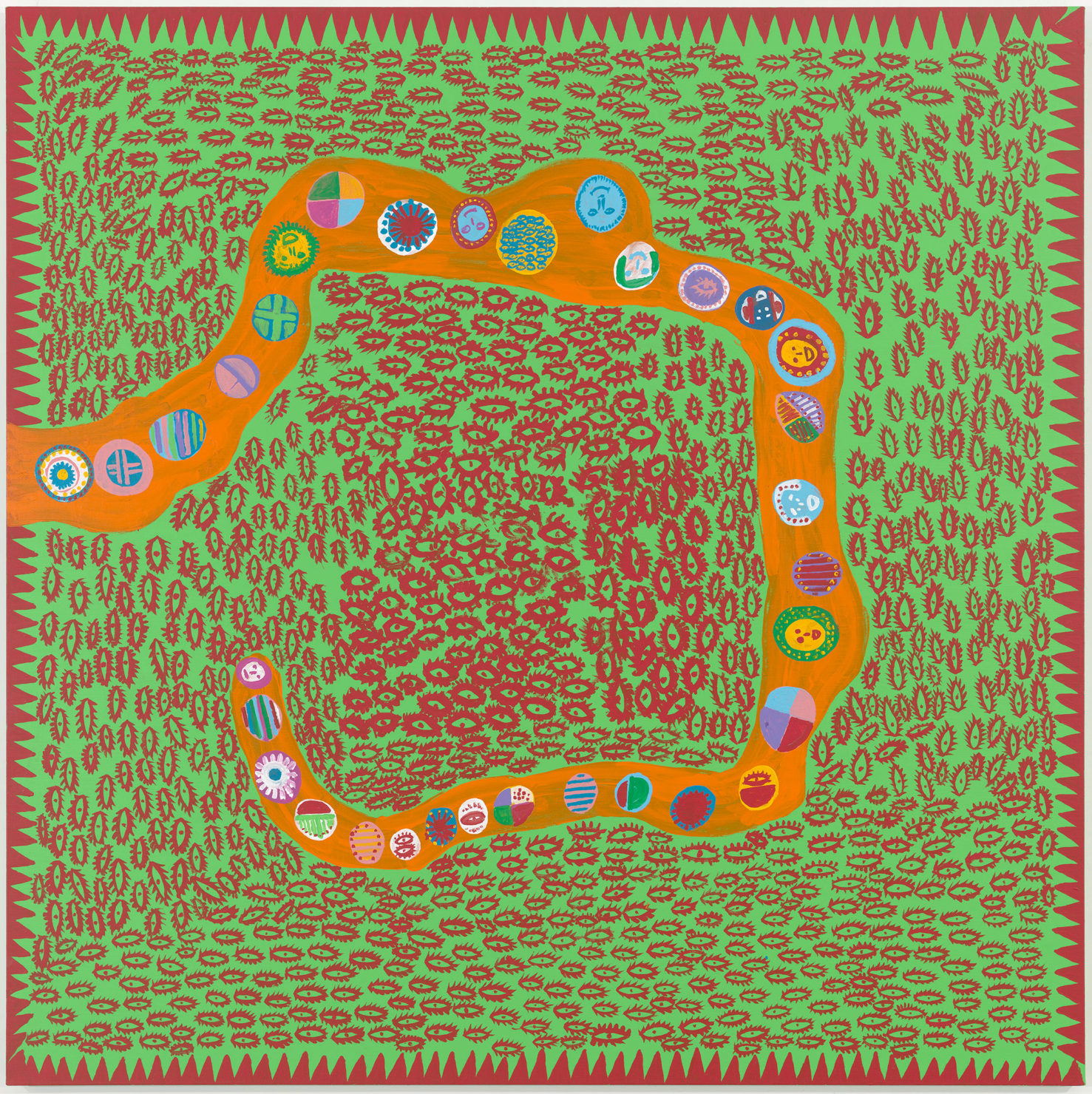
Her early Infinity Net paintings were among the clearest statements of what she would become. They were not loud in the obvious way. They did not depend on heroic gesture, masculine myth, or the dramatic splash of paint across canvas. Instead, they depended on obsessive repetition: small marks, again and again, accumulating until the surface became field, then atmosphere, then something close to psychological weather.
This was radical in a subtler way than the art world sometimes likes to admit. Kusama took the heroic scale of post-war abstraction and drained it of macho thunder. She replaced the big expressive gesture with the compulsive mark. The result was not weaker. It was colder, stranger, more relentless. Where others painted as if announcing themselves, Kusama painted as if trying to disappear.
That difference explains much of her later power. Her art does not simply say, “Look at me.” It says, “Watch what happens when the self cannot stop multiplying.”
There is an unexpected bridge here with the broader history of Japanese visual repetition and formal discipline, from pattern to printmaking. Art-Sheep has previously looked at the hypnotic force of Japanese image-making in Hokusai: The Man Who Mastered Waves. Kusama belongs to another century and another psychological territory, but she shares that rare ability to make repetition feel infinite rather than merely repeated.
3. Pumpkins: The Friendly Monster
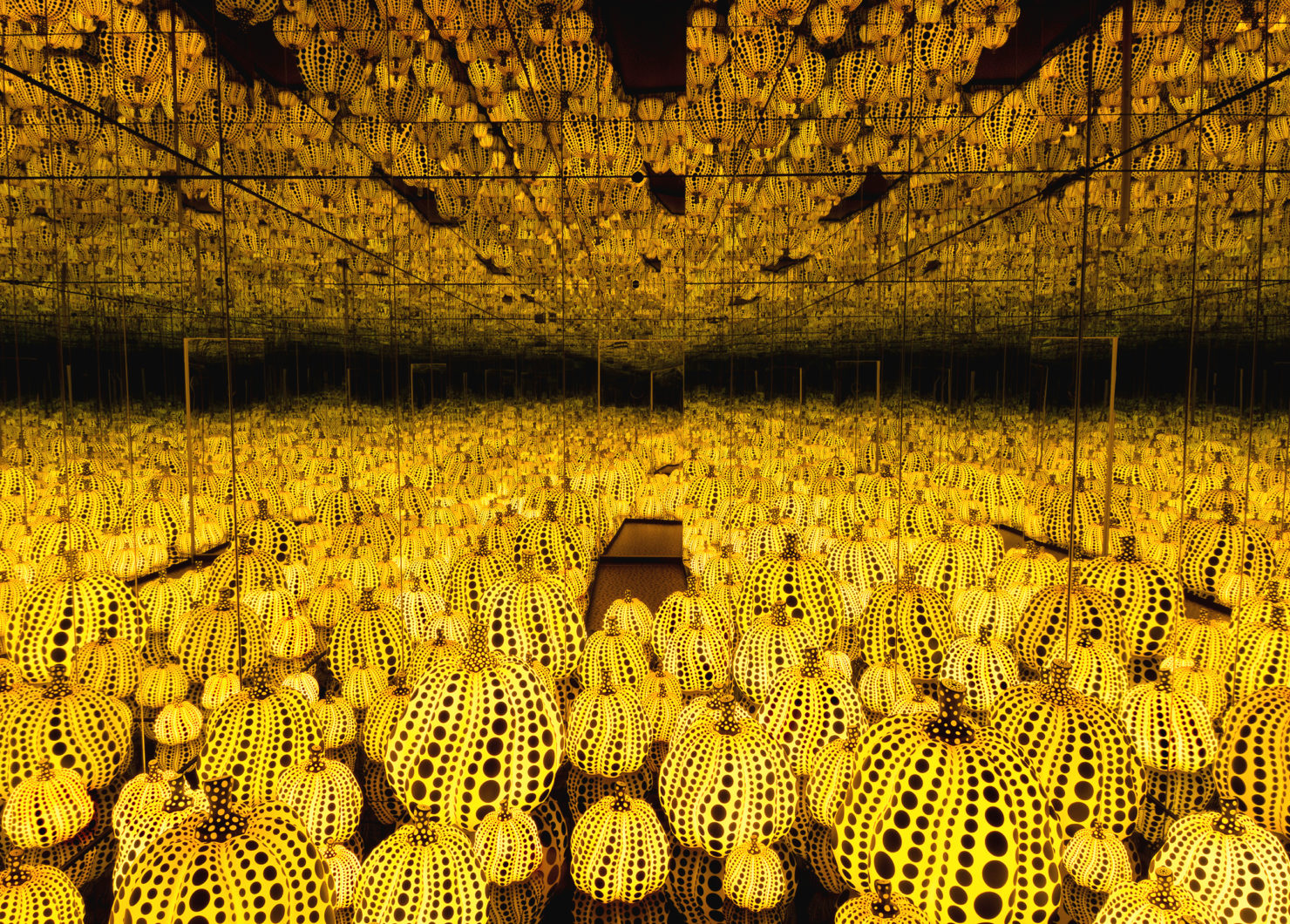
If the dot was Kusama’s atom, the pumpkin was her mascot, shrine object, comic monster and emotional accomplice.
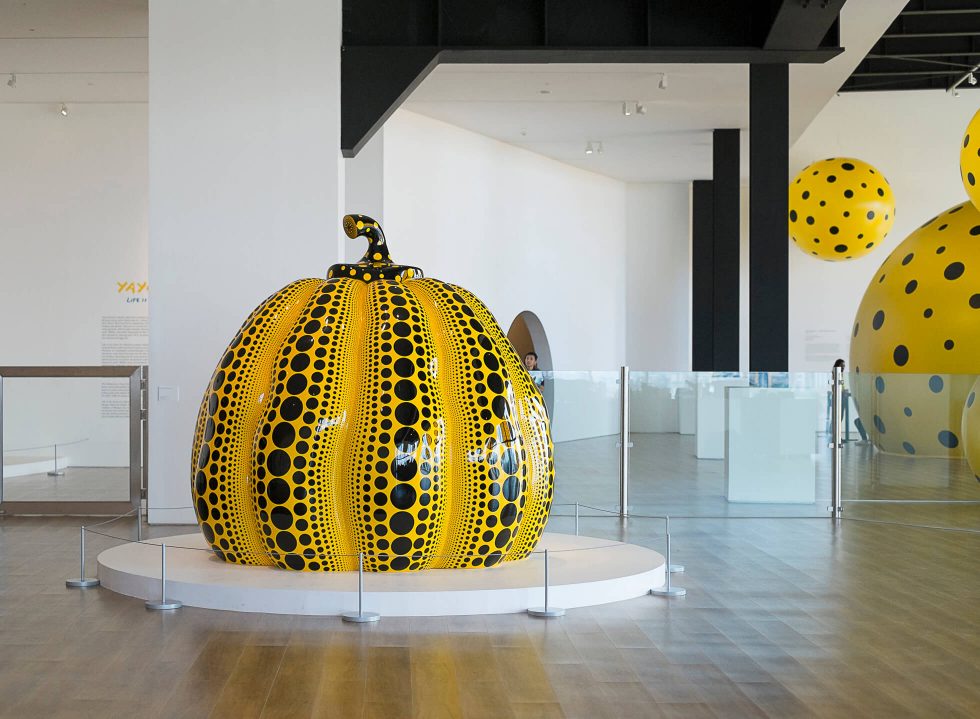
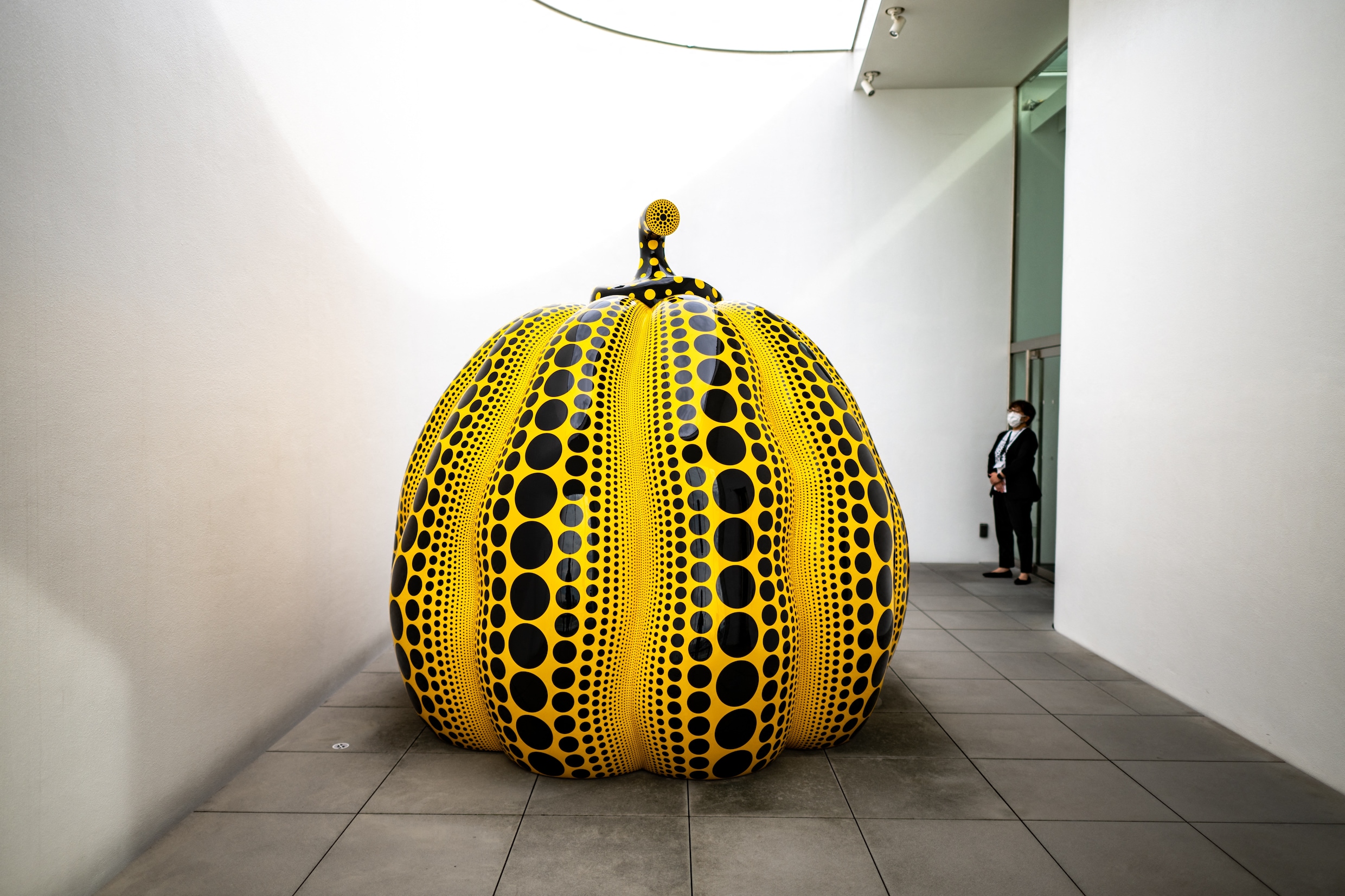
No one made the pumpkin stranger than she did. Before Kusama, the pumpkin belonged mostly to harvest, kitchens, folklore, Halloween, rural abundance and the decorative dignity of being slightly ridiculous. Kusama turned it into an icon. Yellow, swollen, dotted, lumpy, cheerful and vaguely threatening, her pumpkins are among the most recognizable sculptures in contemporary art.
The pumpkin suited her because it resisted elegance in the ordinary sense. It was not a smooth modernist form. It was bumpy, humble, bodily, comic and maternal. Kusama made it monumental without making it noble. That is part of its charm. The pumpkin is grand, but it is never quite serious enough to become authoritarian. It sits there, glowing and dotted, like a saint of absurd fertility.
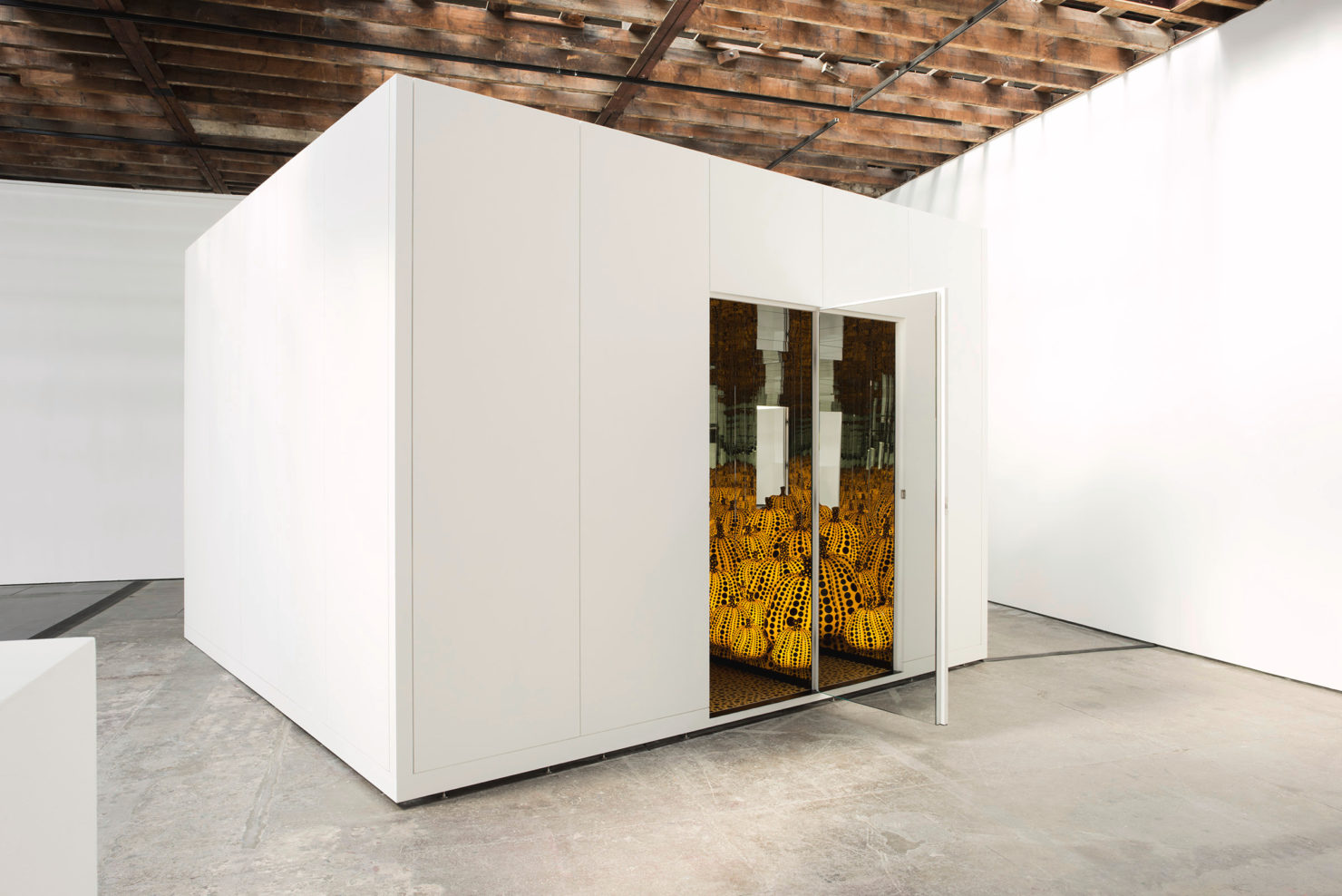
Her pumpkin rooms and sculptures also reveal the emotional complexity of her work. The pumpkin is comforting and excessive at the same time. It suggests warmth, but the dots make it unstable. It suggests childhood, but the mirrored repetition pushes it toward infinity. It is friendly, until there are too many of them. Then it becomes a crowd.
This is classic Kusama: joy with a trapdoor underneath. The viewer smiles first. The abyss arrives later, wearing yellow.
4. Infinity Mirror Rooms and the Museum Queue as Ritual
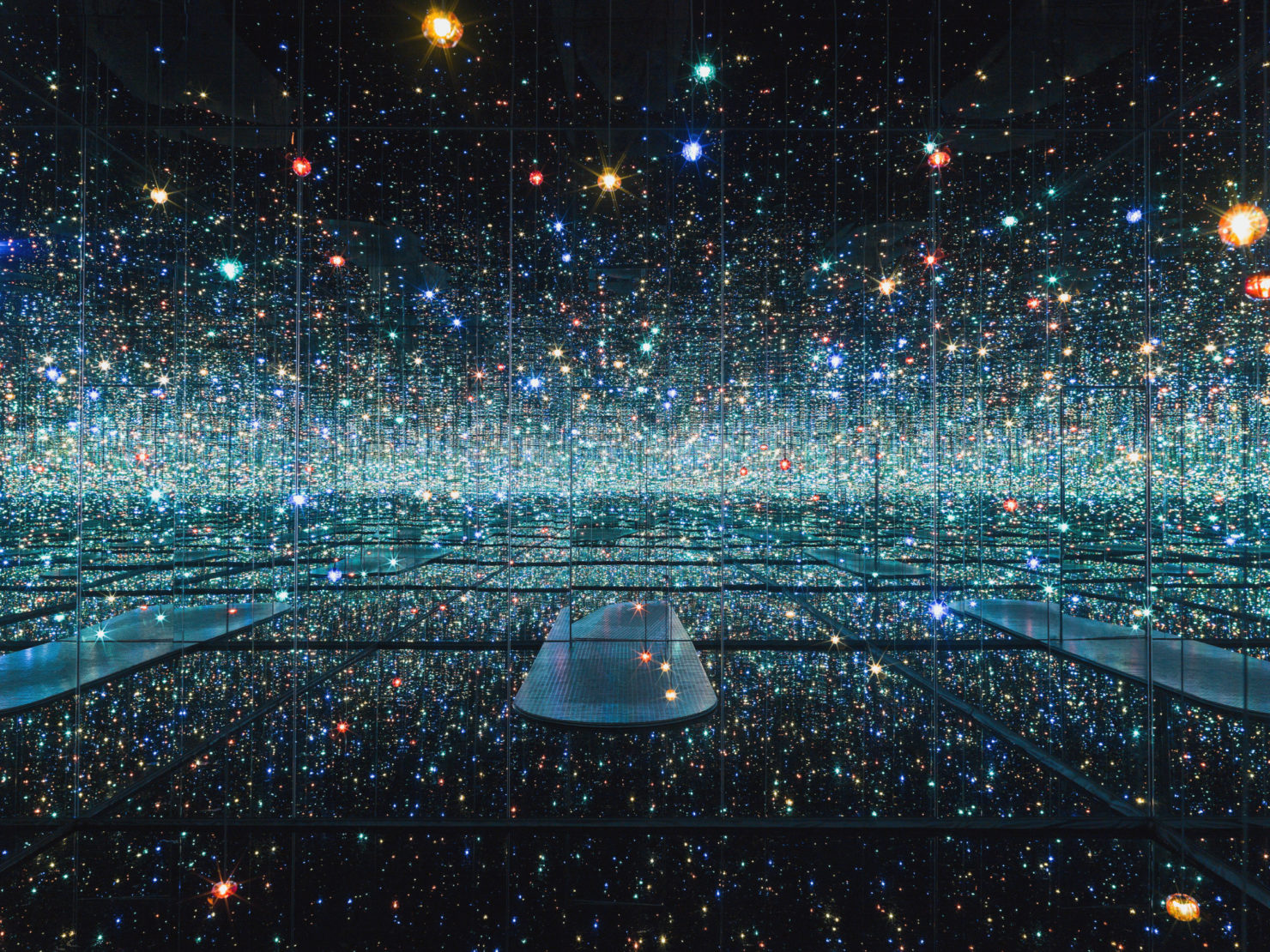
The Infinity Mirror Rooms made Kusama a global museum phenomenon, and also one of the few artists whose work could turn waiting in line into part of the artwork’s mythology.
She first used mirrors as a multireflective device in Infinity Mirror Room—Phalli’s Field in 1965, transforming repetition into an immersive experience. The Hirshhorn Museum describes that room as a breakthrough in which the repetition of her earlier work became spatial, perceptual and participatory. The viewer no longer looked at infinity. The viewer entered it.
That shift was enormous. Kusama understood that mirrors could make the self both central and irrelevant. Step into one of her rooms and your body appears everywhere, then becomes almost nothing. You are multiplied until you are no longer special. The room flatters narcissism and destroys it in the same movement, which is perhaps why it proved so perfect for the age of the selfie.
The social media afterlife of the Infinity Rooms is one of the most interesting contradictions in recent art history. People entered them to photograph themselves disappearing into infinity, then posted the evidence of their own disappearance. The experience became spiritual, spectacular and algorithmic. Kusama’s art, originally connected to hallucination, obsession and self-obliteration, became one of the most photogenic environments on earth.
This could have made the work trivial. Somehow, it did not. The best Infinity Rooms survive their own popularity because the core idea remains too strong. They are not just pretty mirror boxes. They are machines for making the ego glitter before it vanishes.
5. The Obliteration Room and the Democracy of the Dot
The Obliteration Room may be Kusama’s most brutally simple joke.
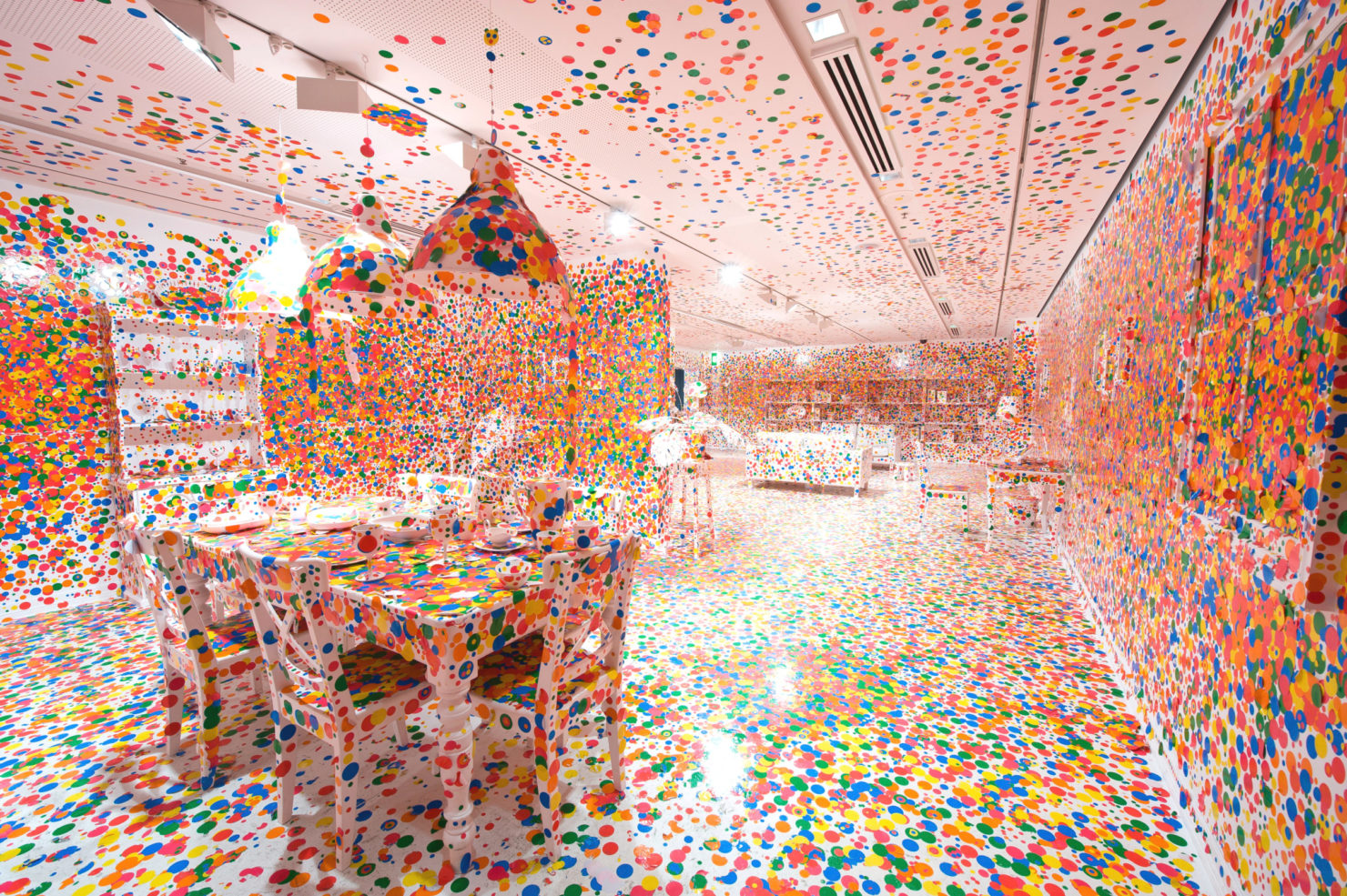
The idea is almost absurdly clear: begin with a domestic interior painted completely white, then invite visitors to cover it with colourful dot stickers. Over time, the room disappears under participation. Walls, furniture, objects, surfaces — everything is gradually swallowed by the collective act of marking.
It is easy to describe this as playful, and it is. Children understand it immediately, which is usually a sign that adults should be more nervous. The work turns participation into obliteration. Each person adds a dot, a tiny signature of presence, but the accumulation erases the original space. Individual expression becomes collective disappearance.
This is why the work feels so perfectly Kusama. It takes an innocent action and lets repetition reveal its violence. The visitor is not outside the artwork. The visitor helps destroy the room. Nicely, colourfully, democratically, with stickers.
There is dark humour in that. A room disappears because everyone wanted to leave a mark. One could do worse as a summary of modern culture.
6. The Artist as Image: Red Wig, Dots, and the Discipline of Becoming Iconic
Kusama did not only make images. She became one.
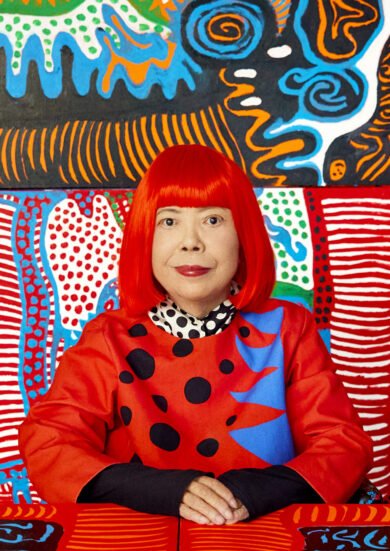
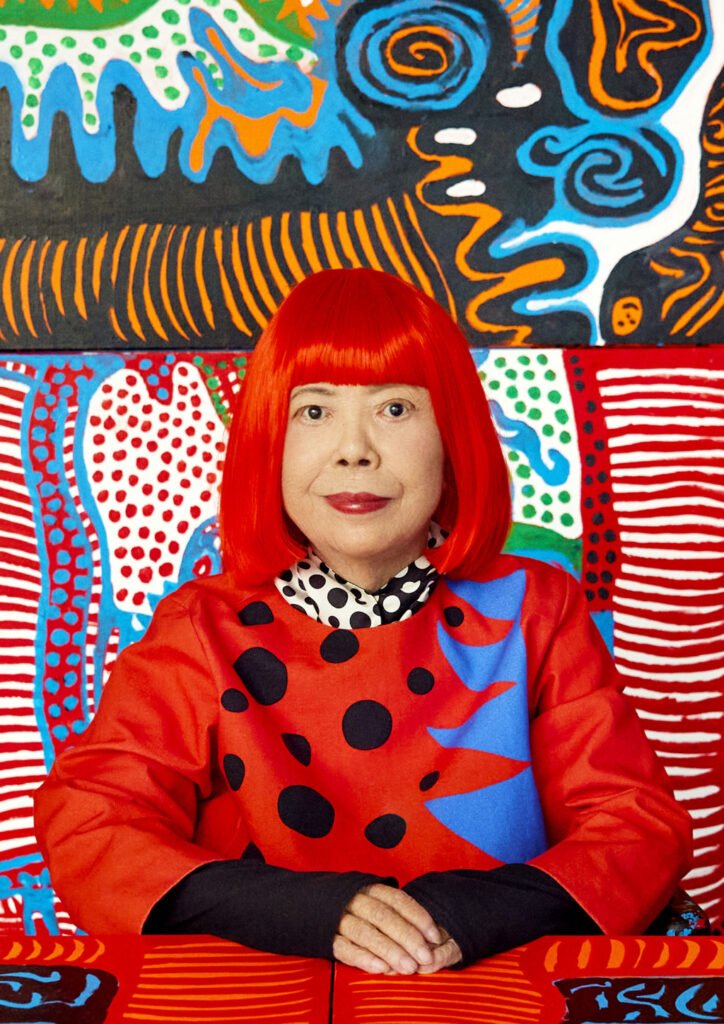
The red bob, the dotted clothes, the frontal poses, the enormous round eyes, the intense theatrical stillness: later Kusama understood the public image of the artist with extraordinary discipline. She turned herself into an instantly readable icon without losing the strangeness that made the work matter. This is harder than it looks. Many artists become brands and die spiritually in the process. Kusama became a brand that still seemed haunted.
There is something both moving and eerie about that transformation. In photographs from her later years, she often appears surrounded by her work like a priestess of her own visual religion. The colours are explosive. The pose is controlled. The face is solemn. The effect is neither casual nor entirely human in the ordinary celebrity sense. She is not merely promoting the work. She appears to have been absorbed into it.
This was not vanity in the simple sense. It was continuity. Kusama’s self-presentation extended the logic of her art: repetition, pattern, infinity, self-obliteration, self-invention. She turned her body into one more surface where the work could continue.
There is a small cruelty in how perfectly the image worked. The world loved the dots, the wig, the pumpkins, the rooms. It loved the Kusama look. It loved the version of madness that could be photographed safely inside a museum. Kusama, to her credit, gave the world what it wanted and made the result much stranger than decoration.

7. Fashion, Commerce, and the Polka Dot Industrial Complex
Kusama’s work became massively popular not only because it was profound, but because it was extremely usable.
Dots travel well. Pumpkins reproduce well. Mirrors photograph well. The red wig is instantly recognizable. The colours are brand-friendly. The motifs can move from painting to sculpture, installation, clothing, handbags, advertisements, museum shops and social feeds without losing their basic identity. In other words, Kusama created one of the most portable visual systems in contemporary art.
This portability is both a triumph and a trap. It helped make her one of the world’s most famous living artists before her death. It also made the work vulnerable to flattening. A pumpkin becomes a selfie backdrop. A dot becomes a design pattern. A mirror room becomes a timed attraction. A language born from hallucination and anxiety becomes a luxury collaboration.
And yet Kusama’s work resists total domestication because it is too obsessive at its core. The commercial version is cheerful. The original engine is not. The dots remain hungry. The repetition remains excessive. The pumpkins remain slightly grotesque. The mirrors still make the viewer vanish.
That is why her collaborations and mass visibility never fully killed the art. They made it easier to consume, yes. But Kusama’s best motifs were always already about consumption, multiplication and disappearance. Capitalism did not ruin the dot. It simply discovered that the dot was very good at capitalism.
8. Death, Repetition, and the Beautiful Terror of Going On
There is a temptation, after the death of a famous artist, to make everything softer.
The obituary machine loves reverence. It sands down contradictions, turns difficult lives into inspirational arcs, and replaces terror with legacy. Kusama deserves better than that. Her work was not merely uplifting. It was not simply colourful. It was not only about joy, imagination or Instagram-friendly infinity. It was also about fear, compulsion, psychic survival, the instability of the self, and the possibility that repetition might be the only way to keep going.
Her official announcement noted that she continued painting until her final days. That fact is moving because it sounds exactly like her: the brush not put down, the pattern not finished, the field still multiplying. Kusama’s art was never about resolution. It was about continuation. The dot continues. The net continues. The mirror continues. The pumpkin returns. The room fills again.
Death changes the weather around the work, but it does not close it. If anything, Kusama’s death makes the central paradox sharper. She spent her life making images of infinity while living inside the painfully finite facts of the body. She built rooms where the self disappears, then became one of the most recognizable artistic selves on earth.
That contradiction is not a flaw. It is the reason she matters.
9. The Afterlife of a Dot
Yayoi Kusama’s afterlife is already everywhere.
It is in museum queues and auction records, in public sculptures and fashion collaborations, in the exhausted phone galleries of visitors who waited ninety minutes for forty-five seconds of infinity. It is in children placing stickers on white rooms, collectors chasing pumpkins, curators staging mirror rooms, and viewers who know the dots before they know the biography.
That kind of fame can be suspicious. It is tempting to distrust anything so popular, especially in contemporary art, where popularity often means the work has become harmless enough for mass affection. But Kusama’s case is more complicated. Her images became popular not because they were empty, but because they were simple enough to enter and strange enough to remain.
A dot is easy. Infinity is not. A pumpkin is funny. Obsession is not. A mirror room is beautiful. Self-obliteration is not. Kusama’s genius was to keep both sides visible, even when the market preferred only the cheerful half.
She leaves behind one of the most instantly recognizable visual languages in modern culture, but also one of the most unsettling. Her work understood something terrible and useful: the self is fragile, repetition is seductive, and infinity looks much better with good lighting.
Yayoi Kusama did not make the world larger by covering it in dots.
She made the smallest mark feel endless.