A Fabric That Pretends Not to Think
There is something almost suspiciously calm about 18th-century French decoration. It smiles too easily. It rests too comfortably within itself. It assures you, with quiet confidence, that everything is in its proper place — the shepherds are content, the animals obedient, the landscape eternal.
And somewhere within that serene fiction sits Jean-Baptiste Huet, an artist who understood, perhaps better than most, that art does not always need to shout to dominate. Sometimes it simply repeats itself across fabric until it becomes indistinguishable from reality.
Huet did not invent toile de Jouy. That honor belongs, structurally at least, to the industrial ambitions of Christophe-Philippe Oberkampf. But invention is overrated. What Huet did instead was more enduring: he gave the medium its language.
And language, as history repeatedly demonstrates, is where power quietly resides.
The Artist Before the Pattern
Before Huet became synonymous with decorative textiles, he was something far less controversial: a painter. Born in Paris in 1745, trained under his father Nicolas Huet, he moved through the expected channels of artistic legitimacy — Salon exhibitions, pastoral scenes, animal studies, the polite hierarchy of subjects that dictated what counted as “serious” art.
He was good at it. Good enough to be recognized, good enough to be included, and — crucially — good enough to become slightly bored.
Huet’s early work leaned heavily into animals and rural imagery. Sheep, dogs, farm scenes rendered with a softness that bordered on theatrical. They were not observations so much as performances of observation. Nature, already, was being rehearsed.
This tendency would later find its perfect medium — not canvas, but fabric. Not uniqueness, but repetition.
But even here, something more subtle was already unfolding. Huet’s paintings suggest a mind less interested in dramatic rupture than in controlled environments. His animals are never chaotic, never threatening; they are composed, placed, aesthetically obedient. His countryside is not wild — it is curated.
In other words, Huet was already thinking like a designer long before he became one.
Toile de Jouy: Before It Became Huet
To understand Huet’s significance, one must first understand what toile de Jouy was before his arrival.
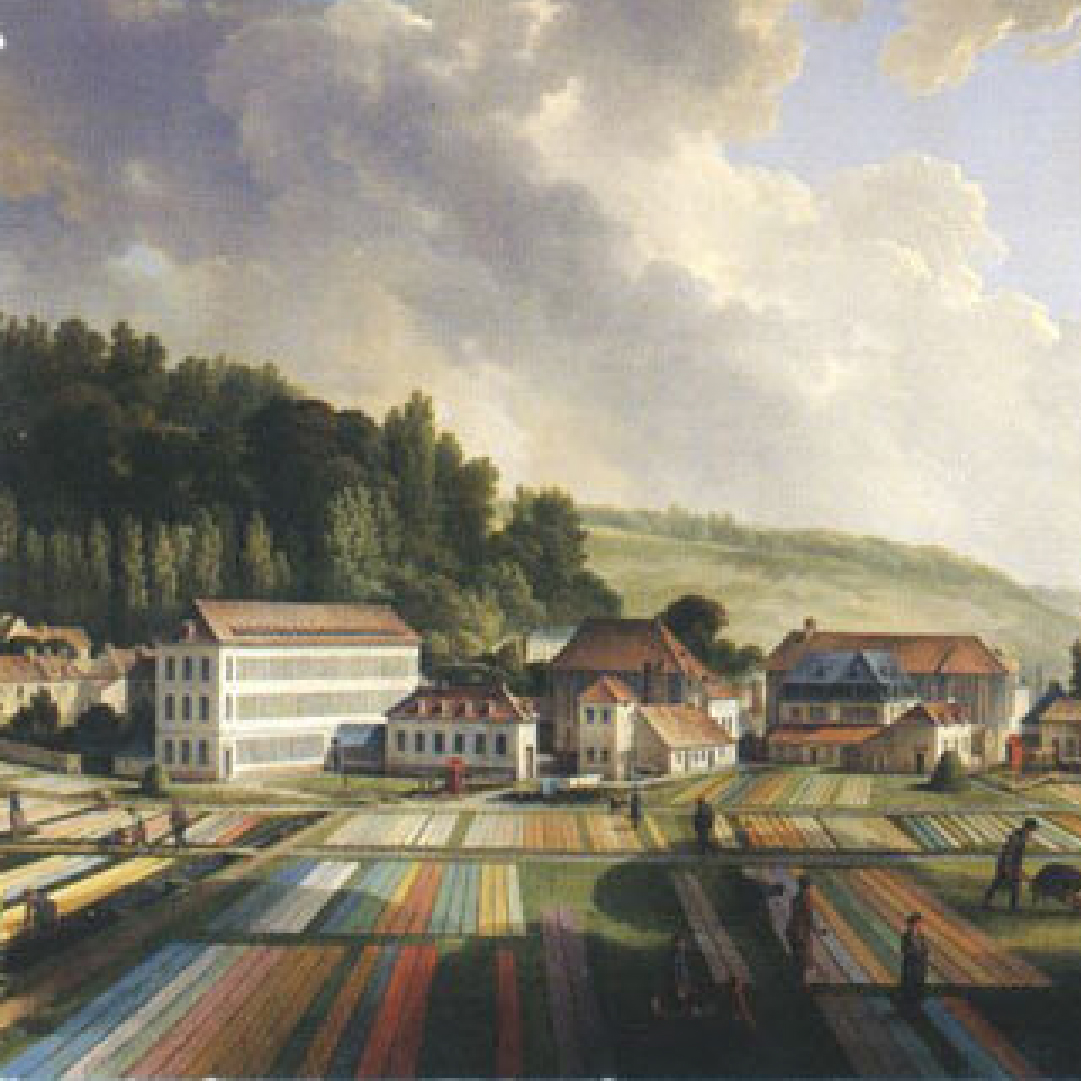 The Manufacture Oberkampf in Jouy en Josas. You can see long stripes of fabric laid out on the grounds to dry in the sun.
Established in the mid-18th century, the Oberkampf manufactory in Jouy-en-Josas specialized in printed cotton textiles — an industrial innovation that allowed for the mass production of decorative fabric. These early designs were functional, ornamental, repetitive. They decorated space without attempting to define it.
Pattern existed as surface, not narrative.
Toile de Jouy, in its earliest form, was not ambitious. It did not aspire to meaning. It existed to fill space elegantly, to create visual cohesion, to suggest refinement without demanding attention.
And then, inevitably, someone decided that this was not enough.
When Decoration Learned to Tell Stories
Huet’s contribution to toile de Jouy was not technical — he did not reinvent printing methods, nor did he industrialize production. What he did was subtler, and far more consequential: he introduced narrative.

Instead of abstract repetition, Huet populated textiles with scenes. Small, self-contained vignettes depicting pastoral life, mythological references, animals in curated harmony, and occasionally, carefully exoticized visions of distant lands.
Fabric, in his hands, became something like a silent theater.
One could argue — and perhaps should — that Huet effectively transformed textile into a precursor of visual media. A repeatable, distributable system of images that carried meaning beyond decoration.
For a broader understanding of how visual systems evolve beyond their original function, see this overview of visual culture.
But what is perhaps more striking is how effortlessly this transformation occurred. There was no manifesto, no declared revolution. Just a gradual shift from ornament to image, from repetition to narrative repetition — a small but decisive change.
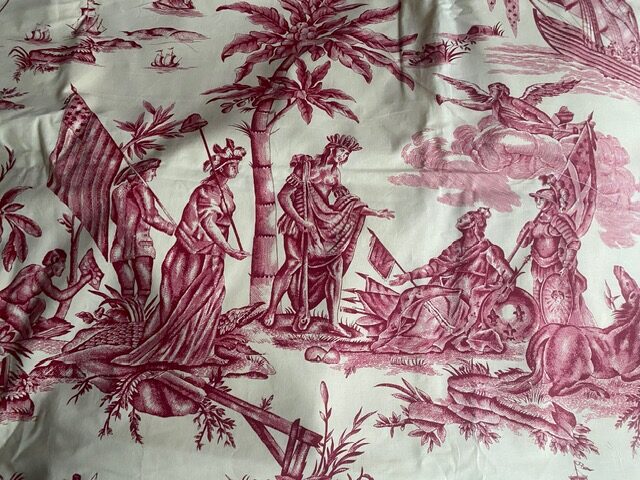 L’Hommage de l’Amérique á la France
And like all effective transformations, it went largely unquestioned.
Egypt, Venus, and the Lion: The Taxonomy of Huet’s Worlds
Huet’s designs were not random. They followed a structured vocabulary — a controlled set of themes that allowed for variation without chaos.
Egyptian Monuments
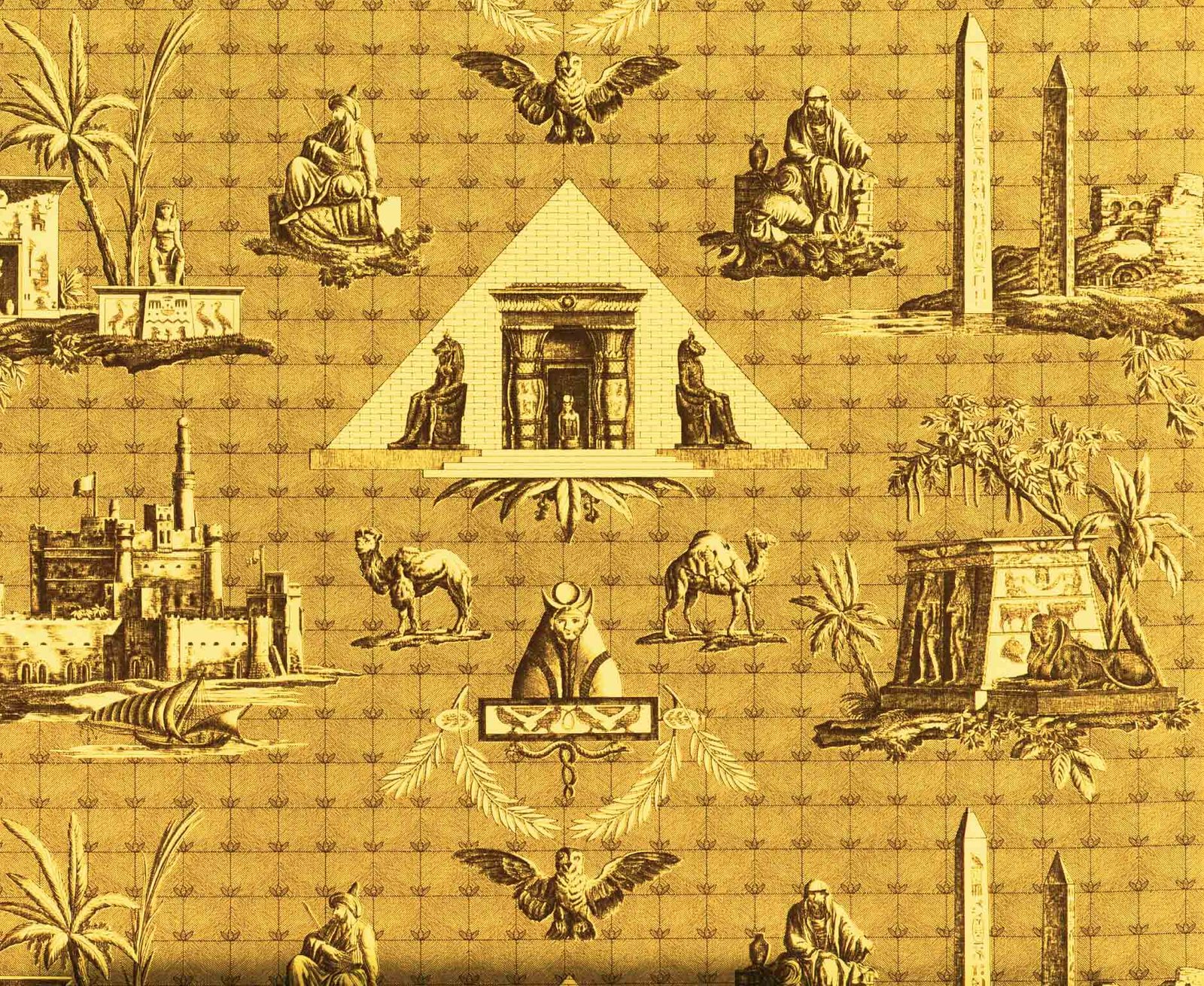
In the late 18th century, Europe developed a fascination with Egypt that bordered on obsession. Long before mass tourism or archaeological rigor, Egypt existed primarily as an idea — distant, mysterious, available for aesthetic appropriation.
 Les Monuments d’Egypte
Huet’s Egyptian-themed designs reflect this perfectly. Monuments appear not as historical realities, but as decorative symbols. Flattened, stylized, absorbed into the logic of pattern.
It is not Egypt that is depicted, but Europe’s imagination of Egypt — a crucial distinction that decorative art rarely bothers to clarify.
And perhaps that is precisely the point. These designs were not meant to educate; they were meant to decorate. Accuracy would only complicate things.
Venus and Mythological Figures
If Egypt offered exotic distance, mythology offered familiar fantasy.
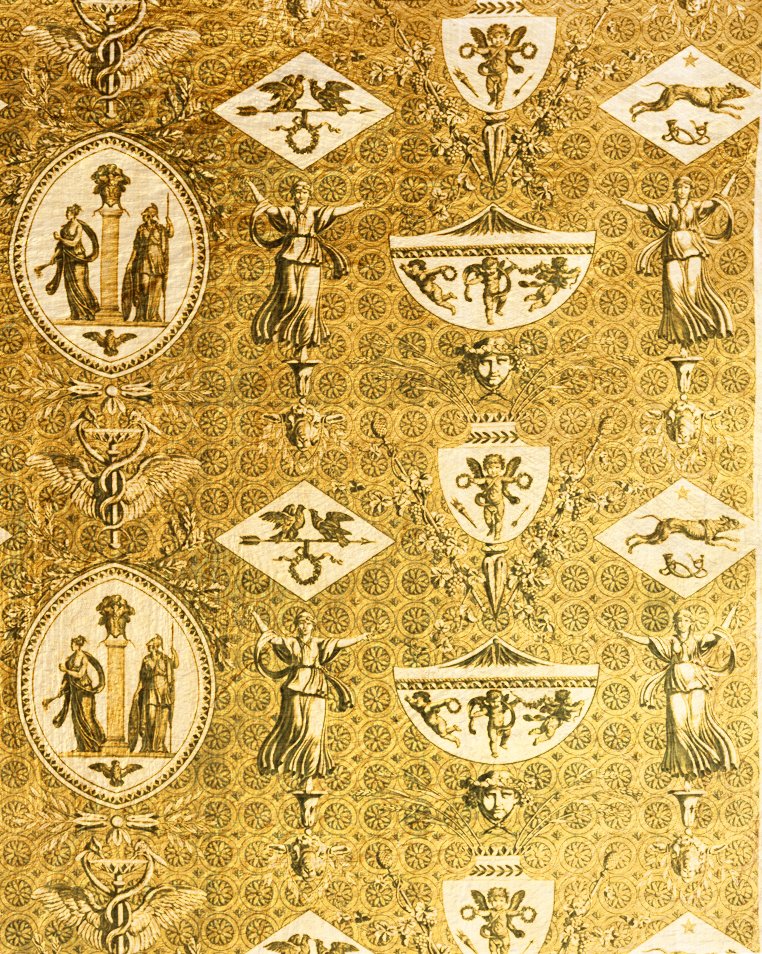
Huet’s Venus designs draw from classical imagery, but they are stripped of narrative tension. These are not stories unfolding; they are moments suspended. The goddess becomes motif, the body becomes ornament.
 Pallas and Venus
It is mythology without consequence — which, one suspects, is precisely why it was so popular.
The classical past, in Huet’s hands, becomes less about reverence and more about availability. Mythology is no longer sacred; it is decorative. It can be repeated, multiplied, rearranged — a flexible system of visual references that can be adapted to any surface.
Lions and Exotic Animals
Animals had always been central to Huet’s practice, but within toile, they take on a new function.
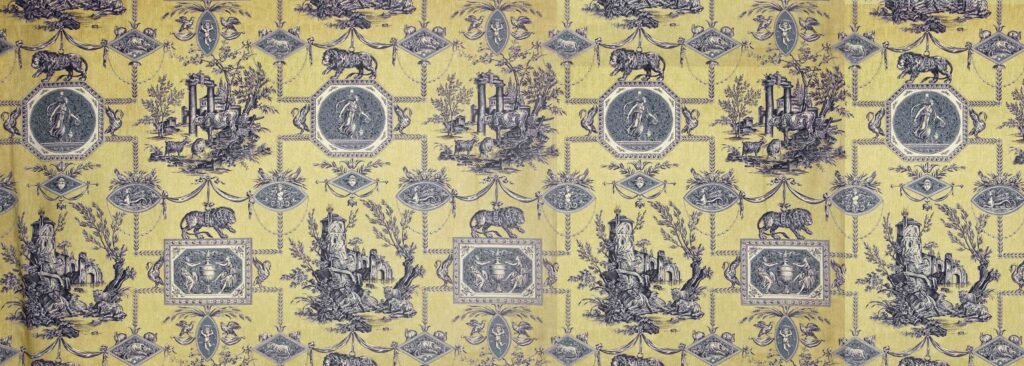
The lion, for example, is no longer a creature of danger or dominance. It becomes an element of spectacle. A symbol of controlled wildness, safely contained within decorative repetition.
The exotic animal becomes less an encounter and more a display. It exists to be seen, not feared.
Nature, once again, is not represented — it is curated.
Pastoral Scenes
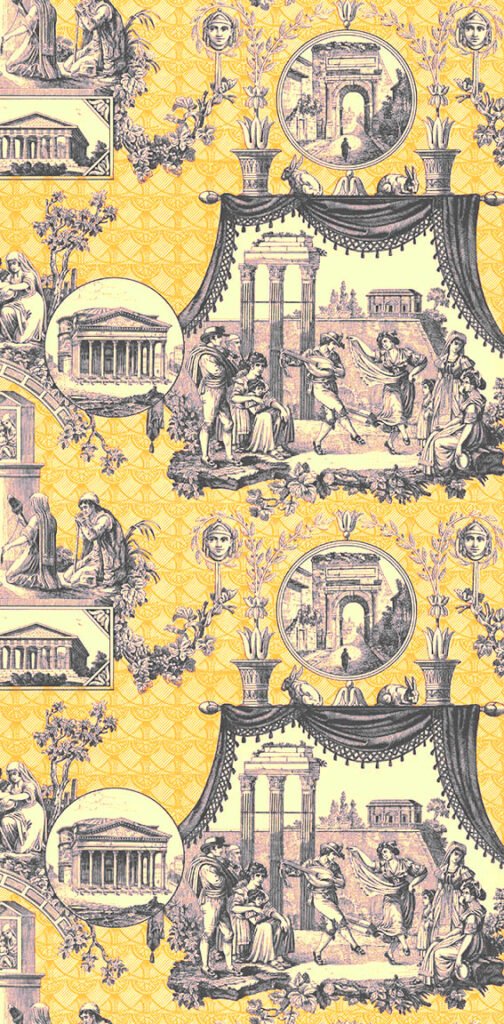
Perhaps the most recognizable of all Huet’s contributions are his pastoral compositions: shepherds, lovers, animals, and landscapes arranged in a delicate choreography of rural perfection.
These scenes are not documentation. They are performance.

There is no labor, no discomfort, no unpredictability. Only the illusion of harmony, repeated endlessly across domestic space.
The countryside becomes something one can own — not physically, but visually. A simulation of nature, accessible without inconvenience.
The Elegance of Repetition
What makes Huet’s work particularly powerful is not any individual design, but the system itself.
Toile de Jouy operates through repetition. The same scene, printed again and again, creates a visual rhythm that gradually shifts from image to environment. One does not simply look at it; one inhabits it.
This is where Huet’s genius becomes most apparent.
He understood that meaning changes when it repeats. That a single image can suggest, but a thousand identical images can define.
In this sense, his work anticipates something deeply contemporary: the logic of visual saturation. The idea that what surrounds us repeatedly becomes invisible — and therefore, unquestioned.
A dynamic not entirely unlike the transformation of everyday imagery explored in Teacher Missed Her Students So She Knitted Tiny Dolls Representing All 23 Students In Her Class, where repetition transforms a simple gesture into something emotionally and symbolically charged.
Repetition, in Huet’s world, is not redundancy. It is reinforcement.
Art, Industry, and the Beginning of Mass Aesthetic Culture
Huet’s collaboration with Oberkampf represents a pivotal moment in art history — one that is often overlooked precisely because it appears too decorative to be serious.
This was art entering industry.
Not reluctantly, but enthusiastically.
For the first time, artistic imagery was not limited to singular objects — paintings, sculptures — but could be reproduced, distributed, integrated into everyday life. Walls, furniture, clothing, interiors became carriers of aesthetic meaning.
Huet did not resist this transition. He embraced it.
Which raises an uncomfortable question: if art can be reproduced indefinitely, what happens to originality?
The 18th century did not fully answer this question. It merely demonstrated that it was profitable.
And perhaps that is why this moment feels so familiar. We, too, live in a world where images circulate endlessly, detached from their origins, repeated until they become part of the background.
Huet did not anticipate the digital age. But he understood its logic.
The Problem with Softness
There is a tendency to dismiss Huet’s work as gentle, decorative, harmless.
This is a mistake.
Softness, in this context, is not absence of power. It is a form of control.
By presenting an idealized version of rural life, Huet’s designs participated in a broader cultural narrative — one that allowed aristocratic society to consume the image of nature without engaging with its realities.
The countryside became aesthetic. Labor disappeared. Conflict dissolved.
Everything was, once again, in its proper place.
Softness reassures. It lowers resistance. It makes the artificial feel natural.
And once something feels natural, it becomes difficult to question.
Huet and the Performance of Nature
Toile de Jouy does not depict nature. It stages it.
This distinction is subtle, but crucial.
Nature, in Huet’s work, is always mediated. It is arranged, composed, balanced. Nothing grows uncontrollably. Nothing decays. Nothing resists.
This is nature as performance — a carefully rehearsed version of reality designed to be consumed.
The shepherd is not a laborer. The animal is not unpredictable. The landscape is not harsh.
Everything exists within a narrow range of acceptable beauty.
And perhaps this is why these images persist. They offer a version of the world that is manageable, understandable, aesthetically pleasing.
Reality, after all, rarely offers such consistency.
Why Huet Was Never Taken Seriously
Despite his influence, Huet was never fully embraced by the highest tiers of art historical prestige.
The reason is simple: he worked in decoration.
 The Lion
And decoration, within the traditional hierarchy of art, has always occupied an ambiguous position. Too functional to be pure, too aesthetic to be ignored.
Huet’s attempts at more “serious” subjects — history painting, for instance — were met with far less enthusiasm. The art world, it seems, prefers its categories intact.
And yet, the irony persists.
While many “serious” artists faded into obscurity, Huet’s imagery spread — across fabrics, interiors, cultures — embedding itself into visual memory in a way that paintings alone rarely achieve.
Perhaps seriousness was never the point.
The Quiet Success of Influence
Huet’s success is difficult to measure in conventional terms.
He did not produce a single defining masterpiece. He did not establish a school, nor did he redefine artistic technique.
What he did instead was more diffuse, and therefore more enduring.
He influenced how people lived with images.
 Venus and Minerva
He transformed decoration from background into environment. He allowed art to enter everyday life not as an object, but as a condition.
And in doing so, he achieved something that many artists aspire to but rarely accomplish: he became invisible.
Not forgotten, but absorbed.
After Huet: The Persistence of an Aesthetic
Toile de Jouy did not end with Huet. It evolved, adapted, resurfaced.
Today, it appears in fashion, interior design, contemporary art — often stripped of context, but still carrying the same visual logic.
Pastoral scenes. Monochrome palettes. Repetition.
The illusion remains intact.
One could argue that Huet’s aesthetic has never truly disappeared. It has simply changed form.
From fabric to wallpaper. From wallpaper to digital imagery. From digital imagery to curated lifestyle aesthetics.
The medium changes. The logic remains.
Final Reflection: The Most Polite Form of Power
Jean-Baptiste Huet did not revolutionize art through confrontation. He did not reject tradition, nor did he attempt to dismantle it.
Instead, he worked within the system — quietly, persistently — until the system began to resemble his work.
Toile de Jouy, in its calm repetition, offers a vision of the world that is orderly, harmonious, and entirely constructed.
It is, in many ways, the perfect aesthetic: beautiful, controlled, and just distant enough from reality to remain comforting.
And like all effective illusions, it asks for nothing more than quiet acceptance.
A Final Invitation
If there is something to take from Huet, it is not simply admiration, but awareness.
Look closely at what surrounds you — the patterns, the images, the environments that feel natural but are anything but.
Because somewhere, behind every carefully constructed surface, there is always an artist who decided what the world should look like.
And, more importantly, what it should hide.
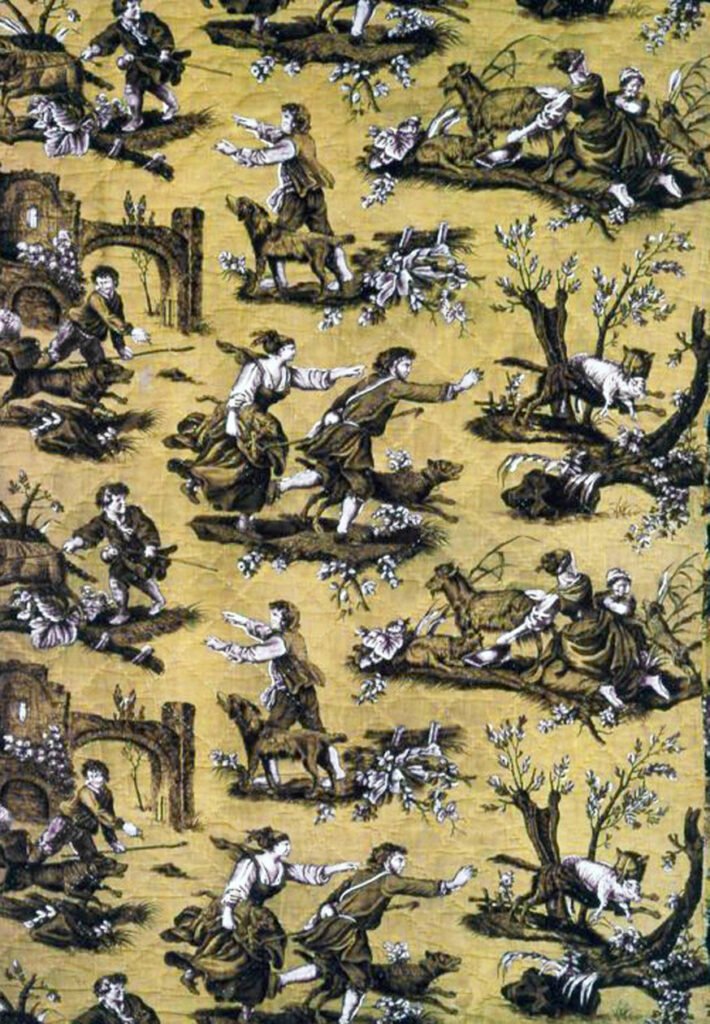 Jean Baptiste Huet – The Wolf
And if that realization feels slightly uncomfortable, then perhaps — finally — the pattern has begun to reveal itself.