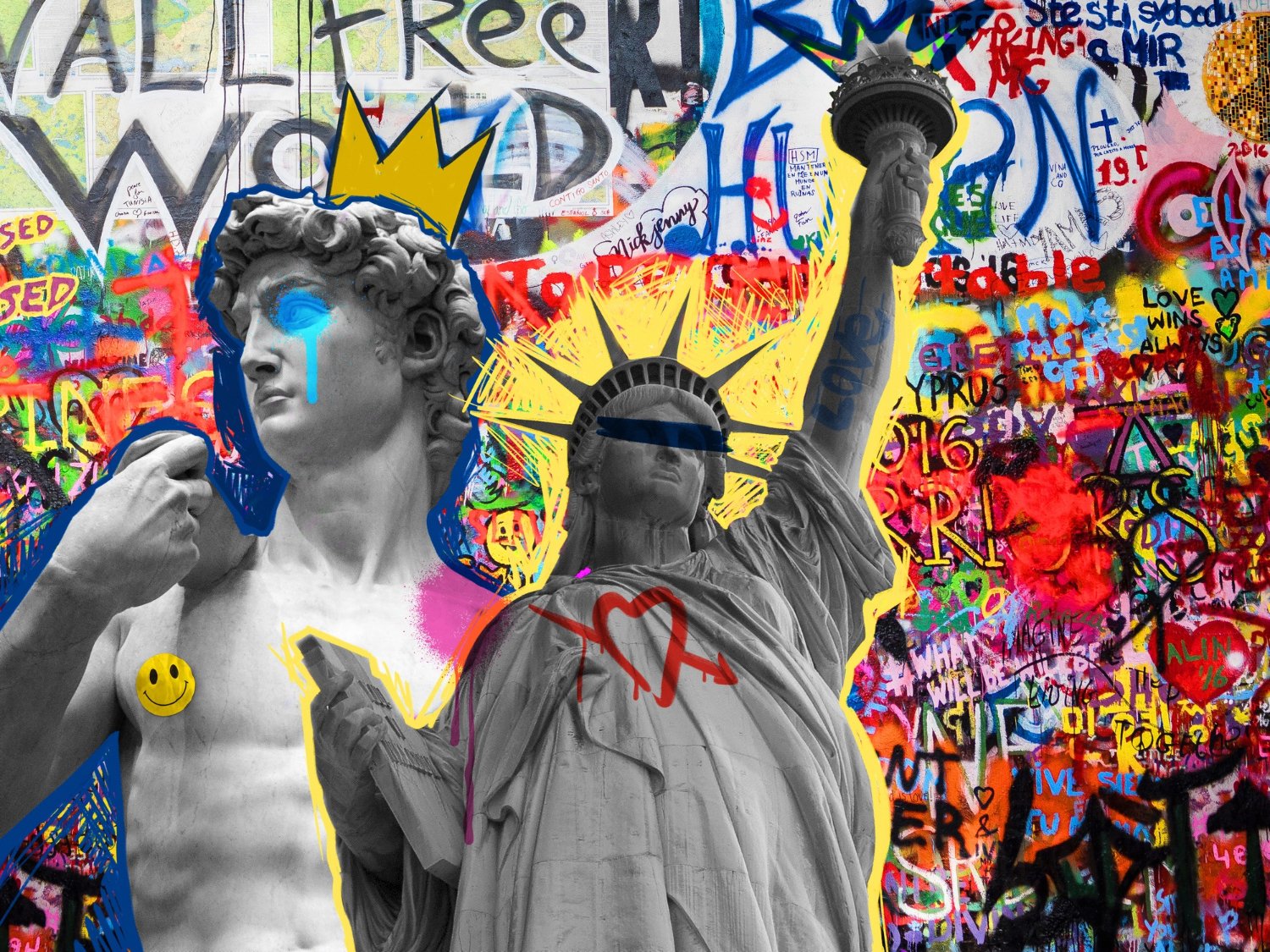
For decades, the hallowed halls of art history departments have focused heavily on the “Old Masters” such as the oil paintings of the Renaissance, the sculptures of antiquity, and the Impressionist landscapes that line the walls of the Louvre. While these works are undeniably foundational, excluding modern urban expression creates a massive blind spot in our understanding of visual culture. Street art is no longer just vandalism. It is the most democratic, political, and accessible art movement of the 21st century. To exclude it from the curriculum is to ignore the art of our own time.
The resistance to including street art in academia often stems from a misunderstanding of its complexity. Critics view it as a simple rebellion, lacking the theoretical depth of Abstract Expressionism or Cubism. However, a deep dive into the work of artists like Keith Haring or Jean-Michel Basquiat reveals layers of semiotics, social critique, and historical reference that rival any museum piece.
Students attempting to tackle these subjects often find the analysis surprisingly difficult. In fact, the theoretical density of urban art is so high that many university students seek online writing services by PhD experts just to help them articulate the nuanced connections between graffiti subculture and high-art theory.
From Vandalism to Valuation
The primary argument against teaching street art is usually legal rather than aesthetic. How can a university teach a subject that is often illegal? This paradox is exactly why it should be taught. Art history is full of outlaws. We study Caravaggio despite him being a murderer on the run, and we study the Dadaists even though they sought to destroy the concept of art itself.
Street art challenges the very definition of ownership and public space. By studying it, students engage with critical questions:
- Who owns the city? Does a property owner have the right to a blank wall, or does the public have a right to a decorated environment?
- What is the lifespan of art? Unlike museum pieces preserved in climate-controlled rooms, street art is ephemeral. It decays, gets painted over, or is destroyed.
- The commodification of rebellion: How did Banksy go from a criminal to an artist whose shredded canvas sold for millions?
The Evolution of Technique
Another reason to bring street art into the classroom is its technical innovation. In the same way professors discuss the invention of oil paint or the use of perspective in the Renaissance, they can explore the evolution of aerosol control and stencil mastery. Early graffiti writers developed complex typography known as “Wildstyle” that functioned as a coded language. Later artists introduced wheat-pasting and sticker bombing to mass-produce images in a pre-Internet viral marketing strategy.
Today, street art has evolved into large-scale muralism and projection mapping. Artists use cherry pickers and grid systems to turn ten-story buildings into canvases. Studying these methods teaches students about scale, public engagement, and the intersection of architecture and design. It forces them to look at the urban environment not just as a backdrop for life but as a medium for expression.
The Academic Demand
The inclusion of street art is not just a theoretical benefit but a practical demand from the student body. Modern students are increasingly interested in art that engages with current events like climate change, gentrification, and political unrest.
This shift in interest is visible in the academic market. When professors assign open-ended research papers, inquiries into urban art skyrocket. This trend is well documented by industry observers. Ryan Acton, a content specialist for EssayHub, has noted a significant uptick in students requesting model papers on street art. As a leading essay writing service, the platform sees firsthand what topics students are passionate about. Acton points out that students aren’t just looking for easy answers. They are looking for ways to legitimize a passion that their traditional textbooks often ignore.

A Mirror to Society
If art history is the study of human civilization through visual objects, then street art is the most accurate mirror of the modern world. It is immediate and unfiltered. A mural about police brutality or a stencil about war appears days after an event. This offers a real-time historical record that a gallery exhibition cannot match because museums take years to curate shows.
Incorporating street art allows curriculums to bridge the gap between:
- High and Low Art: dismantling the elitist idea that art only happens inside a frame.
- Global Perspectives: contrasting the muralism of Latin America with the graffiti styles of New York City.
- Digital Preservation: exploring how Instagram and photography have become the “museums” for ephemeral street works.
Conclusion
Legitimizing street art does not mean delegitimizing the classics. It simply means expanding the canon to reflect reality. We cannot tell the story of art without telling the story of the street. By integrating these works into the curriculum, universities do more than just update their syllabus. They validate the lived experience of the modern city. The writing is literally on the wall, so it is time for academia to read it.